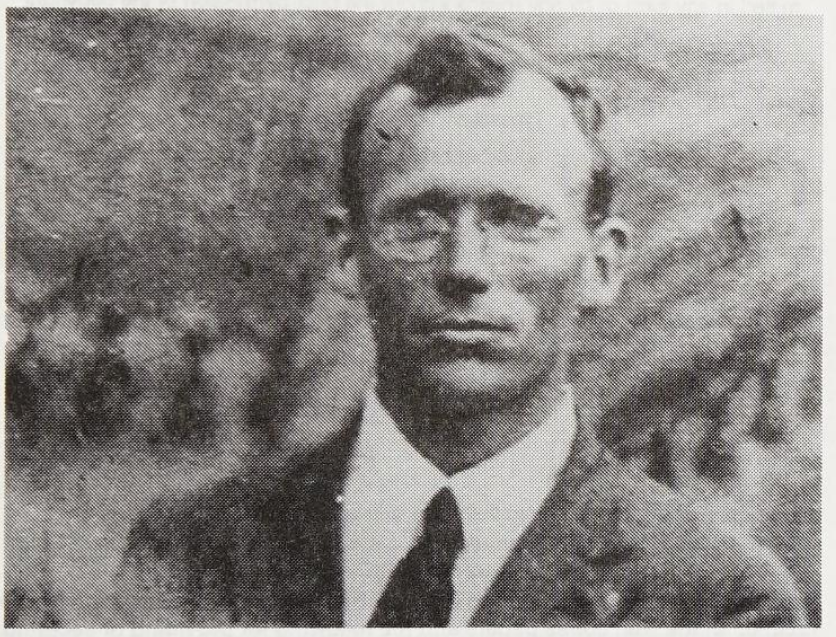
Welsh-born Marxist theorist and prolific writer, David Ivon Jones was a founder of the Communist International and central figure in the formation of South African Communism. Though he died only a year after this notable intervention, Ivon Jones as much as any white comrade steered the Comintern to face the Black and African working class. His orientation to the African proletariat led him to center Black workers in the United States as a pivot of the international class struggle, urging the U.S. party to do the same.
‘Africa’s Awakening’ by David Ivon Jones from International Press Correspondence. Vol. 2 No. 43. June 14, 1923.
The negro is the greatest living accuser of capitalist civilization. The wealth of England and America is built upon his bones. The slave ships of Bristol and New York, with good Quaker prayers to speed them, founded the fortunes of many a Christian home. Every capitalist Government is drenched with the blood of the negro. British Imperialism in South Africa, the French in the Cameroons, Belgium in the Congo, and the German Empire in Damaraland, they all constitute the blackest record in human history of mass slaughters and violation of every primitive human right, continued up to the present day. Even the liberation of the American slaves was only an incident of a civil war between two factions of property holders engaged in a quarrel over the forms of exploitation, and was not the aim of the war as is commonly supposed. And as an aftermath of that war there was created a social attitude towards the negro race which leaves the one-time chattel slaves still degraded outcasts among the peoples of the earth.
This artificially generated race animosity towards the negro pervading the whole of Anglo-Saxon society, infects also the large working masses. The African negro is the hewer of wood and the drawer of water even for the white workers of Europe. The workers of England are trained from childhood to regard the Zulu and Matabele wars as heroic exploits, rather than foul pages in English history. Hence, the apathy and social prejudice towards the negro race, for we hate most those we have injured most. But this period is passing, just as the days of the Second International are passing. The workers of Europe are no longer sharing the profits of their masters. The Communist International has appeared, and calls into the one great proletarian family the negroes of Africa as well as the peoples of the East, along with the revolutionary proletariat of the capitalist countries.
This is the first ray of hope for the negroes throughout all the centuries of their oppression. For the first time, Negro Communists appeared at the Fourth Congress of the Communist International, and a resolution was passed declaring in favor of a World Congress of Negroes.
There have been World Congresses of Negroes before. But they have been composed of members of the very thin layer of Negro intelligenzia, who have placed vain hopes in professions of loyalty to their oppressors. The London Congress of 1921 greeted the recruitment of negroes into the French army as a mark of citizenship. Among the large toiling masses of negroes such a Congress passes by without notice.
There are also the Congresses held by the association headed by Marcus Garvey, a Jamaican negro who has captured the imagination of the negro masses in America and whose slogans “Back to Africa”, and “Africa for the Africans” are even spreading into Africa itself. This organization is strongly flavoured with religious and racial charlatanism. The proletarian character of the negro mass is not so distinct in America as, for instance, in South Africa. In the latter country the negroes form a race of laborers, without any shopkeeping or small tenant element. Probably the small property psychology of the tenant farmers and the small trader element in America reflecting on the purely laboring negro masses, has a lot to do with what is now notoriously known as “Garveyism”, a charlatan exploitation of awakening race consciousness; which, in so far as it takes anti-white forms, is secretly encouraged by the Capitalist class both in America and in South Africa. The number of Negro farmers, mostly with very small holdings, according to the last American census, was 949,889 which, with their families, represents a big proportion of the negro population in America.
But awakening race consciousness in Africa tends to have a positive side among the large industrial masses, namely the outliving of old tribal sectionalism. What the South African bourgeois calls a native hooligan is one who, having worked some time in the towns, no longer recognizes the authority of his tribal chief. Race consciousness, in the case of the Negro in Africa, is a step towards class consciousness, because his race is a race of laborers. The coming World Congress will have to decide the question, how far the movement towards race consciousness can be directed into proletarian forms.
The foremost leader of the negro intelligenzia in America, Burghardt du Bois, a graduate of Harvard, stands apart from the Marcus Garvey organization. He is an author of several books of high literary merit, in which appears a glimmering apprehension of the truth that negro emancipation can only come through proletarian emancipation. But in action, the negro intelligenzia, including du Bois, pin their faith to mixed associations of negroes and white philanthropists. Their eagerness for immediate social contact on equal terms with white intelligenzia, cannot stand the long strain of waiting for proletarian emancipation. But the organization of negro Communists, known as the African Blood Brotherhood, has achieved considerable progress. Undoubtedly, America will supply the leaders of negro emancipation.
But negro emancipation is not an American question; it is a question of Africa, as our American comrades themselves have declared. Who is to get this great Africa, the capitalist class or the Comintern? And when is the European proletariat going to stretch out the hand of brotherhood to the masses of Africa, and wipe out centuries of capitalist wrong? The status of the American negro can not be raised without the awakening of Africa. But it is no less true that the European proletariat cannot obtain a real link with Africa except through the more advanced negroes of America.
To the South African negro, every white man is an oppressor, a master, a “boss”. Even the oppressed among the whites appears to the black the most violent curser of the negro. And therefore it is no wonder that news of class emancipation in Europe must appear to him a purely domestic affair of the whites. A few young industrial workers are beginning to hear news of the Communist Party and of its actions on behalf of the blacks, and these are beginning to spread the idea. They see Communists jailed for declaring the solidarity of black and white workers. But a more imposing gesture is needed to convince the negro masses that a new dawn is breaking, that “white man” and ” oppressor” are not one and the same thing, that there is an army of liberation coming to aid him, the revolutionary proletariat. Time is pressing, the negro armies of imperialism are already on the Rhine. Only the Communist International can reconcile the negro and the white races, and only through proletarian solidarity can this reconciliation be achieved.

The Fourth Congress appointed a Committee to draw up the plans for a World Negro Congress. It is to be hoped that this Committee will report to the forthcoming Enlarged Executive, and that the delegates will be equipped with definite ideas on the subject. The Congress will undoubtedly be a proletarian Congress, but the extent to which non-proletarian representatives will be invited will also be a matter for the Enlarged Executive to decide.
The foregoing notes are written as part of the Committee’s publicity campaign; the Committee hopes that the Party organs in Britain, America, Belgium etc. will devote special attention to the negro question and to the preliminary work necessary for the calling of a World Negro Congress under the banner of the Comintern.
International Press Correspondence, widely known as”Inprecorr” was published by the Executive Committee of the Communist International (ECCI) regularly in German and English, occasionally in many other languages, beginning in 1921 and lasting in English until 1938. Inprecorr’s role was to supply translated articles to the English-speaking press of the International from the Comintern’s different sections, as well as news and statements from the ECCI. Many ‘Daily Worker’ and ‘Communist’ articles originated in Inprecorr, and it also published articles by American comrades for use in other countries. It was published at least weekly, and often thrice weekly. The ECCI also published the glossy magazine ‘Communist International’ edited by Zinoviev and Karl Radek from 1919 until 1926 monthly in German, French, Russian, and English. Unlike, Inprecorr, CI contained long-form articles by the leading figures of the International as well as proceedings, statements, and notices of the Comintern. No complete run of Communist International is available in English. Both were largely published outside of Soviet territory, with Communist International printed in London, to facilitate distribution and both were major contributors to the Communist press in the U.S. Communist International and Inprecorr are an invaluable English-language source on the history of the Communist International and its sections.
PDF of issue: https://www.marxists.org/history/international/comintern/inprecor/1923/v03n43[25]-jun-14-Inprecor-loc.pdf
 Revolution's Newsstand