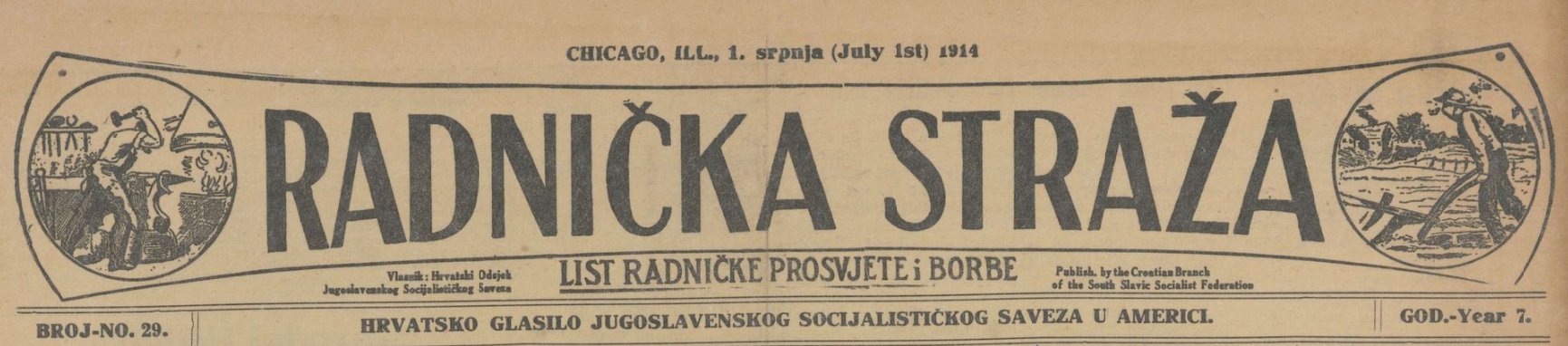
A valuable history of the founding of the Communist Party’s daily Yugoslav paper, Radnik in 1926, and by extension the larger South Slavic working class movement in the United States from the formation of the Croatian Workers Club of Pittsburgh and the arrival of leading comrade Milan Glumac-Jurishich in 1907.
‘A Daily Paper of South Slav Workers: The story of Radnik’ by S. Zenich from the Daily Worker Saturday Supplement. Vol. 3 No. 200. September 4, 1926.
IT was in 1905 and 1906 that the social-democratic movement in the South Slavic parts of the Austro-Hungarian monarchy began to develop with rapidity. Up to then there had been a very small number of the workers around the social-democratic party while the party was young, inexperienced, and its official leaders already leaning to the bourgeoisie, altho that movement itself had been persecuted by the government.
Their leaders came mostly from the ranks of the bourgeoisie and from the liberal intellectuals. The most prominent of these were: Duraj Demetrovich (now one of the leaders of the Croatian fascisti); William Bugshek, supporter of the government during and after the world war; Vitomir Korach, later a member of the Belgrade fascist government (now, as a former minister of social affairs, on the government payroll); Edbin and Anton Kristan, now both in the service of the Belgrade government, and some others. All of them have become traitors to the workers and peasants, but they were the leaders of the social-democratic party.
Nevertheless, the movement slowly but definitely became a mass movement which created its own leaders.
The masses were driven by exploitation to consciousness and struggle. Their wages were small–$1, $1.25 and $1.50 for fourteen hours work–these were the wages of the workers. They had no labor unions, they did not understand the English language at all: they were exploited in all aspects of their life.
These conditions forced to the fore new leaders. One of these new leaders that developed from the ranks was a printer, Milan Glumac-Jurishich.
From the very beginning of his affiliation with the movement he was very active and showed initiative. He never was satisfactory to the official leaders of the party because he did not agree with their reformistic attitude. He was more revolutionary and was considered by party leaders a hotheaded, uncontrolled enthusiast. The government called him a dangerous socialist and sometimes an anarchist.
From the beginning he was isolated in the party, but he was a real fighter in the eyes of the broad masses. In proportion as the party developed into a mass party Milan Glumac became more dangerous to the reformist leaders.
In the meantime in the United States there were hundreds of thousands of Jugo-Slav workers. All large cities and industrial centers, especially Chicago, Pittsburgh, Milwaukee and Detroit, were inhabited by Jugo-Slav wage slaves. In these cities were some workers (qualified to follow a trade) who were members of the social-democratic party and labor unions in Europe. They felt it necessary to organize Jugo-Slav workers into political organizations of the workers. Exploitation of the workers became more and more intense. Not only American exploiters but new Jugo-Slav agents of the bourgeoisie attacked the interests of the workers. Money exchangers, real estate salesmen, builders of new “banks” and churches, and representatives of various political groups in Austria-Hungary–these gentlemen were very busy trying to win over the workers. Of course, the conditions of the workers and peasants were such that they inevitably were forced to create their own leaders. The wages were small, working hours long and the peasantry carried burdens of taxes and military expenses. The leaders were not revolutionists–all that was a condition for the development of new leaders.
In the city of Pittsburgh there was organized the first Croatian Workers’ Club. Pittsburgh was followed by Chicago and general sentiment for independent workers’ organization existed in all larger towns and cities where lived Jugo-Slav workers.
During the short time of activities of those clubs it became necessary to have a workers’ paper thru which the new idea of socialism could be spread. But there was lack of money and there was no capable man who could edit such a paper.
That fact was one more argument for the necessity of a workers’ paper which would defend their interests.
The Croatian Workers’ Education Club of Pittsburgh finally decided, first, to secure one good editor from Europe and, second, to organize a workers’ federation on a national scale.
Communication had been established between C.W.E.C. at Pittsburgh and the central executive committee of the social-democratic party in Croatia (part of which was Austria-Hungary and is now part of Jugo-Slavia).
Social-democratic leaders such as they were did not believe in the success of the C.W.E.C. in Pittsburgh, but they did not refuse to send one of their capable comrades. To get rid of him the central executive committee of the social-democratic party decided to send Milan Glumac-Jurishich.
Milan Glumac-Jurishich had been convinced of his success since he came to America. In 1907 he was in Pittsburgh. The same year the W.E.C. was organized in Chicago and definite preparations had been made for other cities. In 1908 the C.E.F. (Croatian Educational Federation) was organized and its official organ was issued, Radnicka Straza (The Workingclass Guard). The editor of the paper was Comrade Milan Glumac-Jurishich. At once he became a leader of the Jugo-Slav workers in this country.
In its first year Radnicka Straza was issued twice a month in half newspaper size. The next year, 1909, the South Slavic Socialist Federation was definitely organized and affiliated to the socialist party of America. In the meantime, Radnicka Straza became a large weekly paper (like the Radnik or The DAILY WORKER now, in four pages). The socialist movement among the workers became a fact.
Radnicka Straza was born in a hard time. In 1907-10 there was great unemployment in this country. Workers were hungry and desperate; the ignorance of the workers was still strong; religion, patriotism and general backwardness ruled supreme among the workers. But the activity of the comrades under the leadership of Comrade Glumac never ceased. They were very active. Glumac himself was editor and printer of the paper. He worked for four or five dollars a week, with which he had to support his family and pay expenses for medicine and doctor (he had tuberculosis). Many times he gave money to hungry comrades. Radnicka Straza, under his editorship, was a strong whip in the hands of the socialists against the Jugo-Slav priests, business men, speculators and bourgeois in general. The paper gained daily in influence among the masses. Short, sharp, clear and enthusiastic articles in the paper were swallowed by the workers like hot cakes. Organizations were built in all larger cities of this country.
One thing was characteristic of Radnicka Straza during the editorship of Milan Glumac–the writings of the paper were not fully in the spirit of the socialist party. Glumac said many times, “The socialist party is too soft for the capitalist class and its agents.” He was a left socialist in spirit and conceptions of struggle against the capitalists.
Until 1912 the South Slav Socialist Federation grew numerically and the subscriptions increased to 3,000.
Nevertheless the sickness of Comrade Glumac forced him first to a farm, then to California, where he could not remain because he was isolated from the movement.
He came back to Chicago and finally died in January, 1924.
His successor as editor of Radnicka Straza was Theodore Cvetkov, at present a renegade to the Communist movement. Cvetkov was a pacifist by soul and an opportunist by political conceptions. After the death of Glumac the fighting spirit of the movement declined to a great degree.
In 1915-16 came the discussion and split in the South Slavic Socialist Federation. Two wings were created–a right-social-patriotic wing, with Kristan and B. Savich at the head, and a pacifist-opportunist centrist wing with Cvetkov at the head.
In 1917 Radnicka Straza was suppressed by the authorities and Nova Misao (New Thought) was issued. After the first number Nova Misao was also suppressed and Znanje (Knowledge) was issued. Znanje was as large as Radnicka Straza in 1917. From that time up to 1922 Znanje was issued the editors of it were T. Cvetkov and Geo. Kutuzovich, who became a renegade to the movement in 1923. Parallel to the left wing in the socialist party the left wing movement among the South Slavic workers developed. The Cvetkovites were very weak as compared to the influence of the left. The Jugo-Slav workers became class conscious to the degree that they knew that bolshevism is the solution for them. During the world war they passed thru hard experiences; they were attacking the pacifism of Cvetkov, the membership were with Cvetkov because of his anti-militarist attitude. But the membership felt that pacifism cannot save the working class from the heel of imperialism.
The workers passed thru great experiences. The American capitalist class persecuted them. Those who were for the allies were forced into the army and forced to contribute special war donations; those who were for the central powers (Austria-Hungary and Germany) were threatened with jail, persecution, and many of them deported to Georgia prisons, etc.; internationalist workers (followers of the left wing in the socialist party) were under the most terrible conditions, blockaded from all sides by the enemies not only on the part of American capitalist servants, but by Jugo-Slav dollar patriots and priests.
These conditions were the main reason for the large influence of social-patriotism on one side and pacifism on the other. The left wing had no leadership, had no full and correct political line because it was just beginning to develop. Later on the left wing became stronger and stronger and finally became a real power among the Juge-Slav workers in this country.
The South Slavic Socialist (International) Federation as a whole became a part of the left wing in the socialist party. Later on the federation was affiliated to the Communist Party of America and from that time remained an active section of the American Communist movement.
In 1921 the decision was made to change Znanje to Radnik and that instead of a weekly it should be a tri-weekly.
Cvetkov and his followers were opposed to both changes. In connection with other political and principal differences, the question of the press was one of the most important. For nearly one year the fight went on and finally Cvetkov left the party and the federation. Some of his followers went with him. All of them declared that the South Slavic Federation would collapse, that Radnick would not be able to continue publication three times a week. Their demoralizing, pessimistic and opportunistic attitude did not destroy the movement. They did not even succeed in splitting it, because the membership stood strong for Communism and party policy and discipline was sufficiently applied. But they succeeded to a certain extent in isolating the federation and in shaking its morale. Nevertheless, altho very slowly but positively the federation became stronger in all ways.
Radnik as a tri-weekly paper, with a better political line, better articles and greater spirit step by step breaking down the walls of isolation, became a more popular organ. The ranks of the membership became closer and politically stronger.
In 1926 the Bureau of the South Slavic Fraction (former federation) came to the conclusion that Radnik should become a daily. The 1st of May was selected as the date. In reality, on the 1st of May, 1926, Radnik became a daily. The enthusiasm of the membership and subscribers, as a whole, was such that about $10,000 was collected for the daily, altho the Jugo-Slav workers gave for the International Labor Defense at least $10,000 and for The DAILY WORKER at least $5,000 and for strikes and other campaigns a great sum of money. We must have in mind unemployment, also the offensive of the entire reaction and bourgeoisie (including opportunists in various forms).
Radnik is a daily. Its policy is the policy of the Workers (Communist) Party of America. It becomes more and more a mass organ of the Jugo-Slav workers in this country. More than that, Radnik is becoming a Communist (Bolshevik) paper. Its influence reaches the Jugo-Slav workers in South America, Australia, New Zealand, not to speak about Canada, Jugo-Slavia and even Soviet Russia. Radnik has connections with Jugo-Slav workers in all those countries. The conditions of the workers are forcing them to come nearer to the vanguard of their class. Radnik is trying, with success, to reach all the Jugo-Slav workers in this country, to organize them for class struggle against the capitalists.
The fighting spirit of Milan Glumac-Jurishich, the first editor of Radnik (Radnicka Straza), combined with the Communist idea, principles and politics, is leading the Jugo-Slav workers into the ranks of the Workers (Communist) Party of America in the struggle for Communism.
The Saturday Supplement, later changed to a Sunday Supplement, of the Daily Worker was a place for longer articles with debate, international focus, literature, and documents presented. The Daily Worker began in 1924 and was published in New York City by the Communist Party US and its predecessor organizations. Among the most long-lasting and important left publications in US history, it had a circulation of 35,000 at its peak. The Daily Worker came from The Ohio Socialist, published by the Left Wing-dominated Socialist Party of Ohio in Cleveland from 1917 to November 1919, when it became became The Toiler, paper of the Communist Labor Party. In December 1921 the above-ground Workers Party of America merged the Toiler with the paper Workers Council to found The Worker, which became The Daily Worker beginning January 13, 1924.
PDF of full issue: https://www.marxists.org/history/usa/pubs/dailyworker/1926/1926-ny/v03-n200-supplement-sep-04-1926-DW-LOC.pdf
 Revolution's Newsstand