
Pioneering Marxist literary critic V.F. Calverton offers stimulating reflections on the place of post-Cvil War U.S. authors, from Whitman to Upton Sinclair, in the American social landscape.
‘Social Forces in Late American Literature’ by V.F. Calverton from Workers Monthly. Vol. 4 No. 11. September, 1925.
THE development of American industry during the latter half of the nineteenth century had created a social psychology that in its attitude toward ethics and esthetics was peculiarly narrow and rigorous. National and town pride and patriotisms had developed with feverish swiftness and intensity. Religious enthusiasm, shaken among a paucity of the intellectuals had not lost its gusto for the ruling dictators and critics. The family with its unceremonious but inexorable obligation was the impeccable symbol of the advance of civilization. Sexual infidelity and extravagance were elements unpermissible in American realism. The desire for the sweet and the pure in sentiment and life, with an aversion for the brutal and depressing, however vivid as realities, was the singular inconsistency of American realism of this epoch. It was a type of what we might describe as semi-realism, a genre certainly different from that of Hawthorne and Poe, and yet scarcely more vigorous in its artistic photography of life than the poems of Longfellow or the novels of Holmes. Although William D. Howells in Criticism and Fiction (1891), wrote that the realist in fiction “cannot look upon life and declare this thing or that thing unworthy of notice, any more than the scientist can declare a fact of the material world beneath the dignity of his inquiry,” he never treated the matter of sex with candor and was timid of approach to every problem that might induce violation of prevailing convention and propriety. In illustration of this fact we cite an example from Mr. Firkin’s work on Howells–in forty volumes of Howell’s fiction “adultery is never pictured, seduction never, divorce once and sparingly; marriage discord to the point of cleavage only once.” The same can be said, with less sweepingness of description and censure, perhaps, of Henry James and Mary Freeman. It was a kind of myopic realism, then, an affectation of name rather than a reality of substance.

The latter half of the nineteenth century in America was a period of phenomenal, almost volcanic expansion. From a young country struggling to enter the self-supporting stage of economic security we have a country transformed into a swelling gigantic exporting nation that reached a climax in its career at the time of the Spanish-American War when in the words of Senator Frey it had either to “expand or bust.” An era of imperialism had to follow. The intensity and wastefulness of competition had led to the organization of trusts, the creation of the notorious railroad combinations, and as a result the division between employer and employe was widened and aggravated. Millionaires were born with almost oriental fecundity from the new synthesis of industry. The laborers to protect themselves organized into unions and in the great strikes of ’77 and ’78 and later of ’94 violent collisions between the classes occurred. In 1902 Roosevelt. during the coal strike threatened to use soldiers to take possession of the mines and have the government run them, and in definite terms declared that “no man and no group of men can so exercise their rights as to deprive the nation of the things which are necessary and vital to the common life.” Despite the conflicts, and the anti-trust acts that were passed, and on the surface so zealously endorsed by Roosevelt, wealth continued to centralize rather than spread. The era was one of prosperity, however, and denizens of Europe fed upon Algerian stories of success and allured by the promise of illusory bonanzas, concoctions of a prehensile capitalist psychology, crowded into our eastern ports with appalling steadiness and abundance. An unhealthy and bloated optimism pervaded the country. The ideals of the business men determined the character of the leading magazines. The progress of American industry and mercantile enterprises gave spirit to American life. This was America’s great contribution to a Welt Geist. Pragmatism was the philosophy that justified it. In the words of Howells: “If one is young and a poet, Venice may very well call one away from boisterous America; but if one is a man and a doer, America will call one back from Venice.”
Howells represented this optimism, this mawkish semi-realism so strikingly and tragically American. His work is a reflection of the bourgeois psychology that dominated Am- erica during the latter half of the nineteenth century. Henry Van Dyke and Frank Crane, in less finished and subtle style, continue to represent the same attitude today. But within the shell of this same society another embryo was hatching another trend evolved. It was this trend that was the genuine harbinger of the new spirit that we find so emphatically manifest in twentieth century American poetry and prose.
Walt Whitman was perhaps the first in America to express this trend which for convenience and definiteness we shall call the realistic in distinction from the semi-realistic, or the proletarian in distinction from the bourgeois. The labor strikes of the last quarter of the century, the organization of the workers, the concerted rise of the proletariat, created a movement for economic equality that swept over the country with alarming rapidity. The Knights of Labor, for instance, took an unequivocal and fearless stand against the wages system of production, and declared for an entire annihilation of laissez-faire economics. Both the Socialist Labor Party and a few years later the Socialist Party stood for the same economic change in our system of production and distribution. The Haymarket riot only for a time stalemated this movement which was later to throw more of its energy on the political instead of the economic field. The insufficiency of political equality was apprehended throughout the left wing of the labor movement.
Where Howells, affecting an interest in democracy. wrote in reference to the aristocratic spirit in literature:

“It is averse to the mass of men; it consents to know them only in some conventionalized and artificial guise. Democracy in literature is the reverse of all this. It wishes to know and to tell the truth, confident that consolation and delight are there: it does not care to paint the marvelous and the impossible for the vulgar many or to sentimentalize and falsify the actual for the vulgar few.” he nevertheless failed to express any profound democracy in his work and certainly, as we have shown, avoided many truths of singular significance. It was Whitman that actually represented this realistic spirit, this absolute democracy in every branch and phase of life. It was Whitman that in reality overthrew and trampled upon the effete classical conception and tradition. Whitman’s attitude was revolutionary in poetry, ethics and economics. He was not only the precursor but likewise the innovator of modern poetic technique: from his verse is derived the inspiration if not the twist and trickery of contemporary metrics. In ethics he opposed the sex-silence and prurience of the semi-realism of Howells and the class that the latter represented; in fact the frankness and fervor with which Whitman approached and dealt with sex prevented his work from having a wide appeal in the generation in which it appeared. One could not exalt physical desire, and certainly never as in Calumus, with impunity in 1855, nor in 1875 either. In economics he was entirely for the proletarian, for the laudation of work and the worker, for every condition of time or place that would effect a permanent equality and brotherhood among men and women. The influence of Whitman upon twentieth century American literature is very much more profound and enduring than his effect upon the literature of his own era.
Despite the prepotent influence of Whitman upon contemporary literature and the unparalleled character of his achievement, we cannot approach the new literature without noting the sundry gradations of advance toward the modern attitude that are revealed in the work of Bellamy, Norris, Frederic and Phillips. In the writings of the first of these men. Edward Bellamy, particularly in two of his novels, Looking Backward and Equality, we discover an open rupture with the old sociology and a striking if somewhat fanciful picture of the new. At the time that Bellamy wrote, during the 80’s and early 90’s. discontent with capitalist economics had expressed itself in many circles with unconcealed vigor. In the framework of Looking Backward was impaled the delicate and complex framework of the new society. The projection of this new society was placed at the remote date of 2,000, but the hurly-burly of change that was in the air made the readers of the novel conceive it as an approaching and close reality. Not many years before, it must be remembered, Marx was contributing to Greeley’s New York Tribune, and, not many years after, De Leon with many other socialists was preparing the way for what seemed to them the rapid collapse of capitalism and the beginning of the class-revolution. Just two years before Bellamy’s famous novel came out, a Union Labor Party was organized in Wisconsin and a similar party was begun in New York with Henry George as its candidate for mayor. The atmosphere was vibrant with discontent and protest. In response to the excitement caused by Looking Backward, and in keeping with the maelstrom of political and economic opinion that had seized the populace. Bellamy societies were formed in cities and towns over the country and discussion groups everywhere grappled with the problem of social reconstruction. Later the book became a kind of basis of faith for the Nationalist Party. There was in Bellamy’s attitude no un- compromising rigidity of sentiment, no rabid vaunting of class egoisms, but a spirituality of ethic almost religious in character. The Christ-like exaltation of “universal love (as) the seed and fruit, cause and effect, of the highest and completest knowledge” tempered, and, in a philosophic way, sentimentalized, its otherwise revolutionary essence and appeal. Bellamy’s work, however, marked the beginning of a definite revolt in American literature against the old economics, and by the very nature of its theme expressed an advocacy of the cause of the proletariat.

Frank Norris, in less romantic and speculative fashion, represented the same social motivation. Norris was the Upton Sinclair of his generation. The slippery perversity of capitalist enterprise, its basic shallowness of purpose and ruthless exploitation of the commoner, irritated him into stricture and attack, denunciation and exposure, that too often savored more of the heroic than the exquisite. Norris was unquestionably a healthy force in American literature of the last century. A tendency to melodrama that diluted the artistic value of his work heightened its social influence and appeal. The Octopus is a brilliant if melodramatic narrative of the growth of the railroads and the expansion of the west. It is an attack upon the tyrannic methods of the railroad combinations in their struggle for territory, their consuming injustice of theory and tactic. It is an untimid disclosure of graft and greed. In places, its more poetic and less factitious situations, it attains almost an epical sweep and gesture. The character of Vanamee is an iridescent apparition of the wheat-laden fields and the endless plains. In no other instance has Norris contrived such an ethereal creation. Against a background of strife and chaos, Vanamee is like a disembodied spirit gliding in and among the rigid realities of a strange and insensate world. In The Pit, on the other hand, the characters are uniformly human and unmystical. In this novel the center of interest is the Chicago grain market; the struggle and suspense revolve about the gruesome gamble for wheat-values, the catastrophic fluctuations of ex- change, the irrational and merciless rise and fall of fortunes and birth and ruin of lifes. Without the expressionistic hideousness of Toller’s symbolic stock-exchange, Norris’ picture of the Pit is more incisively realistic and impressive. The cancer of capitalistic civilization is seen to redden and swell. In McTeague this social cancer changes profile but does not disappear. Here the study is in an acquisitiveness that a money-mad society can induce in a woman so ill-fated as Trina McTeague, and in the decadence of masculine ambition in the face of such acquisitiveness and subjected to a fitfulness of circumstance sufficient to undermine the finest purpose. Vandover and the Brute reveals a psychological theme exploited to the barest detail, a hard, unyielding picture of a lycophobic crushed by a vicious environment, a study of psychopathology, a case of environmental insanity, regardless of its clumsiness of construction and shoddiness of style, it marks a considerable advance over such a fantastic parade of the strange and abnormal as in Holmes’ Elsie Venner. On the whole, Norris’ novels, although clinging to the old forms and playing to the old heroics express much of the recalcitrancy of their period, and harbinger the revolt against tradition and the old order that we find so invigoratingly characteristic of contemporary verse and prose.

In the work of David Graham Phillips, another precursor of the contemporary spirit, we find the old attitude toward sex undergoing a somewhat precocious and crude annihilation. Susan Lenox was like a volcanic eruption on the American scene. When it originally appeared in periodical form it excited the secret reading and open condemnation of spinster and pedagogue; the sex-neophyte read it with avidity; the preacher, searching for sermons, devoured it with moral gusto; the octogenarian scanned it for vicarious thrill. The novel was a projection, in bold, vivid style, of the life of a prostitute. Its structure was tediously and disconcertedly amorphous, but its episodic vitality so straight- forwardly and bluntly erotic that the interest of the prurient never flagged. As a piece of art Susan Lenox is decisively inferior in both magnificence of conception and power of execution to Nanaor, to take two later novels, inferior to Sister Carrie and A Bed of Roses. Its social signality, however should not be underestimated because of its poverty of esthetic substance. Phillips’ predecessors had in no instance dared the candor of description or the brutal intimacy of sex-situation that he had undertaken to delineate. The sex-laxity of recent musical comedy, the artistic abortion of our generation, and the unhesitating approach to the erotic theme made by a score of American writers in the last decade, are extensions of this trend which found an early and uninsinuating expression in Phillips’ novel. In others of his novels, for instance A Husband’s Story, Phillips revealed an attitude toward the capitalist system and its effect upon personal ambition and domestic felicity that almost dovetailed with that of Norris, if not going as far as that of Bellamy.
There are a score of other writers whom we might discuss before plunging into the last two decades of our century, but the social importance of their work, aside from that of Harold Frederic, is too infinitesimal to be included in a critique of this type. Even the endeavors of Frederic are of limited appeal and significance. It is only his novel. The Damnation of Theron Ware, that shoves his work above the border of oblivion. In this fragmentary fiction the religious struggle of the last quarter of the nineteenth century is epitomized. The conflict between the ancient faith with its adolescent simplicity and the new science with its evolving complexity found clear if not finished expression in this novel. The maudlin sentimentality of the Methodist, the backward bovine nature of his beliefs, are pictured in sharp relief to the latitudinarian attitudes of Father Forbes, the Catholic priest, and Celia, his strange and enchanting mistress. The insubstantiality of Christian evidence is exposed in a story created for popular taste. The superficiality of the Christian ethic is exhibited with unmollified rigor. The severing of the old bonds of theological superstition is here begun in the pages of a novel. That the characters in most instances are uncogent creations, thin pallid snatches of substance patched into grotesque mosaics of reality, and that the plot is loose and obvious, a nexus of dangling episodes twisted into a frail and fragile whole, does not alter the importance of the book as a reflector of the social ideology of its time.

The twentieth century marks a new era in the evolution of America. With the conclusion of the Spanish-American War the period of imperialism begins. Even the affectation at the old democracy disappears. The world-expansionist stage of American enterprise starts in real earnest. Class- divisions among the artists sharpen into uncompromising philosophic dichotomies of approach and attitude. Either the artist falls in rhythm with the march of American progress, painting and praising it with the swelling gusto of the callow optimist, or he beats time out of step, protesting against the madness and fury, the ruthlessness and cost of this aggrandizement of industry and commerce. In the former instance he is a kind of Howellsian, almost Pollyanistic optimist; in the latter he is a pessimist, the tragedy of his outlook tempered only by the prospect of a social reformation or revolution. The latter attitude represents the protest of the under- class, the submerged proletariat. Between these attitudes, as the decay of capitalism begins, there creeps in the pessimism of the bourgeois intellectual who senses futility in all endeavor and sees no hope for a reconstruction of society and a reorganization of life. This intermediate type is always characteristic of the decadence of a social system. It usually marks a return of mysticism. In Shakespeare’s chronicle-plays we have an example of the first type we mentioned. the optimist, the devotee of the ruling class; in the philosophy of the Puritans of the seventeenth century we find the second type, the pessimist with faith in the reconstruction of value through the rise of his class. The school of Dada today is an extravagant example of the intermediate type always an index to social decay.
Howells was the representative of the first type in American literature. Upton Sinclair is a representative of the second. Of the third we have our contemporary esthetes in abundance, our Waldo Frank critiques, Menckenian menageries, Sherman aquariums. While the popular novelist played piper to the bourgeois, Upton Sinclair drove in with his muck-raking stilettoes. The Chicago slaughter yards provided the setting for his Byronic splash into fame. The Jungle was a merciless exposure of the wide-spread and appalling corruption of the meat-industry. It fired the public with indignation and horror. Even the White House heard the reverberation. Roosevelt proceeded to publicly cudgel the slaughter merchants. The An investigation followed. Pure Food Law was one of the results. As a work of art, a creation designed for subtle and sweeping emotional response and catharsis, The Jungle slides into secondary significance. A journalistic tawdriness of style, an unpiquant obviousness of method, and a factitious finale suffice to undermine and cheapen its esthetic appeal. As a social document, however. it is almost without parallel in our literature. Its fearless candor tends in part even to redeem its crude and scabrous substance. King Coal, The Metropolis and The Money-Changers are all novels with social themes. but in no sense comparable with 100 Per Cent, the best social satire Mr. Sinclair has produced. Unhappily, the smart of the satire is largely lost in the incredulous rush of episode, the extravagant parade of personifications, human abstractions of social forces instead of individualizations of character, that need an appendix to support and justify their reality. A brilliant and enduring social satire should be able to stand without explanations or appendices, defense or argument. This 100 Per Cent cannot do. It is this weakness which prevents the novel from rising to exquisite and finished satire. Yet in its picture of the machinery of the frame-up it contrives an ingenious introduction to the agent-provocateur and uncovers the pollution and brutality of bourgeois justice. Its basis in the Mooney case enhances its interest at least from an historical point of view. Between these two novels. The Jungle and 100 Per Cent, almost a decade and a half intervened, yet no deviation in the attitude of Mr. Sinclair is to be detected. The Profits of Religion had appeared and The Brass Check, twin-companions in the Dead Hand Series, and in both of these sojourns into sensational sociology Upton Sinclair attacked the bourgeois and defended the proletariat. No critic could mistake Mr. Sinclair as a herald of American happiness and prosperity.
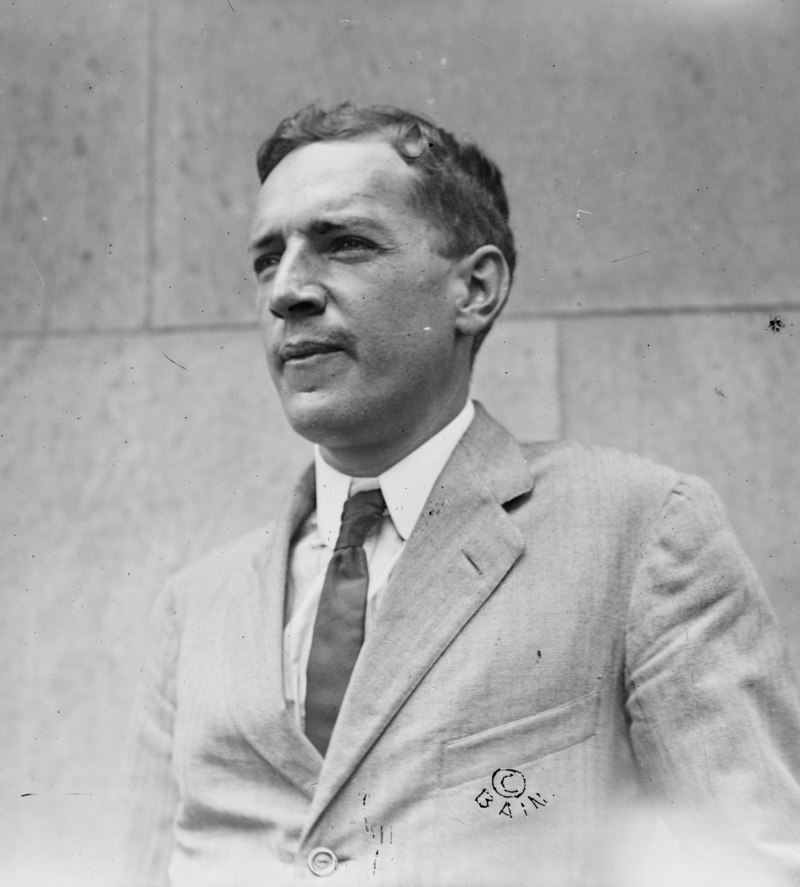
Early in his career he represented in literature the whole movement of discontent which spread so rapidly over America in the years of imperialism that followed the Spanish-American War and which attained their culmination in the catastrophe of 1917. The muck-raking period, beginning about 1897 with the trouble with the great trusts and pandering politicians, which made McClure’s, Cosmopolitan, Munsey’s, Collier’s and Everybody’s the magazines of the hour, soon found Mr. Sinclair in its vanguard. These exposures had been expedited somewhat if not inspired by the appearance in 1888 of Bryce’s American Commonwealth, which had gradually won a wide reading audience in America. Lincoln Steffens and Ida Tarbell but prepared the way for the more thorough and genuinely socialistic onslaughts of Upton Sinclair. The latter was always in the forefront of social controversy, always avid for attack upon social intrigue and political chicanery. Georg Brandes spoke without exaggeration when he declared that “Upton Sinclair is one of the not too many writers who have consecrated their lives to the agitation for social justice…: a convinced socialist and eager advocate of unpopular doctrines (he is), an exposer of social conditions that would otherwise be screened away from the public eye.”
How different is Upton Sinclair’s attitude from that of the first type, the social optimist and chauvinist, can easily be noted by reference to the works of F. Marion Crawford who maintained that all novelists were “public amusers,” and all novels “pocket theaters.” Crawford later, just preceding his death, turned Roman Catholic and completed his reactionary philosophy. His work, his attitude, are distinctly in line with those of his popular contemporary, Richard Harding Davis, whose handwriting is still preserved among the memoried ornaments of the Johns Hopkins University. Aside from the posthumous What is Man and The Mysterious Stranger, confessions of pessimism guilty of the emptiness of a consuming senility, Mark Twain can be classified in the same, smug, conventional, prosperity-whooping group. In fact, he is but a ramification of the Howellsian philosophy. His realism, so risible and roseate to the readers of two generations, was always romantically skittish in the face of the realities of sex and society. He never offended the delicate meticulousness of the Victorian taste. Even his picaresque heroes never do more than rob and plunder–and swear a bit. Twain unquestionably expressed the spirit of his time; his optimism, his satire, his caricatures all represent a social attitude the replica of the Howellsian and the antitheses of the Sinclairian. In the contrasts of these writers we can trace the character of the civilization, the nature of the class struggle, the psychology of the classes, the respective optimisms and pessimisms, felicities and sufferings. Just as Harold Bell Wright crystallizes a type of bourgeois psychology, expresses the bourgeois ethic in our popular novel. Upton Sinclair crystallizes a type of proletarian psychology, expresses the proletarian protest in our literature.
In every literature the interaction of social forces in determining the character of the substance and the peculiarity of the form can always be traced. In ethics and philosophy the same thing is true. Chaos in social conditions produces chaos in poetic conceptions. Bitter class-conflicts accentuate the disparities of the opposing class-protagonists. During the first decade of the twentieth century American literature was in the throes of a seething suspense. Discontent had grown to preponderant stature and in literature was fumbling for new forms of expression. Whitman had been a precocious harbinger of this revolt. Bellamy, Frederic, Norris and Phillips had made more than insinuating contributions to its advance. The young Upton Sinclair was an explosive manifestation of the violence of its gestatory struggle.
The Workers Monthly began publishing in 1924 as a merger of the ‘Liberator’, the Trade Union Educational League magazine ‘Labor Herald’, and Friends of Soviet Russia’s monthly ‘Soviet Russia Pictorial’ as an explicitly Party publication. In 1927 Workers Monthly ceased and the Communist Party began publishing The Communist as its theoretical magazine. Editors included Earl Browder and Max Bedacht as the magazine continued the Liberator’s use of graphics and art.
PDF of full issue: https://www.marxists.org/history/usa/culture/pubs/wm/1925/v4n11-sep-1925.pdf
 Revolution's Newsstand