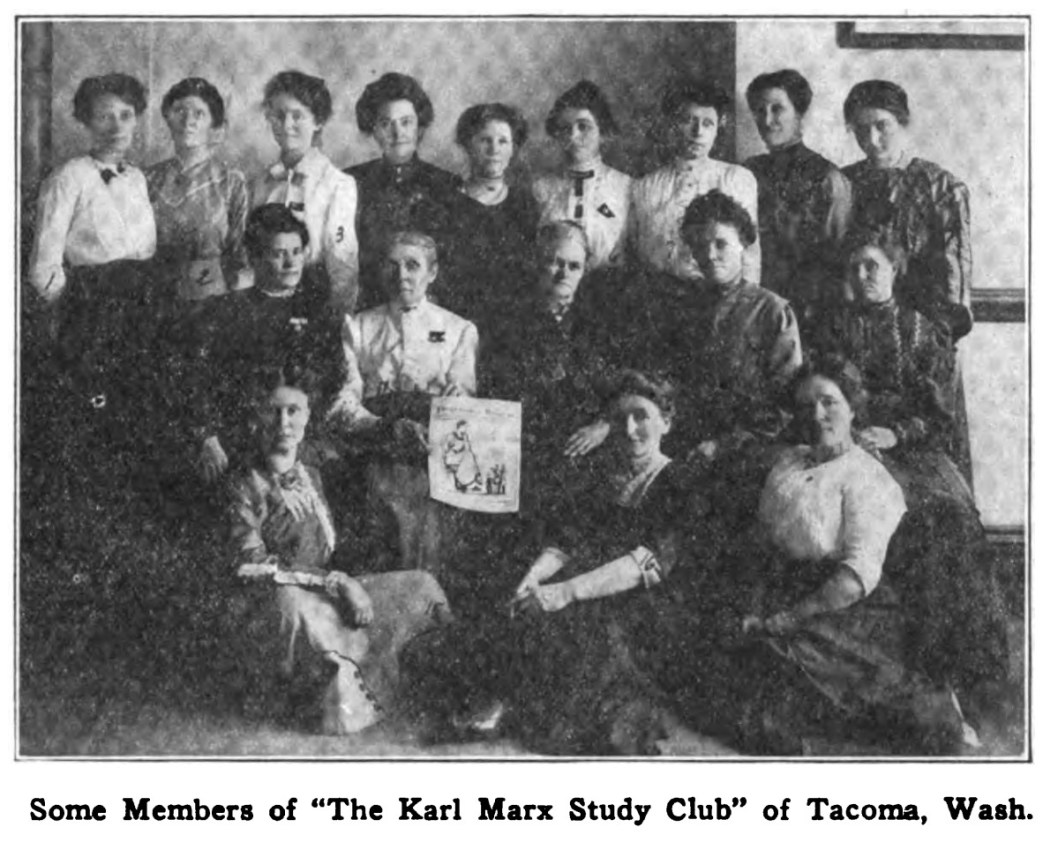
‘Tacoma’s All-Women ‘Karl Marx Study Club” from The Progressive Woman Vol. 7 No. 71. May, 1913.
LAST month we said we would give instances from time to time of women’s committees and clubs that were helping the movement, and how they were doing it. Tacoma, Wash., has a Karl Marx Study Club, with 46 women members. There are no men members, and these women are all busy housewives, or working at other things. However, they are live wires, full of enthusiasm, and are making a success of their work, the corresponding secretary, Comrade May Newhauser, writes as follows about their method of procedure:
“The monthly socials of various characters are our money-raising proposition. Through the city dailies, into which we have forged our way, are announced meetings, entertainments, etc. Our programs are well selected, and often we have speaking. We always have a crowded house, and there is NEVER an opportunity lost to bring The Progressive Woman before the audience.
“No speaker (in most cases woman) ever neglected to dwell on the importance of this magazine, and its message to awaken the women to the importance of right thinking and education. Then we take subs, sell copies, and ASK FOR THE NAME AND ADDRESS OF THOSE WHO ARE NOT YET READY TO SUBSCRIBE, to whom a copy is afterward forwarded, with leaflets enclosed. This is one way of pushing our woman’s paper. When Comrade Twining spoke here for the Lyceum course, she laid stress upon ‘ The P.W.’ and we sold copies and took subscriptions. The literature committee made the wise arrangement that no other literature should be sold at that meeting.
“We gave a social for our delegates the first night of the state convention.
“Our state convention also another chance to push our paper. I got the privilege to put up an attractive sign at the door in the hall, placed a table at the entrance, from where we alternately rushed to gallery or convention floor to get subscriptions. To give The Progressive Woman the widest publicity, we are going to send it to the teachers in Tacoma. I would recommend this step in every town and village. We MUST reach the teachers with our message of Socialism. Think of strength of this vast number in our states, when we once have them on our side!
“Due to the free distribution recently by some women comrades of the Appeal’ and leaflets for women, twenty-two subscriptions were sent the next day to the ‘ Appeal. ‘ This result affects us women with gladness and gives new impetus to further work.
“We need funds. Funds are very important, but where there is a will there is a way. At present our Study Club donates each month toward the stamp expenses of the local to forward literature to the homes, especially to the teachers.
“Following is a program of the Woman’s Day meeting given by the Karl Marx Club. It may be helpful to other women’s committees, and to locals:
“Those who were present at the celebration of our National Woman’s Day at Maccabees Hall, came with big expectations, which were realized . A pleasant sight in reviewing the audience the many bright rosettes worn by the Socialist women members.
“The programme opened with an address by the chairman, Mrs. Reichardt, which was followed by a song, ‘Arise, Arise Brave Woman’ by the women members who, upon request of the chairman, were accompanied by the audience.
“Then Comrade Kate Sadler gave a delightful, and at the same time powerful, talk. In her view of human from the Dark Ages where the women had the management of affairs, she showed how her dominion was gradually narrowed and limited to the four walls of her home, and how in the later years economic conditions forced her to step out from those walls where she has been kept enslaved, to take up the double yoke of breadwinner, mother and wife.
“The speaker urged the women to study the social problems of today which are more than dishwashing, because they mean self-development, mentally and physically. And the broadest path to develop her full social and economic freedom is found in the ranks of the Socialist party, where she is not looked upon as a sex creature. (Great applause)
“Comrade Sadler introduced the publication of The Progressive Woman to her hearers, emphasizing the great need to circulate this paper among the women as the best educating factor on economics, from a feminine standpoint. Many copies were sold, leaflets distributed, and subscriptions taken.
“Comrade Mrs. Larsen, in a sketch entitled ‘ Patchwork’ presented a well-arranged drill with eight children and a typified capitalist in the person of Comrade Sutton. The play was very well received.
“A masterly recitation by Comrade Miss Wildt was greeted with enthusiastic applause.
‘”The Arrest of Suffrage’ played with vim and vigor by each of the characters. With a song entitled: ‘Love’s Paradise,’ in which again the women took part, the programme ended.
Who say we do not need women in our movement, when they are as fine and helpful as the Tacoma Socialist women? We are going to tell about the work of other fine committees and clubs. Meantime, do YOU wake up, O sleeping local, and get some women members!
Progressive Woman replaced The Socialist Woman. The Socialist Woman was a monthly magazine edited by Josephine Conger-Kaneko from 1907 with this aim: “The Socialist Woman exists for the sole purpose of bringing women into touch with the Socialist idea. We intend to make this paper a forum for the discussion of problems that lie closest to women’s lives, from the Socialist standpoint”. In 1908, Conger-Kaneko and her husband Japanese socialist Kiichi Kaneko moved to Girard, Kansas home of Appeal to Reason, which would print Socialist Woman. In 1909 it was renamed The Progressive Woman, and The Coming Nation in 1913. Its contributors included Socialist Party activist Kate Richards O’Hare, Alice Stone Blackwell, Eugene V. Debs, Ella Wheeler Wilcox, and others. A treat of the journal was the For Kiddies in Socialist Homes column by Elizabeth Vincent.The Progressive Woman lasted until 1916.
PDF of full issue: https://www.marxists.org/history/usa/pubs/socialist-woman/130500-progressivewoman-v7w71.pdf
 Revolution's Newsstand