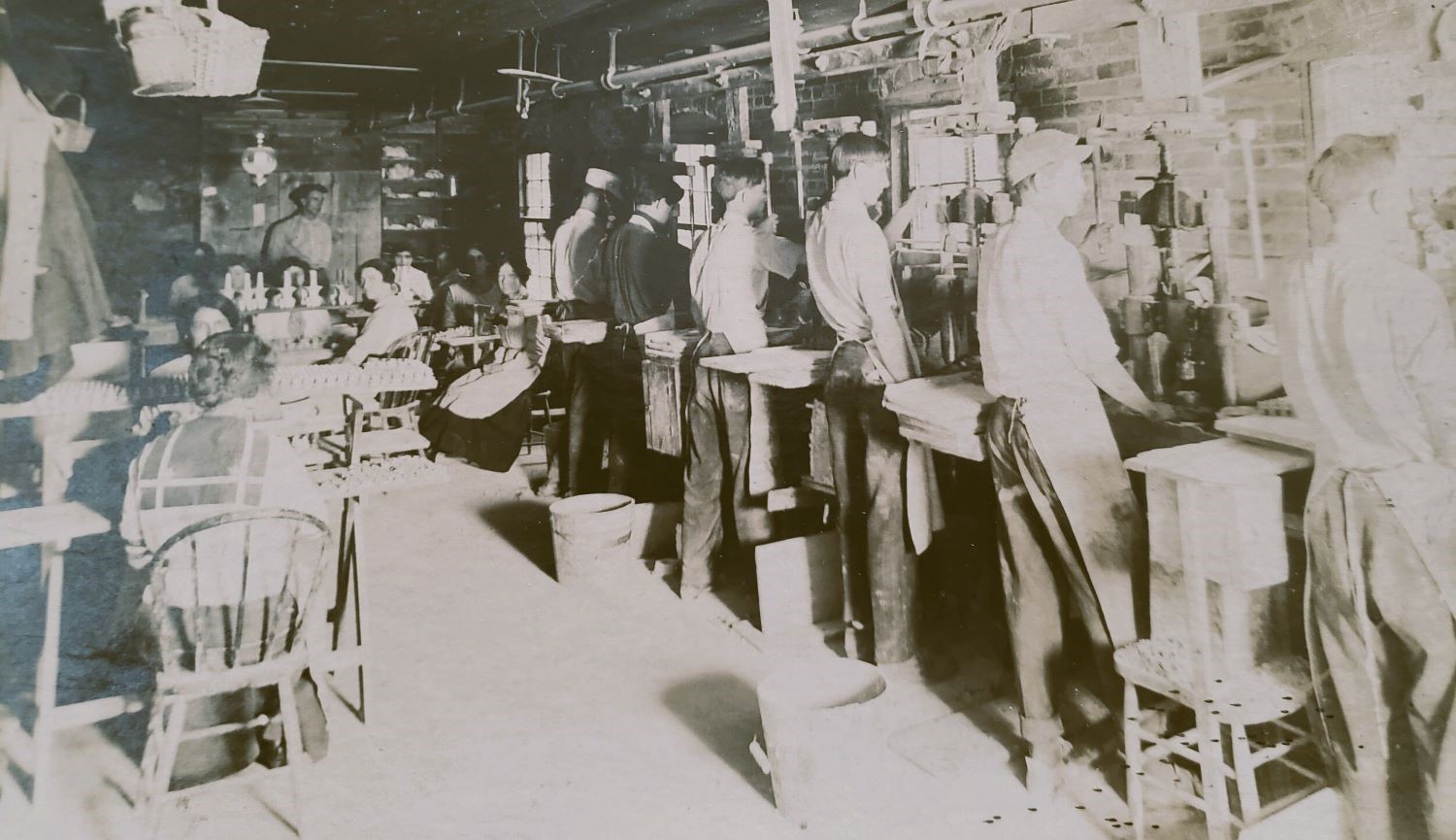
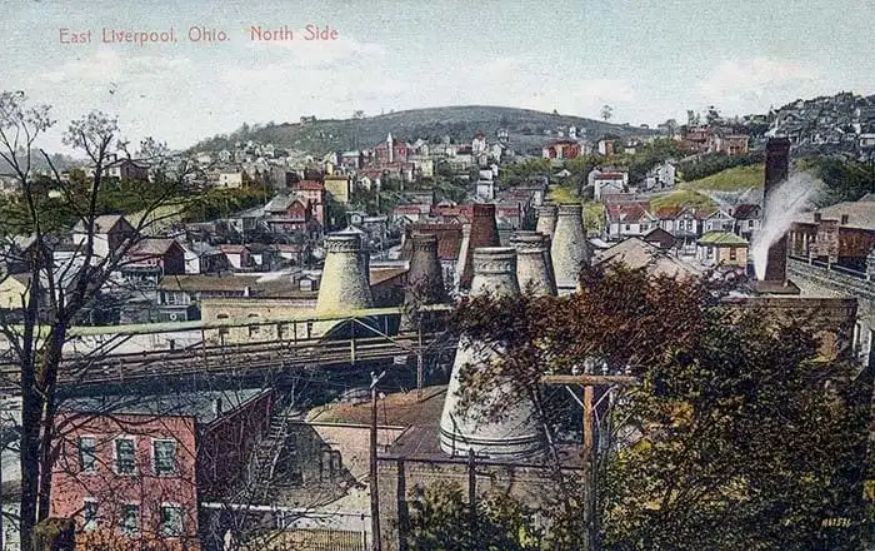
A look at the industry in East Liverpool, Ohio and the pretensions of the potters.
‘The Pottery Industry’ by John D. Goercke from The People (S.L.P.). Vol. 12 No. 19. August 9, 1902.
East Liverpool, Its Center, Graphically Described The Operative’s Condition.
East Liverpool, Ohio, Aug. 11. To the uninitiated workingman it would appear that this is a community of embryonic millionaires when he hears that wages range as high as $5 per day, and that the average is about $12 per week, women and children included. But in this little city, the pottery center of the United States, the wage-slaves are, in the first place, no better housed than in any other town of its size, where the average wage is considerably lower. House rent is outrageously high, and “any old shack” is eagerly snapped up, the demand exceeding the supply. The workers are as closely huddled together as in a large city, in so far as the numbers of rooms are considered, at least.
The boarding and lodging houses are, as a rule, a fair criterion of the standard of life of the “inner man” in any community. I am sojourning in one of them, recommended to me by comrades as a good place for the price. At the rate of $5 per week I am chastising myself for past sins. An abbreviated diet might be a commendable practice from the standpoint of physical culture, but to pay $5 per week for the privilege of fasting I consider “middle class robbery.”.
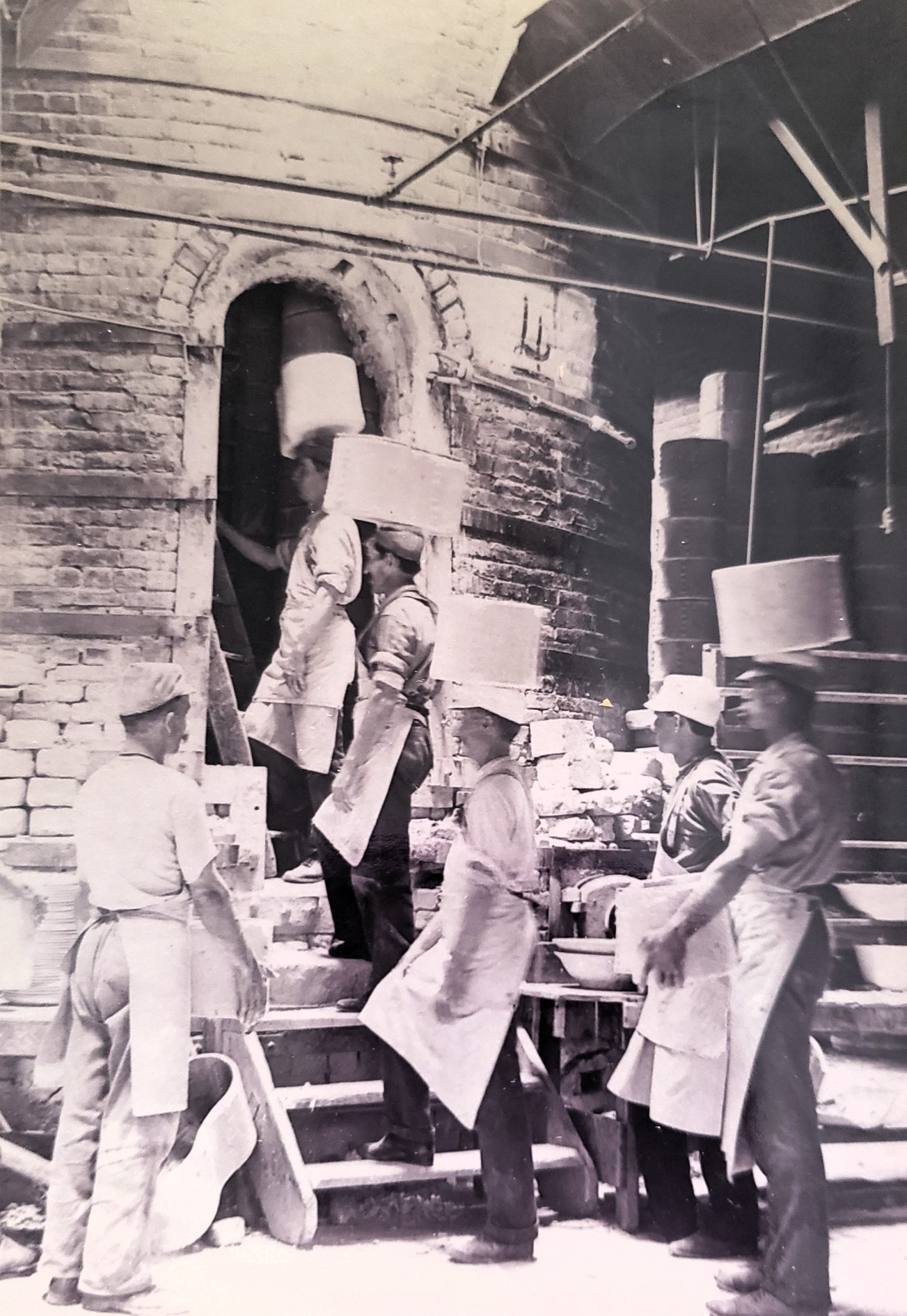
The pottery industry is an “infant industry,” protected by an effective tariff; skilled workmen are always in demand; the new potteries springing up in all immediate directions absorb all the surplus of “skilled labor” turned out at this place, leaving a scarcity even at home. But what the worker, under the economic law of supply and demand, can force the capitalist to pay him in wages our “friend,” the “small man in business,” appropriates to himself as a reward for his “risk of investment.” At the end of the year our well-paid American pottery worker, who so religiously votes the Republican ticket, to protect himself from the cheap labor of Europe, finds that he has had a bare existence; he tremblingly hopes that our prosperity may last forever, and that the economic teachings of the S.L.P. may prove faulty. Instead of studying for himself and trying to understand the inevitable development of all industry, he puts his head in the sand of the only recreation that he can afford, and to which the incessant and monotonous grind in a pottery, enveloped in dust and a peculiarly oppressive heat, naturally draws him. He scrapes together the few nickels which the grocer, butcher, landlord and shoddy dealer have overlooked, and pays them over to the saloonkeeper. To make sure that ignorance of political and eco- nomic questions on the part of the wage worker be perpetual, the capitalist politician around about election time pays homage to the “demon drink” by free distribution of “booze,” in order to keep in those that cannot be reached by the prohibition parson and the “man of all work” in capitalist politics–the labor fakir.
There is as yet a portion of the workers here who have not been exploited to the last cent; who shrewdly avoid the waiting saloonkeeper; who have reduced working class abnegation to that science called “saving”; pinching their own and their family’s bellies to the utmost (to the chagrin of the small merchant, who is thereby deprived of his “fair share of the general prosperity”); who, true to the capitalist philosopay, regard “work a virtue,” and who are so virtuous as to commit slow suicide by working until their hide cracks, which opportunity is afforded for a temporary reward granted them by the peculiar piecework system in vogue here.
Among these men there are still a few dollars, jingling in their pockets, which brings a pious smile upon the face of the real estate shark and a vague fear into the heart of their capitalist employers, who, naturally, dread the idea of their wage slaves being even for a few days independent of their masters and a job.
The result is that building and loan associations are springing up like mushrooms, which are eagerly patronized by the poor deluded wage slaves, who imagine that it is possible to extricate themselves from poverty by a sacrifice of life tissue.
That the whole working-class population here is living from hand to mouth is emphasized by the fact that the Grocers and Butchers’ Associations issued a statement on July 1, of this year, that the time limit of credit would not exceed two weeks. This statement was the result of an agitation among the potters to enforce a demand for a raise of wages with a strike. It is the middle-class parasites who keep the closest tab upon the purchasing ability of the working class, and after extracting the last cent out of the pockets of their customers by a systematic method of cajoling, begging and “advertising,” always gauging their profits by the paying ability of the worker, they add insult to injury with a show of mean contempt for the “improvident” workingman, who deserves no sympathy.
From all this it would appear that the pottery worker is well taken care of:” that there is nothing on the horizon that would immediately, or perhaps remotely, disturb the peaceful co-operation of “Capital and Labor.” But, although the wealth-creating energy of the workers has been so securely circumscribed that it all redounds to the interest of the capitalist class from top to bottom, there are still wheels within wheels that are rotating in opposite directions, and that is the general state of the present development of the “infant” pottery industry.
Like all comparatively undeveloped industries, the infant pottery industry has its peculiar features, which must be carefully investigated to be understood. The comparatively and abnormally high wage paid to-day to the operatives leaves a wide latitude for “readjustments.” The “cheapening” of production is bound to come; in fact, a solid foundation for future developments in this respect has already been established. Although the wage worker cannot be forced, in this instance, below the cost of living, at least for the time being; although the screws of the middle-class merchant will have to ease up, as those of the capitalist class employer tighten down; it will not take place without friction. And to furnish the necessary oil that the friction may be reduced to a minimum is the function of the labor fakir of the National Brotherhood of Operative Posters. It would make this communicator too lengthy to throw a light upon the subject at present.
I am at present investigating and interviewing: will have time for that until Sunday, and then communicate the facts to the readers of the, PEOPLE through its columns. I would state that I am addressing audiences in this town for a week, and have had to “cut out” two nights on account of rain. While I do not hope for that success which crystalizes itself in a strong and clear organization of an S.L.P. section or an S.T. and L.A. local, I am confident that the lessons taught to-day will not be. lost. To judge by the way the remarks are received, and how here and there a workingman will step forward to purchase a pamphlet and investigate for himself, or place his name upon our petition list, shows that he who would lose hope and confidence in his (the working) class will please step to the rear and give the fighter elbow room.
New York Labor News Company was the publishing house of the Socialist Labor Party and their paper The People. The People was the official paper of the Socialist Labor Party of America (SLP), established in New York City in 1891 as a weekly. The New York SLP, and The People, were dominated Daniel De Leon and his supporters, the dominant ideological leader of the SLP from the 1890s until the time of his death. The People became a daily in 1900. It’s first editor was the French socialist Lucien Sanial who was quickly replaced by De Leon who held the position until his death in 1914. Morris Hillquit and Henry Slobodin, future leaders of the Socialist Party of America were writers before their split from the SLP in 1899. For a while there were two SLPs and two Peoples, requiring a legal case to determine ownership. Eventual the anti-De Leonist produced what would become the New York Call and became the Social Democratic, later Socialist, Party. The De Leonist The People continued publishing until 2008.
PDF of full issue: https://www.marxists.org/history/usa/pubs/the-people-slp/020809-weeklypeople-v12n19.pdf
 Revolution's Newsstand