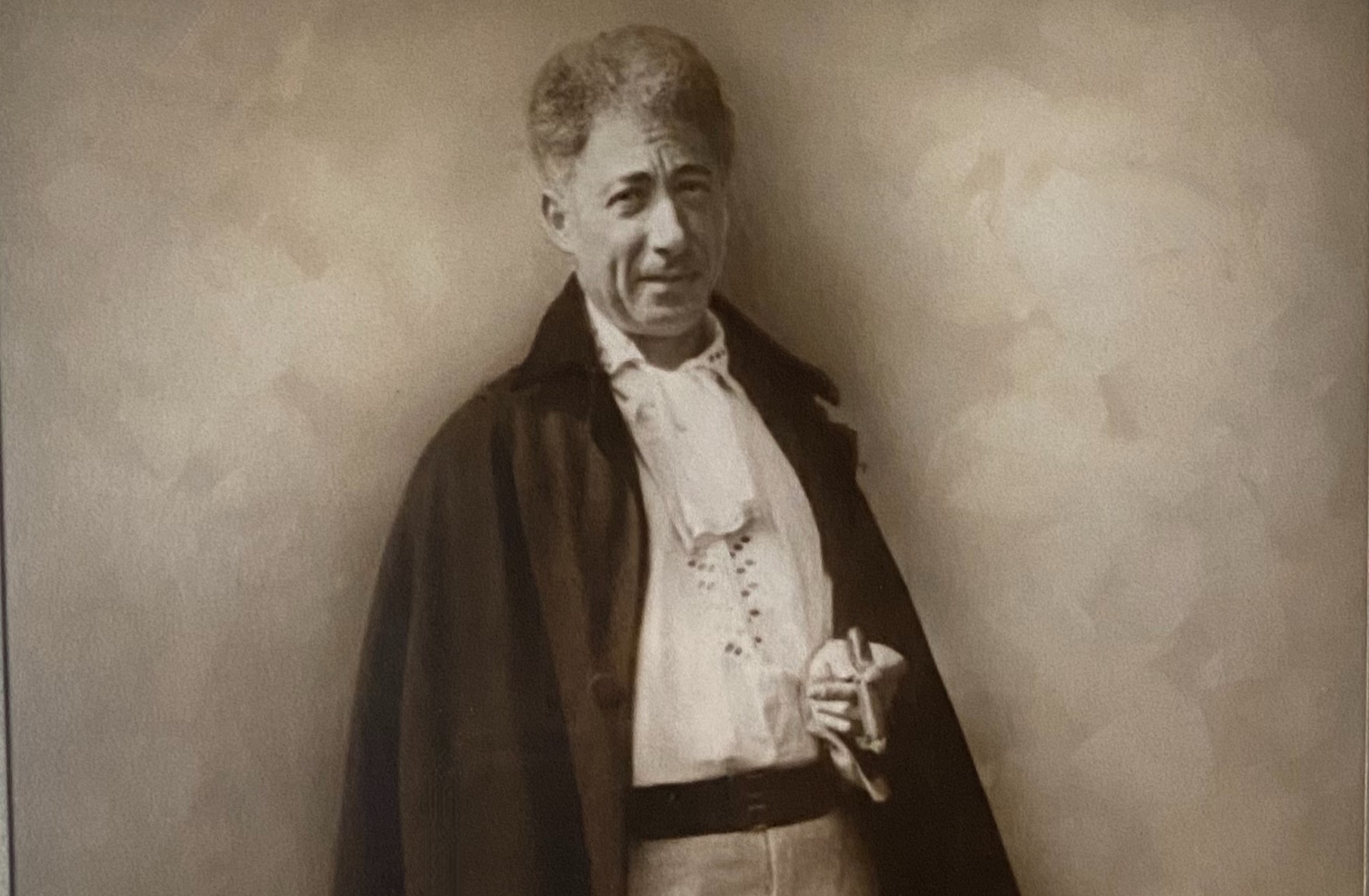
The story of the transformation of Moishe Nadir, satirist and playwright who would become one of the most popular voices of the Yiddish-language Communist press of the 1930s until leaving the Party in 1939 with the signing of the German-Soviet Non-Aggression Pact.
‘Moishe Nadir, From Play-Boy to Revolutionist’ by A.B. Magil from the Daily Worker. Vol. 4 No. 130. June 15, 1927.
When Moishe Nadir stood up in Central Opera House the other night to receive the ovation of the many admirers that had come to welcome him, he was already tired. Tired of his travels, of the excitement of coming back, of meeting people, shaking hands, answering questions. Tired. But most of all there was that festive tiredness of a person who has passed through a deep emotional experience which has left him a little confused, a little uncertain of his waking and dreaming.
More than a year ago Moishe Nadir stood up to receive a similar ovation in Carnegie Hall. He was going away on a European trip, most of which would be spent in Soviet Russia. Moishe Nadir, the skeptic, the scoffer at all deep ardors and positive faiths, was going to the land where ardor and faith and knowledge were creating tangible miracles. In search of what? Perhaps he didn’t himself know.
But at Central Opera House the other night there stood up a worshipper, one who had participated in something intimate and joyous, and in whose blood all that he had seen and experienced during the last year had risen to a great tide of love and understanding.
About ten years ago Moishe Nadir was a regular contributor to a capitalistic Yiddish newspaper in Philadelphia. At that time he was one of many Yiddish humorists, grinding out copy for the press. And if one wrote a little cheaply at times, a little vulgarly, it didn’t matter much. One had to live…But behind the name Moishe Nadir there still glowed something of the man Isaac Reiss-Isaac Reiss, the Galician Jew, who had wanted to be a serious poet, and had been compelled to become merely Moishe Nadir, the professional humorist. Perhaps he only dimly sensed that Moishe Nadir, the humorist, would become a far greater poet than Isaac Reiss could ever have been.
After Philadelphia there was Greenwich Village. Joe Kling, editor of “Pagan,” an ephemeral literary magazine, began printing translations of Nadir’s experimental verse, momentous trifles, composed for the initiate only. Nadir was the first and only “Villager” among Yiddish writers. But the Village, like Philadelphia, was only an episode.
Slowly Moishe Nadir was emerging into a position unique among Yiddish writers. He was becoming a storm center. He was discussed, anatomized, quarreled about. No Yiddish writer has been the subject of so much controversy. There are those who worship him and those who hate him-his enemies have always been many. When Noah Steinberg, a young Yiddish writer, recently issued an extensive study of Moishe Nadir, he was attacked on all sides. Nadir doesn’t deserve such serious treatment, the pedants shouted; he’s a poseur, a trifler, he writes unintelligibly, scorns all correct and dignified expression. Nadir’s numerous personal and literary idiosyncrasies have made him peculiarly susceptible to these petty attacks.
Some of these criticisms have no doubt been justified, A vivid, mercurial personality, he had exploited his extraordinary talents until he had become something of a professional esthete. He jeered at philistinism, at banality and soggy sentimentalism, but also at all strivings toward great goals, the struggles of the oppressed, all passionate living. The name itself: Moishe Nadir. In Yiddish there is something impudent in the sound, something vagrant and unabashed. Nadir was the eternal nose-thumber.
Yet something was gnawing at Moishe Nadir, and the sterility of such attitudes was creating a great need. It was all very well to laugh at bourgeois smugness. But it was laughter in vacuum. And it created a smugness of its own, that contemptuous smugness that made itself felt in regard to “the mob,” that is, the toiling masses.
Something was gnawing at Moishe Nadir and he joined the staff of the “Freiheit.” The esthete, the darling of the “literary” cafes, became a contributor to a Communist newspaper. This was in the early days of the paper when its existence was precarious and salaries were even more uncertain than they are now.
Nadir began conducting his daily column, “From Yesterday Till Tomorrow.” This was a personal vehicle, in which he wrote anything that happened to pop into his mind-and the mind of Moishe Nadir is amazingly, breathlessly fertile. It quickly became one of the most popular features of the “Freiheit.” There is nothing comparable to it in the bourgeois American press. Nadir is easily the most brilliant columnist in America: F.P.A. and Heywood Broun are tyros in comparison. He is never perfunctory, never wistfully weary. Nadir always writes as if he were discovering language for the first time. His words are mocking yet tender, warm, light, flexible, always unpredictable. And most remarkable of all is his apparent spontaneity, his endless and effortless ingenuity. Of course, Nadir frequently outrages the academicians. He takes too many liberties with the language that they have taken such pains to teach correct behavior.
Yet even on the “Freiheit” Nadir remained very much the dilettante, the incorrigible child babbling inspired precocities. But the discontent in him was growing more clamorous, urging him to go away. As a revolutionary artist he sympathized with any attack on the old order, though he himself remained a bystander, not a participant. And he found himself drawn to the land where the old, decaying order was being destroyed and in which something vital and strong was struggling into being.
To Soviet Russia he brought with him his skepticism, his disillusion and discontent, his capricious mockery. And Moishe Nadir, the humorist and poet, who had gone from Galicia to the United States, to Philadelphia, Greenwich Village, the Second Avenue cafes, found at length that home that he had always been seeking. At the age of forty-two Moishe Nadir fell in love with a strange country and a strange people.

The love songs of Moishe Nadir, the love songs that he wrote during the past year to Soviet Russia, are among the greatest in the Yiddish language. They appeared at intervals in the “Freiheit,” written ostensibly in prose. He embraced the country, its people, its language and its way of life with the passion that all his life he had denied. And he wanted everybody to take part in this love of his: he spoke constantly of “our country,” “our government.”
There are those who continue to scoff at this new fervor. But it remains real and profound. For when Moishe Nadir, a sympathizer with the Revolution, returned as Comrade Moishe Nadir, a participant in that Revolution, he returned as a man reborn.
His first published work since his return to the United States appeared in the “Freiheit” the other day. It is a rather lengthy poem called “The Jazz Song of Stoker Jim.” Judged by esthetic standards, it is perhaps not a very good poem, but as an expression of Moishe Nadir it is an amazing testament. He speaks throughout the poem of “Brother Jim,” “Comrade Jim,” and towards the end says:
“Sickle and hammer are the sign
Of the day that is coming for Jim.”
The esthete stoop to propaganda? Call it what you will. But one should remember that the esthete is dead. Not the artist, however, nor the human being.
Moishe Nadir has returned to America. But he is only visiting this country now. Shortly Comrade Moishe Nadir goes back home–home to Soviet Russia, where he intends to live and to work.
PDF of full issue: https://www.marxists.org/history/usa/pubs/dailyworker/1927/1927-ny/v04-n130-NY-jun-15-1927-DW-LOC.pdf
 Revolution's Newsstand