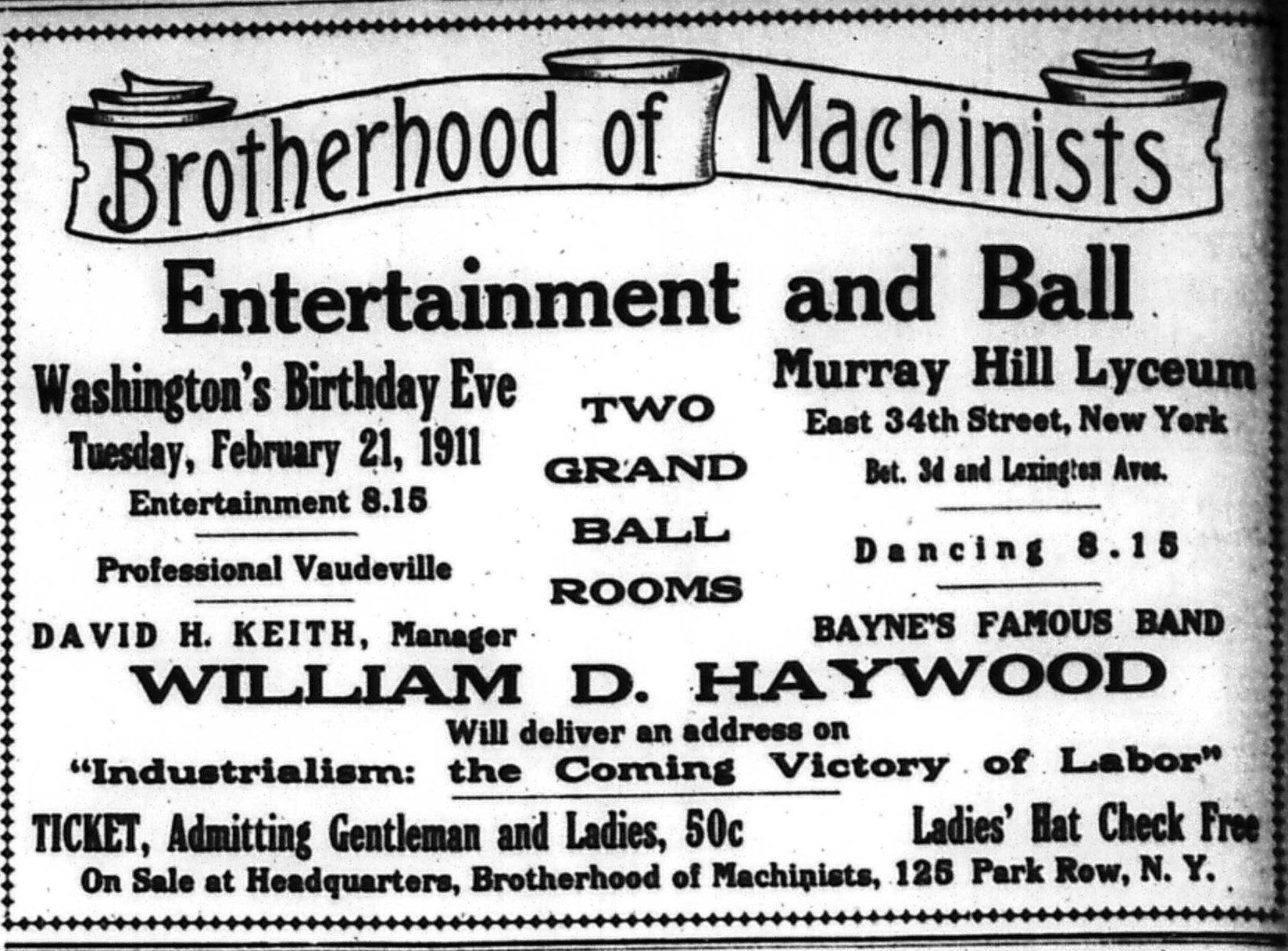
‘Haywood At Great Machinists’ Ball’ from the New York Call. Vol. 4 No. 53. February 22, 1911.
At Great Ball He Declares Forces of Labor Must Unite.
Both halls of the Murray Hill Lyceum, 34th street near Third avenue were jammed last night when the Brotherhood of Machinists turned out for their annual entertainment and ball. The entire affair was a huge success. It was even greater than the one held last year on the same date.
The drawing card of the evening was Bill Haywood who came direct from Detroit to address the brotherhood on the subject: “Industrialism, the Coming Victory of Labor.” Haywood spoke to the large gathering composed of women and children as well as men, for more than an hour on his favorite topic. Repeated applause greeted the big miner.
“I came a long way to talk to you machinists,” said Haywood, in ‘beginning his speech. I am here because you are rebels, because you have revolted against despotism and leadership which was against your interests. It seems to be my fate to be always among rebels and undesirables.”
He said he deplored the division in the ranks of labor and then he went on to show why these divisions exist. For examples he went over the history of the International Association of Machinists and stated that membership of that organization several times through referendums decided on changes in the organization which if carried out by their leaders would have prevented the breaking away from that organization of the Brotherhood of Machinists about a year and a half ago.
Labor Always Divided.
Haywood said that labor had lost because it has always been divided against itself. He emphasized his remarks by saying that 3,000 members who are of one opinion and who are for the same principles are stronger than 30,000 divided in opinion, and he was glad that the Brotherhood of Machinists were of one opinion.
After a short sweeping review of the class struggle as it is taking place in present-day society throughout the world, the former secretary of the Western Federation of Miners pitched in to expose what he called the crime of craft unionism in America.
He said he could prove conclusively that the present leading exponents of craft unionism today do not want larger and stronger labor organizations. As examples he referred to the apprentice system employed by several trade unions which keep down, the membership by making the initiation fee so large that only a few can enter. He also gave example after example showing that several craft union organizations have actually closed their books and have refused to take in any more members.
Breeds Scabs.
According to Haywood this breeds the scabs that break the strikes. He said in the office of the Boston American there are 300 printers and only five apprentices. Some day, he said, there will be a whole lot of little printers, the sons of these same printers who now refuse to take in even a very limited number of learners. Inevitably, he declared, the sons of these printers are forced either to scab or to join the ranks of the criminals.
Haywood said some time ago a father told him that his five sons were refused admittance to a labor organization and today three of them are in the army. Now, as soldiers, he declared, the workers have to support them, where. if they were given a chance to into an organization they could be supporting themselves and at the same time strengthening the general organization of the working class.
$250 Initiation Fee.
He gave another example of a German photo engraver who was asked $250 in order to get into the union. He told the secretary of the organization that he did not have the money and was told that there was a strike on in a non-union shop in Philadelphia and if he would go there and scab–the secretary called it work–he could probably get into the union by paying but a hundred dollars. The German, Haywood said, told the secretary he would not scab.
Five hundred dollars initiation fee to join the green bottle blowers’ union he quoted another instance of opposition to a large organization. The speaker made the startling statement that if the capitalists of this country tried to evolve an institution to keep the workers in submission they could not do better than form such an organization as the present craft union movement of this country The keynote of Haywood’s speech was “one big labor organization broad enough to take in the entire working class.”
The Big Teachers.
He brought a somewhat surprised expression to the faces of many workers present when he said that Morgan, Rockefeller, and Carnegie were the greatest men in this country. Haywood’s explanation, however, brought considerable applause when he said that he didn’t mean that they were personally admirable creatures, but that they have shown in the great organizations, such as the steel trust. that the workers are able to run the industries.
“Labor,” said Haywood. “must organize along the lines that industry is organized on today. Organized in that manner, there would be no lost strikes. The world would then belong to the workers.”
Remembers His Rescue.
Haywood wound up his speech by thanking the machinists and all the workers present for their assistance given him when he was in the shadow of the gallows. He said he only hoped they would now do for themselves what they did for him and his comrades in the West.
“I am willing.” said the husky miner, “to go back to jail again and stay there the rest of my life if that would bring about the complete solidarity of labor in America.”
“Industrial and political solidarity.” he concluded. “is the greatest need of the working class of this country today.”
When he uttered his well known slogan: “Industrial unionism is Socialism with its working clothes on, a shout went up and the monster gathering broke up to take part in the dance which had already started.
Robert L. Lackey, general secretary of the Brotherhood of Machinists, was the chairman of the evening.
The New York Call was the first English-language Socialist daily paper in New York City and the second in the US after the Chicago Daily Socialist. The paper was the center of the Socialist Party and under the influence of Morris Hillquit, Charles Ervin, Julius Gerber, and William Butscher. The paper was opposed to World War One, and, unsurprising given the era’s fluidity, ambivalent on the Russian Revolution even after the expulsion of the SP’s Left Wing. The paper is an invaluable resource for information on the city’s workers movement and history and one of the most important papers in the history of US socialism. The paper ran from 1908 until 1923.
PDF of full issue: https://www.marxists.org/history/usa/pubs/the-new-york-call/1911/110222-newyorkcall-v04n053.pdf
 Revolution's Newsstand