
In this notable article from Harry Haywood, clearly feeling the Party had pulled back from its promotion of Black self-determination developed during the ‘Third Period’ as it pivoted to progressives and liberals with the Popular Front, he both defends the position’s fundamentals, a future land-based Black nation, and reframes those notions for the ‘immediate,’ democratic demands the Popular Front mandated.
‘Self-Government–Struggle for Equality of Negro People’ by Harry Haywood from the Daily Worker. Vol. 13 No. 185. August 3, 1936.
Haywood 9th Convention Report Stresses Fight on Discrimination
In all our work among the Negro people, as among all oppressed peoples, our aim as Communists is to bring about the unity of Negro and white, to eliminate all obstacles, prejudices, and inequalities that divide the ranks of the people. Our aim as Communists is to unite all oppressed peoples in the struggle for equal rights, for democratic liberties, and for the achievement of socialism. Our aim is to unite the toiling population of the oppressing nations with the toilers of the oppressed nations. The removal of all inequalities–that is our central aim in our Negro work.
That is why we place at the center of our work today the slogan for a united struggle against discrimination, lynching, for the right to hold jobs in public utilities, civil service. for the right to vote, serve on juries, elect officials, enforcement of the thirteenth, fourteenth and fifteenth amendments to the U. S. Constitution, etc. That is why we demand removal of the discrimination which results in lower wages for Negroes, against discrimination in the trade unions, against discrimination in the distribution of relief, housing, etc.
Distribution of Land
As Communists, we are, as Lenin said, for the voluntary unity and co-operation between all peoples, even up to merging of all peoples. But we have to understand how our struggle against immediate inequalities is bound up with our complete program for the liberation of the Negro people in America, that is to say, the distribution of land in the Black Belt and the right of self-determination in that area. We have to understand the slogan of self-determination in its inevitable and necessary relation to our efforts for welding the unity of Negro and white in the struggle for equality and democracy.
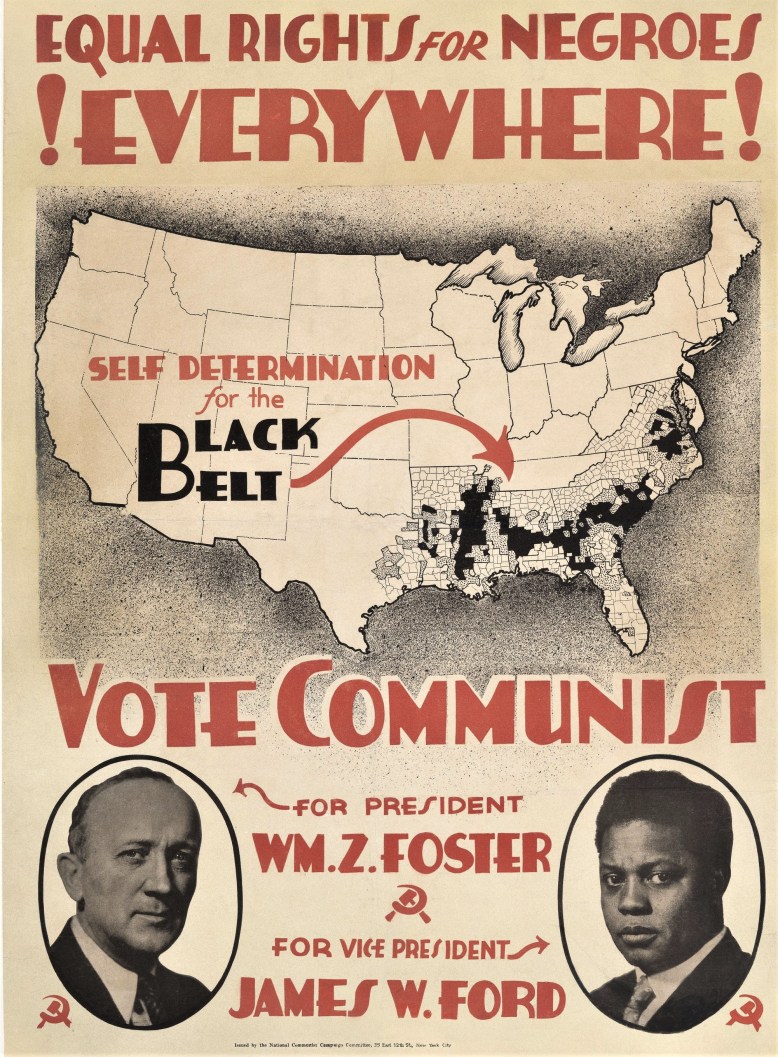
I believe it is necessary to emphasize this point now because lately, as we have been making our correct and energetic efforts to build the broadest people’s front among the Negroes, we have tended to submerge our basic slogan of the right of self-determination in our propaganda. We seem to have forgotten that the right of the Negro people to decide their own fate can be the only final guarantee of the unity of Negro and white.
Slogan for Equality
I want to show you, comrades. that if we do not understand this. that if we forget this, it will affect the very core of our struggle for unity, and the building of the People’s Front. Today, there is no doubt that the slogan under which we can build the united front and the people’s front is the slogan for equality in political, economic and social life. Today, there is no doubt that we could not develop the powerful movement for unity except under this slogan. But we must always keep in mind the possibility, or rather, the certainty that a moment will come in the fight against reaction and the rise of the Negro liberation movement when the Negro masses of the South will begin to see clearly that self-determination is the only guarantee for the winning and preservation of real equality.
We cannot say, of course, exactly when this will be, but when that time comes we must be able to convince the white workers, the American people’s front, that the equality which is essential to the unity of Negro and white can only be guaranteed by complete democratic rights for the Negro up to and including the right of self-determination.
Possession of Land
After all, that which gives to our Communist position on the Negro question its preeminence and effectiveness is the fact that we Communists are the only ones who go boldly to the roots of the whole problem. It is we alone who show how the heavy burden of oppression which crushes the backs of the Negro people throughout the country has its basis and origin in the Black Belt of the South. It is we Communists alone who show that the Negro people can never be free until the Negroes in the Black Belt finally possess the land upon which they work, the land which is owned today by a small clique of landlords supported by Wall Street banks. Only possession of the land can make the Negro toilers free. But, between the Negro and the land stand the armed forces of the land. And what will guarantee to the Negroes in the South that the great landed estates will be broken up and divided among those who toil on them? What can guarantee him that when this has taken place the Negro farmer will be able to hold on to the land? Only self-government, the right to govern himself, can guarantee the Negro toilers this. The Negro majority in that continuous stretch of land known as the Black Belt must have the right to their own government, their own self-rule, courts, people’s militia, etc. This is the only guarantee that the Negro will hold his land and procure liberty and equality. People’s Front
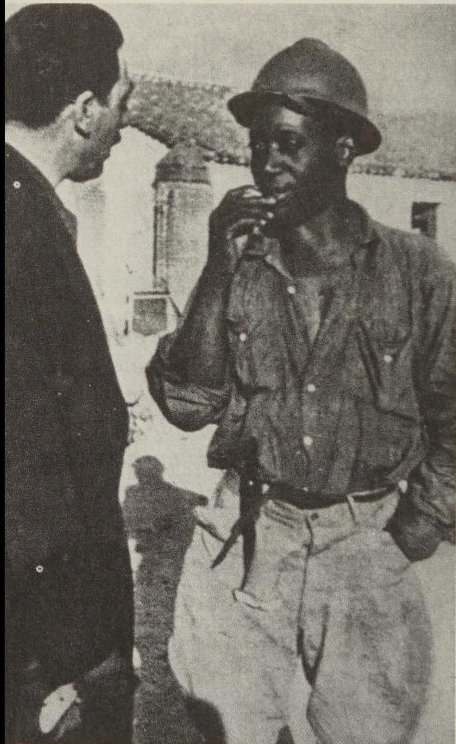
Today it is correct that a people’s front among the Negroes, the National Negro Congress, does not put forward the slogan for complete self-determination. But, with the development of the people’s front, the basic needs of black and white alike are developed more and more clearly. Then it will be necessary to put the question of freedom for the Negro people where it finally rests the possession of the land and its guarantee through full self-determination. So, in Spain, at a certain stage of the struggle, the People’s Front became the supporter of the Catalonian movement for autonomy, self-rule, as a basis for unity in the People’s Front. Such a stage will also arrive in this country, when the People’s Front of America will have to support a similar movement for self-government of the Negro people, in order to effect unity.
But even today, the right of self-determination is not abstract, up in the air, divorced from our work. Even where it does not enter directly, our understanding of this fundamental position guides us. Our ability to lead the Negro masses depends upon this understanding. It is only our Party’s complete sincerity, it is only our Party’s complete understanding that makes it possible for us to proudly say as Comrade Browder was able at the Ninth Convention this week, that we are the Party of the Negro people. It is because we carry our stand for equality to its logical conclusion, that we are able to lead the Negro masses. It is not chance that we are the ones who built the first organization of the sharecroppers. It is not chance that we are the ones who spread the infamy of Scottsboro to every corner of the world. It is not chance that from our ranks came Angelo Herndon.
Education of Members
But if we forget to educate our members systematically in this basic understanding of our position on the Negro question, in an understanding of the relation of our day-to-day struggle for equality, unity, to the right of self-determination, then we will be in danger of weakening the fight for unity, we will be unable to achieve unity, unable to lead the daily struggle for the needs of the Negro people.
And lately this danger has arisen. Our opponents are taking the offensive against this basic line of the Party, as for example in the review of James Allen’s book on the Negro question in the liberal weekly. The Nation, where Sterling Spero attacks our stand on self-determination as being a hindrance to united action between Negro and white. But it is noteworthy, nevertheless, that he praises the Communist Party for having done “excellent work in the fight for justice and equal rights for Negroes.” This writer does not see that we Communists have been able to do “excellent work in the fight for justice and equal rights for Negroes” just because at the basis of all our work has been our adherence to the principle of self-determination, our understanding of the position of the Negro people as an oppressed nation.
Self-Government Discussion
The seething ferment among the Negro masses has not yet reached the stage where it takes the conscious form of a demand for self- determination, although the development of the struggle against inequality will eventually reach a point where the recognition of the right of the Negro masses to decide all questions concerning their interests and welfare will become a practical issue.
Therefore, I should like to put a new problem before you. Since the Negro people are a new nation whose development has seriously been retarded by American imperialism, we can see that the concept of nationality has not fully matured among them. Therefore, it may be possible, and I put it forward for discussion, to consider for the clarification of our propaganda the proposal for some sort of intermediate stage in the fight that will lead up to self-determination. What would such an intermediate stage be? It would have to grow right out of the immediate struggle for economic demands of the share-cropper and worker and political rights such as the right to vote, elect officials, sit on juries, and enforce the 13th, 14th and 15th Amendments. These are the issues which are becoming prominent as never before, in the election campaign. How would we define such a stage? It would be, comrades, a struggle for self-government in the Negro areas of the South. Such a stage would give the Negro majority the above democratic rights, without, however, yet reaching the stage of self-determination, that is, the right to federate or separate from the rest of the country. Is it not possible that with this slogan for self-government we can establish a bridge between the immediate struggles for equality and the struggle for self-determination?
Reconstruction Days Cited
As a matter of fact, in our country’s history we have already seen, during the Reconstruction days following the Civil War, something of this local self-government of the Negro majority in the Southern counties and states, if even in an incomplete and crude form. In the governments, state and country, set up following the Civil War, the Negro majority for a short period enjoyed political rights, that is, the right to vote, hold office, etc. This was not yet complete self-determination. Nevertheless, even this partial self-government brought such democratic liberties to the South as were not seen before or since. This self-government, it is especially important to note, gave the masses of “poor whites” more liberty than they have today. The granting of political rights, self-government, to the Negro masses, resulted in the abolition of the poll-taxes, property taxes, which had disfranchised the “poor whites,” and established free, universal education, equality and easing of mortgage debts on small farmers.

The desperate distortions of reactionary historians attempt to conceal these vital facts. As it pre- pares to organize fascist reaction today, the ruling class attempts to blind the “poor whites” to the liberating effect which self-government for the Negro people would have upon the whole South. It raises the spectre of “black domination,” as we have seen in the notorious film, “The Birth of a Nation,” and in the writings of Thomas Dixon, Jr. But the experiences of the Reconstruction days proved how utterly false is this propaganda. It proved that only through political equality and self-government of the Negro majority can the exploited white masses in the South achieve democracy.
Therefore, I emphasize that we must be aware in our struggles for unity, in the development of the National Negro Congress, in the building of the Farmer-Labor Party, our most important, immediate tasks that we have a clear conception of the relation of these immediate struggles to our basic position on the Negro question, the struggle for land, the slogan for self-determination.
The Daily Worker began in 1924 and was published in New York City by the Communist Party US and its predecessor organizations. Among the most long-lasting and important left publications in US history, it had a circulation of 35,000 at its peak. The Daily Worker came from The Ohio Socialist, published by the Left Wing-dominated Socialist Party of Ohio in Cleveland from 1917 to November 1919, when it became became The Toiler, paper of the Communist Labor Party. In December 1921 the above-ground Workers Party of America merged the Toiler with the paper Workers Council to found The Worker, which became The Daily Worker beginning January 13, 1924.
PDF of full issue: https://www.marxists.org/history/usa/pubs/dailyworker/1936/v13-n185-NY-aug-03-1936-DW-Q.pdf
 Revolution's Newsstand