
A fine look at the political economy of baseball from Communist former college football star Martin Abern.
‘Karl Marx and the Business of Baseball’ by Martin Abern from The Daily Worker. Vol. 4 No. 292. December 21, 1927.
The economic theories developed or the laws formulated by Karl Marx are now making themselves felt in the field of sports, particularly baseball. To many, this new development is unusual; actually, it is natural, inevitable and based on ascertainable causes.
The trend in professional baseball is for trustification of the enterprise, towards a system of concentration of the ownership of the ball teams thruout the country, high and low, and towards interlocking directorates or ownership.
Whereas in the past, a Major League Ball owner, for example, of New York, Pittsburgh, Chicago or St. Louis, was satisfied to despoil and profit through the ownership of his particular group of players, it is now found necessary to maintain either domination or actual ownership of a group of teams in the minor leagues.
Big and Little Magnates.
This is resulting in a good deal of discussion and bitter dissension between the owners of the teams in the larger cities, or major leagues, and the minor league teams; that is, a struggle between big business and small business, or the petty bourgeoisie of baseball,
Some Exceptions.
Baseball rules and laws, of course, are not governed entirely even by ordinary capitalist procedure. They have their own special laws such as relate to the ownership and trade of their labor, that is, the ball players, which go further in their enslaving aspect, contractually, than even ordinary capitalist business. But with this we are not concerning ourselves at the moment.
Big Capital Counts.

It has been noted even in recent years that such ball clubs as New York and Chicago and those having the largest sources of income are the ones to get the best commodities–the best baseball products. The less influential and rich owners of major league teams have to be satisfied with lesser products. The result is that such teams as the New York Yankees, the Giants, Chicago manage to get superior teams. But this is a struggle within big business itself and which, no doubt for its own economic interests, it will find some ways of adjustment. But adjustment with the petty bourgeoisie owners leaving out of account the laborers, the players, is not so simple.
Squeezing the Little Fellows.
As we note today, it is insufficient, for example, for a steel corporation merely to have control over matters in its immediate vicinity, the factory, ground, the men in the factory, and so on. It is essential that it also control, dominate, and own subsidiary bodies and raw materials. So such corporations own also railroads, coal mines, electric power plants, etc. That is, all the raw materials also which go into the final making of a particular product. While in the past, it is true, such monopoly tended toward cheaper prices, and often better products, today we know that the result is monopoly of price and, due to the partial elimination of competitive forces, the passing off of inferior products.
The Competitive Period.
For years in the history of baseball and in fact up to a very recent period, the little fellows, that is, in the small towns throughout the country, such as Dallas, Texas, San Francisco, California, Waco, Texas, Minneapolis, Minn., and so on (to use names at random to illustrate. I do not know the status of these particular clubs) had ownership of their teams. In many cases, it has been a “sporting” proposition, a town-booming proposition, and not entirely an ordinary business proposition, though the trend is very much in the latter direction, even in these places. For the most part, the owners of these small town teams depended upon the sale of a particular player who might have exceptional ability to a higher grade team, and thus perhaps realize financial equilibrium over the period of a baseball season.
Small Fry Methods.
However, like all other petty bourgeois business men who are after their full pound of flesh, or, if you please, desire their rights, these little fry naturally try to squeeze the highest price possible out of the big business baseball moguls and have often succeeded. Since sport is not sport, but business, the Morgans of baseball, such as the John McGraws, the Ruperts, the Wrigleys and the rest have sometimes squirmed and become a bit sore over these excessive prices, as they termed them. Occasionally, they received a “lemon” and were soured. Generally, they “strike” the minors pretty hard thru the “draft” and other forms of squeezing. Still, this method of obtaining new players desired in the big business institutions was too unsatisfactory and uncertain. Big baseball was and is determined to have a permanent source of supply of raw material.
Buying the Source of Supply.
In recent years, therefore, major league ball teams have been either openly or secretly (more often the latter, because they did not wish as yet such transactions to be publicly known), purchasing minor league ball teams.
This practice was instituted in a large degree by Branch Rickey, former manager of the St. Louis Cardinals, who purchased, for instance, the Syracuse, Ft. Smith and Houston teams and developed his raw material of baseball players at the source.
Cheaper Labor.
He was then later able to bring them to the major league team of St. Louis at little or no cost at all. In other cases, the practice of lending or “farming out” players to smaller teams for further training and development, that is, for finishing up or polishing up within their own laboratories, has been a steady and common practice. Virtually every team in the major league has followed this method. Now it is desirous of having complete ownership and certainty in this field as far as possible.
Big Business Methods.
The methods of big business, of advanced capitalist economy, must and will prevail throughout baseball. With economic foresight, such as it is, they are preparing for the future. Individual ownership is passing; the sale and distribution of the commodity– the baseball player. the form of his contracts, promise to become even more rigid and slave-like, going much further than the well known and hideous “yellow-dog contract,” in their form (as is known, the slaves of baseball nave no union, although Davey Pultz attempted many years ago to form such an organization.)
Some Revolts.
This might be of interest to the youth for a detailed article some other time, as would also be probably the history of the occasional rebellions and revolts in baseball: the successful one of the American League and the unsuccessful revolt of the Federal League.
In essence, this struggle is a struggle between the bourgeoisie of baseball and the petty bourgeoisie, in which the players themselves have very little say, except occasionally, and particularly when there is one of marked calibre who is able to sell his labor power, or ability to play, at a high price, such as Babe Ruth or Ty Cobb.
No Longer a Sport.
Hereafter, therefore, it will be an increased method to dig up rookies, to train them for years on minor league teams which are owned by that particular big league team, and then to bring them to the big league team.
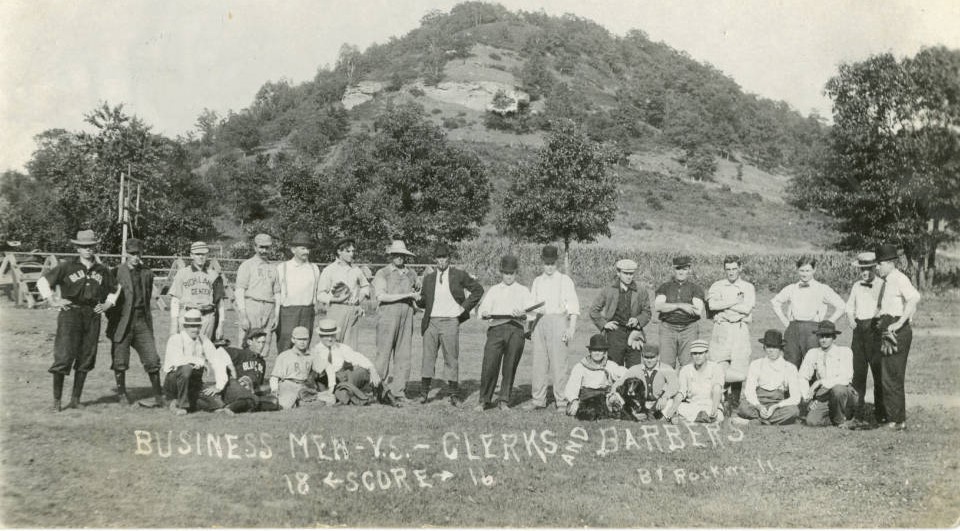
Some may lament this development in baseball, believing that it is still a sport instead of a purely commercial proposition. It still is a sport in some places, (sandlots mainly) but not in very many, and surely the re- cent scandals in baseball should awaken everyone to realize that this “sport” is no different than selling potatoes, cabbages, railroads, or seats in the Senate.
It would be well for the youth especially to learn these lessons and to recognize that professional sports an purely capitalistic enterprises are that the entertainment of the youth is of really no concern to them, not to speak of their physical and mental development.

Professional and Employers’ Sports Against Workers’ Sports.
The outcome of this conflict between big business and little business is quite clear: the little fellows will be squeezed, cry and resist as they will. As Miller Huggins, Yankee manager, puts it: “Whether or not it will be a good thing for baseball, I won’t attempt to say, but it’s surely coming–unless, of course, legislation should be passed by baseball itself to prevent the practice.”
The Trend of Development.
Cheap materials, control of raw material, ownership of the products from top to bottom, that is the development of baseball today in America. Other sports will show similar developments. Professional baseball is hokum and clever exploitation, both of the players themselves and of the masses who come to watch. With scandal, gambling, corruption, exploitation in this field of professional baseball, it becomes more necessary than ever in this country to develop a workers’ sports movement. Here and there, in the soccer field, for example, we have already such workers’ organization, but the mass of young people in this country are interested in the two major sports of baseball and football.
Sport and Company Unions.
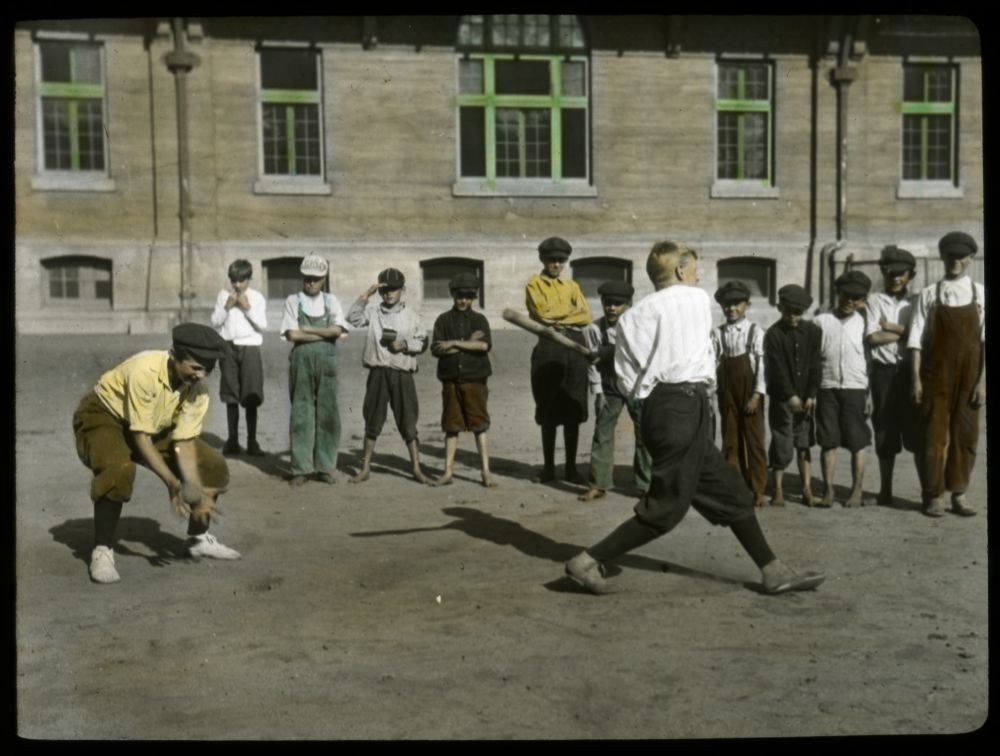
Owners of large factories, such as the Western Electric and many other big corporations realize this, and take advantage of this natural interest to develop a greater loyalty, interest and speed of work on the part of their employees. They toss out a few pennies of their profits for a gymnasium, baseball or football field, and then tell the boys to go to it.
Workers’ Sports.
Trustification, monopoly, company union baseball, all these parallel the development of capitalism in the fields of industry and finance. As we endeavor to meet and resist capitalist oppression on the economic and political field through our trade unions, cooperatives and political parties of labor, the working youth must consider the formation of workers’ sport organizations, for their physical and mental development, on a class basis.
The Daily Worker began in 1924 and was published in New York City by the Communist Party US and its predecessor organizations. Among the most long-lasting and important left publications in US history, it had a circulation of 35,000 at its peak. The Daily Worker came from The Ohio Socialist, published by the Left Wing-dominated Socialist Party of Ohio in Cleveland from 1917 to November 1919, when it became became The Toiler, paper of the Communist Labor Party. In December 1921 the above-ground Workers Party of America merged the Toiler with the paper Workers Council to found The Worker, which became The Daily Worker beginning January 13, 1924. National and City (New York and environs) editions exist
PDF of full issue: https://www.marxists.org/history/usa/pubs/dailyworker/1927/1927-ny/v04-n292-NY-dec-21-1927-DW-LOC.pdf
 Revolution's Newsstand