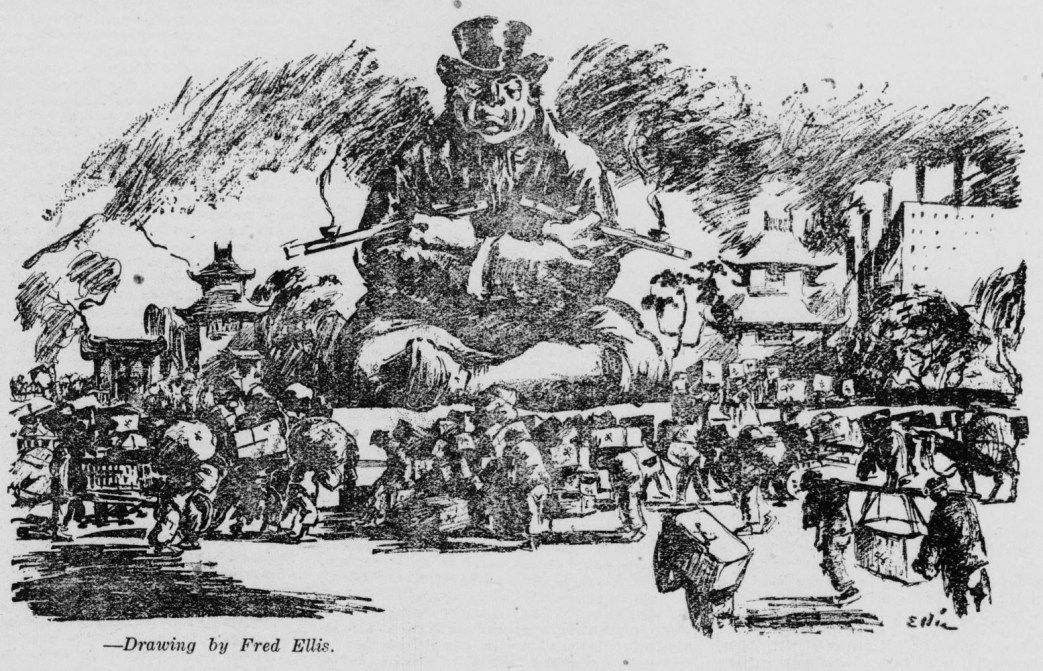
Karl Radek analyzes the mid-1920s imperialist rivalry between Britain, the U.S., and Japan for dominance in China while faced with a a new opposition in Guangzhou’s alliance between the Kuomintang and the Chinese Communist Party, the ‘First United Front.’
‘The World Imperialists and the Chinese Revolution’ by Karl Radek from The Daily Worker Saturday Supplement. Vol. 2 No. September 5, 1925.
The first wave of the Chinese revolution has shaken the ranks of world imperialism. It has revealed the existence of profound antagonistic interests among the imperialist powers. Of these we will only mention the most important. British and Japanese imperialism are defending the positions they have captured and the rights they have acquired. American imperialism, on the other hand, which before the world war had relatively insignificant interests in China, is now following an uninterrupted upward line of development. It is now beginning to penetrate economically into China and can therefore, far more than the English and Japanese, rely upon the growing force of its economic powers. The simple fact that Japanese goods cannot compete with American goods in quality and in price, the simple fact that the extent of the capital, which is decreasing with every year, that England can invest abroad, renders her incapable of successfully competing with the United States–these facts show how different is the situation of these two main groups of world imperialism.
As regard the other imperialist powers, as for instance France and Italy, they consider their positions in the Chinese struggle as objects of exchange in their European affairs. The Germans who by the Versailles Treaty have lost their extra-territorial rights, display a certain amount of malicious joy. They make a virtue of necessity and make use of the position forced upon them by the Versailles Treaty to extend the influence.
But even among those powers who have the greatest interest in maintaining the status quo–England and Japan–one cannot speak of unity of aims and unity of tactics. The English press, with the “Times” and the “Daily Telegraph” at the head, is attempting to oust Japan into the forefront as regards the defense of all the robber privileges which imperialism has wrung from China. The “Times” of July 6, published a long article under the title “Japan and China” which attempts to prove that here it is a question of life and death for Japan. In this article the whole Chinese revolution is represented as a Russian threat against Japan. “It is not the hostility of the Bolsheviki to England with which Japan must reckon but the growth of Russian influence in China.”
In what manner does the growth of this influence threaten Japan?

First, it threatens Japan’s military security; second, it threatens Japan’s attempts to transplant her surplus population to China. Experience has shown that Manchuria and Korea are not capable of supporting this surplus population; third, Japan needs Chinese cotton, coal and iron. A third of Japan’s exports go to China. The Chinese market is the most important one for Japan, as access to it is not made difficult thru customs duties. These are the arguments of the “Times,” which, in the opinion of this organ of English imperialism, must compel Japan to become the chief champion of the imperialist interests in China.
The “Daily Telegraph” which sings the same tune, even went so far as to claim that there existed a danger of war between Japan and America, should America support the Chinese demands. The Americans, when they read this article, probably laughed in their sleeves at the idea that honest John Bull is now attempting to compel Japan, whom only three years ago he betrayed in Washington at the first demand of the United States, to fetch the chestnuts out of the fire for England. Of course, at present a Japanese-American war is impossible for the simple reason, that Japan, who has been weakened by the earthquakes and is dependent upon American credits, is incapable of carrying on a war. But even regarded from the standpoint of future development we must ask, Has Japan any interest in being the champion of English interests in China?
We doubt very much whether the more or less farseeing Japanese politicians view the situation in China with the eyes of the “Times.” As regards Japanese security, there exist not the least doubt that the Chinese revolution which has aroused the masses of the Chinese people and which has filled the Chinese troops with a new spirit, is decidedly changing the relations of power in the East. Japan must decide: With China or against China. Should Japan decide to go hand in hand with the European imperialists against China, then of course the endeavors of China would mean a great danger for Japan. But to go hand in hand with the imperialist powers of Europe and America against China means not only to risk the danger of a war with a great and awakening people, to lose popularity thruout all Asia, but to incur the decided danger of being on the losing side. Among the robbers who are preparing to plunder China, Japan would not be the strongest. Not only that, American capital will stake all its cards upon the uniting of China, upon the economic exploitation of the whole of this enormous country, and the Japanese policy of dividing up China could lead in the future to a conflict with America. It is much more probable that Japan, after certain hesitations, will play the role of that power which would enable the Chinese bourgeoisie to organize a powerful state, that Japan will not play the role of the champion of the dividing up of China, but of the policy of co-operation with the Chinese bourgeoisie.
The economic arguments of the “Times” will not hold water. China is still less suited for the settlement of Japanese than Korea and Manchuria, as it is a very thickly populated country. Japanese emigration is tending towards the islands of the Pacific Ocean and not to China. It is true Japan needs China as a market for her manufactures! Should Japan however, take part in the fight against China, she will only render more difficult her situation in this country, owing to the lack of any possibility of a new division of China. Japan would be very severely hit by a Chinese boycott. On the other hand she has everything to gain by cooperation with the Chinese bourgeoisie, as she is best acquainted with the Chinese market and Chinese habits, and can in many respects promote the industrial organization of China.
There is no doubt that the Japanese government has not yet decided upon a sensible policy towards China. It has not yet quite realized that the time of the 21 demands is already past, it is still under the influence of those Japanese cliques which are immediately interested in the plundering of China. The further development will enlighten the Japanese bourgeoisie as to the growing strength of the Chinese revolution and will compel it to abandon its present policy. The Japanese franchise reform, which is bringing wide circles of the commercial bourgeoisie into contact with state power, will also contribute to this end. At present Japanese policy is vacillating, but the English will hardly succeed in completely harnessing Japan to their chariot.

With regard to the policies of America, it would of course, be a great mistake to believe that the Americans would simply renounce the special foreign courts which secure a privileged position to the foreign capitalists. The majority of American capitalists think just as the English capitalists and are of the opinion that the holy work of the capitalists cannot be under the jurisdiction of a court of “Chinese barbarians.” The Americans however, are less keen upon the outward form of foreign prestige in China and are ready to grant a number of concessions regarding small and minor questions which do not affect the American money bags, but which, to some extent, pacify Chinese public opinion. The Americans are making a great fuss over the fact that they are studying the question of extra-territorial rights, in order to show the Chinese the prospects of a way out of the present situation: “Introduce proper laws and then we will gladly meet your demands for the abolition of capitalist privileges in China.”
As a matter of fact, however, the Americans are endeavoring to get two trumps into their hands; the first trump will consist in allowing the Chinese customs duties to be raised. This question is exceedingly import- ant for the Chinese bourgeoisie and for the Chinese government. For the Chinese bourgeoisie, because the present low and uniform tariff has permitted the foreign bourgeoisie to overflood China with its goods. The raising of the customs duties, however, will render it possible for the Chinese bourgeoisie to build up its own industry. This, however, is not dangerous for America. By means of free competition America will be able to beat the capitalists of other countries. And as regards the growth of Chinese industry, the American bourgeoisie, which has sufficient capital for export at its disposal, is beginning to set up, at a rapid rate, industrial undertakings under the protection of the new Chinese customs duties.
The second American trump is the granting of loans to China. The present American ambassador in Pekin, MacMurray, former chief of the Far Eastern department in the American foreign ministry, shortly before his appointment, published in the April number of the American periodical “Foreign Affairs” an article on the problems of foreign capital in China. In this article he develops the idea of the creation of an international bankers’ consortium which would provide China with the necessary funds for the purpose of constructing railways and for other economic undertakings. Such a consortium, declares MacMurray, would free China from the danger of separate actions on the part of the various capitalist groups, who combine the efforts to build railways in China with the effort to divide up China. As at present, however, there is no power apart from the United States which is capable of granting big loans to China, the international consortium would only constitute an indication of the growth of American propriety in China.
“As regards the abolition of the privileges of the foreigners, the opposition of the foreigners against this demand is based on the fact that the Pekin government is weak and that the anarchy which prevails in China renders the immediate abolition of these privileges impossible. It must not be assumed that they will be soon abolished. But the simple fact such a reform opens up to China the of the discussion of the possibility of prospect of attaining a speedy independence from foreign control.”
Thus wrote the “Journal of Commerce” an influential New York financial paper, on the 3rd of July.

American diplomacy is fighting for this program in the negotiations which it is conducting with English and Japanese diplomacy. For the time being all are agreed that the central problem for them consists in the setting up of a Chinese government which will be capable of fighting the growing national movement.
In the article from the “Times” of the 6th of July, which we have already quoted, the way is indicated which the great powers will in all probability follow. This article states that Japan does not think of the possibility of setting up a strong Chinese government by means of a national conference.
“Who is to take part in this conference? The military governors who have brot China into its present situation. Many of them are not even endeavoring to consolidate their own power. They only collect funds with which they then settle in the treaty ports. The Pekin politicians on the other hand only represent themselves and their wishes. They would very willingly sell themselves as well as China. The students understand neither the outer world nor China with her 400 million peasants. The officials, bankers, business people would give expression to patriotic views, but which they cannot realize.”
Where then is the point of support to be found? Now such a point of support exists:
“Chang Tso Lin possesses certain qualities which win him respect. He governs Manchuria well, he is at present the strongest military governor of China. Should he succeed in arriving at an agreement with Wu Pei Fu, then he could break the influence of Feng Yu Hsiang and rule over North- ern and Central China. As an open [problem there would then remain the red government in Canton. It is true, one cannot solve all the Chinese problems at once. Should a Chinese government arise, possessing authority in Northern and Central China, this would mean a great step towards the stabalizing of China).”
This program is put forward by the “Times” as the program of Japan. But in reality it is the program of England, and forces are already to be seen which are endeavoring to make it also the program of America.
The plan of the imperialists therefore, consists in opposing the Chinese revolutionary movement with a military government which is to be supported by the upper section of the Chinese bourgeoisie, which has been bought with loans and concessions, and which would be capable of suppressing the revolutionary movement.
The Saturday Supplement, later changed to a Sunday Supplement, of the Daily Worker was a place for longer articles with debate, international focus, literature, and documents presented. The Daily Worker began in 1924 and was published in New York City by the Communist Party US and its predecessor organizations. Among the most long-lasting and important left publications in US history, it had a circulation of 35,000 at its peak. The Daily Worker came from The Ohio Socialist, published by the Left Wing-dominated Socialist Party of Ohio in Cleveland from 1917 to November 1919, when it became became The Toiler, paper of the Communist Labor Party. In December 1921 the above-ground Workers Party of America merged the Toiler with the paper Workers Council to found The Worker, which became The Daily Worker beginning January 13, 1924.
PDF of full issue: https://www.marxists.org/history/usa/pubs/dailyworker/1925/1925-ny/v02b-n203-supplement-sep-05-1925-DW-LOC.pdf
 Revolution's Newsstand