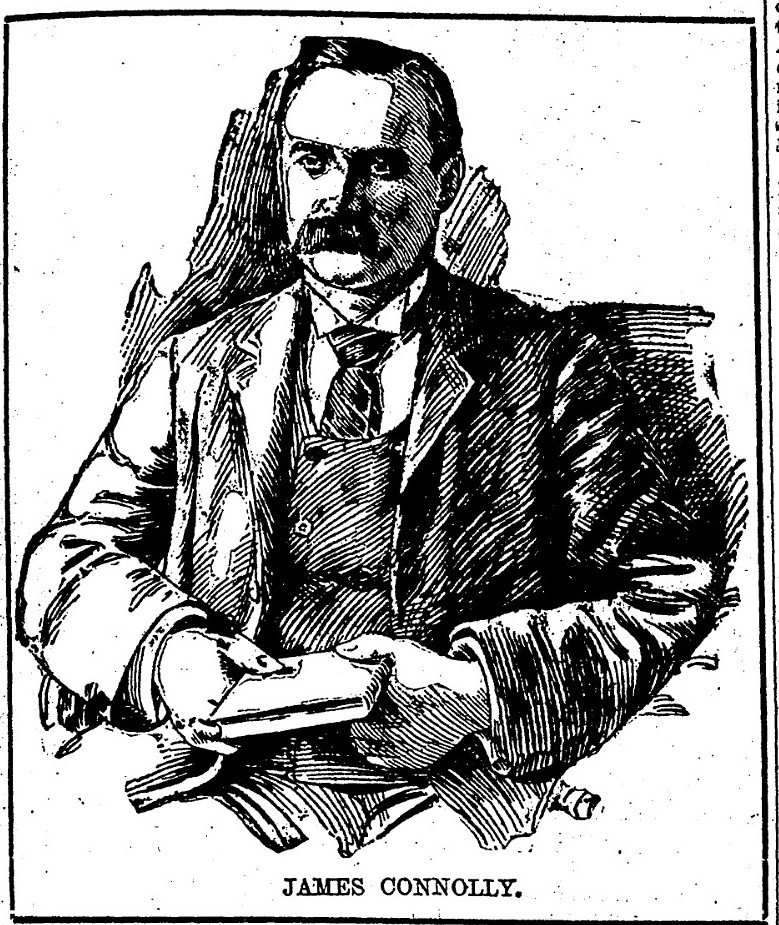
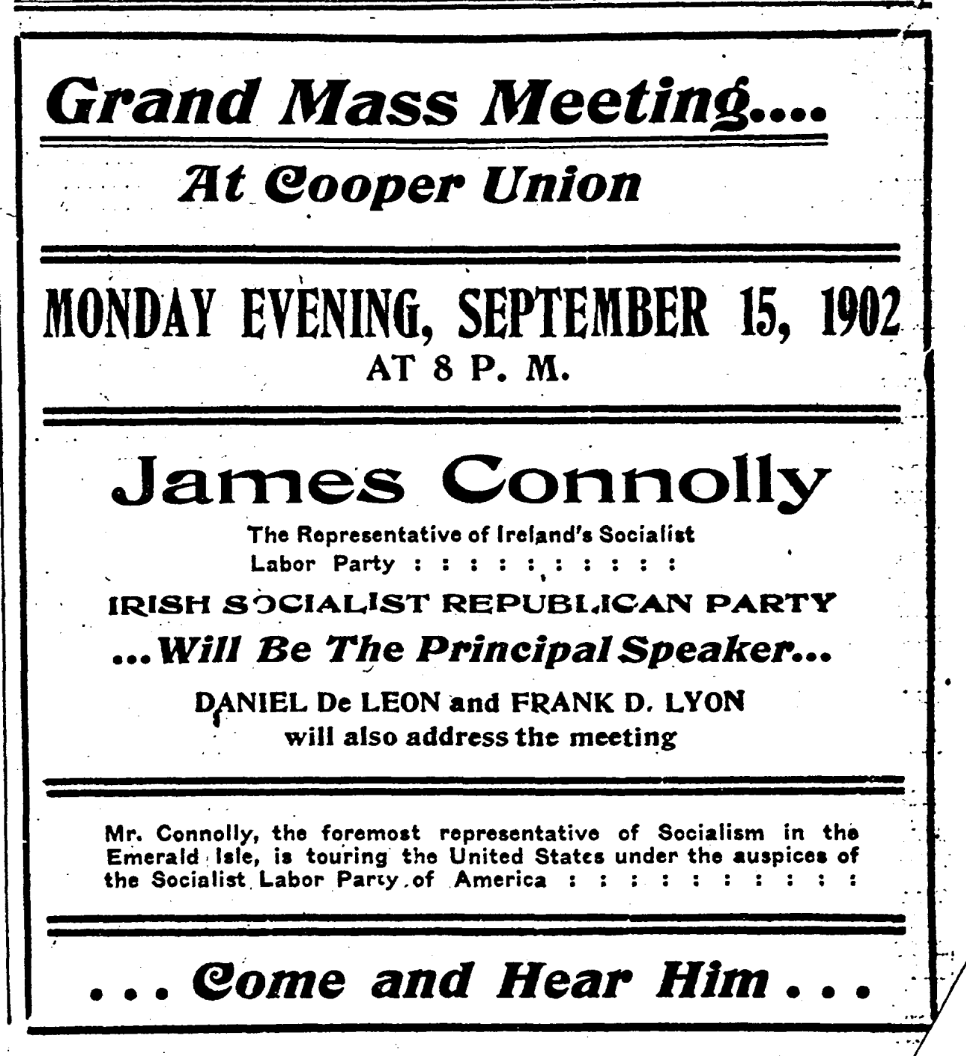
James Connolly is greeted on his arrival to the United States for an extended speaking tour with a poem by M.D. FitzGerald, also included is Connolly’s account of his twelve-day Atlantic journey, and most importantly a biography offered of Connolly’s already eventful life by Mark Deering.
‘Welcome to the Soldier from Ireland—James Connolly Arrives on These Shores’ from The Daily People. Vol. 3 No. 74. September 12, 1902.
“Ceade Mille Failthe,” to this Comrade of ours,
Coming to us from the land of the Gael,
Preaching the Freedom that Socialists cherish,
Despite all the “Powers” that vainly assail.
The true voice of Ireland too long has been stiffed
By rigmarole cant of the vaporing kind;
Bourgeoise politicians and poltroons have trifled
With the gospel of Freedom her martyrs defined.
But now with the banner of Socialism unfurled,
While traitors and cowards shrink back in dismay,
Her voice swells the cry ringing all round the world,
From the millions who toil ‘neath King Capital’s sway.
Here in this land where Freedom once flourished,
Wealth now controls, while the Creators decay;
False leaders of Labor are soothingly nourished
By class legislators who know not the Toilers except to betray.
Now let us, like men by science enlightened,
March on to the goal that is clearly in view;
From the Socialist Republic we cannot be frightened
By Capitalist henchmen, or whate’er they may do.
With our ballot and press we are fighting the battle
That Labor is making for justice to-day.
Soldier of Freedom, as comrades we greet you,
While spreading the light that brightens our way.
[Written for The Daily and Weekly People by M.D. FitzGerald, of Boston, Mass.]
The Irish agitator, James Connolly, is on American soil at last after a twelve day voyage. He arrived yesterday morning at 9 o’clock on board the Allan State line steamer Sardinian. He was met on the dock by Henry Kuhn, the national secretary of the Socialist Labor Party, and escorted to The Daily People Building in New Reade street. There Connolly was given an informal reception by the comrades who happened about the premises, and was made to feel at home. The Irish agitator is of short and sturdy build, with a keen and intelligent face. He is a witty talker, concise in his comments and more inclined to listen than to be heard. He was plainly and well, though not elegantly, dressed, in a suit of Scotch tweed, with a Fedora hat. Yesterday Connolly’s face was all aglow with the sunburn acquired during his ocean voyage. On the whole the Irish agitator made a good impression.
When interviewed yesterday, Connolly said that he was treated well on the voyage; but he was impressed by the bad treatment of the steerage passengers. Four people, he claimed, had to sleep in one small unsanitary compartment, over which were the toilets. The food, Connolly declared. that the steerage passengers were forced to eat, was so bad that a large number of passengers couldn’t eat half of it.
The Irish agitator said he would have liked to come on a quicker ocean liner, but owing to the number of Americans returning from Eddie’s coronation, he couldn’t get a steamer from Queenstown, so he had to travel north to Londonderry, where he took the steamship Sardinian August 31.
Connolly was thoroughly at home on board the ship, many of his own nationality and Scotchmen coming over. A tug-of-war was held for diversion, which ended in the success of Ireland. He was instructed by the Dublin Trades Council to collect statistics of the condition of labor under the trusts, and report to them on his return.
On the trip across the pond the Irish agitator had many arguments on Socialism with his fellow passengers, always beating them to a standstill.
Connolly jokingly remarked at the end of the interview that he was of the opinion that St. Brendan discovered America for Irish agitators to come over. He wouldn’t be a true Irishman not to claim that honor for his countryman, instead of Columbus, Connolly concluded.
He starts on his tour of the country to-day by speaking at New Britain, Connecticut.
James Connolly, whom the Irish Socialist Republican Party has selected to tour the United States under the auspices of the Socialist Labor Party, was born in 1869 near Clones in the County of Monoghan, Ireland.
Particulars concerning his early training and education are scarce, because there was none, for Connolly was “dragged up” like most proletarian boys. Connolly is, nevertheless, well educated. His education is of that kind which comes from conflict with circumstances, and the constant reasoning on, and analyzing of, those circumstances. His whole character has been colored by these experiences, which have been bitter. has a deep hatred of those social institutions that have weighed so heavily on the working class. Connolly was, in early years, a nationalist of the extreme type. He was not long in finding out the insufficiency of the nationalist ideal, and soon turned for salvation to Socialism.
James Connolly has a profound knowledge of ancient and modern history, especially in its applicability to the problems of social development. He is particularly well versed in Irish history, especially in the revolutionary phases of it. Connolly excels, as none other within our experience here, in the following and applying of abstract, economic principles and historic parallels to the ordinary phases of our social life. An indefatigable propagandist and an excellent platform speaker, his speeches are mainly marked by close, logical reasoning, though there is also a plentiful play of the imaginative faculty. Connolly has a sledgehammer repartee.
In person Connolly is about medium height, with the expressive grey eyes and black hair and eyebrows, which are said to be typical of the Celt. He conceals a highly sensitive and highstrung nervous system under an exterior of almost unvarying imperturbability.
James Connolly founded the Irish Socialist Republican Party in Dublin in 1896. He had had some previous experience as a Socialist lecturer in Scotland and England, and is well known in both countries.

On the occasion of the Diamond Jubilee of Queen Victoria, Connolly wrote, and the I.S.R.P. issued, a manifesto setting forth the attitude of the revolutionary working class of Ireland toward the celebration of that event, and calling upon the workers to demonstrate their hostility to it. This manifesto was distributed in thousands all over Ireland and was the first public declaration made in Ireland antagonistic to this official parade of loyalty. As the official Home Rule party had advised the people of Ireland to take up an attitude of “benevolent neutrality,” and the Parnellite newspaper, “The Daily Independent,” refused the loan of their offices in O’Connell street for the purposes of an anti-jubilee magic lantern show, the task for organizing the popular hostility was taken up by the I.S.R.P. A public meeting was accordingly called and held in College Green the evening preceding the official day of celebration. The meeting was attended by thousands of stalwart workers, Connolly acting as chairman, Miss Maud Gonne being among the speakers. The rowdy students of Trinity College attempted to capture a black flag which was carried by the I.S.R.P., but were handsomely drubbed in spite of the protection of the police. On the following evening Connolly headed a procession organized by the I.S.R.P., which paraded the city of Dublin carrying a coffin labelled “The British Empire,” and accompanied by six black flags, setting forth the number of famine deaths, evictions and emigrations during Queen Victoria’s reign. More than 30,000 people accompanied this procession through Dublin; it held possession of the main streets in a thoroughly orderly fashion for over three hours, but was eventually broken up by a series of baton charges by the police, one woman being treated for wounds as a result of the police brutality.
In revenge for this wanton attack the enraged people smashed the glass in the windows of every shop which had put out loyalist flags or decorations.
The official estimate of the damage stated the loss at $5,000.
As the authorities had arrested a number of persons who had no official part in the demonstration, Connolly presented himself at the police station in the course of the week and claimed as his property the band instruments which the police had seized at the head of the procession, thus inviting the castle authorities to prosecute him if they desired; out, as it was the wish of the British government to represent Ireland as joining in the jubilee rejoicings, and as a prosecution of this kind would have frustrated this design he was not molested and the instruments were returned to him as their owner.
On the formation of the Centenary Committee to arrange for the celebration of the Irish insurrection of 1798, Connolly was appointed one of the delegates of the I.S.R.P. to that committee until the Socialist Republicans withdrew, owing to the refusal of the committee to pass a resolution limiting membership to those who agreed with the republican principles of those whose memory they were honoring. He also produced and published a series of ’98 Readings, in which were reprinted for the first time the most important writings, manifestoes, etc., of the United Irishmen.
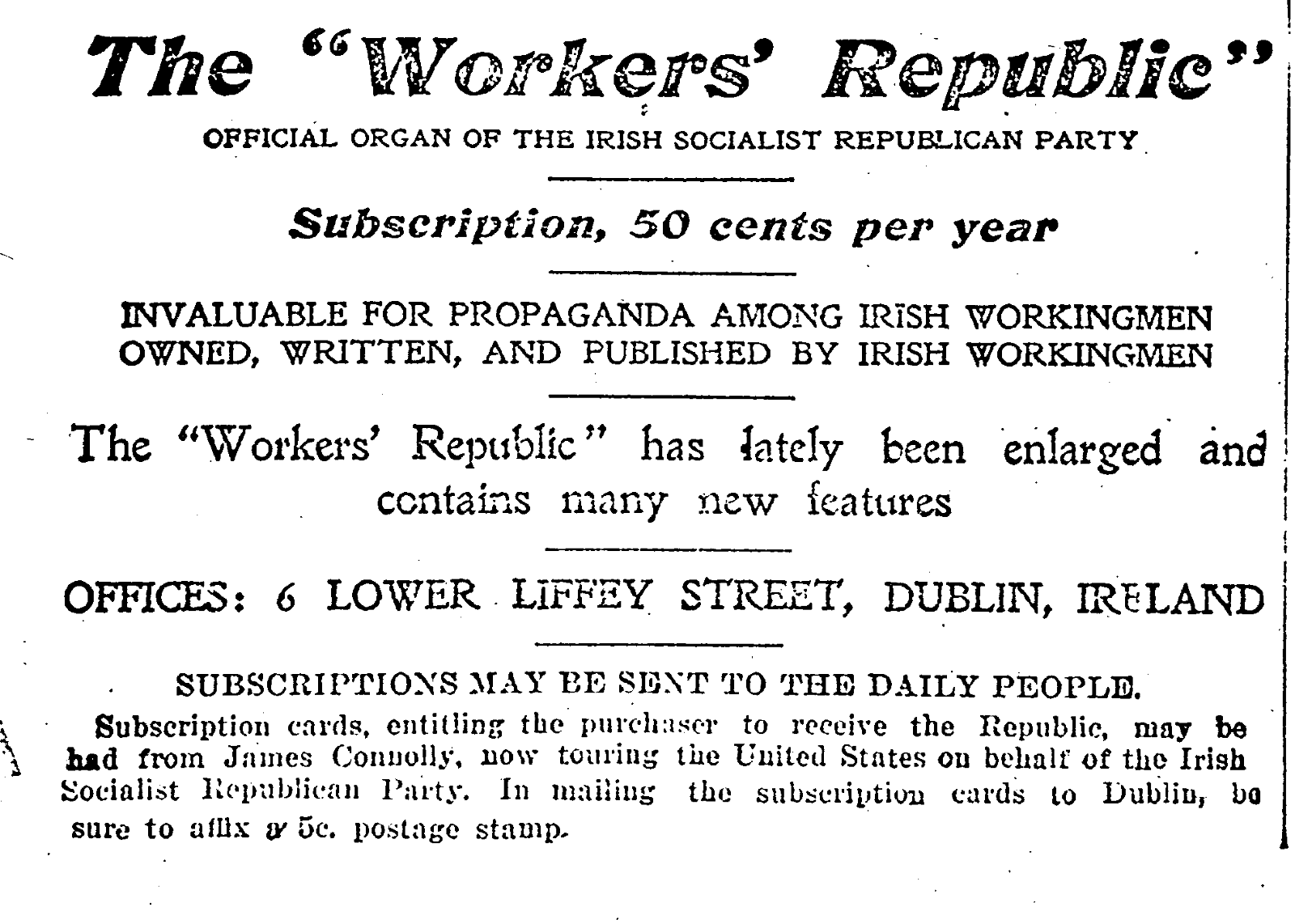
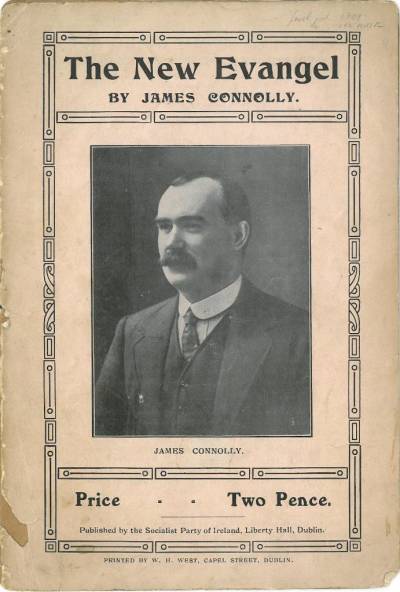
On the foundation of the Workers’ Republic in 1898 as the official organ of the I.S.R.P., Connolly was appointed editor, a position which he has held ever since. He also wrote under the nome-de-plume of “Spalpin” and has produced under the auspices of this party- various pamphlets, pamphlets, “Erin’s Hope,” “Home Thrusts,” “New Evangel,” “Socialism and Nationalism.”
The Irish Socialist Republican Party held the first public meeting in Ireland to protest against the Transvaal war, Connolly being one of the principal speakers. Again on the occasion when the colonial secretary visited Ireland and a public meeting of protest against the war called by the Transvaal committee was prohibited by the government, Connolly was appointed chairman of the meeting which the Transvaal committee attempted to hold in defiance of the authorities and for his action in accepting the post was arrested and fined.
On this occasion Mr. Willie Redmond, M.P., after advising the people to hold their meeting and defy the police prudently stayed within doors himself, leaving to a woman, Miss Gonne, the Republican Nationalist, and the Socialists, the task of facing the police.
Connolly was also chosen secretary of the committee which was formed by the anti-Loyalist bodies of Dublin on the occasion of Queen Victoria visit in April, 1900.
Connolly has acted as secretary to all the election committees of the Dublin Socialists since the passing of the local government (Ireland), act of 1899, first enfranchised the Irish workers in the municipalities.
He was the Socialist Labor candidate for Wood Luoy Ward at last elections and polled 431 votes, in spite of the fact that the electors were told by the priests that they could not as Catholics vote for a Socialist; that the Roman Catholic clergy worked against him; that the home rule politicians threw all their power in the scale against him, and the saloon, keepers debauched the constituency with bribes and drinks to keep him out and that the Tory and Home Rule vote was exerted in favor of his opponent.
Connolly is an unskilled laborer, and has been successfully a carter, a navy builder’s laborer, shipyard laborer, proof reader on a newspaper, and followed various other minor occupations.
Mark Deering. Dublin, Ireland, July 8.
New York Labor News Company was the publishing house of the Socialist Labor Party and their paper The People. The People was the official paper of the Socialist Labor Party of America (SLP), established in New York City in 1891 as a weekly. The New York SLP, and The People, were dominated Daniel De Leon and his supporters, the dominant ideological leader of the SLP from the 1890s until the time of his death. The People became a daily in 1900. It’s first editor was the French socialist Lucien Sanial who was quickly replaced by De Leon who held the position until his death in 1914. Morris Hillquit and Henry Slobodin, future leaders of the Socialist Party of America were writers before their split from the SLP in 1899. For a while there were two SLPs and two Peoples, requiring a legal case to determine ownership. Eventual the anti-De Leonist produced what would become the New York Call and became the Social Democratic, later Socialist, Party. The De Leonist The People continued publishing until 2008.
 Revolution's Newsstand