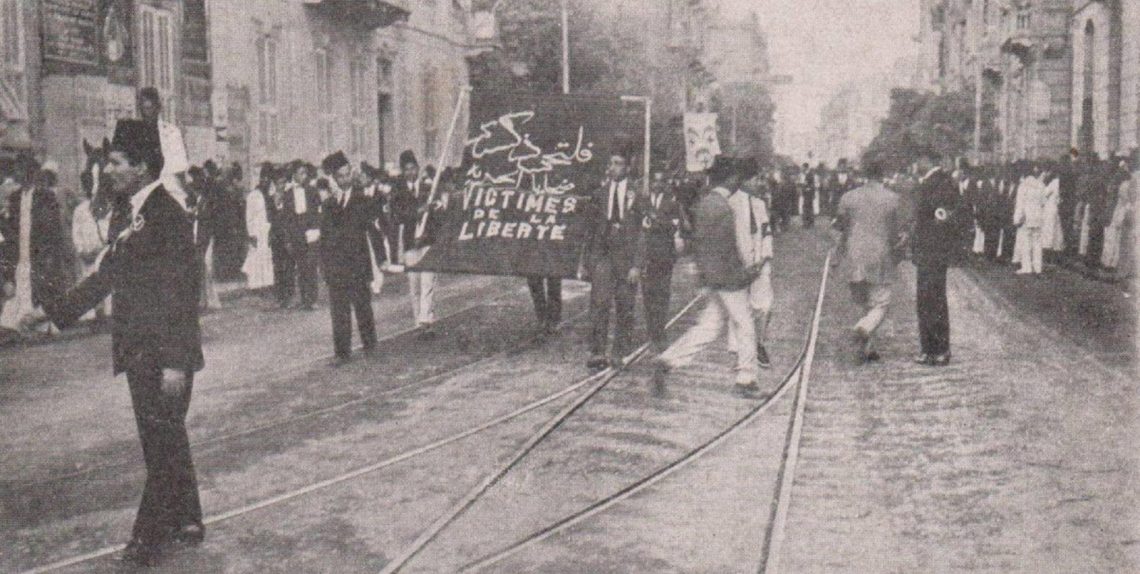
The newly formed Egyptian Communist Party, among the first in the Arab world, would be decimated by repression, including the death Anton Maroun in prison, the year following this report, virtually ceasing to exist as an organization for a number of years.
‘The Congress of the Egyptian Communist Party’ from International Press Correspondence. Vol. 3 No. 27. March 20, 1923.
The ex-socialist party, which had already applied for admittance to the Communist International, unanimously accepted the 21 conditions at its recently held congress, and definitely joined the CI. By this step, the Egyptian proletariat has constituted its revolutionary class party and the Egyptian people is confronted with some of the most important tasks of its history, for it has not only to fight for its national independence, but at the same time for its emancipation from the yoke of European and native imperialism. The Egyptian government took advantage of the martial law proclaimed in our country, and hand in hand with the English military authorities declared our party to be outlawed; it attempted to prevent the constitution of our party as a Communist Party, and now prevents our legal existence and the publication of our own legal newspaper.
All in vain! The government had even prohibited the congress. But the Egyptian comrades held it despite the prohibitions of the government and the threats of the Anglo-Egyptian police.
The congress was held secretly out in the country, in Upper Egypt, in the open air, beneath the free sun and sky, while the “Fellahs” were toiling all around in the fields. The congress thus received so to speak, a symbolic consecration. In the brightest sunshine the group of men who had gathered together inaugurated the party, the party whose task it is to restore freedom to the millions of Egyptian peasants oppressed by feudal serfdom.
Representatives of various sections were present. Several Europeans, Greeks, Italians, and Russians, mingled with the natives.
After comrades N.’s opening speech, the party secretary read and explained the 21 points. Comrades Ariel, representatives of the Communist International, then rose to speak. The representative of the Comintern, Comrade Ariel greeted the congress on behalf of the Comintern, and in the name of the Italian CP.
He then proceeded to point out that by the acceptance of the 21 conditions, and by the alteration of the name, the congress definitely made the Egyptian party into a section of the Communist International.
He showed the importance of the Egyptian CP in the International. The International will grant its utmost moral and material support to the Egyptian CP. In order to be able to enter the International, the party has freed itself from all the opportunist and petty-bourgeois elements in its ranks. The Party has now to gather together all the revolutionists scattered over the Nile valley, to organize them, and transform them into good and disciplined communists.
The Party is young. As yet it is unknown to the masses. It is therefore necessary that the Party claim a share in Egyptian
political life and that it makes its power and initiative felt in directing the course of events. The Party must draw the attention of the “Fellahs”, and of the hand and brain workers, to its activity.
How will the Egyptian CP realize the slogan: “Go to the masses”.
1. by trade union activity;
2. by a suitable agrarian program, taking into account the requirements of the peasants, so that the millions of “fellahs”, who form the main labor and revolutionary force of Egypt, may be gathered beneath the flag of the Egyptian CP;
3. by extensive propaganda, among the masses, for a program demanding absolute national independence from English domination. The Egyptian CP. will issue the slogan of the revolutionary united front against English imperialism, and this slogan will enable the Party to gather together every national force among the people of Egypt.
Comrade Ariel then explained in detail the three points forming the fundamental basis for the activity of the Egyptian CP: the trade union movement, the agrarian question, and the question of national independence.
With regard to the last of the three points, comrade Ariel examined the phases of the Egyptian national movement, and demonstrated the “waft” to be a fundamentally capitalist and conservative party, founded by the upper strata of the Egyptian bourgeoisie. Despite all appearance, Zaguils party will not be able to give Egypt real political independence, for the reason that the common interests between Egyptian and English capitalism, and the dependence of Egyptian capitalism on English high finance, fetter any actual realization of independence. Saad’s party, which was forced further to the Extreme Left by the pressure of the revolutionary population of Egypt, is now seeking the possibility of a permanent understanding between Egypt and England. This party has always been anxious for such an understanding, and its leading men have themselves declared that they recognize England’s predominant interests in Egypt.
The Egyptian CP, however, is sincerely and earnestly opposed to any compromise with English imperialism against which it is fighting. And it will not fail to reveal the truth about any deceptive plan of independence which the “Waft” attempts to force upon the people of Egypt.
Comrade Ariel showed with the utmost clearness that Egypt can only be freed by a revolution, a revolution at one and the same time political, economic, and social. National independence and emancipation of the proletariat are closely bound up with one another.
Comrade Ariel then gave a general survey of the European and world situations, and pointed out the tasks awaiting the peoples of the East in their struggle against capitalism.
In conclusion, he expressed his full confidence that the young CP of Egypt, and every individual comrade, will always be found in the front ranks of the fighting Egyptian proletariat, beneath the flag of the Communist International.
After comrade Ariel’s speech, the congress enthusiastically accepted the 21 conditions without any opposition whatever, and resolved on altering the name of the old party.
The Party program.
Comrade O. gave the report on the Party program, and submitted this to the central committee of the congress.
The task of the Party is the emancipation of Egypt and the Soudan, and the union of these two countries, so that the wo united peoples may secure for themselves the natural wealth of their country, and fight in union against their native and foreign oppressors and exploiters.
With regard to the Suez Canal, the Egyptian CP will demand its nationalization, not because the realization of this demand would be of any immediate advantage to the working class, but because it could strike a death blow at the whole of England’s imperialist plans.
One of the main activities of the Party consists of communist penetration into the trade unions.
Cancellation of public debts, abolition of capitulations, introduction of compulsory education, sex equality, separation of church and state these are the other main points of the Party program.
For freeing the agricultural proletariat, the Egyptian CP will not only endeavor to have the communist theories realized, but will stand for the following immediate demands:
1. Annulment of the debts of the poor Fellahs;
2. Abolition of taxation of the small-holding Fellahs;
3. Expropriation of large landowners, and distribution of the land among the Fellahs; formation of communist agricultural cooperative societies;
4. Formation of banks upon a cooperative basis, for supporting the poor Fellahs.
The resolution.
The congress unanimously accepted the following:
The 4. congress of the Communist Party of Egypt resolves:
1. after having accepted the 21. conditions of the 3. International, to adopt the name of the “Communist Party of Egypt, section of the Communist International”, in place of the old name of “Socialist Party”.
2. to express the solidarity of the Egyptian CP. with Soviet Russia in its struggle against world capitalism;
3. and to inform the brother parties of all countries regarding the resolutions.
After this resolution had been passed, the congress closed with the singing of the “International”.
PDF of full issue: https://www.marxists.org/history/international/comintern/inprecor/1923/v03n27-mar-20-1923-Inprecor-loc.pdf
 Revolution's Newsstand