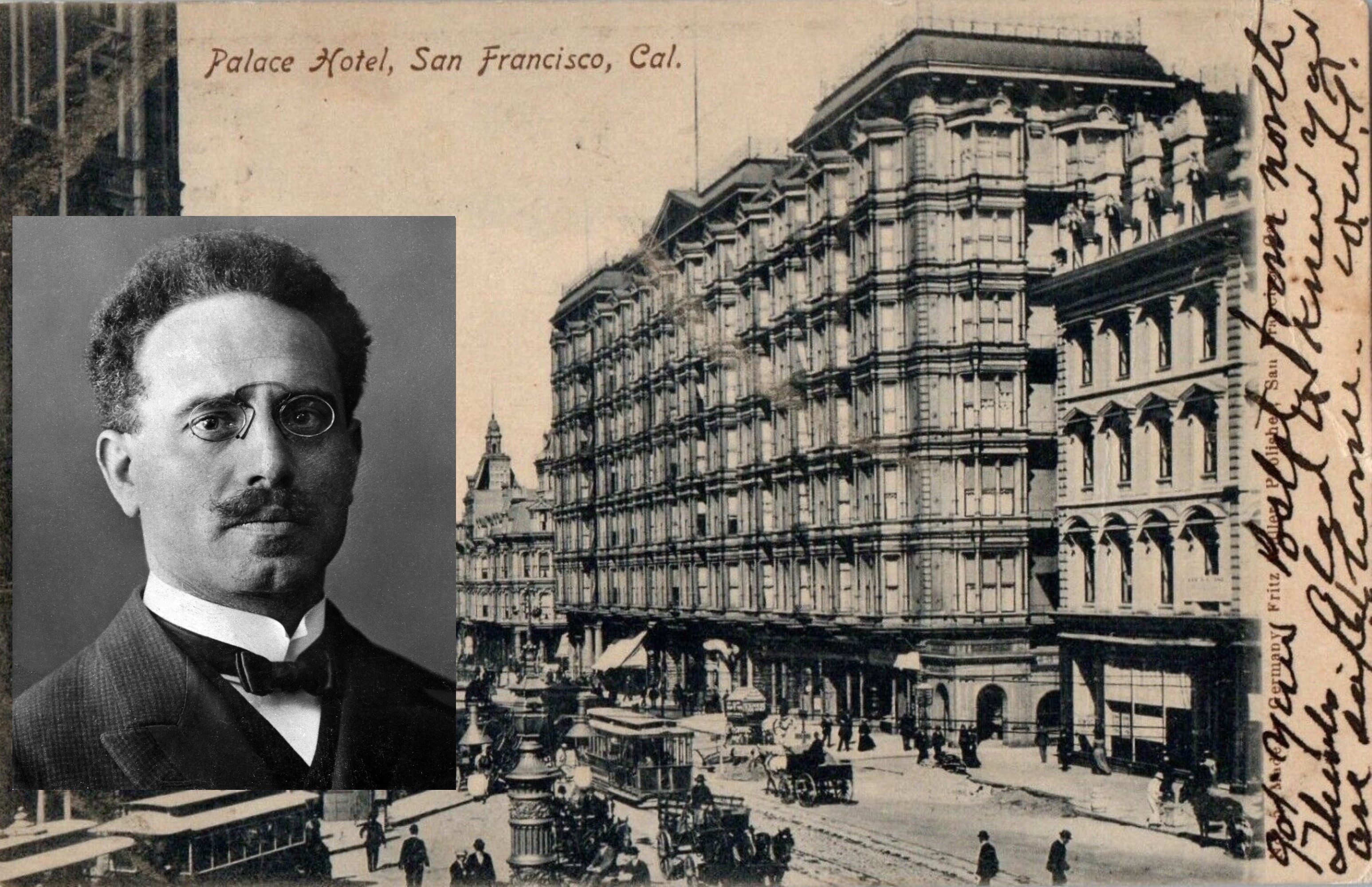
An S.L.P. comrade meets Karl Liebknecht at San Francisco’s Palace Hotel for an interview about the conditions he found in the United States on his two-month speaking tour.
‘Interview with Karl Liebknecht in San Francisco’ by R.S. from the Weekly People. Vol. 20 No. 37. December 10, 1910.
GERMAN SOCIALIST’S CLEAR UTTERANCES ON MANY MATTERS.
Questioned on Young Socialists’ Movement, Syndicalism, General Strike, Japanese Immigration, A.F. of L., Ownership of Party Press, Etc., He Reveals Revolutionary Attitude.
San Francisco, November 22. I waited for the hour of my appointment with Dr. Karl Liebknecht in the lobby of the Palace Hotel. Flunkies in blue and gold flitted about the marble halls on noiseless feet; women, “faultlessly” gowned in the ultra-fashionable hobble moved by with the inevitable jerky glide; men who looked as though they had been cut of character clothes advertisements strolled in and out of the long corridors or were. lost amid the green palms and red plush of the world famous Palace Court. And I wondered by what irony of chance, Dr. Karl Liebknecht, propagandist of the proletaire, the mouth of Marxism, had found quarters in the Palace. I thought, “He is a Socialist for revenue only, or a hot-house culture, a dilletante, or a pure and simple parliamentarian, or one of those whose heart throbs sympathetically for the poor.'”
But in meeting Dr. Karl Liebknecht, I met a simple straightforward man, with an unaffected cordiality, one who has nothing to hide, one who talks as he thinks. The reception committee from the Socialist party had placed him in the Palace and there he was. His hair, short and curly, is brushed up in a German pompadour, and here and there streaks of gray beginning to show in it. His high forehead slopes back slightly, and underneath a pair of calm gray eyes gaze steady and clear through a pince-nez. Most people look conceited in a pince-nez, because there are those who wear them! for ornament. It looks so distinguished, you know. But Dr. Liebknecht wears them for service and they look very natural on his German nose. His moustache, thick-haired and short-clipped, is turned up in the Prussian fashion at the end.
All these details of appearance I noted while the formalities of an introduction were being gone through. When he began to talk, they disappeared and he became merely a voice. Like all clear thinkers, he is a clear talker. His words march from his lips like companies of well-drilled soldiers. Each word is clean-chiseled, individual, enunciated. He has the trick of giving his every word, even the smallest, its fullest meaning. As he talked, he paced up and down, up and down, with an easy athletic stride, a stride born of the training gained from the German Turner societies. The Doctor said:
“The Young Socialist movement has been organized in Germany for about five years. At first all manner of opposition was encountered both within the Party and without. But once the movement was shaped and got under way, its beneficial influence was immediately apparent. The ruling class and the church have long ago recognized the importance of shaping the mind of the growing child. The Social Democratic party gained great strength from the Young, Socialists. The most enthusiastic workers were to be found in its ranks. And there is no enthusiasm and faith like that of youth.” Comrade Liebknecht paused a moment to smile. “The Young Socialists give lectures, conduct Socialist and science classes, they publish a weekly paper, ‘Arbeitende Jugend.’ which has a circulation close to twenty thousand.
“But these are not their only activities. The children of the proletariat, cooped up in the cities, with the hard and ugly streets for playgrounds, the youth of the land lashed to the wheel of Industrialism, lose all sense of the beautiful, and they themselves become ugly and deteriorate physically. So the Young Socialists organize countless excursions into the open country, to the free streams, the virgin mountains and the strength-giving mountains. In the cities they have equipped gymnasiums. The Young Socialists grew and grew. Quite a few of the comrades who had reached maturity, joined our ranks. And this was well, it gave the organization balance. The Young Socialists have spread all over Europe, and in some places they have become very powerful and influential. Thus in Sweden they have to a certain extent shaped the policy of the party.”
Liebknecht stopped at the window and paused a moment to gaze out over the blue bay that was embraced by brown hills and tented by a turquoise sky.
“Suddenly the police fell upon us. Ou organization was dissolved. We appealed the matter in court but the police were sustained. Further, all under 18 years of age were forbidden to attend political meetings.” Liebknecht paused to smile a smile that had all the faith and buoyancy of youth. “Was the Young Socialist movement crushed out under the iron heel of repression? Not any more than was the Social Democracy under the exception laws of Bismarck. It is true that our organization has become looser, but in adversity we have actually gained strength. Do I think that there is room for a Young Socialist movement in America? I think that it is an essential aid to the Socialist movement anywhere. When Socialism gets a new recruit, his head is filled with all kinds of nonsense which has been drilled into him by bourgeois schools and institutions. It takes years to eradicate this and sometimes something still sticks.”
Here he was interrupted by a knock at the door, and a woman gushed into the room, all smiles and volubility. She introduced herself as Mrs. B.; her husband was of the firm of B. Brothers. (She mentioned one of the biggest firms of its line in the city.) Yes, she too was a Socialist. Her nephew was one of the editors of the “-” (She mentioned one of the foremost Socialist papers of Europe.) She had read a good deal of Dr. Liebknecht in that paper. What did he think of San Francisco? Quick to rise from its ashes, eh? The enterprise of the San Francisco people was marvelous, wasn’t it? Our capitalists are far more energetic than those of Europe. And the workers were far better off, didn’t he think so? The Doctor said that the conditions of the working-class are not much different here from those abroad. Capitalism was international and the greatest leveler ever known. It reduced everything to a uniformity. It was true, America was a young country, rich in natural resources and, here and there, primitive conditions still prevailed. It was because of its matchless resources that America developed with such unheard-of rapidity. As for the brains, enterprise, pluck of the capitalist, they would be found, upon analysis, to consist of unscrupulousness, consciencelessness, craft and cunning. To call this intellect would be an insult to the human race. The lady had said everything was better, Better for whom? For the capitalists. perhaps. The American proletariat yielded more richly than those of any other country. However, in some directions the rope that bound them was longer. They had the framework of a popular government, for one thing. But in other directions they were far worse off. The frightful and wanton slaughter in the American mills, mines and railroads was without parallel anywhere. Such things as the Colorado outrages and, more recently, the Times investigation outrages were impossible in Europe. “When we in Germany think of California, everything shimmers; we see purple hills and golden sunsets and the glitter of green trees and flowers. How different is the reality! I saw Pacific street, the Barbary Coast, with its street fights. I saw an open and unmolested flaunting of vice and a white slave traffic that would put even the unspeakable Turk to shame. I saw police brutality that would make a Berlin policeman grow green with envy.”
The lady took her departure, still smiling and chattering. She had not understood.
I took up my interview again.
“Which do you consider the more important to the Socialist Movement, the economic or the political wing?”
“Why even an angel couldn’t fly with one wing,” laughed Liebknecht. “But seriously”, he continued, “I consider every form of Socialist organization valuable; political parties, economic organizations, Young Socialist and every other possible form of organization that conditions may dictate. The two main forms age of course the political party and the union.”
“Has Syndicalism found a friendly soil in Germany?”
“If you mean by Syndicalism, pure and simple economic action, I must say no. Pure and simple economic action in the light of history and Socialist science is idiotic. How dangerous this one-sided view is could be seen in the fact the Syndicalist movement was becoming more and more Anarchistic.”
“What do you think of the General Strike?”
“It all depends upon the use it is put to. I have long advocated the General Strike as an auxiliary weapon, in 1904, at the Bremen Party Day I was the first one to advocate the General Strike for political purposes. It was there too that I first advocated anti- militarism and the necessity of Young Socialist movement. On all three propositions I was fought by everyone from Bebel to Katzenstein. All three propositions have become live issues since. To come back to the General Strike. It is absurd to advocate it as the sole means of accomplishing the emancipation of the workers. It is a weapon and powerful, but a single weapon is not an arsenal nor are bayonets effective at a thousand yards.”
“What do you think of the Japanese Immigration Problem?”
“Organize the Japanese if that is possible.”
Here I informed the comrade that the Chinese butchers of San Francisco had applied for a charter from the A. F. of L. and that Japanese had several times tried to get a charter. But all in vain. They had been refused. I told him that the Japanese were getting longer wages and shorter hours than the so-called “white men” in the fruit and hop fields and that these despised yellow men were absolutely merciless to the boss when they had manouvered him into a tight position. Then I informed him of the Socialist Party’s anti-Jap stand.
Comrade Liebknecht said, “Das ist ja eine kolossale Dummheit!” (That is a piece of monstrous stupidity.) He was pretty well acquainted with the high dues and initiation fees of the A.F. of L; he knew of their craft scabbing: of their narrow self seeking: of their corruption. He said that to his mind, it seemed a better policy to come out and fight them openly.
“Does the Social Democratic Party own its press and do you consider it necessary for the movement to own its press?”
“Yes the Social Democratic Party owns its press, for that is the only way it can be controlled. To leave it in private hands is, to say the least, dangerous. As the American movement develops it will recognize the necessity of party ownership of the press. I do not think that the time is far distant when the party will realize this.”
“What do you think of the Socialist Movement across the country?” “There are splendid possibilities.” “Do you think there is room for both Revisionists and Marxists within the German Social Democracy?”
“Certainly there is room for both within the German Social Democracy. The Revisionists do not differ from us to such a marked extent as is generally supposed. They too are Socialists and their differences from us are largely tactical ones. Should the Baden comrades repeat their error that would. indeed be a serious matter and the Party would have to adopt harsh measures.”
Upon being questioned as to the anti-Militarist movement, the comrade said that it was now a part and parcel of the Party itself. “The Party has been largely won over to our views”.
He then went on to say that the book for the writing of which he was sentenced to two years in jail had been suppressed by the police, but that it was drifting in like all forbidden works, from Switzerland.
“Comrade Liebknecht, we say to the proletariat, workingmen of the world unite. Yet in this country we have two Socialist parties. What do you think of unity?”
“Every country must settle such things for itself, although our Inter- national Congress advises us on such matters. I am not in a position to say much about this matter, but I think unity must come.”
New York Labor News Company was the publishing house of the Socialist Labor Party and their paper The People. The People was the official paper of the Socialist Labor Party of America (SLP), established in New York City in 1891 as a weekly. The New York SLP, and The People, were dominated Daniel De Leon and his supporters, the dominant ideological leader of the SLP from the 1890s until the time of his death. The People became a daily in 1900. It’s first editor was the French socialist Lucien Sanial who was quickly replaced by De Leon who held the position until his death in 1914. Morris Hillquit and Henry Slobodin, future leaders of the Socialist Party of America were writers before their split from the SLP in 1899. For a while there were two SLPs and two Peoples, requiring a legal case to determine ownership. Eventual the anti-De Leonist produced what would become the New York Call and became the Social Democratic, later Socialist, Party. The De Leonist The People continued publishing until 2008.
PDF of full issue: https://www.marxists.org/history/usa/pubs/the-people-slp/101210-weeklypeople-v20n37-DAMAGED.pdf
 Revolution's Newsstand