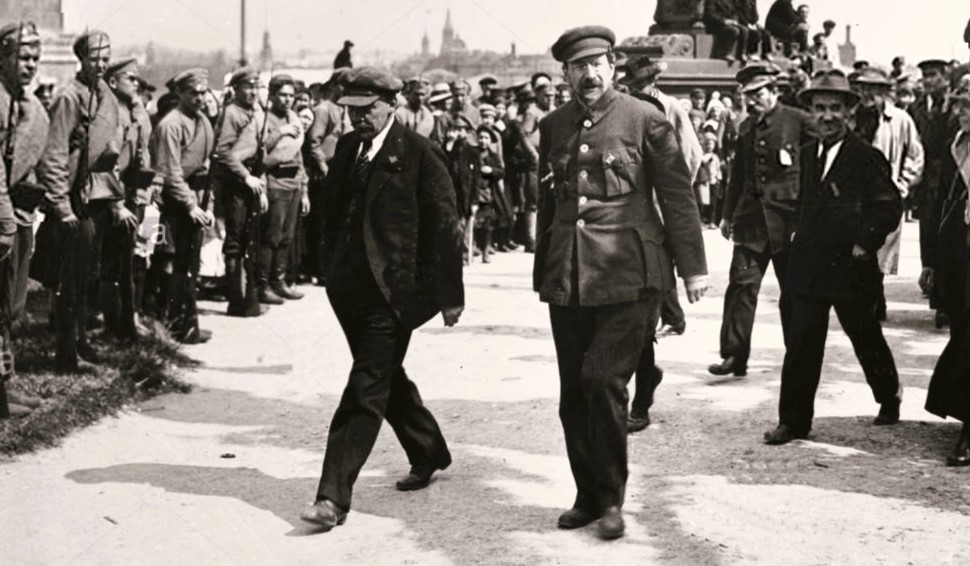
Anatoly Lunacharsky, Commissar for Education, surveys the accomplishments and continued struggles of the Soviets in the realms of education and the arts as they sought to raise the country from Tsarist nescience.
‘The Achievements of the Cultural Revolution’ by Anatoly Lunacharski from International Press Correspondence. Vol. 8 No. 79. November 9, 1928.
The slogan of a “Cultural Revolution” was most emphatically proclaimed at the XV. Party Congress of the Communist Party of the Soviet Union, but it is no novelty for the Communist mentality.
Lenin frequently expressed his ideas on the subject and declared in his famous theses that the chief and only obstacle in the way of Socialism in the territory of our Soviet Union lies in the low cultural level of the masses. If this level is sufficiently raised, so Lenin assumes, nothing more would stand in the way of the realisation of our Socialist aims.
True, Lenin immediately went on to declare that culture itself costs money and that the provision of sufficient means for the cultural work in the country can in view of the great demands made by the revolution only be attained by further achievements of our economy and a further growth of our budget.
At times we encounter the fortunately not very widely-spread opinion that these reflections on the part of Lenin are not a direct proof that he considered the construction of Socialism possible in a country and wished to underline the immense importance of the fundamental presumption therefor, in the shape of a high cultural level; on the contrary, the relative passage is interpreted as follows: Seeing that we are culturally backward and that our economy is backward and does not provide sufficient means for culture, we should harbour no illusions regarding the construction of Socialism. It is hard to imagine a cruder distortion of the leading ideas of Lenin.
Meanwhile, however, practice has made clear the real sense of this idea even to such circles of economy as allow immediate economic needs to blind them to the requirements of the so-called “third front”, i.e. the cultural struggle.
At the XV. Party Congress all the leaders of the Party, with the full support of the Congress itself, declared what was subsequently reflected in the relative resolutions, viz. that, in comparison, let us say, with the growth of our industry, our cultural development is proving backward and that it is necessary that lost ground should be brought in on this front and that our culture must be developed at a “revolutionary” rate if an uninterrupted development of the industry of our country and an improvement of our agriculture and its transformation into a collective agriculture are to be ensured.
The budget of popular education increased in the course of this year (I speak of basic figures, as the details are not yet known) by 40 per cent. as regards its central, Governmental section. It must, however, be pointed out at once that this increase in the budget was made to a considerable extent for the sake of higher technical institutions and industrial high-schools. If this sort of growth of the budget appears one-sided at first sight, seeing that the other branches of the cultural campaign make relatively smaller progress, this first impression must not engender the opinion that our development is actually one-sided. For surely the tasks of industrialisation are our foremost tasks. The misproportion between the training of the specialists needed for industry and the general growth of economy was quite particularly obvious. There can be no doubt but that in the near future in the next few budgets, at any rate, agricultural education, followed by other forms of education, will receive due attention.
In the present year the budgets of the municipalities can provide but little for cultural purposes, seeing that the present year is an extraordinarily difficult one. But it cannot be denied that the local organisations, too, have done much to put through the principles announced by the Party.
A second presumption for the realisation of the slogan of a cultural revolution should be a widespread and general movement in the circles of the Party, of the young generation, of the trade union organisations, the various cultural organisations, and among the population in general.
Of late such a movement has been clearly apparent. Thus of late years the attention paid to the liquidation of illiteracy among adults has fallen off regrettably. Now we can again see an increase of attention to this task; the trade unions and co-operatives have set aside substantial sums out of their cultural funds for this purpose and a whole number of organisations in the provinces and in the Moscow district have set themselves the task of a rapid and complete liquidation of illiteracy. Finally, the young generation recently started and carried through a big campaign, known as the “campaign of culture,” and is preparing Sunday work throughout the country on behalf of the schools.
The growing attention paid to cultural work is everywhere decidedly noticeable. “Contribute to education” is now one of the daily demands whenever the workers come into immediate touch with the Government.
The urge towards knowledge, which has at all times been strong, is more and more enhanced. The independent initiative of the population in this connection cannot be doubted for a moment. In the circles connected with the People’s Commissariat for Education the laudable idea has arisen, that large funds be provided next year in support of cultural work, funds which would form the basis of collections among the population.
Naturally far too short a time has elapsed since the XV. Party Congress for the achievements of the cultural revolution to be available in detail with reference to last year. I intend rather to give a general characterisation of the achievements of the cultural revolution during all the ten years, for the XV. Party Congress merely represented an acceleration of the rate of progress and perhaps a certain accentuation of the class character apparent in our cultural development, but not the beginning of our cultural creation itself.
On the contrary, I was already in a position to speak of our achievements in this direction on the occasion of my report at the festive session of the Central Executive Committee of the Soviet Union on the tenth anniversary of the revolution. The said session then expressed in a special resolution how far we still are from our objectives and from the satisfaction of the requirements of the population but how far we have nevertheless progressed along certain lines of cultural development.
In respect of elementary education, which is effected in this country by the four-grade primary schools frequented by children between the ages of eight and twelve, we may compare the following figures: Before the war there were in the whole country 104,000 schools; now there are 115,000. But our success lies not so much in the number of the schools as rather in the number of children frequenting them. In this respect we can record an increase by 45 per cent., for in the current year 10,500,000 children are being taught as against 7,200,000 before the war. The percentage of children taught in the elementary schools has increased by at least 20 or 25 per cent.
The Government has worked out a plan for general compulsory education in the four-grade elementary schools, which will affect the first grade, i.e. the children of eight years of age, in the course of the school-year 1932/33. At Moscow, Leningrad, Ivano-Vosnessensk, in the Crimea, in Georgia, and in the Kama district, almost 100 per cent. of all children are comprised in the educational system. In other regions the situation is less favorable; in the Republic of Dagestan, e.g., only 26 per cent. of the children are included. It must be pointed out that no effort is being spared to widen the educational system and to comprise the children of such Republics and regions of the R.S.F.S.R. as are inhabited by undeveloped nationalities.
In regard to the secondary schools we may witness the same development. Before the war there were 1790 such higher schools for general education (Latin schools, grammar schools, etc.). We now have 1811 such schools, no very great number, especially if it is remembered that under the influence of the first great revolutionary enthusiasm in 1920 we increased the number of these schools to 4163, a figure which exceeded our capabilities, as regards both the financial means required and the qualified teachers. If we transfer our attention to such figures as reflect the increase in the number of pupils, we can record a more satisfactory result. Before the war these higher schools comprised 564,000 pupils. At the time of the great enthusiasm just after the revolution the number rose only to 569,000. Now we have a total of 869,000, that is to say an increase of more than 50 per cent.
It must be added that very great progress has been made in the direction of vocational schools. In pre-war Russia there were some 3000 such establishments. In the current year the R.S.F.S.R. alone comprises almost 6000 schools of this type, so that the total may be said to have doubled. In regard to the number of pupils the result is still better. In the ten years since the revolution the number of pupils in the vocational schools has advanced from 266,000 to 638,000.
Less satisfactory conditions obtain as regards the remuneration of the teachers and the available funds for the requirements of the schools. Our budget is still poor, but we expect it to increase rapidly during the next few years.
Mere figures, however, do not give a proper conception of the actual growth of our schools, whether primary, secondary, or vocational. The aims and objects of our schools are directly opposed to those of the schools under the Tsarist regime. A great deal has been done in the direction of the complete methodical pedagogic transformation of the schools, their social composition has been changed, the former material has been replaced by altogether different elements, and our schools have been brought nearer to the ideal of a uniform technical working school. It is not possible to enumerate the achievements effected in this direction in a short article. Celebrated foreign pedagogues who have visited us have delineated them in full.
Creative work in the schools is being continued. The increasing means and the growing attention of the Party, of the young generation, and of the entire Soviet publicity, together with the growing care of the economists for the enlightenment of the population, provide the possibility of making big strides forward in the course of the next few years.
In regard to schools, increased attention is being paid to the seven grade working schools. In the school-year 1932/33, simultaneously with the introduction of compulsory education, especially as regards the rural districts, all the municipalities thickly inhabited by the proletariat will be provided with such seven-grade schools. These schools will have a decidedly industrialised character and will approach that type of proletarian school which was roughly outlined by the hand of Marx.
Colossal changes have also been brought about by the revolution in regard to the high-schools. The social composition of the student staff has completely changed, now consisting to 70 per cent. of workers and peasants. A new type of high school has been established which did not exist before the war and which enables the workers to acquire the most essential knowledge in four years, sufficient to qualify them for a high-school training. These are the so-called workers’ faculties, a peculiar creation of our popular educational system.
In the whole Soviet Union there are 129 high-schools as against 91 before the war. A growth of more than 40 per cent. The number of students has meanwhile advanced by more than 25 per cent., from 124,000 to 157,000. In this connection it must be remarked that the 124,000 students of pre-war times were recruited exclusively from the privileged classes of society, including at most the poor intelligentsia. At present our students derive mainly from worker and peasant families. It is obvious that such a change called for the provision of great sums for the support of our students.
Great interest attaches to certain types of schools, such as the schools of the young peasants (of which there are now more than 500), training the peasants in particular for the co-operatives and for the collectivisation of agriculture, and the working schools for apprentices which have become (and will, it is hoped, remain) the most important institutions for the training of the main cadres of the working class and which approaches the Marxian type of a proletarian school.

An important factor in the cultural struggle is the method employed in the free education of the population. Under Tsarist rule this was altogether unimportant. The so-called enlightenment of the people is a creation of the revolution. The education of the population outside the schools consists mainly in the liquidation of illiteracy. In this respect we have attained considerable success but we must not rest on our oars. As a result of the great backwardness of the female population, there are in the R.S.F.S.R. still some eight million illiterate adults. Added to this it must be remembered that after learning to read and write a great number of people very speedily forget what they have learnt. For this reason we are now applying the more expansive but more thorough system of reading and writing instruction in one-year schools.
For the development of knowledge among adults there is a growing system of the most varied instructional establishments; at present they number about 1000 and comprise 150,000 pupils. In the first place we have the workers’ universities, of which there are about 40, with 100,000 students.
One of the innovations of the revolution are the reading- rooms. Of these there are about 22,000. They are small centres of culture, dispersed in the most primitive villages.
Our political education and the improvement of the cultural level of the population owe much to broadcasting and to the cinematograph. In this respect we have naturally not got so far as would be in our interest, but nevertheless our achievements are most significant. Broadcasting and the films have not only conquered the towns but have to a great extent penetrated into the rural districts. Both the Party and the Government have of late been paying great attention to the furtherance of the penetration of the country by these two factors of culture. In the near future a remarkable advance in this direction may be expected. Though the reproaches we hear in regard to the ideological contents of our films are sometimes merited, they are yet far and away in advance of those of western Europe. The bourgeois, but decidedly progressive and enlightened German critic Kerr, who has written a preface for the book on “The Russian Film”, deals with the question as to how it is possible that in spite of its backward technique and the small means at its disposal in comparison with American and other European productions, the Russian film can yet surpass these productions in its artistic effect. He finds the answer to his question in the explanation that in the capitalist countries the commercial consideration is paramount in the production of a film, while in the Soviet Union the film is intended to serve cultural aims and the discussions of the great problems with which the country is occupied. There is no lack of ideas and of sentiment. In the Soviet Union the cinema is in every sense of the word an artistic means in the service of enlightenment.
What has just been said in regard to the cinema also applies to other realms of art. Our theatre is likewise showing signs of a rapid recovery and evinces a pronouncedly revolutionary aspect. Its great achievements in the direction of representative technique and stage management have been recognised in all the world. The repertory of our theatre, too, has improved, being influenced by the requirements of the country. True, our dramatic literature still falls short, both in quantity and in quality, of the requirements of the country and even of the requirements of the theatre and of its possibilities, but ideologically it is infinitely superior to that of the rest of Europe or of America.

Russian fiction has of late been giving sings of a remarkable rise, but at the same time of a variegated ideological surface. We are gratified to say proletarian literature is increasing. In the realm of poetry and the drama it has achieved remarkable successes and has particularly developed in regard to novels. We can already boast a considerable library permeated by a sincere proletarian spirit and bearing comparison with the best productions of Russian literature in general. I may point to three novels which have appeared almost simultaneously and all of them quite recently, “Bruski” by Panserov, “Tichij Don” by Sholochov, and “Lieso-Zavod” by Karavayeva. These three novels deserve to be translated into all civilised languages. They are, however, by no means single instances; there are a number of products which at times attain the same level. I may call to mind the highly artistic works published by the proletarian writers Fadeiev, Lebedinski, Gladkov, and others.
A less important reflection of the cultural revolution is to be found in the realm of the creative arts and of music. We may point to the recently apparent interest of the masses in art exhibitions, concerts, and museums. This broad contact with the main masses of the working and peasant public is the guarantee of a further sound development of these branches of art.
Great interest attaches to the statistics regarding our press. As early as 1922 we surpassed the circulation totals of the best pre-war years. Before the war there appeared in the whole country 2,500,000 copies of newspapers in the aggregate. As early as 1926 we had 8,000,000. Our book-production in 1927 was as great as before the war in regard to the number publications, but the actual number of volumes was 5 per cent. greater. The returns of scientific editions are particularly instructive and interesting. In 1910, 464 works of scientific interest were published, comprising 8000 printed pages and an aggregate edition of 19 million copies. If we take the year 1927, we shall see that there are detailed statistics in this regard. In that year 945, purely scientific works were published with a total edition of 16 million copies. In 1910, the number of technical books of instruction published was 3,500,000 copies. In 1926, the total was 35,000,000, or just ten times as many. Pavlov’s “Functions of the Great Hemispheres of the Human Brain” was published in 10,000 copies at three roubles each. Many collaborators of the State publishing works declared that such a large edition of so difficult and expensive a book would suffice for many years in a backward country such as ours. However, the first edition was sold out within the year and a second is about to appear. This shows that many of our cultural workers, students among them, save their copecks for the purpose of buying and studying first-class and important works.
Our scientific work has not only not ceased, but has rather constantly been developing since the revolution. A series of international congresses have shown that our scientists can record important and interesting results of their research work. Particularly instructive in this respect was the Congress of Geologists in America. Alongside the development of sciences in general, we have in particular cultivated Marxism. In this direction we have achieved much and the number of our publications, both scientific and popular, is very great.
It is the classics of Marxism in particular that are published. The Marx-Engels Institute, founded in 1922, has become a first-class scientific institution of world-wide importance. The sections and the work of the Communist Academy, of the All-Russian Council of Scientific Institutions, and of the Academy for Material Culture have likewise augmented.

Our Scientific Academy is now being reformed; new forces are being enlisted, and the institution is being brought into line with the times. There can be no doubt but that the Academy is about to enter upon the most brilliant period of its existence. Together with the Russian Academy of Sciences, the Ukrainian Academy has developed, while a White Russian Academy has just been founded.
In my report in the Central Executive Committee a year ago, I also had occasion to speak of certain factors characterising yet another side of our mass-culture. I refer to the important progress of women in public work and the great advance in the consciousness of women, even of the most primitive among them, such as the peasant women and the women of the East. The Women’s Congress which took place last year showed some surprising achievements in this respect. It is only for lack of space moreover, that I refrain here from speaking of the rapid development of physical culture among us, of its qualitative and quantitative success, and of the important achievements of the Health Protection League, which recently celebrated its tenth anniversary. Added to these results, we have the undeniable fact of the regression of infant mortality and in consequence a satisfactory development of the population.
The growth of the Party and of its influence, the development of the Young Communist League and of its activity, the rising cultural level of the working masses and of the young peasants all these factors are reflected in thousands of satisfactory circumstances.
The principle of self-criticism demands of us that we should be circumspect and that we should not cease to control and report. If a widespread development of self-criticism were to show up all shorts of things which are faulty about our development–seeing that criticism must in the first place reveal the unsatisfactory side this would discourage none that has really a proper conception of the internal character of this process. It must be pointed out, however, that the realisation of Gorki’s idea is now at hand, for a special publication, to be known as “Our Achievements”, is shortly to appear and will confront a sound self-criticism with the enumeration of the results attained. Such an enumeration must be thoroughly healthy; it must reveal the character which distinguished the resolution of the Central Executive Committee following on my report on our cultural work, delivered on the occasion of the tenth anniversary of the revolution. Without forgetting our achievements, we must always remember that they are still slight in comparison with what the population and our great cause demand.
International Press Correspondence, widely known as”Inprecorr” was published by the Executive Committee of the Communist International (ECCI) regularly in German and English, occasionally in many other languages, beginning in 1921 and lasting in English until 1938. Inprecorr’s role was to supply translated articles to the English-speaking press of the International from the Comintern’s different sections, as well as news and statements from the ECCI. Many ‘Daily Worker’ and ‘Communist’ articles originated in Inprecorr, and it also published articles by American comrades for use in other countries. It was published at least weekly, and often thrice weekly.
PDF of full issue: https://www.marxists.org/history/international/comintern/inprecor/1928/v08n79-nov-09-1928-Inprecor-op.pdf
 Revolution's Newsstand