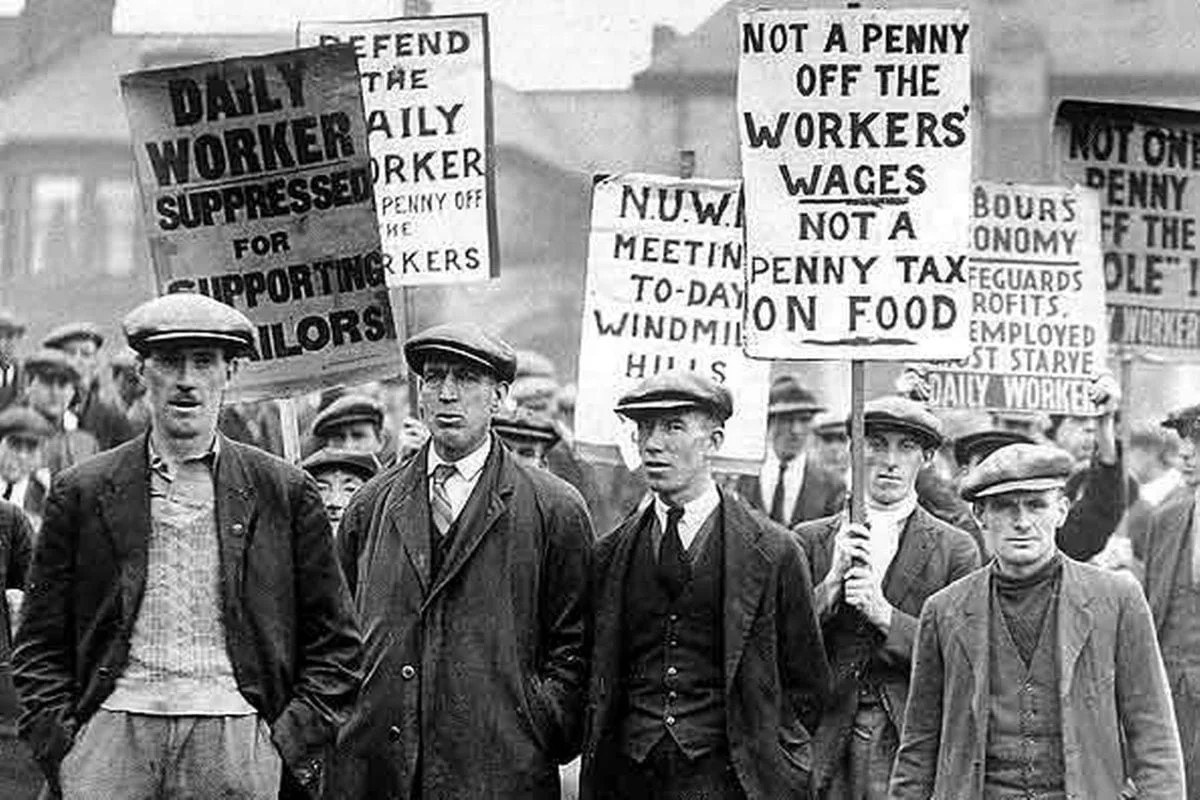
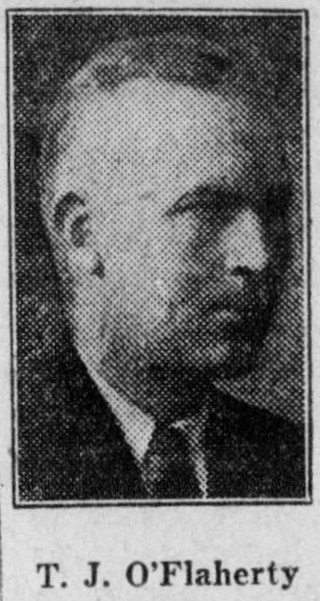
In Britain during the momentous 1926 General Strike, T.J. O’Flaherty, as only he could, gives the impression of the Party’s place in the struggle.
‘The Role of the Communist in the British General Strike’ by Thomas J. O’Flaherty from the Daily Worker Saturday Supplement. Vol. 3 No. 164. July 24, 1926.
WHERE were the Communists during the general strike? What were they doing?
“That reminds me of a story” as an old S.L.P. speaker was in the habit of saying when his audience showed signs of restlessness after the first three hours. Really it is more like an excerpt from a St. Patrick’s day patriotic speech than an anecdote. But I think it is good.
During the battle of Fredericksburg, this was in Civil War days, an Irish soldier was anxious to die with the Irish Brigade, if death was to be his lot on that day. He shouted: “Where is the Irish Brigade?” And he was answered above the din of battle, I am afraid by a fellow countryman: “Where is the Irish Brigade? Where the battle rages loudest; where the leaden hail pours thickest; where steel meets steel with the sharpest clang–there the sons of Erin fight and bleed.”
And while the use of superlatives and military terms in this article may be only justified were I to resort to verse as the British general strike did not develop leaden showers or the din of clashing steel, yet in this great struggle the Communists were in the front of the fight leading it in some places and taking orders as the case may be, in full, performing their duty as a part of the army of labor.
A few words on the boasted freedom allowed by the British government to its subjects. Even American radicals suffered from the delusion that the British ruling classes were “different” from their crude imitators in the United States and in other countries, in allowing the workers to blow off steam in Hyde Park and say things about the realm that would land an American agitator behind the bars. Those glassy-eyed radicals ignored the fact, that where real danger faced the empire, where action was liable to follow talk, where conversation between radicals did not run into futile discussions on the evolution of the human being into such a perfect creature that he would grow a wart on the back of his neck to render unnecessary the presence of a collar button, and incidentally put the collar button trust out of business, in those imperial real estate subdivisions, the hand that was gloved in Hyde Park wore knuckle dusters. There was no danger of immediate trouble for the British ruling classes from their factory slaves, who filled their skins with food and drink, such as it was, partly at the expense of the still more exploited slaves in the colonies.
BUT those happy days of British imperialism are gone forever. The British worker has changed. The colonial slaves are champing on the imperial bit and they have seen too many bloody bayonets in the world war to be frightened even by an Amritsar massacre,
A threatened revolt in the heart of the empire is the inevitable consequence of the loss of British trade to its dearly beloved rival, the United States (such love is indeed rare between pals) and to the reduced spoils from the colonies, protectorates, dependencies, and mandatories.
The British worker can no longer fill his belly with stale beer and chips and the imperialists can no longer take enuf from the Hindoo-Egyptian Peter to soothe the temper of the skilled British craftsman Paul, and leave the fat man enuf to live in his customary style. Action is liable to follow words now in Merrie England and the velvet glove is now deposited in the British historical museums while the mailed fist is brought into play. It is the operation of the law of self-preservation and as sure as a cat will jump at a mouse the capitalist class, suave or surly, plebian or aristocratic, will all do the same thing in much the same way to their natural enemies when necessity arises. Freedom of speech, of the press and of assemblage is as dead today in England as it is in Passaic, New Jersey or in Boston, Massachusetts, the home of the dried and sacred codfish and the birthplace of Paul Revere.
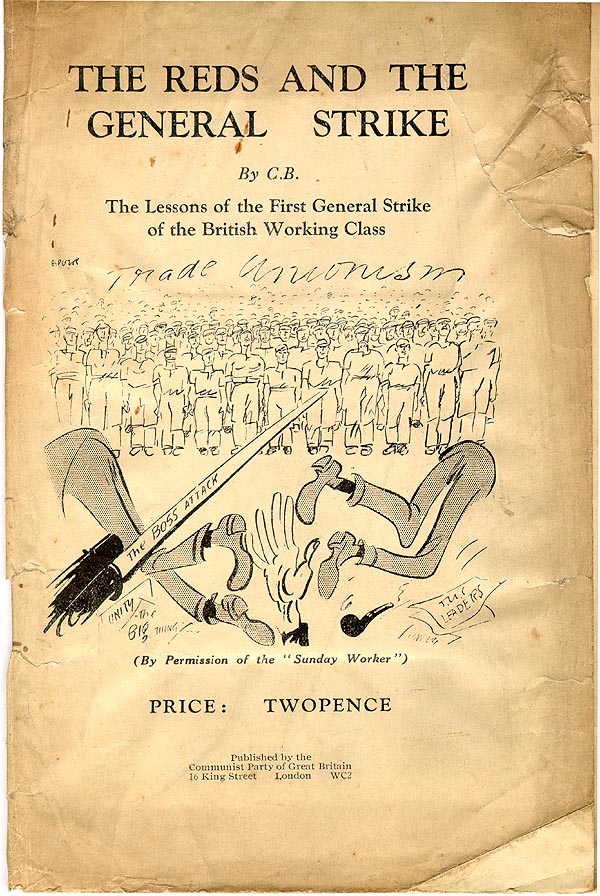
THE government has been sniping at the British Communist Party for several years. Tho the party is small in numbers, it has considerable influence among the workers. The greater part of its membership are in the trade unions and many of them occupy leading positions in the unions. Tho there is a constant theoretical war on between the Communists and all other working-class political parties, nevertheless, many local labor parties, and I.L.P. branches invite Communists to speak at their meetings and look upon the party as their political guide.
The Minority Movement, which is led by such well known trade unionists as Harry Pollitt, Nat Watkins, Tom Mann, George Hardy and supported by A.J. Cook, Gossip and other prominent left wing officials, was given its program by the Communist militants in the trade unions. Its most active spirits are Communists and hundreds of thousands of workers follow its lead. Many of the slogans that it issued were reluctantly adopted by the trade union leaders who were in charge during the general strike. This was the driving force inside the trade unions which the government feared might eventually put an end to the twaddle of the right wing and “left” wing leaders, that the strike was an economic struggle and not a political fight, while millions of workers took their orders from the T.U.C. in Eccleston Square and told the tory government at Downing street, in effect, to go to hell.
Therefore it was not surprising that the government decided to outlaw all organizations in which the Communists had a footing. Detectives from Scotland Yard and amateurs from the university kept close watch on the headquarters of organizations that were labeled “Communist.” Four of those dicks ambled up and down the sidewalk in front of the Minority Movement headquarters on Great Ormond Street and eventually padlocked the place. The officials of the movement escaped arrest, at the moment, and were obliged to keep on the move. SCOTLAND YARD detail was on constant watch near 16 King street, the headquarters of the Communist Party. The fascists were in the habit of visiting the place at dead of night and smearing the shutter that protected the window of the Communist bookstore, with paint, The police never interfered with those vandal acts. The most active leaders of the party were under constant surveillance and some of those dicks who stood on the corner near the C.P. headquarters watching everybody who entered and left are sorry-looking specimens. A prominent Communist leader who was accosted by the Scotland Yard man, a “specialist” in “red” propaganda, affected indignation over the type of human animal assigned to watch himself and his comrades, The dick laughed and admitted that he had just cause for complaint.
When the strike broke the government publicity organs had soft words for the right wing labor leaders but the Communists were given to understand that their movements would be watched. They were blamed for bringing the strike “disaster” on the dear “public.” The right wing leaders thru their organ the Daily Herald covertly charged the Communists with being disrupters and enemies on the inside the same kind of twaddle that William Green, head of the A.F. of L. or his friend, founder and exploiter of that flourishing business known as the Loyal Order of the Moose, James J. Davis, who works the department of labor as a side- line, throw up here in America.

HERE is a little tid-bit that I have not seen published: On the morning of the strike the Daily Herald carried a sub-editorial entitled, “Trust Your Leaders.” A perfectly proper title under certain circumstances! But the title was used as a cloak for a libel on the active militants in the unions who knew that Thomas was the logical successor to Judas Iscariot and was as certain to betray the workers whenever he saw a golden opportunity as a poisoned rat is sure to take to drinking water.
“Do you know the reason for this?” I was asked by a known left wing journalist. He proceeded to inform me.
A series of articles appeared in the Sunday Worker by William Paul, editor of that paper, explaining the aims of the left wing in the trade unions. Paul threw his harpoon into J.H. Thomas and the right wing leaders. This angered the Daily Herald and it attacked the Sunday Worker viciously. Tho the Herald is supported by the trade union movement as a whole, and tho its best friends are in the left wing, it seems to feel that its mission is to sneeze every time J.H. Thomas, Snowden or MacDonald take their snuff.
A.J. Cook, who is a genuine left winger, a man whose head has not been turned by his election to the secretaryship of the miners’ federation, one of the most powerful labor unions in the world, resented this attack on the Sunday Worker and phoned his complaint to the Daily Herald. He in- formed the editor that he intended to reply to the attack in the columns of the Herald.
“But I may not publish it” replied the voice over the phone.
“But perhaps you may be compelled to publish it,” replied Cook.
For a little while a series of gurgling sounds came over the wire, Cook suspected for a moment that the unseen conversationalist was swallowing a pill. Then there was a resumption of speech,
“Why, do you know that you are speaking to Mr. Hamilton Fyfe?”
“Oh, yes,” answered Cook, “and perhaps Mr. Hamilton Fyfe might be interested to know that he is speaking to the secretary of an organization that is subsidizing the paper he edits.”
COOK also informed the managers of the Herald that unless their right wing friends watched their step the Sunday Worker might have “Watch Your Leaders!” editorial such as might be remembered by the heroes of Black Friday, 1921. Whether Cook was able to get his reply into the Daily Herald I do not know but the front page of the Sunday Worker carried a spirited article from his pen, And the editorial “Trust Your Leaders!” was the Herald answer to Cook’s telephone conversation.
And yet when the government held up the paper supply of the Victoria Publishing Company which published the Herald until stopped by the printers’ walkout and afterwards the British Worker which was issued by the T.U.C. during the strike, the Sunday Worker placed its entire supply of print paper at the disposition of the British Worker, The charge of disruption hurled at the Communists and the genuine left wing elements by the conservative leaders fell to the ground during the general strike and hundreds of thousands of trade unionists who prior to the great struggle believed the fairy tales told by the labor imperialists about the radicals, saw for themselves that the disrupters were not red but yellow, and that the maligned reds constituted the steel backbone of the struggle.
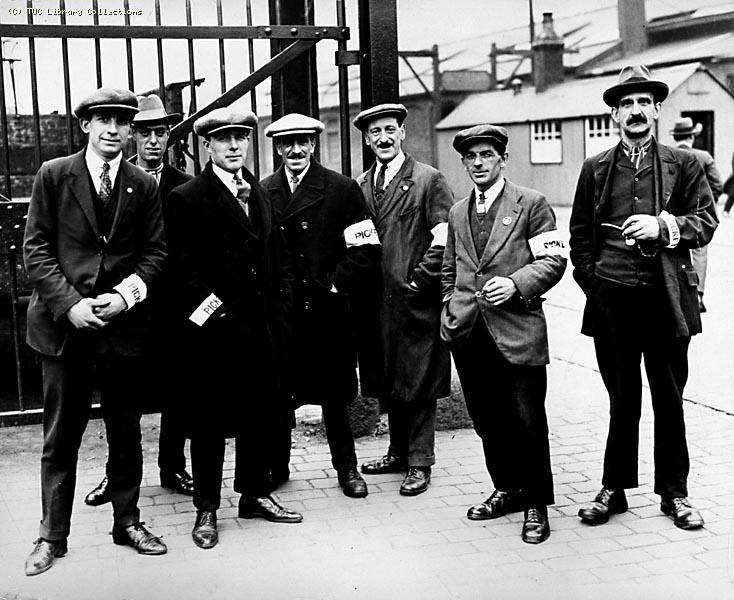
When the general strike was called, every active Communist whose presence was not urgently required at or near headquarters was assigned to a district to engage actively in helping the local trade union leaders to conduct the fight with the utmost efficiency. Wherever councils of action were organized, wherever the movement to build workers’ defense corps was pushed vigorously it was almost a certainty that the Communists were on the job. It was not surprising therefore that the government ordered its agents to round up the Communists and if the general strike had not come to an end on May 12, it is more than likely that every active member of the party in Britain would be locked up, provided there were enough jails. As it was, even after the general strike was called off hundreds of Communists were arrested on flimsy charges and many of them given jail sentences. Any local trade union leader who did not devote his energies to singing hymns or praying for success was also subject to persecution and arrest.
THE “dress rehearsal” ended as it started suddenly. It is folly to consider it a victory, in view of what It could have been. Looking at the incident in a historically objective sense it must be admitted that it was an event that marks a tall milestone in the march of world labor towards complete emancipation from wage slavery.
The British Empire is on the toboggan. Her political bagmen still put up a bold front and say, “We will pull thru.” But despair is beginning to seize them. The economic situation at home is only one of the empire’s worries. A General Bying muffs the imperial ball in Canada and rumbles of rebellion are heard with the dollar magician Uncle Sam watching the drama: Egypt is hanging to the empire by a wig, and the silence that is hanging temporarily over the teeming million’s of India is not the silence of peace; John Bull’s wares are as popular in China as the rattle of a snake; Japan is now engaged in an open diplomatic war with the British drummers for Chinese trade.
And the growing power of Red Russia, with its far flung frontiers in dangerous proximity to India is causing the proud ruling class of England uneasy dreams. Why, on the eve of the general strike, when news of the Russo-German treaty was made public, a near-panic prevailed in Downing Street and British papers devoted more space to that event than to the birth of an heir to the Duke and Duchess of York.
Still the king and queen entertained royally and abundantly; the guards at Buckingham Palace and the horses at the Horse Guards performed their tricks as usual; American tourists watched them and said: “Aren’t they too cute for anything.” Other Americans were received in audience by the king and queen, very likely in consideration of a donation to the tory treasury, all those things were taking place while the empire hung on the brink of a debacle.
The Saturday Supplement, later changed to a Sunday Supplement, of the Daily Worker was a place for longer articles with debate, international focus, literature, and documents presented. The Daily Worker began in 1924 and was published in New York City by the Communist Party US and its predecessor organizations. Among the most long-lasting and important left publications in US history, it had a circulation of 35,000 at its peak. The Daily Worker came from The Ohio Socialist, published by the Left Wing-dominated Socialist Party of Ohio in Cleveland from 1917 to November 1919, when it became became The Toiler, paper of the Communist Labor Party. In December 1921 the above-ground Workers Party of America merged the Toiler with the paper Workers Council to found The Worker, which became The Daily Worker beginning January 13, 1924.
PDF of full issue: https://www.marxists.org/history/usa/pubs/dailyworker/1926/1926-ny/v03-n164-supplement-jul-24-1926-DW-LOC.pdf
 Revolution's Newsstand