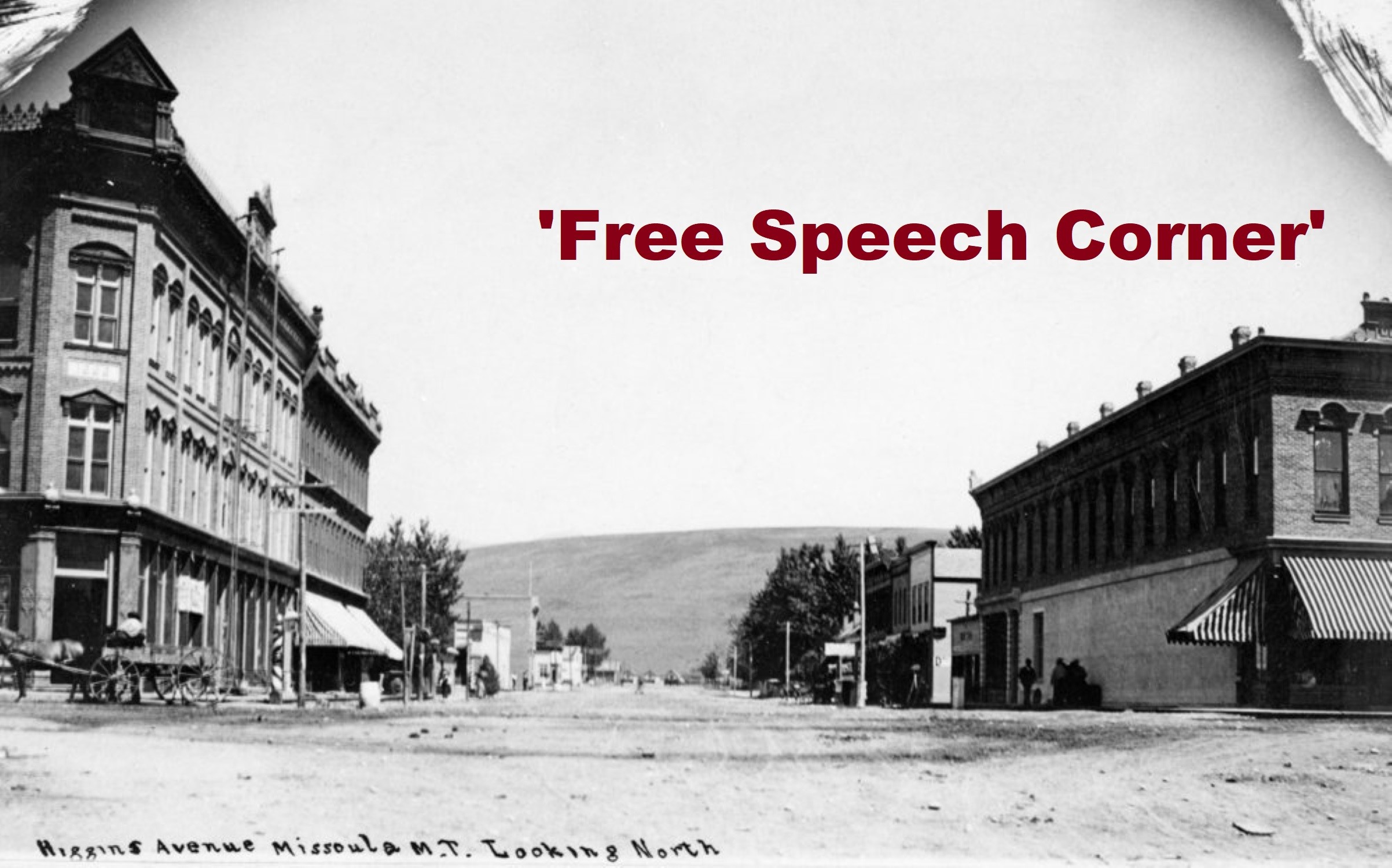
A nineteen-year-old Flynn delivers a delightful communique from the street-corner, free speech fight of the I.W.W. in Missoula, Montana starring a soap-boxing agitator Frank Little.
‘American Freedom Is Not For Workers’ by Elizabeth Gurley Flynn from Industrial Worker. Vol. 1 No. 30. October 7, 1909.
The silence of the capitalist class in this burg has been finally broken, but as the I.W.W. thrives on opposition, which is the best possible sort of advertisement, we are not at all alarmed. Wednesday night at our regular meeting we discovered that Fellow Worker Little, one time organizer for the W.F. of M. and at present voluntary organizer and “hobo agitator” for the I.W.W., was in the crowd. He is a man whose courageous fighting in Arizona, Nevada, and New Mexico is well known, and we introduced him to speak. We did not know at the time that he had just ‘boed in and had eaten nothing for 24 hours, but he made a short talk, straight to the point, on the organization. The first intimation we had of trouble was when a tall, thin special policeman, who had been shadowing our meetings continually, said to me: “He’s too radical, he’ll have to cut it out.” Jones called out to Little across the heads of the crowd, “The bull says you’re too radical, Little,” and Little answered: “I guess they don’t want the truth.” The crowd applauded and shortly after he finished up. The policeman returned and said to me: “You people had better not have that fellow talk anymore, he won’t do you any good (of course he is terriblhee worried about our good!) and they won’t stand for that kind of talk in this town.” I wonder who the all-powerful “They” is, for judging by the applause at our meetings, the working class seem to like “that kind of talk!” I replied: “You will have to talk to the organization. I am not responsible for the speakers. So you are going to establish a censorship over us?” “Not over you,” he replied hurriedly. “Well, I don’t want to be discriminated in favor of,” I replied, and the discussion ended.

Friday evening Fellow Worker Little spoke again and during his discourse the policeman, at the instigation of an older and more seasoned officer, I am told, stepped up to him and said: “You’re too rank; you’ll have to cut it out or I’ll take you off the box.” I wonder if the policeman wouldn’t be “radical” and “rank” if he had periodic doses of 24 hours’ starvation? Little repeated the policeman’s warning to the audience and then said in his easy-going way. “But as I was saying–” continuing right where he left off, to the chagrin of the police, and delight of the crowd.
The Slave-Upheld “Constitution”—Ha, ha!
Saturday night our meeting was continually annoyed by these obstreperous defenders of law and order, who probably never heard of the Constitution of the United States and its guarantee of free speech. One of them was heard to remark before the meeting: “The only people we have any trouble with are the I.W.W. In Spokane they had to pass a law to keep them off the street, and they are a nuisance in Seattle, Portland and everywhere on the coast.” The Salvation Army usually quits at eight o’clock sharp, but Saturday night the captain talked until twenty-five minutes past eight, so we started up. He was probably insulted by the I.W.W., for the night previous he told his crowd that what they needed was not material bread but “spiritual” bread, and we asked the impertinent question, “Why the nickel on the drum, if he can live on spiritual bread?” A little round-shouldered policeman with his helmet pulled down over his ears, where his head ought to be, and a look on his face of chronic indigestion, said: “You people have no right talking while the Salvation Army is talking.” If they continued to save souls until 12 o’clock, I suppose it’s up to us to wait like meek little lambkins till they conclude. The officer had better not hold his breath till we do it! Jones told him: “You can’t shut us up!” and he answered, “We’ll find a way.” It was this same policeman I heard say, when Little spoke about places in Mexico where the working class earn 7c a day, “Yes and spend 6 for booze.” Policemen, of course, all belong to the W.C.T. U. certainly, my dear child, what makes you ask? Little gave a talk on “Radicalism,” taking up the history of the W.F. of M. and showing how radical, rank, and unscrupulous, were the methods of the Mineowners’ association. The tall, thin policeman said to me: “If he doesn’t. stop soon, I’ll take him off the box,” and I answered, “That’s up to you, it isn’t up to me.” But I didn’t notice him carry out his threat. Little didn’t give him even a shadow of an excuse, for his talk was absolute and unvarnished truth.
I.W.W. Literature Free to Soldiers.
The night previous we sold 25 copies of Herve’s “Anti-Patriotism” and I remarked that they would be given free to soldiers who are usually broke after their “booze-bills” are paid. One of the soldiers complained to a policeman that they were tired of being insulted by street-corner speakers. I have seen more drunken soldiers in Missoula than any other type of drunk. The tall special officer it was, who told me how they walk in four miles from the fort just to get booze; said it just after ordering two of them who were reeling around the street back to the fort or he would put them in jail. One evening, just before our meeting, I saw a soldier in uniform reeling down Higgins Avenue with a whiskey bottle in each hand, an example of our splendid protectors of “the American home.” On Labor Day our stand was nearly upset by a drunken soldier trying to steady himself by leaning against it, yet they are “insulted” when you tell the truth about themselves. He said further that the children on the street even jeer at them, laughing at the “extra white rags” they wear on their sleeves. “In some places,” he said, the children are taught to take off their hats to a soldier.” “Well,” said an I.W.W. man who overheard it, “here’s one man who, if he saw his kid taking off his hat to a soldier would kill him.” The policeman said, “The I.W.W. is a no-good bunch and must be stopped.”
Persecution Helps Us.
Our receipts for Saturday night, aided by the opposition, were $17.05. What hurts the middle class and police of this town is that we are here to stay and are paying our running expenses. The town council meets to- night and I read in this morning’s “Missoulian” that a letter from the chamber of commerce will come up for discussion and action. As we meet just in front of the chamber of commerce hall, it is likely in regard to us. But whether the council takes action or not, we are going to continue to hold meetings. “They say. What say they? Let them say!”
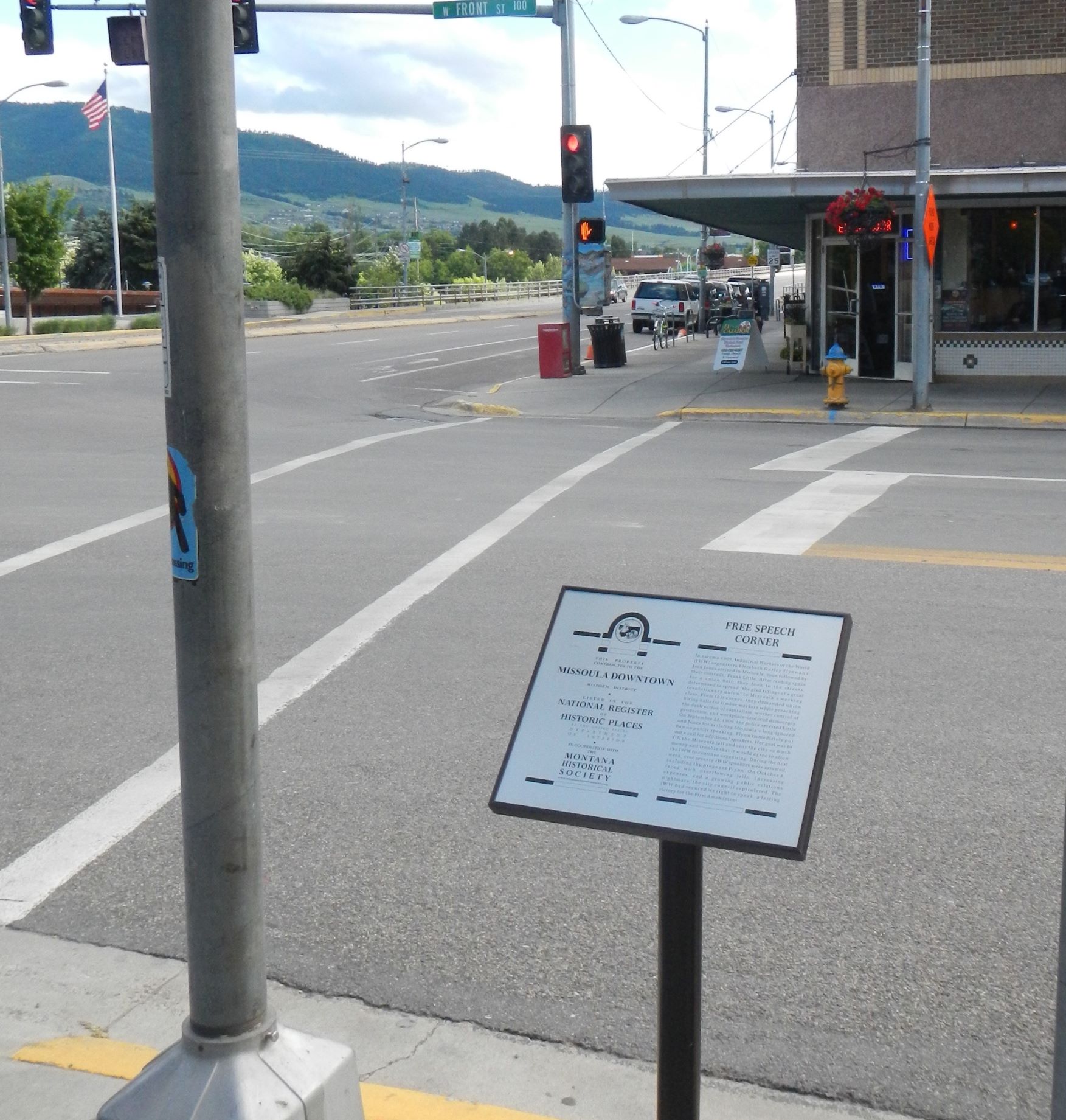
It looks as if the fight is on and we may need help, not financial as yet, but men. Any members of the I.W.W. traveling through or near Missoula are earnestly urged to drop off. We hold our meetings at the corner of Higgins avenue and Front street, and our address is 544 East Main street. Any member who reads this article in Spokane Seattle, Butte or towns in the northwest, who has no particular ties to hold him, is invited to pay us a visit also. Fellow Worker Borland, the singer, requested to communicate with us at once.
We intend to fill the jail of this town to overflowing if they start arresting, so while we regret we have no hall as yet to accommodate you, the city government of Missoula will probably kindly furnish you with board and room free of charge.
Let’s say, in the words of the poet: “Come one, come all, this rock shall fly From its firm base as soon as I.” W.W. Yours for industrial freedom, ELIZABETH GURLEY FYLNN.
PDF of full issue: https://www.marxists.org/history/usa/pubs/industrialworker/iw/v1n30-oct-07-1909-IW.pdf
 Revolution's Newsstand