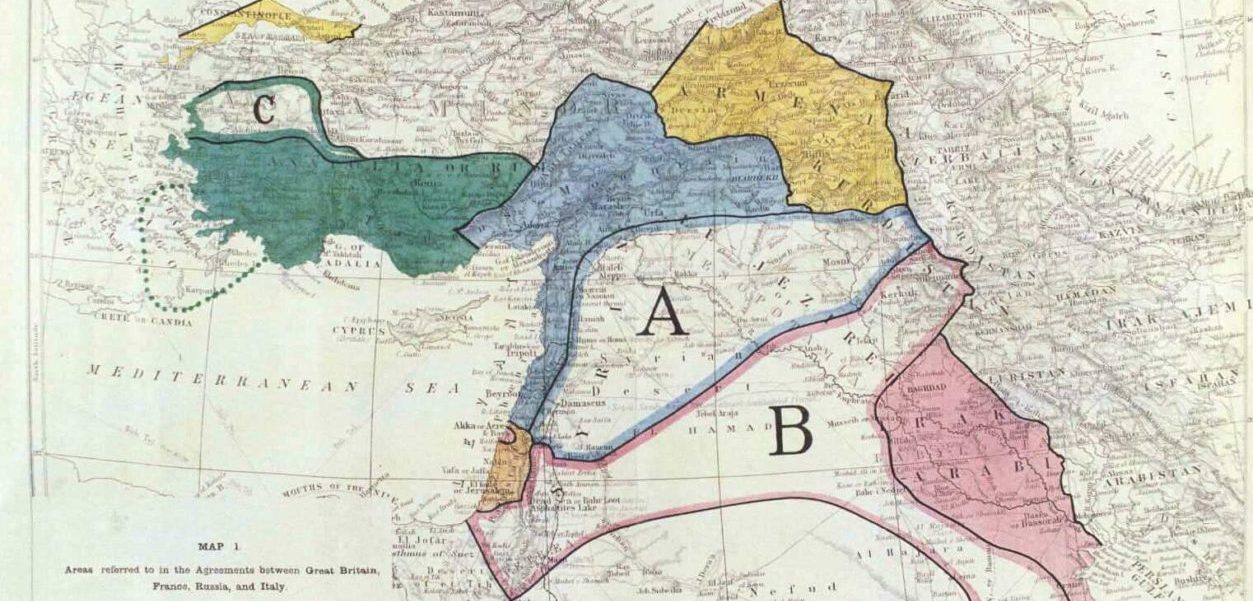
Historic leader of the Palestine Communist Party, Joseph Berger looks at the many effects, direct and indirect, of the October Revolution on the ‘Near East.’ Not least of which was Bolshevik exposure of secret documents from imperialist diplomacy such as the Sykes-Picot Agreement.
‘The October Revolution and the Near East’ by Joseph Berger from International Press Correspondence. Vol. 7 No. 63. November 10, 1927.
For the various peoples of the Ottoman Empire 1917 was a fateful year. The imperialist world-war had converted the countries of the Near East into one of the many battlefields on which the struggle for world dominion in that year entered upon its decisive stage. The population of Mesopotamia and Syria, of Northern Arabia and Palestine was immediately drawn into the events of the war: terrible suffering, starvation, plagues, devastation were the concomitants of the war for the peasants and the urban population of these countries. The weak national movement, which received a fresh impetus as a result of the hardships suffered by the people during wartime, found itself jammed between the devil and the deep sea: on the one hand, it was suppressed by means of forms of reprisal dating from the Middle Ages and exercised by the Turkish Pashas and German generals; on the other hand, it was in danger of being exploited for the imperialistic purposes of the Entente.
For the Entente powers England, France, Russia had long before the end of the war divided up among themselves the countries and peoples of the Ottoman. Empire: an agreement dated in the year 1915 provided for the allocation of Mesopotamia and Northern Arabia to England, Syria and Cilicia to France and a large portion of Anatolia, Trebizond, Erzerum, as also the whole of Kurdistan as far as the Mesopotamian frontier, to Russia. Among the parties contending for power and influence in the Near East Tsarist Russia was a constant factor whose imperialistic appetite had been only further whetted through the war and its alliance with England. Just as was the case with other imperialists, the Tsarist monasteries and endowments, missions and charitable institutions, priests and traders served as pioneers for the realisation of expansionist aims.
The February Revolution took over the traditions of Tsarism in relation to Russian policy in the Near East and continued the policy of a closer and more intimate connection with British imperialism. The secret treaties relating to various territorial concessions were amended in favour of Russia, and in exchange “democratic” Russia gave its consent to a number of new British combinations, such as the Balfour Declaration. Expansion at the cost of Turkey, i.e. the enslavement of the inhabitants of the Ottoman Empire, was one of the main pillars of the policy of the Provisional Government.
When the October Revolution swept aside this arch-imperialistic government with its mask of democratic phrases, one of its first actions was the publication of the secret treaties found in the archives. In this manner the peoples of the Near East learned of the scandalous Sykes-Picot Agreement of the year 1916, which while the Arabs were promised in proclamations and negotiations full rights of self-determination and national independence divided their territories among the parties to the imperialistic adventure. In tearing up the imperialistic agreements, disclosing the intrigues of the imperialists, renouncing the privileges and “capitulations” extorted from the various peoples, the Soviet power converted the conception of “Russia” from a menacing, tyrannising spectre into a State organisation to which suppressed nations might look for help and support.
As was only to be expected, the Anglo-French imperialists did everything they could to minimise the overwhelming impression made by the October Revolution upon the countries of the Near East. The whole machinery of imperialistic calumny and misinterpretation was brought into play in order to paint in the darkest of hues conditions in “Bolshevist Russia”. No demagogy, no fantastic and malicious legends were too bad to be used in deprecation of the Bolshevists and to represent them as the enemies of mankind. The imperialist agents took particular pains to exploit for their own purposes the religions prejudices of the population. In order that there should be no obstruction to the circulation of lies, the imperialists saw to it that the former very lively intercourse between Russia and the Near East was completely suspended. No Russian ship, no Russian subject (with the exception of attested White Guardists), no Russian newspaper was, until quite recently, allowed to enter Egypt, Syria, etc. In the eyes of the imperialistic authorities sympathies for Bolshevism or for the Russian Revolution were in themselves criminal.
All this however, was unable to prevent the constant growth of these sympathies. The imperialistic oppression which was felt all the more keenly by the native population of countries separated from the Ottoman Empire and subjected to Anglo-French dominion, because it was in marked contrast to all the promises of freedom made during the war, resulted in a reinforcement of the revolutionary tendency. The oppressed peoples looked for allies in their fight for freedom. The fight waged by Mustapha Kemal, which, as was plainly apparent, would never have been successful without the friendship of the Soviet Power, the example of Persia, which, thanks to the support it got from the Bolshevist State, was able to save itself from British rapacity, the exemplary solution of the national question in the Soviet Union showed the national-revolutionary movement where the true friends of national liberty are to be found. The Communist movement, the development of which could not be prevented even by the draconic measures of the imperialists furthermore showed that real national liberty was only to be achieved through the emancipation of the working masses after the fashion of the October Revolution.
Thus little by little the ring of isolation drawn by the imperialists around the October Revolution and its ideas was broken through. In addition, as the Workers’ and Peasants’ State grew in economic power, the economic blockade, which had been carried on for years, became impracticable. Trade missions of “Arcos” were opened in Syria, Palestine and Egypt, and in a comparatively short time “Russian business” became so popular that… the French and English authorities promptly deported the missions without making use of any pretexts. However, at the present time, after the Anglo-Soviet rupture and while the agitation against the Soviet Union is again at its height, the Egyptian Government has been compelled under the pressure of an economic situation, which found expression in Parliament and in the producers’ associations, to resume direct trade with the Soviet Union.
Throughout the world and especially in the countries of the Near East, which feel the direct and burdensome pressure of British imperialism, the tenth anniversary of the October Revolution will be a day of celebration and of expression of the solidarity of the masses with the work of the Russian proletariat. The slogan: “Hands off Soviet Russia” will resound in these British colonies and prove to Chamberlain that the ideas of the October Revolution have penetrated to every corner of his world empire.
The ECCI published the magazine ‘Communist International’ edited by Zinoviev and Karl Radek from 1919 until 1926 irregularly in German, French, Russian, and English. Restarting in 1927 until 1934. Unlike, Inprecorr, CI contained long-form articles by the leading figures of the International as well as proceedings, statements, and notices of the Comintern. No complete run of Communist International is available in English. Both were largely published outside of Soviet territory, with Communist International printed in London, to facilitate distribution and both were major contributors to the Communist press in the U.S. Communist International and Inprecorr are an invaluable English-language source on the history of the Communist International and its sections.
PDF of full issue: https://www.marxists.org/history/international/comintern/inprecor/1927/v07n63-nov-10-1927-inprecor-op.pdf
 Revolution's Newsstand