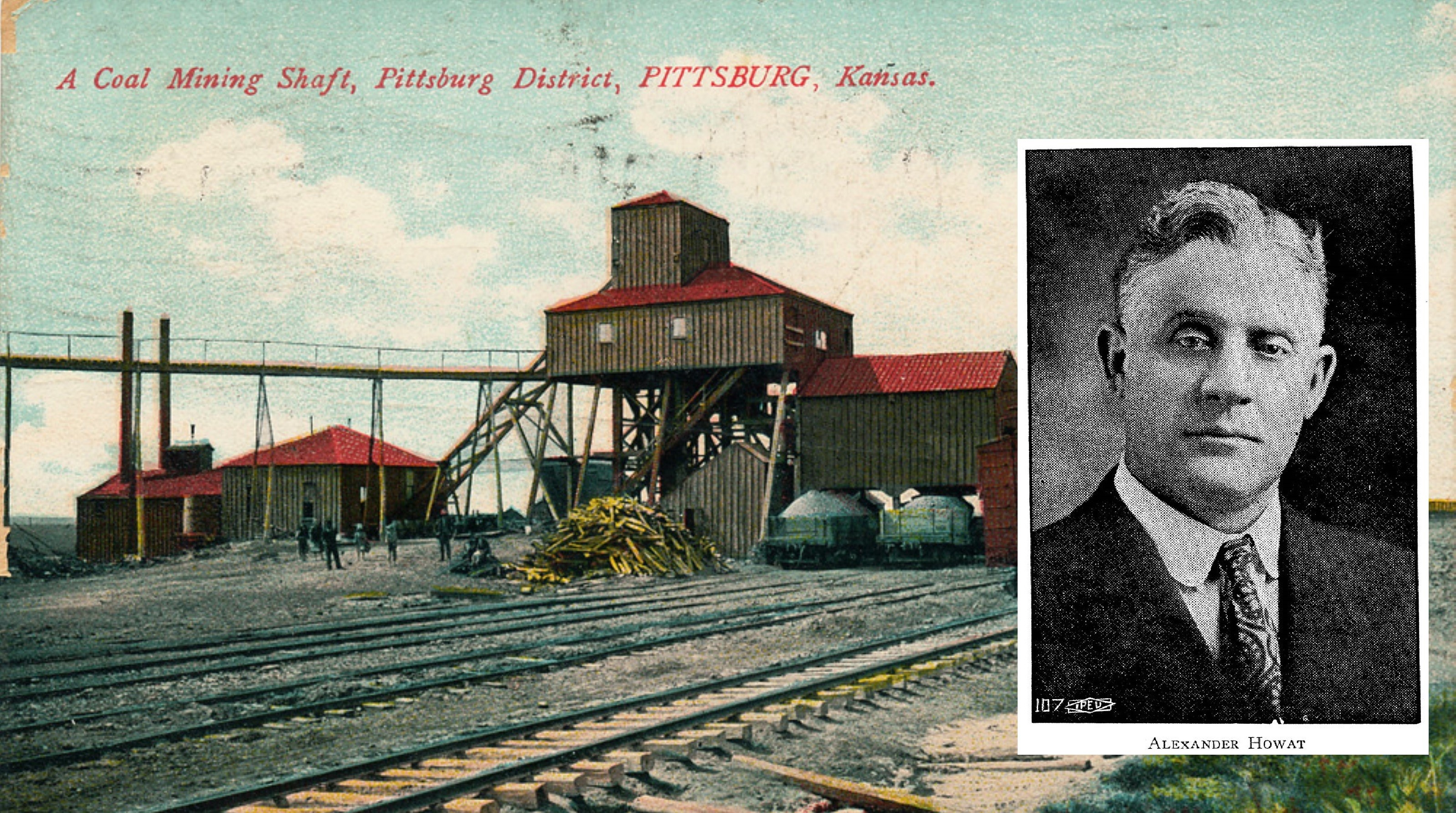
Though barely remembered today, Scottish-born Kansas miners’ leader was among the outstanding labor leaders of his generation. Long an advocate of democratic, progressive unions he was a constant thorn in the side of the U.M.W.A.’s corrupt leadership including John L. Lewis, who had this loyal union stalwart expelled from the U.M.W. and ‘blacklisted’ from the labor movement. Howat’s career stills casts a favorable shadow over the labor movement today.
‘Alexander Howat’ by John Dorsey from Labor Herald. Vol. 2 No. 2. April, 1923.
AMONG the most outstanding characteristics of our trade union leaders are their lack of principles and their general spinelessness. In their company Alexander Howat is as a lone pine in a landscape of sage brush. He is honest and fearless. His connection with the labor movement has been one long struggle against terrific odds for the principles that are within him. Howat is a striking example of the kind of labor man we stand most in need of, one who has the integrity to advocate something worth while, and the courage to fight for it.
Alexander Howat was born in Glasgow, Scotland, September 10th, 1872, of a coal-mining family. He came to the United States when three years of age. His people settled in Illinois, where he went into the mines at the age of 10. Three years later he went to Kansas, where, with the exception of one year that he spent working in the mines of Scotland, he has been employed ever since in connection with the mining industry. He was elected President of District 14, including Kansas and three Missouri counties, in 1902, and has been re-elected President for each succeeding term, until the present.
Howat Whips John P. White

In his never-ending fight for the Kansas miners, Howat has had many bitter struggles with the fakers heading the United Mine Workers of America. A memorable one was his battle with John P. White in 1914-15. In an effort to ruin him the coal operators of Kansas charged Howat openly with having accepted a heavy bribe to support the formation of an arbitration court which should hamstring the Kansas miners and make it impossible for them to strike. White, posing as the friend of Howat, induced him to resign his office as President of District 14, pending the time when he could be vindicated in the courts. Then, double-crosser that he was, White tried to foist upon Howat an Iowa lawyer, a tool of the coal companies, to defend him in his fight against the Kansas coal operators. The sturdy Howat, however, refused to be so manhandled, and insisted upon a lawyer of his own choosing. The fight dragged on for 21 months. Then the District election took place. Howat secured 25 nominations out of the first 27 locals to vote. Alarmed, White demanded that the District do not elect Howat until he had “vindicated” himself. Then he foolishly agreed to go to Kansas and debate Howat on the proposition.
What happened in the White-Howat debate is one of the most picturesque items in the checkered history of Kansas. There were five set-to’s scheduled. The first one took place in Pittsburg. The opera house was packed with miners; they barely listened to the platitudes and lies of White and his attorney. But when Howat spoke they tore the opera house to pieces, so to speak. For 14 minutes a raging demonstration took place. Even the capitalist papers, all violently opposed to Howat, admitted that he had received the greatest reception of any labor man in the history of Kansas. White was absolutely flattened. Without any further ado, he called off all the other debates and then and there granted the fighting Howat the right to hire his own lawyer.
Howat secured Frank P. Walsh to defend him. This defense was in the form of a suit for libel against C.S. Keith, President of the Kansas Coal Operators’ Association. What Walsh did not show about the rottenness of that organization was not worthwhile mentioning. He forced the coal operators and their agents to clear Howat, and to admit that their bribes had got no further than the tool with which they had wished to corrupt Howat. Result, a rousing vindication of Howat and a complete defeat for John P. White and his Kansas coal-operator friends.
Howat versus Lewis
Unable to “get” Howat through John P. White, the coal operators are now trying to kill him off with the help of John L. Lewis, the present head of the U.M.W. of A. Seizing upon the pretext of an alleged violation of the agreement at the Dean and Reliance strip mines, Lewis, acting in direct response to a letter from the Kansas Coal Operators’ Association, ordered Howat and his men to surrender unconditionally. This Howat refused to do. Lewis then expelled him and the whole District with him, using the notorious Van A. Bitner to reorganize it with hand-picked officers. Then Lewis, to cinch his victory, counted Howat out at the Convention. No tactics were too unscrupulous for him to use. Even to this day he has not preferred charges against Howat or given him a trial.
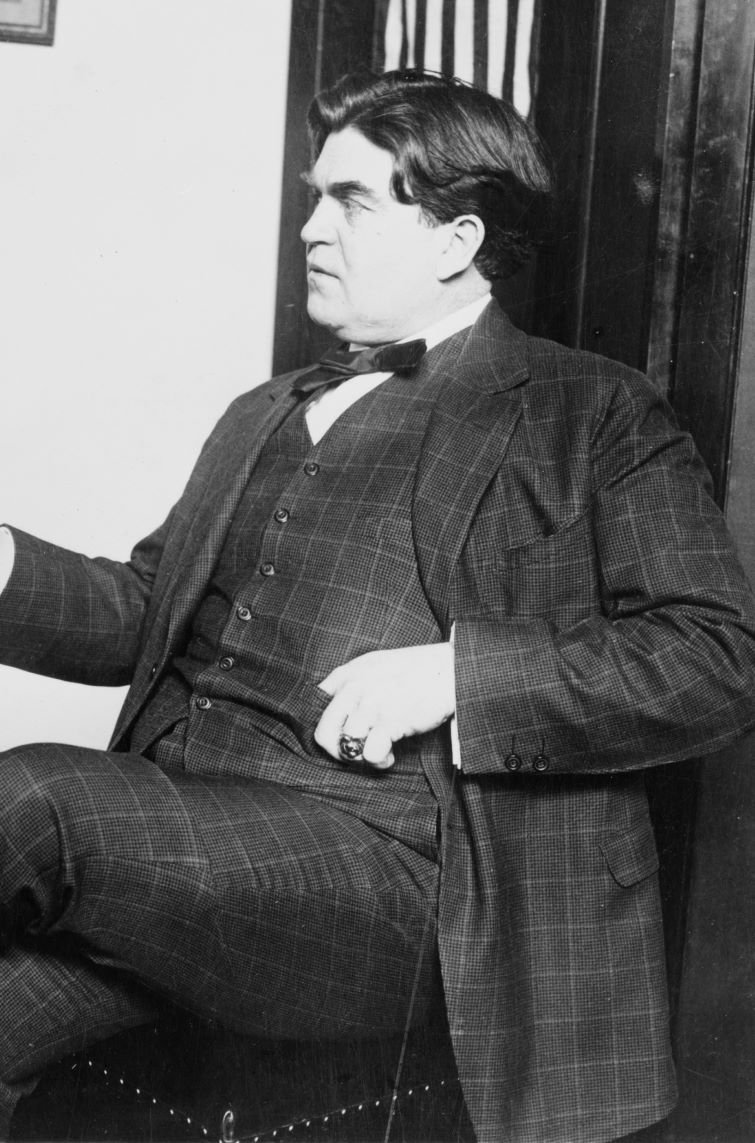
Expelled from the Union, and with his District organization broken up, would seem to be “licking” enough for any man. But not so with Howat. He has just started to fight. Already the reorganized Kansas District is with him fully 90%. Now that he is out of jail he is organizing his fight for a square deal and readmittance to the U.M.W. of A. From all over the country assurances of support are being sent him.
That he will force the granting of a trial and his reinstatement is a foregone conclusion. John L. Lewis is in for a bigger defeat at the hands of Howat even than was given to John P. White. Lewis made the mistake of his life when he expelled the bull-dog Howat. This he will learn to his cost before many months have gone by.
Howat Smashes Industrial Court
Incidentally, while carrying on his fight against Lewis, Howat gained one of the most important victories ever achieved by Labor in this country, by wrecking the Industrial Court in Kansas. When Governor Henry J. Allen brought forth this new-fangled court he was heralded all over the country as having solved the labor problem. At last the means had been found to safely hog-tie the working class and render it incapable of intelligent revolt. Allen was boomed for the U.S. presidency, and his Industrial Court proposition spread to many states. Undoubtedly organized Labor was in for a disastrous siege under this new attack.
But Howat, with the backing of his loyal Kansas miners, upset the whole program. Despite the fact that Lewis, President of his own organization, knifed him at every opportunity and co-operated openly with the mine operators, Howat boldly defied the Industrial Court. He ordered strike after strike, in the face of its sharpest condemnation. He gamely went to jail rather than yield to its jurisdiction. And the result has been the complete discrediting of the Industrial Court, not only in Kansas but throughout the country. Governor Allen’s bubble has burst, punctured by the indomitable Howat. The people of Kansas have overwhelmingly repudiated Allen and his system of enslavement. At the last election they voted into office, by a tremendous majority, a new Governor pledged definitely to abolish the Industrial Court.
Howat Saves U.M.W. of A.
One of the strongest characteristics of Howat is his absolute opposition to dual unionism. He is an old experienced fighter in the organization, and has no sympathy whatever for the elements that say nothing can be done. He has learned from past fights that where the militant elements put up even a little bit of an organized effort they are bound to get results. In the capitalist press recently stories appeared to the effect that Howat, upon his release from jail, would start a dual organization in opposition to the United Mine Workers. This was a lie cut from whole cloth and was circulated by his coal-operator and union-bureaucracy enemies to discredit him.
The supreme test of Howat’s loyalty to the United Mine Workers and his good sense as a labor tactician, came immediately after his expulsion by Lewis. It was a critical moment. The organization was confronted by a national general strike, the biggest in its history. All over the country the dual unionists, seeking to discourage Howat from further battling in the U.M.W. of A., urged him to quit that organization and to form a new coal miners’ union. Had he hearkened to this advice the miners’ organization would have been split in the middle and unquestionably destroyed by the terrific offensive of the operators. But Howat, true to his principles, refused such fatal advice. Notwithstanding his expulsion, which was one of the most outrageous in labor history, he stood his ground, determined to fight out the issue under the banner of the U.M.W. of A. This stand of Howat surely saved the Union. For his loyalty and good sense in this crisis the organization owes him a debt it can hardly repay. The very least it can do is to reinstate Howat and the loyal fighters who have stood with him in the struggle against the Kansas coal operators and their friend, John L. Lewis.
The Labor Herald was the monthly publication of the Trade Union Educational League (TUEL), in immensely important link between the IWW of the 1910s and the CIO of the 1930s. It was begun by veteran labor organizer and Communist leader William Z. Foster in 1920 as an attempt to unite militants within various unions while continuing the industrial unionism tradition of the IWW, though it was opposed to “dual unionism” and favored the formation of a Labor Party. Although it would become financially supported by the Communist International and Communist Party of America, it remained autonomous, was a network and not a membership organization, and included many radicals outside the Communist Party. In 1924 Labor Herald was folded into Workers Monthly, an explicitly Party organ and in 1927 ‘Labor Unity’ became the organ of a now CP dominated TUEL. In 1929 and the turn towards Red Unions in the Third Period, TUEL was wound up and replaced by the Trade Union Unity League, a section of the Red International of Labor Unions (Profitern) and continued to publish Labor Unity until 1935. Labor Herald remains an important labor-orientated journal by revolutionaries in US left history and would be referenced by activists, along with TUEL, along after it’s heyday.
PDF of full issue: https://www.marxists.org/history/usa/pubs/laborherald/v2n02-apr-1923.pdf
 Revolution's Newsstand