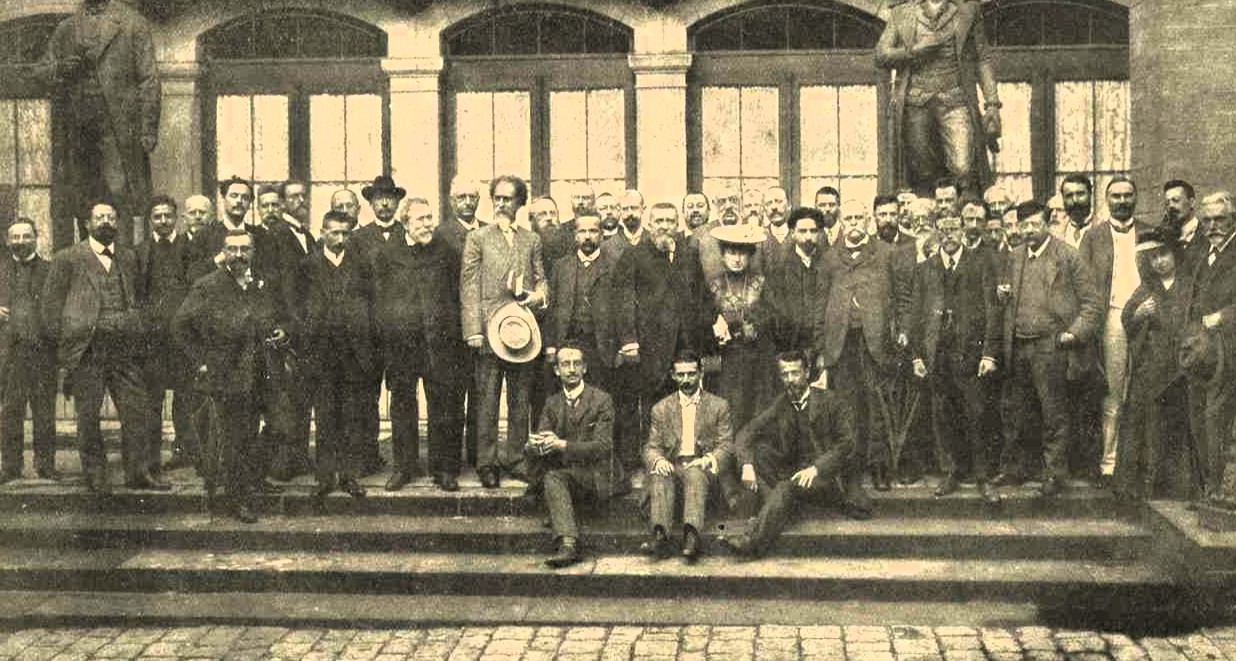
An important document from our movement’s history. In what was also a stinging rebuke to U.S. delegates Morris Hillquit, Algernon Lee, and A.M. Simons, the 1907 Congress of the Socialist International held in Stuttgart passed this resolution. At the time, many conservative trade unions sought restrictions on immigration. The Socialist Party’s delegates (minus Louis B. Boudin) echoed those reactionary voices and supported a racist exclusion of Asian emigrants. The International was compelled to take a stand and overwhelmingly supported this position, to which Lenin remarked, ‘…in the Commission there was an attempt to defend narrow, craft interests, to ban the immigration of workers from backward countries (coolies—from China, etc.). This is the same spirit of aristocratism that one finds among workers in some of the “civilised” countries, who derive certain advantages from their privileged position, and are, therefore, inclined to forget the need for international class solidarity. But no one at the Congress defended this craft and petty-bourgeois narrow-mindedness. The resolution fully meets the demands of revolutionary Social-Democracy.’
‘Resolution on Emigration and Immigration of Workingmen’ by the Socialist International from The Worker (New York). Vol. 17 No. 27. October 5, 1907.
Declares Against Restrictive Laws, Especially as Applying to Specified Races, and Advises Various Remedial Measures.
The following is the resolution adopted, after long and animated debates, by the Commission on Emigration and Immigration and approved by the International Socialist Congress at Stuttgart:
The Congress declares:
Immigration and emigration of workingmen are phenomena as inseparable from the substance of capitalism as unemployment, overproduction, and underconsumption by the workingmen; they are frequently one of the means to reduce the share of the workingmen in the product of labor; and at times they assume abnormal dimensions thru political religious and national persecutions.
The Congress does not consider exceptional measures of any kind, economic or political, the means for removing any danger which may arise to the working class from immigration and emigration, since such measures are fruitless and reactionary: especially not the restriction of the freedom of migration and the exclusion of foreign nations and races.
At the same time the Congress declares it to be the duty of organized workingmen to protect themselves against the lowering of their standard of life which frequently results from the mass importation of unorganized workingmen. The Congress declares it to be their duty to prevent the import and export of strikebreakers.
The Congress recognizes the difficulties which in many cases confront the workingmen of the countries of a more advanced stage of capitalist development thru the mass immigration of unorganized workingmen accustomed to a lower standard of life and coming from countries of prevalently agricultural and domestic civilization, and also the dangers which confront them from certain forms of Immigration.
But the Congress sees no proper solution of these difficulties in the exclusion of definite nations or races from immigration, a policy which is besides in conflict with the principle of proletarian solidarity. The Congress, therefore, recommends the following measures:
I. For the countries of Immigration:
1. Prohibition of the export and import of such workingmen as have entered into a contract which deprives them of the liberty to dispose of their labor-power and wages.
2. Legislation shortening the workday, fixing a minimal wage, regulating the sweating system and house industry, and providing for strict supervision of sanitary and dwelling conditions.
Abolition of all restrictions which exclude definite nationalities or races from the right of sojourn in the country and from the political and economic rights of natives or make the acquisition of these rights more difficult for them. It also demands the greatest latitude in the laws of naturalization.
4. For the trade unions of all countries the following principles shall have universal application in connection with It:
a. Unrestricted admission of immigrant workingmen to the trade unions of all countries.
b. Facilitating the admission of members by means of fixing reasonable admission fees.
c. Free transfer from the organizations of one country to those of the other upon discharge of the membership obligations towards the former organization.
d. The making of international trade-union agreements for the purpose of regulating these questions in a definite and proper manner and rendering possible the realization of these principles on an international scope.
5. Support of the trade unions of those countries from which the immigration is chiefly recruited.
II. For the countries of Emigration:
1. Active propaganda for trade unionism.
2. Enlightenment of the workingmen and the public at large on the true conditions of labor in the countries of Immigration.
3. Concerted action on the part of the trade unions of all countries in all matters of labor immigration and emigration.
In view of the fact that emigration of workingmen is often artificially stimulated by railway and steamship companies, land speculators, and other swindling concerns thru false and lying promises to workingmen, the Congress demands:
Control of the steamship agencies and emigration bureaus and legal and administrative measures against them in order to prevent the abuse of emigration in the interest of such capitalist concerns.
III. Regulation of the system of enumeration, especially on ships.
Employment of inspectors with discretionary power who would be selected by the organized workingmen of the countries of emigration and immigration. Protection for the newly arrived immigrants, in order that they may not become the victims of capitalist exploiters.
In view of the fact that the transport of emigrants can be regulated only on an international basis, the Congress directs the International Socialist Bureau to prepare suggestions for the regulation of this question. which shall deal with the conditions, arrangements, and supplies of the ships, the air space to be allowed for each passenger as a minimum, and shall lay special stress, that the individual emigrants contract for their passage directly with the transportation companies and without intervention of middlemen. These suggestions shall be communicated to the various Socialist parties for the purpose of legislative application and adaptation as well as for purposes of propaganda.
The Worker, and its predecessor The People, emerged from the 1899 split in the Socialist Labor Party of America led by Henry Slobodin and Morris Hillquit, who published their own edition of the SLP’s paper in Springfield, Massachusetts. Their ‘The People’ had the same banner, format, and numbering as their rival De Leon’s. The new group emerged as the Social Democratic Party and with a Chicago group of the same name these two Social Democratic Parties would become the Socialist Party of America at a 1901 conference. That same year the paper’s name was changed from The People to The Worker with publishing moved to New York City. The Worker continued as a weekly until December 1908 when it was folded into the socialist daily, The New York Call.
PDF of full issue: https://www.marxists.org/history/usa/pubs/the-people-the-worker/071005-worker-v17n27.pdf
 Revolution's Newsstand