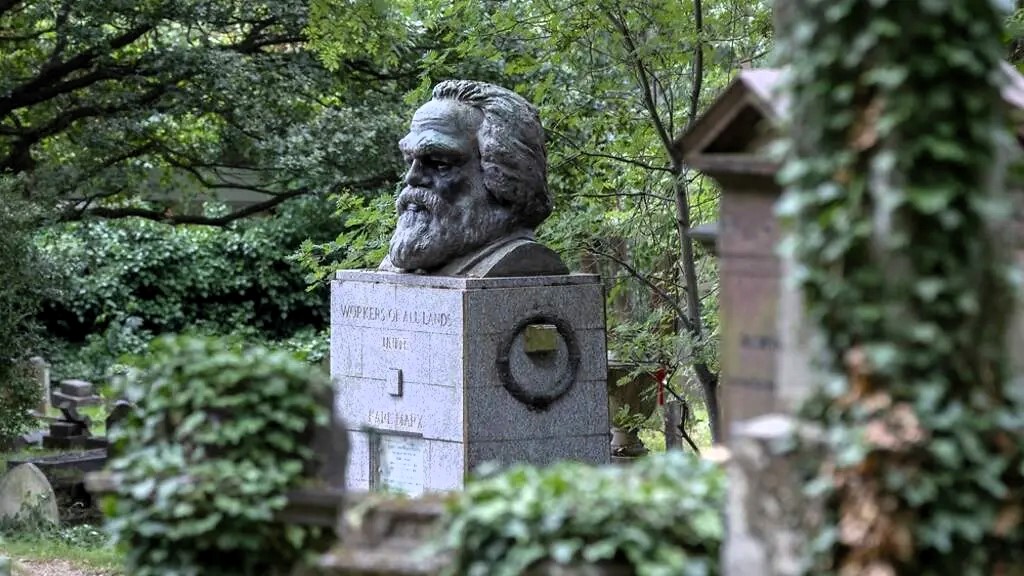
‘Karl Marx on the Irish Question’ (1916) by Grigory Zinoviev from the Daily Worker. Vol. 4 No. 215. September 22, 1927.
Marx and Engels followed the national movements of the Italians, Hungarians, Poles, Irish, etc., with the greatest attention and the warmest sympathy. In many articles and in many more letters to their friends, there can be found abundant material disclosing the attitude of Marx and Engels toward these national currents. They understood how to explain every one of these movements from a historical-materialist standpoint, how to reveal their social-economic causes. Marx followed with particular eagerness, the movement in Ireland, while he lived in England. And during the time of the 1st International and thereafter, he tried to support the Irish movement with all his power, always stressing to the English workers, that the independence of Ireland must be their first thought, and that this was unthinkable without a proletarian revolution in England.
In his letter to Siegfried Mayer on April 9, 1870, Marx wrote: “Ireland is the bulwark of the English land-owning aristocracy. The exploitation of this country is not only the chief source of England’s national riches, but it is her greatest moral power. It represents in fact the hegemony of England over Ireland. Ireland is therefore the powerful means whereby English aristocracy maintains its rule over England itself. On the other hand, if the English army and police should evacuate Ireland tomorrow, you would immediately have an agrarian revolution in Ireland. The overthrow of the English aristocracy in Ireland, makes necessary, and will be the result of its overthrow in England. Thereby the preparatory conditions for a proletarian revolution in England would be fulfilled…
“As far as the English bourgeoisie is concerned, its interests are fully in accord with those of the English aristocracy, to turn Ireland into a mere pasture land, in order to furnish the English market with meat and wool at the lowest possible price…But the English bourgeoisie has a still more important interest in the present-day Irish economy. Ireland, because of the perpetually increasing concentration of leaseholds, furnishes a continual surplus for the English labor market, and thereby depresses the wages as well as the material and moral position of the English working class. And most important! All industrial and commercial centers of England now possess a personnel, which is split into two opposing camps, English proletarians and Irish proletarians. The ordinary English worker hates the Irish worker as a rival, who depresses his standard of life. He looks upon the Irish worker as does a member of the ruling nation, and therefore he makes himself the tool of the aristocrats and capitalists against Ireland, and thereby strengthens their rule over himself. He nurses religious, social and national prejudices against him. He conducts himself toward the Irish worker in about the same way as did the whites to the Negroes in the former slave states of the union. The Irishman pays him with interest in! his own coin. He sees in the English worker, simultaneously the accomplice and the stupid tool of the English rule over Ireland. These antagonisms are cleverly kept alive through the press, the pulpit, the humorous magazines, in short through all the means at the command of the ruling class. This antagonism is the secret of the weakness of the English working class, in spite of its organization. It is the secret of the enormous power of the capitalist class of England. Of this fact the ruling class is fully aware.
“This evil does not stop here, but is carried across the ocean. The antagonism between Englishmen and the Irish, is the secret foundation of the antagonism between England and the United States. It makes every earnest and honest cooperation between the working class of the two countries impossible. It permits the government of the two countries, as soon as they deem it necessary, to break the edge of the social conflict, by raising these antagonisms, and in case of necessity through war between these two nations.
“England as the metropolis of capital, as the power, which until now, has ruled the world market, is for the time being, the most important country for the workers’ revolution, and in addition the only country, where the material conditions of the revolution, have developed to a certain ripeness. To accelerate the social revolution in England is therefore the most important task of the international workers’ association. The only means of accelerating it, is to make Ireland independent. It is therefore the task of all internationalists, every- where, to place in the foreground the conflict between England and Ireland, openly to take the side of Ire- land. It is the special task of the General Council in London, to awaken the consciousness of the English working class to the fact that the national emancipation of Ireland is no abstract question of justice or humanitarian feeling, but that it is the first condition of its own social emancipation.”
These wonderful words of Marx have a deep historical significance. They give a clear explanation of the entire stand of Marxism toward the national question. It behooves socialists who are vacillating in their position on this question, those who cannot find the correct path, to study these Marxian words.
The workers of a world power remain the slaves of their bourgeoisie and forge their own chains, if they do not fight for the freedom and independence of the oppressed peoples, if they do not fight, for the political independence, i.e., for the self-determination of those nations which are under the yoke of their own bourgeoisie. (Mark does not employ the term self- determination, but he writes in this sense.) Without the elimination of the differences between the workers of the oppressing and the oppressed country, a successful struggle for socialism is impossible. The bourgeoisie know very well, that the best means of maintaining capitalist domination, is by creating conflicts between the workers of the different lands, particularly between the workers of the ruling nation and those of the oppressed. nation. And the best means of inciting this conflict and of bringing it to a protracted head, is for the workers of the oppressed nation to sow the suspicion that the workers of the ruling nation are denying them and their people, freedom, independence and self-government. In order to create conditions, which will rally the workers of an oppressed nation, without hesitation, alongside of the proletarians of the ruling nation, it is necessary that the latter fight ceaselessly against its own bourgeoisie for the self-determination of all nations. Particularly those proletarians, which belong to the dominant nation, must battle for this right. If they don’t do this, they will become blind tools of the bourgeois chauvinists, and in this manner they help the bourgeoisie of various countries to push social conflicts into the background and to substitute for them national conflicts. The bourgeoisie is thus placed in a position to declare wars, whenever it suits its purpose, and thus the workers are forced to fight, brother against brother.
In a public speech at a meeting, arranged by the association of “Fraternal Democrats” on the 29th of November, 1847, in memory of the Polish uprising of 1830, Engels said, “A nation cannot become free and at the same time continue to oppress other nations. The freedom of Germany cannot therefore be realized, without the freedom of Poland from the oppression of Germany becoming a fact.”
The words underlined by us contain a very important Marxian principle on the nation question. In a few words’ we have here displayed the contents of the entire politics of Marx and Engels in the field of the national question. The working class of a ruling nation, which does not recognize the necessity of the struggle against the privileges of domination and for the right of self-determination of peoples, cannot hope to overthrow its “own”. bourgeoisie. It must remain the slave of this bourgeoisie.
Only when the working class comes out for self-determination of peoples, does it take the initiative from the hand of the bourgeoisie of the oppressing as well as the oppressed nation, and create the conditions, whereby it brings about the unity of the working class of all countries, the oppressed as well as the imperialist powers. Now, when five or six world powers force the yoke upon hundreds of millions of dependent, oppressed nationals, it is the particular duty of the workers of the ruling countries to advocate the right of self-determination. This is the only method of carrying on a struggle against the chauvinism of one’s “own” bourgeoisie. Only by this struggle, will it be possible for the workers of the oppressed countries to eliminate the suspicion toward the workers of the ruling nation, and only this struggle will take from the bourgeoisie the possibility of inciting the workers against each other, splitting up their forces and thus to hindering the struggle for socialism.
The quoted words of Marx have not only a significance for the solution of the Irish question. They carry a far more universal character. It behooves not only the social Chauvinists to study them, but also those socialists, who stand upon the ground of international socialism, and yet find it unnecessary and even harmful to raise the question of self-determination of peoples, in the consideration of a Marxian program.
Translated by Bert Miller from “War and the Crisis of Socialism,” by G. Zinoviev.
The Daily Worker began in 1924 and was published in New York City by the Communist Party US and its predecessor organizations. Among the most long-lasting and important left publications in US history, it had a circulation of 35,000 at its peak. The Daily Worker came from The Ohio Socialist, published by the Left Wing-dominated Socialist Party of Ohio in Cleveland from 1917 to November 1919, when it became became The Toiler, paper of the Communist Labor Party. In December 1921 the above-ground Workers Party of America merged the Toiler with the paper Workers Council to found The Worker, which became The Daily Worker beginning January 13, 1924. National and City (New York and environs) editions exist.
PDF of full issue: https://www.marxists.org/history/usa/pubs/dailyworker/1927/1927-ny/v04-n215-NY-sep-22-1927-DW-LOC.pdf
 Revolution's Newsstand