
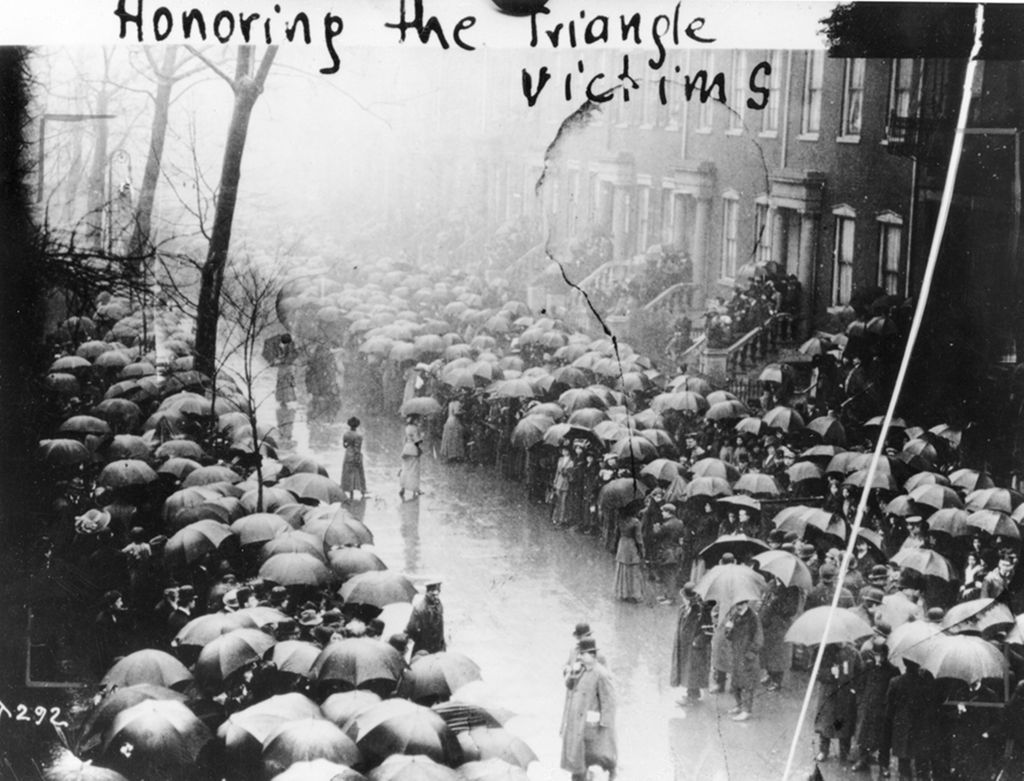
The Triangle Shirtwaist Factory fire, in which 146 workers perished, swept the New York sweatshop on March 25, 1911. Mostly young women and girls, the largely Jewish and Italian immigrants working there were burned to death or died from smoke inhalation attempting to flee the building, only to find the exits locked by management seeking to prevent unauthorized breaks. The outrage gave great impetus to organizing by the International Ladies Garment Workers Union and other unions. The funeral, in the pouring rain, for the victims was one of the largest ever held in the United States with hundreds of thousands participating or observing. Theresa Malkiel, herself a garment worker, gives this powerful description of the procession through the class-divided streets of Manhattan.
‘The Funeral Procession’ by Theresa Malkiel from The New York Call. Vol. 4 No. 98. April 8, 1911.
Dark gray and threatening was the atmosphere above on this April morning: dark gray and fearsome rose the tall factory buildings where human life is cheaper than gold: dark gray and determined looked the host of workers gathered to pay their last tribute to their murdered comrades and sound a warning to the cold blooded, murderers.
Tramp, tramp, through the wet, slippery streets: fast and steadily. men and women and children hurried on to join the ranks. Column after column, division after division was started off and still they came, even as the pouring rain.
Stooped from the long days of toll, pale and tired even during the early hours of the morning, and they were yet eager and anxious to join the procession.
Hatless, and often coatless, their wet clothes clinging to their bodies. their thin, mud-soaked shoes squeaking, the sorrowing workers heeded not the elements nor the shortcomings of the human organism. It did not seem to matter.
Self was eliminated for the time being. Their thoughtful, far away gaze, their tightly shut lips, their fast breathing bespoke eloquently, though silently, their deep emotions. At the first glance one was convinced that this mute army of horny handed sons and daughters of toil was imbued with the spirit of self-sacrifice for the common good.
Even to a casual observer it was clear that to them the disaster of the Triangle fire was a never to be forgotten occurrence. And yet they did not weep or lament–nature did it for them. It looked as if the heavens had heard their silent cry of protest, and, donning the dark garb of mourning. poured out the suppressed tears.

Neither pen nor words could ever express the impression created by the joint tribute which nature and humanity paid to the innocent victims of the terrible disaster.
Never before, and let us hope never after, will New York witness as sad and heartrending a gathering as the one assembled to pay tribute to the dead, innocent victims. Starting from amidst a neighborhood of squalor and poverty, keeping time with the black clouds above, the black wave below moved onward, further and further into the very heart of the city, toward the million dollar shops, toward the gay white way, where music. frolic, and laughter are never wanting.
But gradually, as the human tide advanced, the brilliant displays in the shop windows lost their brilliancy and faded into insignificance. Music and laughter ceased, a silence possible only in the presence of the dead fell over all.
Slowly moving came the three pairs of white horses dressed in black harness which pulled the truck of floral tributes. High, high, piled one on top of the other lay the pink, red and white roses, each petal fluttering in the air like the pure innocent lives while they were being crushed out of the youthful bodies. Like so many accusing fingers trembled the numerous stems and leaves bringing the horrible crime straight home to every human heart, to every thinking mind.
Flowers were there instead of the bodies that were at that moment being buried in obscurity. And around them, forming the guard of honor, walked the Waist Makers’ Union, that brave body of men and women who sought a year ago to avert the terrible calamity. Following them came thousands, nay hundreds of thousands, of men and women, warped and crippled by hard toll and the bitter struggle for existence, legions upon legions of over- worked. exhausted men and women. all in the prime of life and all bearing the stamp of suffering and submission on their sad faces. Hour after hour went by and still they came, a cosmopolitan assembly such as no other city had ever witnessed before, a power to which even the enemy had bowed its head and lowered its flags. Business, profit and greed were lost sight of. Love, that almighty elixir of life, permeated all: people realized of a sudden that they, too, were but mortal. They centered their eyes on the gruesome cortege, on the silent mourners, then tried to avert a guilty gaze.
Human nature, true human nature, full of sympathy, sorrow and regret, was their next expression. It came spontaneously, flashed from every eye, old and young. Jew and Gentile, foreigner and American, they all seemed imbued with one feeling, one thought–something must be done, something shall be done to avert a similar occurrence.
Thus sad and earnest, even as the marchers themselves, stood by far the greater multitude of lookers-on. They were not the usual curious crowd so easily gathered in the streets of New York, but a body of men and women deeply impressed by the significance of the event.
Three hundred thousand workers. nay, even more–a vast uncountable number of workers, organized and unorganized alike; men, women and children from every corner of Greater New York: people of all sorts of trade and occupation sacrificed their earnings and time, braved the elements and came out to mourn the dead, to protest against the existing dangers to the living.
Labor, that great, powerful army that swarms the mills, factories and sweatshops, submissively dragging on in miserable existence that others may live, threw down the shackles of bondage and forcefully demonstrated its tremendous strength to the world at large. Soaked to the bone, cold and hungry, it carried with it, nevertheless, the dignity which is always its own, but is so seldom expressed, and for this once the world took labor at its true worth. Another few manifestations of stanch solidarity and the tables will have to be turned, the sacrifice of human life stopped.
The New York Call was the first English-language Socialist daily paper in New York City and the second in the US after the Chicago Daily Socialist. The paper was the center of the Socialist Party and under the influence of Morris Hillquit, Charles Ervin, Julius Gerber, and William Butscher. The paper was opposed to World War One, and, unsurprising given the era’s fluidity, ambivalent on the Russian Revolution even after the expulsion of the SP’s Left Wing. The paper is an invaluable resource for information on the city’s workers movement and history and one of the most important papers in the history of US socialism. The paper ran from 1908 until 1923.
PDF of full issue: https://www.marxists.org/history/usa/pubs/the-new-york-call/1911/110408-newyorkcall-v04n098.pdf
 Revolution's Newsstand