
Another, less hellish, look at the process of production from ISR. Here Arthur Ruskin takes us into a potters workshop.
‘The Potter and His Clay’ by Arthur Ruskin from the International Socialist Review. Vol. 16 No. 3. September, 1915.
OF ALL the great industries in the world today, perhaps the one that has progressed least with the passing years, is potting. It is true, of course, that the demand and the output have increased wonderfully, but the modern machine and the automatic process seem to have made less headway here than in any other known branch of industry. This is perhaps due to the character of the raw materials.
While glass making has leaped from the old hand or blown method into a process where, from the mixing of the raw materials to the blowing and packing of glass bottles themselves, these commodities are practically untouched by the hand of man, pottery ware, though often partially cast in moulds, is still “turned” by lathe by hand.
Perhaps there are more pottworks in the world today than plants for any other industry. Over one hundred thousand families in Japan have their own home kilns. There every member of the family is engaged in home potting and their products are sold so cheap as to compete with the most modern potteries abroad. Millions of dollars’ worth of Japanese ware are shipped out annually.
Early methods of preparing clay for the potter’s hand were, naturally, of the most primitive character. The crude material was simply thrown into the tank or pit and manipulated with a spade or paddle, then taken out in large chunks and cut through and through with a fine wire stretched be-tween the two hands of the workman, the pebbles and other foreign substances being picked out as the work progressed.
In 1835 a patent was granted Adam Weber of Womelsdorf, Pa., for a contrivance for purifying potters’ clay, consisting of a hollow metal or wooden cylinder with a wire sieve placed across the bottom through which the moist clay was forced by means of a block or piston worked by a lever. This simple apparatus is still employed in some of the potteries where coarse earthenware is made.
Today most of the clay used in potting is carefully washed before being shipped to the manufacturer and the flint and feldspar are finely ground at the quarry. These materials in due proportions are placed in tanks called “plungers” with the necessary amount of water and worked, tons at a charge, by machinery in a short space of time.

The mass is then sifted and forced through canvas bags held in what is termed a “press,” the surplus moisture being expelled. An improved hydrostatic press, made by A.J. Boyce of E. Liverpool, Ohio, is now in use in many potteries with great success.
The potter’s wheel used until only a few years ago was a clumsy affair. The potter sat on a framework bench behind the wheel while in front were piled lumps of clay to be manipulated. This contrivance was termed a “kick wheel.” The workman pushed the wheel around with his feet.
The “throw wheel” was an improvement but required an extra hand to turn the wheel that in turn caused the potter’s disk to revolve. And on this disk was the lump of clay worked by the potter. Small potteries use a treadle today.
“Jiggers” and “jollies” now facilitate the manufacture of circular and swelled vessels such as jugs, crocks, cuspidors, etc. A “jigger” is a machine carrying a revolving mould in which the clay is shaped by the “former” which is brought down into the mould and held there by a lever.
A “jolly” is a somewhat similar contrivance used principally in making plates, saucers and flatware. It consists of a revolving disk or wheel on which the mould is placed.
The lathe used by the potter is similar to the lathe used in wood turning. A wooden block made of the proper size for the cup or other articles to be turned is screwed to the spindle of the lathe. These are the only important machines that have been added to the old time pottery industry. Other similar machinery has been invented but owing to the nature of the materials, never proved really practicable.
The model for any piece of ware, a jug, for instance, having been designed and finished, is taken in hand by the mould-maker who makes the mould from it that will part in the middle. This is called the “block mould” and is carefully preserved. From this a “case” is made, which is a replica in plaster of the model. From this “case” as many working moulds as may be required can be made. Plaster of paris moulds are used in the manufacture of all wares except in such as are “thrown.”
When a vessel is made by hand on the potter’s wheel the process is called “throwing.” This is the oldest method of pottery making employed by civilized man and is still in use in many potteries. The vessels are formed by hand, rubbed smooth with a wet sponge and a piece of leather and set apart to dry.
When the ware is sufficiently dried it is placed on the spindle blocks of the lathe and the turner with a thin tool shaves the vessel to the proper thickness, then, reversing the lathe, burnishes it until the surface is even and smooth.
In making plates and saucers and flat ware, the workman throws the “bat” of clay upon the mould which forms the face of the piece. This is placed on the revolving “jigger” and the back is shaped by a tool which is pressed upon it. The piece is then set aside to dry, after which it is taken from the mould, the edges trimmed and it is ready for firing.
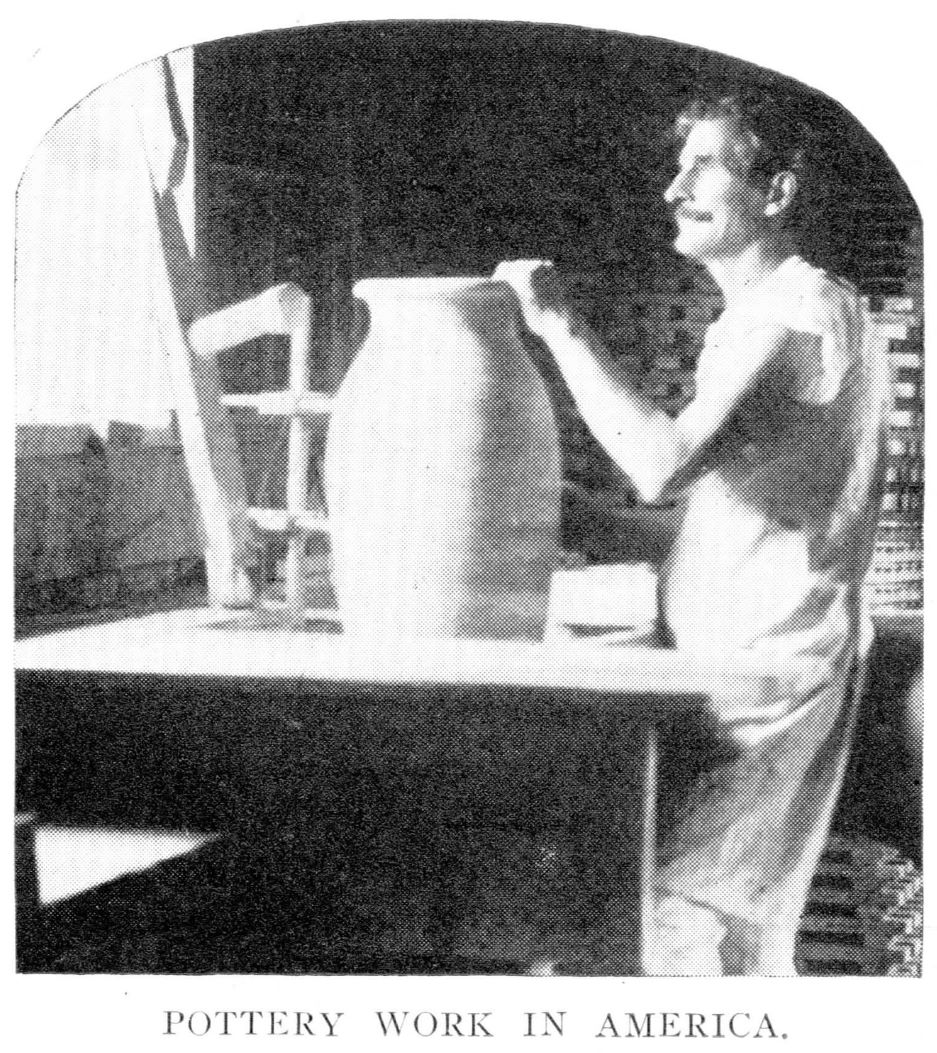
In making hollow pieces such as pitchers, covered dishes and pieces of similar shape, the clay is carefully pressed into the mould, made in two parts which are then brought together. The interior is smoothed and the seams of the mold are covered with a strip of glaze which is worked on smoothly and the mould is set aside until the plaster has absorbed sufficient moisture to allow the pieces to be safely removed. The handles, knobs and spouts which have been made in other moulds are then fitted to the ware and fastened by slips and then the vessel is smoothed and finished and sent to the “green room” to dry.
Thin wares are sometimes made by the casting process, but this has not proven very successful in practical pottworks.
When the biscuit ware is ready to be glazed, the “dipper” immerses it in a tub filled with the glaze which is of the consistency of cream. The ware is then carried to the glost kiln for the second firing.
DECORATION
Pottery and porcelain are decorated either over the glaze or under the glaze. In overglaze decoration vitrified colors (that is, colors that will become as glass), are applied to the glazed surfaces of the finished ware and fixed in the enameling kiln. In under-glaze decoration the colors are placed on the ware either in the green or unfired state or on the biscuit, but it is glazed.
Decorations may also be hand painted or printed. The printing process is used extensively, the designs being engraved on copper plates and transferred to the surface of the ware. Mineral colors which have been carefully mixed are used to print the design onto linen tissue paper which is then laid upon the ware and rubbed with a piece of soft flannel until it adheres evenly and firmly. In a few hours the paper is plucked from the ware and the printed design is then touched up with color by hand and gold lines are frequently applied.
The early Virginia emigrants made coarse earthenware vessels for culinary and other purposes. Previous to 1649 there were several small pottsworks in America which did a thriving business. The Dutch settlers in New York made a ware that almost rivalled Delft.
Some one in England in writing of America in 1688 said, “the potters get sixteen pence for an earthenware pot which may be bought for four pence in England.” About this time the first white ware was made in this country and by 1848 English potters were producing ware for this country from clay shipped from America over to them.
How long ago the first American Indian and before him, his ancestors, first learned to bake clay into crude vessels–who can say?
The International Socialist Review (ISR) was published monthly in Chicago from 1900 until 1918 by Charles H. Kerr and critically loyal to the Socialist Party of America. It is one of the essential publications in U.S. left history. During the editorship of A.M. Simons it was largely theoretical and moderate. In 1908, Charles H. Kerr took over as editor with strong influence from Mary E Marcy. The magazine became the foremost proponent of the SP’s left wing growing to tens of thousands of subscribers. It remained revolutionary in outlook and anti-militarist during World War One. It liberally used photographs and images, with news, theory, arts and organizing in its pages. It articles, reports and essays are an invaluable record of the U.S. class struggle and the development of Marxism in the decades before the Soviet experience. It was closed down in government repression in 1918.
PDF of full issue: https://www.marxists.org/history/usa/pubs/isr/v16n03-sep-1915-ISR-riaz-ocr.pdf
 Revolution's Newsstand