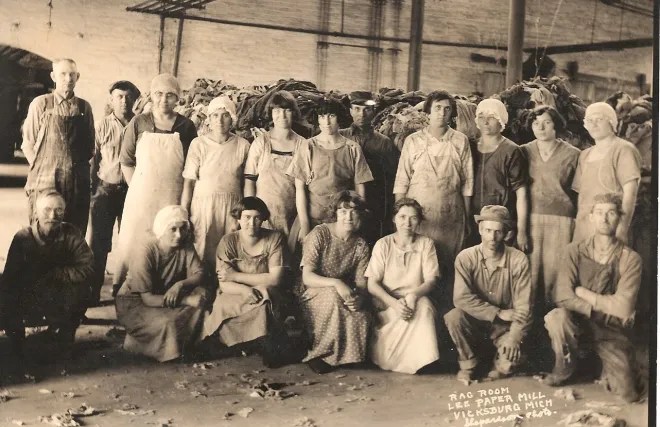
‘Making Paper in Kalamazoo’ from Solidarity. Vol. 3 No. 25. June 15, 1912.
While paper making is one of the leading industries of the United States, there is probably no other line of business in which the profits are larger and their employees exploited more. Dividends of from
50 to 100 per cent are common, yet all the evils of low wages, and dangerous and unhealthy working conditions are, present. Owing to the large amount of water used in the paper making processes, the men have to work bare-footed, and their clothes are nearly always wet.
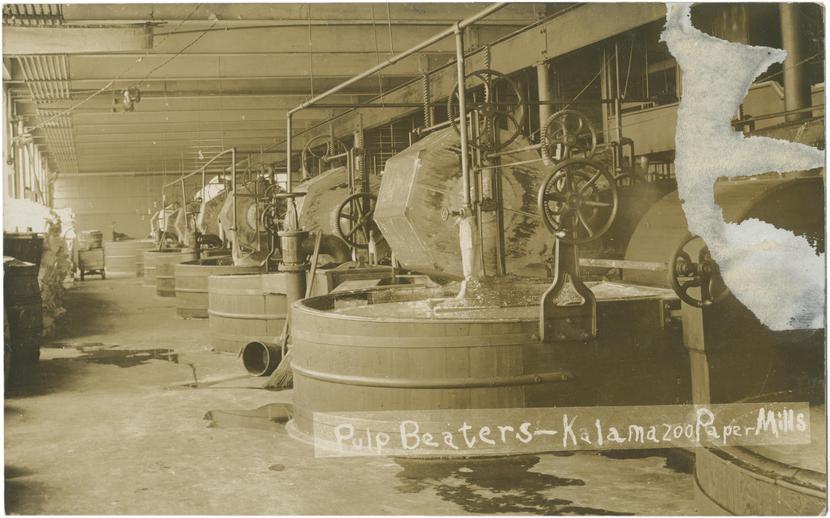
They inhale continually steam and noxious gases caused by the powerful chemicals used in the bleaching processes. The old rags and papers are placed in mammoth bleaching vats, and soaked in hot water and chemicals From this tearfully hot soggy mass, steam and foul vapors arise, and the penetrating odor is staggering.
After the paper or “stock” as it is called is bleached it has to be placed on trucks. Clad only in overalls with no shirts men have to get in these vats of hot steaming water and pitch it on the trucks. As they are paid by the ton there is no loafing on the job. Many are overcome by their frenzied efforts to make a living wage, and the foul atmosphere they have to work in.
Last summer the local press called the attention of the city dads to the fact that the city streets were insufficiently sprinkled. The newspapers emphasized the great danger of epidemic from the dried filth, in the form of street dust, that was being blown in the nostrils of the public by the winds.
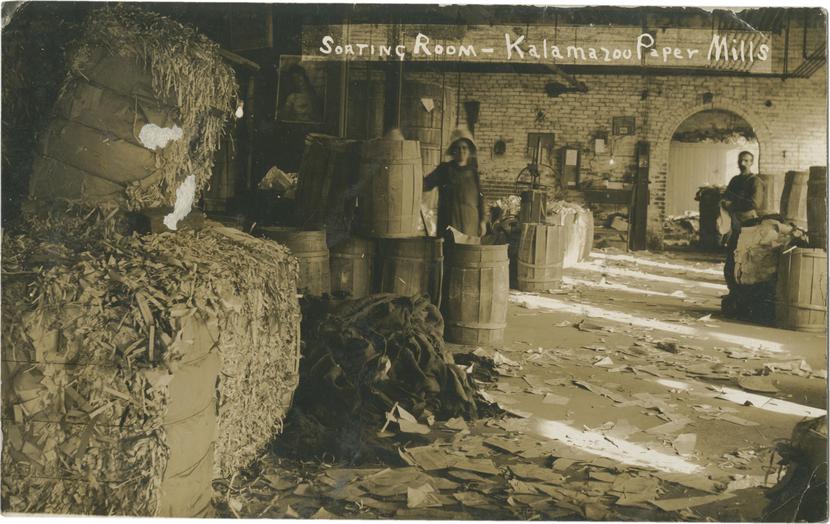
Yet we have in the “sorting rooms” of our Kalamazoo paper mills women and girls who work continually in an atmosphere surcharged with dust and all manners of impurities. Dirt is on the floor, the walls, ceiling, in the air, everywhere in incredible quantities. The chance visitor in these “sorting rooms” can hardly draw breath at first because the dust is so thick in the air
Women Exposed to Disease.
These female employees work in the constant danger of contagion, sorting the old filthy rags and paper collected from every source. You see the junk man with his pack on the street. How would you like to see your wife or daughter handling that dirty refuse? Yet that is the proposition these unfortunate women contend with.
But no one pays any attention to that, oh, no! They are just “sorters.” With the rattle and roar of the machinery, odor and gases from the bleaches, the dirt and dust in the “sorting rooms” make conditions that can only be compared to Dante’s Inferno.
It is a sad sight to see the men leaving these “hell holes” after a night shift of thirteen hours. The duties of many require them to lift and feed into the machines literally tons of “stock.”
The men on the machines work two shifts or “towers,” as they are called, one crew working nights and the other days. These are changed every week, the night “tower” working days and the day “tower” nights. Owing to this alternation, the night crew just gets accustomed to sleeping days when their turn comes to work days the succeeding week. Therefore the evil is much greater than if they worked nights entirely.
The faculties of the night force are therefore always more or less benumbed by loss of sleep. In this condition their duties require them to adjust and climb over and around machinery where the least slip or inattention may cause them to lose life or limb. They have to guide with their fingers thin sheets of paper between swiftly revolving rollers, weighing hundreds of pounds.
The danger is recognized to such an extent that the accident insurance companies class the paper mill occupation as extra-hazardous. It is a common thing to read of accidents in the paper mills and many happen that are never reported in the newspapers.
Last summer a man was killed by being pulled bodily through the rollers of a paper machine. Men have their fingers crushed, and arms and legs wrenched off with altogether too much frequency.
Physically exhausted, with senses dulled from loss of sleep, men are in no condition to be around much dangerous machinery. The great wonder, considering the conditions, is that there not more accidents.
The paper mill corporations are all insured in the factory associations against loss by an accident to an employee. Their profits therefore are secure, even if the breadwinner of a large family loses life or limb by their neglect of the common appliances that make for safety around machinery.
It is a common occurrence for the men to have to work thirty-six and even forty-eight hours without sleep. Any occupation that requires such inhuman, brutalizing service as that needs no comment.
One may ask why do they stand for it? What are they going to do?
The peculiar coincidence exists that all of the large numbers of mills in Kalamazoo pay exactly the same wages, and the same dangerous conditions are present to every one. And they are all owned by practically the same group of men.
Usually when any industry is centralized in one city as the paper mill business is in Kalamazoo, it causes a higher wage scale than would be the case if there were only one factory of that kind in the town. But the reverse is true in Kalamazoo, as there are thousands of men in the paper mills who only receive $1.50 a day. And a large number of married men who receive even less, working at the hardest kind of labor, in constant danger.
Many, to eke out an existence, have to send their wives and families to work in the mills. The paper companies can then. grind their lives out for profits which they will use to build still more of their “hell holes,” and which will in turn exploit another crop of unfortunate wage slaves. For what are they else?
The day “tower” is on duty eleven hours, and receives $1.50, and the night force thirteen hours for $1.08, so the great majority of the paper mill employees receive little better than 18 cents an hour. It is a blot on Kalamazoo that a business paying such profit should pay its employees such a miserable pittance. No wonder large dividends can be paid and mammoth factories built to carry on the exploitation of the working class.
Shame! Shame! that men who have spent their whole lives in acquiring skill in the operation of these machines should be held down at a wage but little above the bread line just because one group of men control the mills in this city.

Well may the promoters ride in automobiles, live in costly mansions, while their employees whose loyalty and skill makes this possible, live in poverty and want.
These mills could be provided with all the safety appliances, they could provide sanitary workrooms and have their employees work human hours and still pay a reasonable dividend.
Above all they could pay better wages and the employees could keep their families at home to make it happier and brighter. The men receiving more wages could patronize our local merchants to a larger extent. Such being the case the paper industry, instead of being a means of excessive profit to the few, would be a source of benefit to the entire community.
Kalamazoo Socialist.
The most widely read of I.W.W. newspapers, Solidarity was published by the Industrial Workers of the World from 1909 until 1917. First produced in New Castle, Pennsylvania, and born during the McKees Rocks strike, Solidarity later moved to Cleveland, Ohio until 1917 then spent its last months in Chicago. With a circulation of around 12,000 and a readership many times that, Solidarity was instrumental in defining the Wobbly world-view at the height of their influence in the working class. It was edited over its life by A.M. Stirton, H.A. Goff, Ben H. Williams, Ralph Chaplin who also provided much of the paper’s color, and others. Like nearly all the left press it fell victim to federal repression in 1917.
PDF of full issue: https://www.marxists.org/history/usa/pubs/solidarity-iww/1912/v03n25-w129-jun-15-1912-Solidarity.pdf
 Revolution's Newsstand