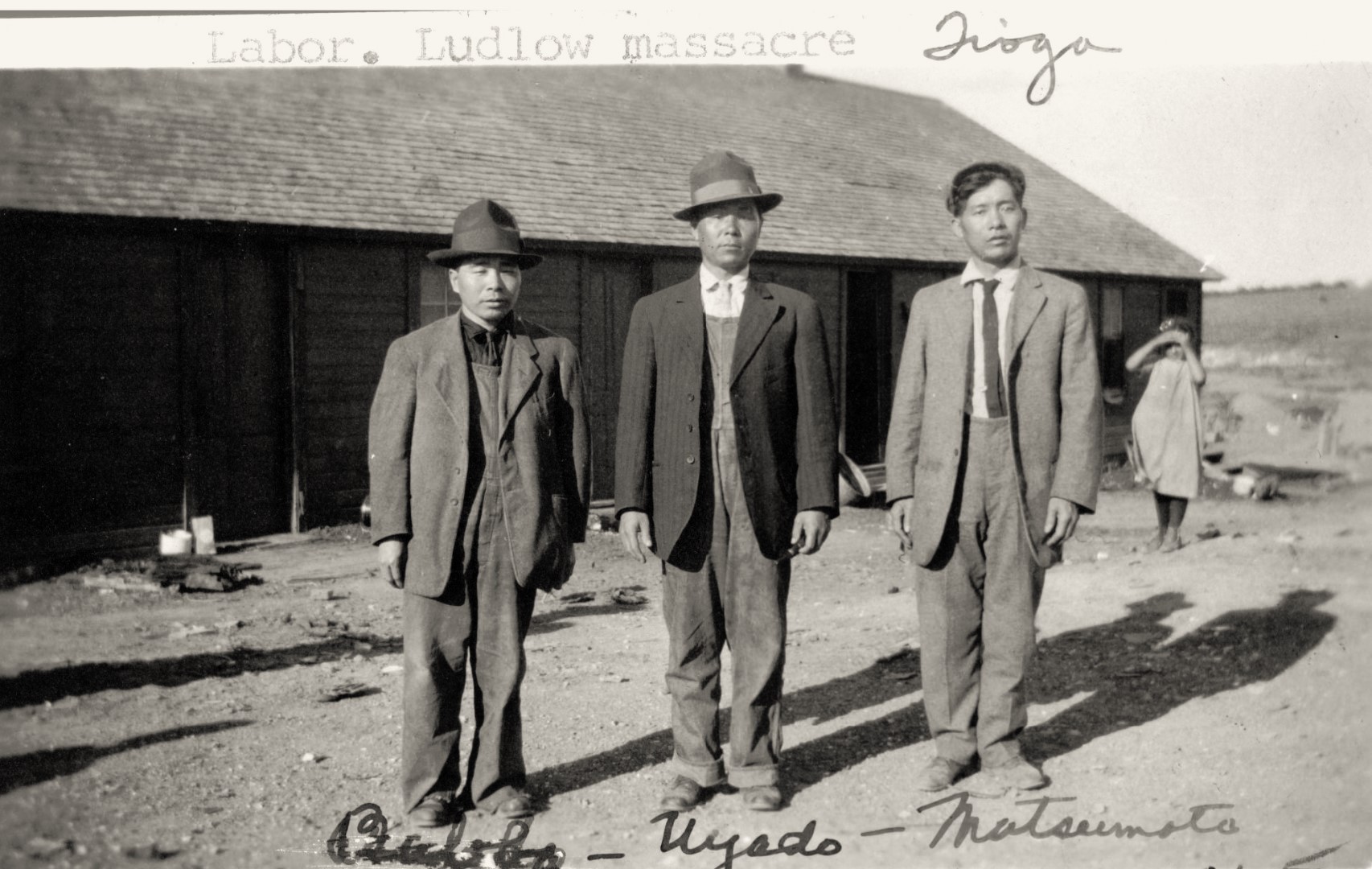
The attitude towards immigration, particularly from Asia, was a barometer on which to gauge the progressive or reactionary character of a labor organization. That division unfortunately existed within the U.S. Socialist movement for all of its history before World War One. Here IW editor Walker C. Smith contrasts the I.W.W.’s embrace of all workers with S.P. right-winger Lucy Goode White’s ‘race first’ policy.
“The Yellow Peril” by Walker C. Smith from Industrial Worker. Vol. 5 No 8. May 15, 1913.
On May third, in the Social Democrat, the official organ owned by the membership of the Socialist party of California, Lucy Goode White says of the Japanese:
“The Japanese workman upon Californian soil, whether he be able to comprehend the fact or not, betrays into the hands of the exploiters not only the workmen of California, but the workmen of Japan and the whole world as well, for the liberation of labor must be international if it is to be at all, and anything which tends to lessen the liberty of the Californian but postpones the liberty of the Japanese.
It is not enough for this socialist writer to play into the hands of the capitalists by dividing the workers on an alleged “yellow peril,” but she must do so in the name of internationalism. Can anything be more incongruous than the socialist slogan “Workers of the World, Unite,” coupled with the A.F. of L. anti-asiatic yell of “Down with the Jap and Chink?” Of course, it comes from the same source and is on a par with the actions of the Job Harriman brand of socialists, who clamor for working class solidarity and then vote in their dinky little craft unions to raise the initiation fee so as to get a tighter cinch on the jobs.
The person who thinks that the Japanese or Chinese are inferior in intellect or ability to the average Missourian or the Connecticut Yankee is a stranger to the facts. All workers can be organized, regardless of race or color, as soon as their minds are cleared of the patriotic notion that there is any reason for being proud of having been born of a certain shade of skin or in an arbitrarily fenced off portion of the earth. We don’t know whether Lucy Goode White is really white or not, but white, black or yellow, we’re sure that she had but little to say about the selection of her color.
This tendency to look down upon the workers of the “far-off” lands is foolish, for we venture to remark that the United States is just as far off from Japan as Japan is from the United States.
On this one point the I.W.W. is confident. There are but two nations–the exploiters and the exploited; but two races–the robbers and the robbed. We want to see the exploited organized solidly and we welcome the Japanese to membership, but when it comes to a fight we will wage just as relentless warfare against a Japanese employer as we will against a star-spangled American labor skinner.
If the workers need fear any “yellow peril,” it is from yellow socialists of the Social-Democratic stripe.
The Industrial Union Bulletin, and the Industrial Worker were newspapers published by the Industrial Workers of the World (IWW) from 1907 until 1913. First printed in Joliet, Illinois, IUB incorporated The Voice of Labor, the newspaper of the American Labor Union which had joined the IWW, and another IWW affiliate, International Metal Worker.The Trautmann-DeLeon faction issued its weekly from March 1907. Soon after, De Leon would be expelled and Trautmann would continue IUB until March 1909. It was edited by A. S. Edwards. 1909, production moved to Spokane, Washington and became The Industrial Worker, “the voice of revolutionary industrial unionism.”
PDF of full issue: https://www.marxists.org/history/usa/pubs/industrialworker/iw/v5n08-w216-may-15-1913-IW.pdf
 Revolution's Newsstand