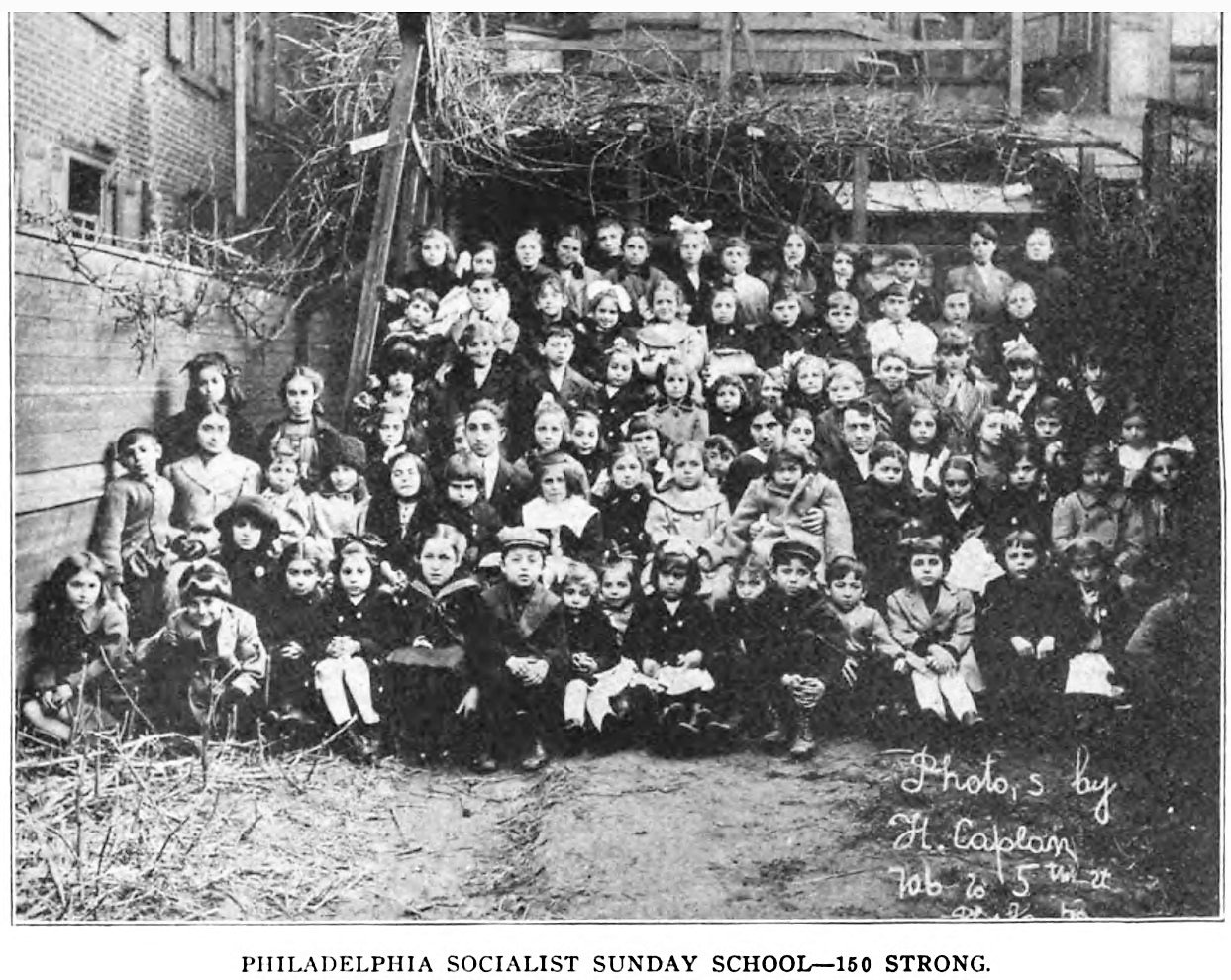
How are cabinets arranged in the Socialist Party’s Local Philadelphia headquarters? The answer below as we are taken into the most minute details of Socialist bookkeeping.
‘Local Philadelphia’s Organizational Work’ by Horace S. Reis from The Chicago Daily Socialist. Vol. 3 No. 81. January 3, 1909.
Local Philadelphia’s method of doing organization work, like the Socialist movement itself. is a product of evolution. Some time ago the local concluded to substitute an organization committee, in place of one officer-organizer. The plan worked well from the start; the working, being divided among six committee men became simplified. Each member of the organization committee has a certain part of the work to handle, and is responsible for its correct and prompt performance. The committee, as a whole, seldom meets, each member does his share as the work comes to him, and thus roll book, index cards, etc., are kept up to date. The committee reports for each month’s work at the first central committee meeting of the succeeding month, and for the two six-month terms each year at special local meetings called in January and July for the purpose of receiving the semi-annual reports of all committees.
The most important feature of this work is the keeping in close contact with each member, notifying him of arrears in dues, and getting him to keep his standing good. All this work is now done by the organization committee from local headquarters, but no doubt when the membership increases to a considerable extent, it will have to be taken to the ward branches, thus making a still greater subdivision of the work.
A description of the way applications for membership are handled will give the best idea of Philadelphia’s methods. First, of course, the applicant signs the usual form in which he subscribes to the principles of the Socialist party, and fills in, on this application card, his address, his occupation, the ward and election precinct in which he resides, whether he is a member of a labor organization, and, if he is, gives its name and number, his age, citizen-yes or no?: will he act as watcher on election days (fills in yes or no), and “If you are not a citizen, do you desire to become one?” answers yes or no). The last line on application card is for the signature of the member who proposes the applicant, and the date.
An application, having thus been properly filled out, is turned over to the branch in whose jurisdiction the applicant resides (unless he does not speak English, in which case it is handed In to a nationality branch.)
Thus, for example, an applicant living In the First ward will have his application handed into the First and Thirty-ninth wards branch, this branch being composed of members living in these two wards. At the next regular meeting of this branch the application will be accepted, the new member’s name will be at once entered on the roll book of the branch and in the branch financial secretary’s ledger. The recording secretary of the branch will then fill in, in spaces provided for the purpose on the back of the application card, the name of the branch, the date on which the application was accepted, and his own name and address. The application card, thus endorsed, will be given to one of the delegates to the central committee of the local and at the next regular meeting of the central committee the delegates from each branch hand in their applications. The application is then passed upon by the central committee, and when accepted the local recording secretary signs upon the back (below the space for the branch endorsement) his name and the date upon which the applicant was accepted into full membership by the central committee.
The financial secretary of the local Immediately takes the accepted applications and makes out the red dues cards. which the local recording secretary signs and delivers to the delegates to take back to their branches. Each new red card is accompanied with a circular letter to the new member. telling him which branch he belongs to, where and when it meets, who its financial secretary is and his address, and also when and where the local meetings are held. The two leaflets, “Why Socialists Pay Dues” and “Socialist Methods,” Issued by the National Office, are also sent with each new dues cards.
At this point the work of the local organization committee begins. The first step is to take the application cards which have just been received and enter the names of the new members in the local’s roll book.
The roll book contains about 200 pages. Tabs, bearing the name or number of each branch, divide the roll book into sections for quick handling, and are arranged numerically. Thus the first tab is marked 1 and 39, the next 2 and 5, etc…for the respective branches, and after the ward branches are the tabs indicating the sections for the German, Bohemian, Flemish, Finnish, Jewish and other nationality branches, whose members speak only their native tongue.
There is room for forty names on each page of the roll book. As soon as the organization committee receives the accepted applications the names are added to the list of members under the proper branch. The pages of the roll book are ruled across with enough columns for keeping a record of dues for two years and six months. At the top of the first page for each branch the committee notes (in pencil) when and where the branch meets and the name of its financial secretary. Almost all of this committee’s business is done with the branch financial secretaries. Each branch is expected to have its monthly financial report sent In to headquarters by the fifth of the following month; if not on time the organization committee sends a letter reminding the financial secretary of the branch that he should get busy.
As each report is received containing the names of members who paid dues that month the amount each one paid and for what months paid-It is entered in the roll book. By this method there is always in headquarters a complete record of each member of the local, with his financial standing: Changes of address are also noted in each monthly branch report, in a ‘remarks’ column. The addresses are entered opposite the member’s name, in pencil.
The next work is that of getting after the delinquents. As each month’s report is entered the roll of the branch is looked over, and those three months in arrears receive a delinquency notice; those over six months in arrears receive a suspension notice. Thus, for example, on January 4, a branch sent in the report for December. Each member’s dues being duly entered, the organization committee went over the roll: those who had paid up to September (and consequently owed for October, November and December received delinquency notices: those who had not paid since June (and were therefore six months in arrears) received suspension notices and their account was so marked in the roll book. Members exempt on account of sickness or unemployment, are marked exempt on the monthly reports and of the local’s roll book, and, of course, are not suspended for arrearages. In the January column a “D” or an “B” indicates that in January a delinquency or suspension notice was sent.
Besides mailing these notices direct to members, each financial secretary is sent a list of the members of his branch, to whom notices were sent, whereupon he either looks them up himself, or has the ward organizer do it. Branches have their own methods for doing this end of the work.
Members moving from one ward to a other are taken off the roll of the old branch and added to the roll of the new branch in the local’s roll book, and ‘transferred’ marked after their names on old ward roll.
Naturalization. When the applications of new members have been accepted, and the names entered on the roll book, a list of those who are not citizens is made out and turned over to the naturalization committee: this committee sends each of these non-citizens two leaflets, one containing an extract from the naturalization laws and one containing questions. and answers on the constitution of the United States, which applicants for second papers must know. These extracts from the naturalization laws are printed In English, German, Jewish. Lithuanian, Finnish and Polish. The naturalization committee endeavors to have all members and sympathizers become citizens as soon as possible.
The application cards are next turned over to another member of the organization committee, who makes out three cards, exactly alike, for each member. These are filed in three separate cabinets; in the first the cards are alphabetically arranged for each branch. In the second, the entire local membership is arranged alphabetically. In the third the cards are arranged by political divisions–that is, each ward for itself, and then the cards by the numbers of the election precincts in which the members reside.
By this method we can quickly locate members according to name, to branch. and also find what members live in a certain ward or precinct. This third file makes it easy work to get up a list for watchers certificates, which we must do four times a year under the present election laws in Pennsylvania.
If a member is expelled his three cards are destroyed, and he is marked expelled in roll book. If suspended his three cards are taken out and put in three similar cabinets marked respectively ‘suspended, by wards,’ ‘suspended, by branches,’ and ‘suspended, alphabetically.’ When the member makes his standing good again his cards are restored to the regular files. Besides these six cabinets there is one for suspended branches.
A suspended branch is one that has less than five members in good standing. Changes of address and transfers from one branch to another. after being marked in roll book, are, of course, changed on all three cards of the member. By these methods, if the roll book should be lost or destroyed it could be reconstructed from the cards and branch ledgers; if anything goes wrong with the index cards, they can be replaced by referring to the roll book and branch books.
An eighth cabinet contains cards bearing the names of those who have been reported to headquarters as sympathizers. These are arranged according to wards, and, at intervals, the branches receive lists of these names, to look them up and get them to join the party. Suitable leaflets are distributed to sympathizers, explaining party methods, etc.
By using the methods described above the organization committee is able at all times to render to the local complete reports on branches, members, sympathizers and all organization work. We have made organization work easier, and can cover the ground more quickly. The present method is adequate for the needs of any local, no matter how large.
The Chicago Socialist, sometimes daily sometimes weekly, was published from 1902 until 1912 as the paper of the Chicago Socialist Party. The roots of the paper lie with Workers Call, published from 1899 as a Socialist Labor Party publication, becoming a voice of the Springfield Social Democratic Party after splitting with De Leon in July, 1901. It became the Chicago Socialist Party paper with the SDP’s adherence and changed its name to the Chicago Socialist in March, 1902. In 1906 it became a daily and published until 1912 by Local Cook County of the Socialist Party and was edited by A.M. Simons if the International Socialist Review. A cornucopia of historical information on the Chicago workers movements lies within its pages.
PDF of full issue: https://www.marxists.org/history/usa/pubs/chicago-daily-socialist/1909/090130-chicagodailysocialist-v03n081.pdf
 Revolution's Newsstand