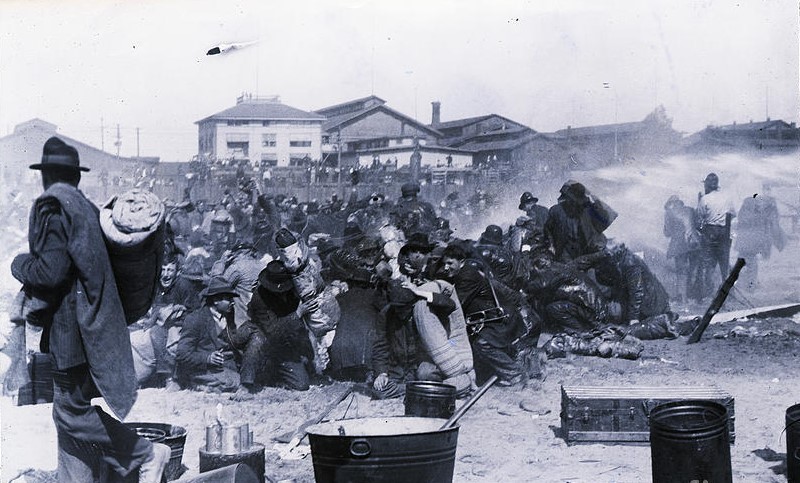
The California capital forces hundreds of unemployed from its streets with fire hoses and clubs, driving them onto an island in the Sacramento River.
‘Sacramento’s Brutal Treatment of Hungry Army of Unemployed’ from Solidarity. Vol. 5 No. 219. March 21, 1914.
Men On March To East Driven From City At Point Of Gun And Marooned On River Island. Many Unarmed Out of Works Clubbed, Jailed Or Sent To Hospital. Several Reported Killed.
CAPITALISM’S CONSOLATION TO HUNGRY MEN
(Special to Solidarity) Headquarters, Army of the Unemployed, West Sacramento, Calif., Mar. 13, 1914.
It was about 9:30 Monday morning, March 9th, when the members of the unemployed army, both factions, Union army and Kelly’s, by this time about 1900 in number, were notified by the authorities in Sacramento City and County, through the Hon. Mr. President of the local Chamber of Commerce as spokesman, that the trains of the S.P. line would be ready at 10 a.m., and he asked us as law-abiding citizens to board these trains, and return to San Francisco whence we had come. This he said was the ultimatum at which they had arrived after two days of anxious meetings. They were perhaps not greatly surprised when this offer was rejected with jeers, and a firm stand was taken by both sections of the army. The City and County authorities had all their slugging forces ready prepared. The State militia were encamped six companies strong in the local Armory ever since the arrival of the unemployed in this city. And it was the wish of the “respectable citizens” caring only about their precious private property, that the Governor should order out the militia to drive out the unarmed unemployed at the point of the bayonet. After our refusal to move, we sat still and waited patiently for the next move on their part. They held another conference and District Attorney Wachherst said it was no use to defer action any longer. “The stubbornness of the unemployed must be broken, and the City of Sacramento must once for all get rid of this menace. They are a bunch of people who refuse to work even if they could get it, for their own spokesmen made the statement to the Governor, as well as at the five street meetings they have held since their arrival in the city.” These talks of the speakers had caused an awful stir up in the minds of the “respectable citizens” of this Capital City.
While the Union Army of men and one lone woman sat down with folded arms on one side of the sand lot, on the other side Kelly’s Army were also preparing to remain pat in their position. They advanced the regular police to the number of 300, a force of specially recruited deputies of like number, all armed with clubs, pickhandles and revolvers, and the fire brigade equipped with a high pressure hose.
Picture the scene of violence in free America in the 20th century. On one side of the lot is a mighty electric sign “SACRAMENTO, THE HEART OF CALIFORNIA.” On the opposite side is the S.P. depot where we arrived. And round about, occupying every point of vantage, on the tops of box cars and buildings, thousands of spectators whom before proceeding to their nefarious business the authorities caused to be cleared from their points of view so that there might be as few spectators as possible, of their barbarous doings. Thus the hireling tools of capitalist society were ready with their clubs, guns and firehose. First of all, they picked out about 24 men, and put them under arrest on the familiar charge of vagrancy. As usual, they assumed that by arresting the supposed leaders, they would have no difficulty in breaking up the movement. Next the combined force moved on Kelly’s camp, and immediately began to use their clubs. Several men were injured more or less severely, and while there are reports that at least two men were killed outright or died later in the present situation of the army, it is not possible to get definite and accurate information. The local authorities and press of course indignantly deny the reports, as they are afraid of adding further stigma to the already tarnished fame of their fair city. But there is a very strong suspicion that they are trying to suppress the truth from leaking out, and a significant fact is that the hospital officials are most reticent about giving satisfactory answers to the inquiries that we have instituted. When they had succeeded in chasing Kelly’s army from the lot and were congratulating themselves that they were rid of half their troubles they moved over towards our camp. And while they were looking at us still sitting together and defying them to do their damnedest, about 400 of Kelly’s bunch who were supposed to be dispersed, came round by a side street, and climbing over the fence, joined their array to ours, to sit with folded arms. But the passive resistance of even 1900 people could avail nothing against at mass of armed citizens, police, deputies, and firemen with a modern high pressure hose. If they were ineffective, the militia were waiting in readiness to finish the job.
The call was given, and the water was turned on until its full-force literally lifted the front ranks of the seated band clean off the ground. Immediately the dripping victims began to get on to their feet, the clubbing process recommenced and then instead of water blood began to flow freely from the faces, heads and arms of the defenseless unemployed. It was a wild orgie of brutality that Sacramento and its legalized hoodlums and “respectable citizens’ committee” shall have cause to remember for many a long year to come. Nor has the last word by any means been spoken in their temporary triumph over an unarmed mob of hungry men. In the flight as much damage was done to property as possible. with such missiles as we could pick up on the way. Windows of street cars, saloons, and pool rooms were smashed, and the offices of Murray and Ready, the principal employment sharks of California came in for special attention. How many times will these scenes of terrible brutality have to be repeated at the expense of the working class, before the workers learn to unite and rise in their might, whether employed or unemployed, to throw off forever the rule of a class whose private property is of more consequence than the hunger of millions. Thus the unemployed were driven over the river into Yole County where they now are. They are at present practically marooned on an island, with the Sacramento river on one side and flood waters on all other sides. The bridges across the river have been guarded both night and day ever since the army crossed, and the river is patrolled by police in motor boats. And up to the present time the authorities of Yole County are undecided what action to take. They are unwilling as yet to resort to the violent measures of the Sacramento, and are offering the army transportation in small bunches back towards the bay of San Francisco. This offer, as before, the army of the unemployed still steadfastly refuses to accept. The army demands the release of all their men now in jail, some sixty in number. And although the supplies of food have now been very scant for some days past, they are still holding their ground while the Yole officials are counting on the effects of semi-starvation in an impasse resulting in gradual disintegration. Most of the army intends to hold on to the ground to the last unless they are again ejected by superior force. The authorities of Sacramento are maintaining a strict watch on everybody crossing the bridge and are turning back all whom they in any way suspect are at all likely to encourage us to stand pat, while the local press still assiduously spreads alarmist reports of all descriptions.
Therefore we are issuing this call to all red blooded members of the working class, irrespective of affiliations, to help us in this our hour of need, in a fight which is your fight as well as ours. If public authorities are to be allowed to get away with their brutalities at the expense of one section of the working class, you have no assurance that it will not be your turn next. Remember that there are several hundreds still standing pat in camp, although in direst need of food and the other necessities of life, and as the authorities refuse to help us in our miserable condition, we have to appeal to you the members of our own class for assistance. Publish wide our story, and help us all you can.
Publication Committee Union Army of the Unemployed.
The most widely read of I.W.W. newspapers, Solidarity was published by the Industrial Workers of the World from 1909 until 1917. First produced in New Castle, Pennsylvania, and born during the McKees Rocks strike, Solidarity later moved to Cleveland, Ohio until 1917 then spent its last months in Chicago. With a circulation of around 12,000 and a readership many times that, Solidarity was instrumental in defining the Wobbly world-view at the height of their influence in the working class. It was edited over its life by A.M. Stirton, H.A. Goff, Ben H. Williams, Ralph Chaplin who also provided much of the paper’s color, and others. Like nearly all the left press it fell victim to federal repression in 1917.
PDF of full issue: https://www.marxists.org/history/usa/pubs/solidarity-iww/1914/v05-w219-mar-21-1914-solidarity.pdf
 Revolution's Newsstand