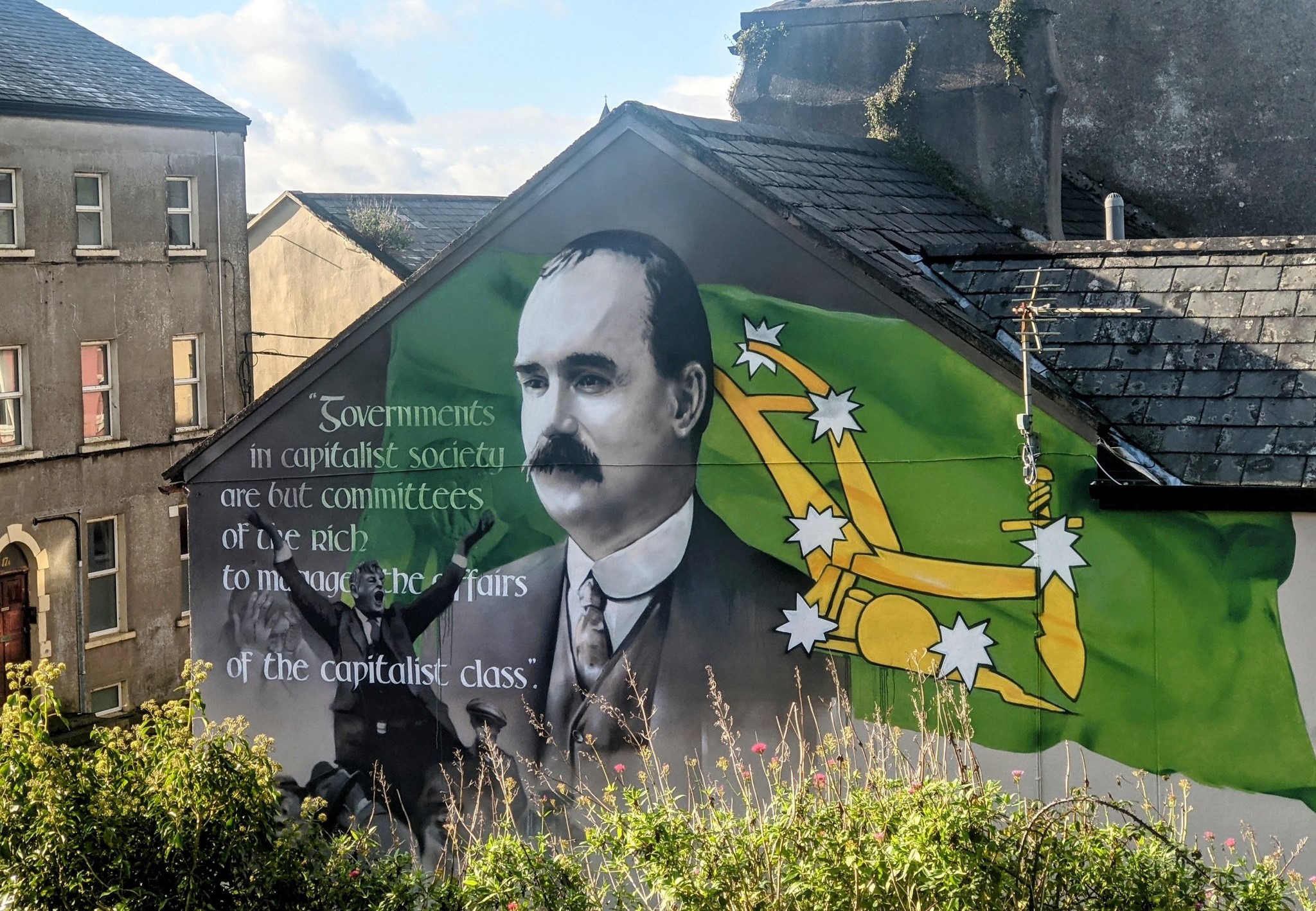
When the Communist Party of Ireland was (re)founded in 1933, the U.S. Communist Party began (another) effort to reach Irish-American workers forming the Irish Workers Clubs in 1934. Here, Martin Moriarty from the I.W.C. gives a lesson from Connolly still lost on many who claim him.
“We Follow the Lead of Connolly When We Are No More Tools of U.S. Than of British Imperialism” by Martin Moriarty from The Daily Worker. Vol. 11 No. 149. June 22, 1934.
IN 1908, guided not only by his experience in the class struggle of the workers in Ireland and America, but also by his knowledge of Irish nationalist organizations here, James Connolly challenged the domination of middle class politicians over his countrymen through the organization of the Irish Socialist Federation.
The political name of the organization may not have been so appropriate but certainly the idea behind it was. For this was the role of the Irish in America as Connolly saw it. They were made tools of the American empire, whose demagogues found Irish hatred of England most useful in America’s plans to conquer the earth. And the Tammany orator who roared most about British oppression in Ireland was most silent about the oppression-that very real class oppression of capitalists over the Irish workers in the States.
For thus rallying the exiles Connolly was bitterly attacked. Respectable Irish nationalists who wilted at the very suggestion of “class struggle” denounced him as “un-Irish.” Misguided “radicals,” who mistook their paltry scraps of book-learning for “revolutionary” ideas, parroted the boss politician, though in slightly different language. Hiding behind the excuse of an “internationalism” that soared in the clouds, they denied that Irishmen in the States need be approached on such “non-revolutionary” ideas as the freedom of Ireland. This was nationalism!
Connolly Flayed Pretenders
“You pretend to be internationalists,” Connolly stingingly reminded them. “Then why do you deny us the right to be practical internationalists and help the fight for national freedom in Ireland?”
The Irish in the States, Connolly argued, were about the one race definitely organized in America for the support of a capitalist political party in Ireland. Hence he proposed to fight the boss with his own weapons. The Irish exiled workers also would organize and put for- ward a program for the national freedom of Ireland. But they would aid, not the middle class careerist, but the men and women of their own class, the truest and most resolute national fighters for freedom organized in those days by the Irish Socialist Republican Party.
New generations have risen in Ireland and America to test the truth of Connolly’s ideas. He pointed out 30 years ago that the hard-earned dollars of the Irish exile were being I used to bolster up a political party of slum landlords who masqueraded as the United Ireland Party, the Home Rule clique. What happened to the war chest? We know the tragic story: It was used to build up a conscienceless band of rogues and traitors who later, like John Redmond, herded thousands of Irishmen into the British army to fight in the cause that Britain, with its unequalled capacity for easy irony, described as the “rights of small nations.”
Compromise, deceit and betrayal so characteristic of the middle class politicians, has imprinted its foul story on every page of Irish-American history since then. The scoundrels spawned by the old Home Rule clique showed their “patriotism” in 1916. It was not enough to drape themselves in the Union Jack and tell their dupes: “Fight for the empire that holds you in bondage.” It was they, through William Martin Murphy’s “Irish Independent,” who howled for the blood of the Connollys and Pearses who organized the battle for independence, and led the protest against recruiting and against imperialist oppression in the rising of 1916.
What became of the millions of dollars collected to help the Irish Republican campaign from 1916 on? The wealth was used to raise to power the tyrants who were the spokesmen of the big businessmen in 1921 and who, because of their class affiliation enforced the “treaty” with soldiers and guns provided by England.
Fianna Fail
And now Fianna Fail. Its party organ, the Irish Press, was founded with the help of the exiles’ dollars. “To advance the republican movement,” its leaders said. In practice today it means “To halt the republican movement, to tolerate and encourage its enemies like the blue shirts, to pack the prisons with republican and anti-fascist fighters
Clearly what was true of Irish-America in Connolly’s day is as true today. The Irish are still the pawns of the middle class politician who builds them into a team for the use of American imperialism. And just as the old Tammany-inspired “friend of Ireland” directed the discontent of the Irish voter into the one channel–against England–and preached boss-class politics while he did it, so the long distance Irish patriot of today serves more than one political boss when he shouts to the Irish unemployed: “You’re unemployed because England won’t pay her war debt! You have no unemployment relief while the Englishman has the dole, because England won’t pay her war debt! Your home and property is in danger, because England won’t pay her war debt! Make England pay! Make our navy second to none!”
War-Mongers
As capitalist statesmen prepare to scrap their precious pacts and treaties the war-cries rise fiercer, Irish editorial lions, taking their cue from Washington and Hearst, out-do their masters in war propaganda. The United States is pictured as the starveling Cinderella who “made nothing out of the war.” To these willfully-blind demagogues the American armament companies must have been living in Never-Never Land in 1917-19. The Carnegie Steel Corporation, the United States Steel, the Bethlehem Steel Corporation, DuPont–these famished shareholders who made nothing from the war! They made millions! They’re ready to make millions in the coming war and precisely for that reason organize such jingo groups as the Navy League, whose publicity receives such generous display in the columns of the Irish-American press.
Clearly the Irish Hearsts are helping to whip the Irish into a war- fever under the convenient guise of “Make England Pay” and “Preparedness.” Clearly their useful weapon is a hypocritical exploitation of the Irish question.
Clearly the way to expose them is through building up the Irish Workers’ Clubs.
The Irish Workers’ Clubs, following the example of James Connolly, must prove to the Irish here that empires (this means American also) are not interested in freeing subject nations, however much they trifle with such causes purely to taunt and embarrass rival powers.
Just as the fight for Irish independence must be led by the most resolute fighters, the revolutionary working class aided by the small farmers, so the Irish-American auxiliary must be led by their class brothers and sisters in America. Then the role of all the Irish in America will become once again truly progressive and worthy of the finest traditions of the Irish struggle for freedom.
The Daily Worker began in 1924 and was published in New York City by the Communist Party US and its predecessor organizations. Among the most long-lasting and important left publications in US history, it had a circulation of 35,000 at its peak. The Daily Worker came from The Ohio Socialist, published by the Left Wing-dominated Socialist Party of Ohio in Cleveland from 1917 to November 1919, when it became became The Toiler, paper of the Communist Labor Party. In December 1921 the above-ground Workers Party of America merged the Toiler with the paper Workers Council to found The Worker, which became The Daily Worker beginning January 13, 1924.
PDF of full issue: https://www.marxists.org/history/usa/pubs/dailyworker/1934/v11-n149-jun-22-1934-DW-LOC.pdf
 Revolution's Newsstand