
Walk through the streets of Red Berlin with a Pennsylvania miner in 1930. Ed Falkowski went into the mines of Shenandoah, Pennsylvania as a teenager and quickly became a radical activist in the UMWA. Always an intellectual, he attended Brookwood Labor College in the 1920s and began writing. In 1928 Falkowski, traveled to Germany as an exchange student and immersed himself in Berlin’s left life reporting of his experiences in the U.S. radical press. He would spend most of the 30s in Moscow editing an English-language paper before returning to the States in 1937 where he worked at a factory and helped to found the UAW. He died in 1984.
‘Berlin in Crimson’ by Ed Falkowski from New Masses. Vol. 5 No. 10. March, 1930.
1. RED ECHOES IN UNTER DEN LINDEN.
Of Germany’s three-million Communist vote, Berlin contributes over a good half-million. 52 Communists participate in the city council; three daily papers and a horde of weeklies and glowing monthlies flood the streets, smoking from the presses; hundreds of thousands of pamphlets are gobbled up by a proletariat hungry for information; 300 writers are bound in a revolutionary-author’s league, and at least five publishing houses give themselves entirely to the publication of proletarian literature.
Revolutionary artists design simple, yet effective scenery for plays issuing from rebel pens, which thousands of workers flock to see when produced. The actors, many of them professionals, take part in these protest-plays out of devotion to the cause. Everywhere one feels life, movement. Nightly meetings are called, protesting against movie censorship, against press restrictions, against Zorgiebel’s freshest outrages. Crimson banners, flaming speeches, hooting audiences attest the popularity of the present sovereigns of the German “Republic.”
Unter den Linden maintains its smug, fur-coaty complacency. Its coffee-houses are crowded with idlers; limousines haul fine ladies about, on shop-errands; well-dressed students hustle with briefcases to the university; hotels advertise “American bars.” Frowning upon this whirling traffic stands the red sandstone headquarters of the Soviets. Formerly a palace, it houses now the Russian consuls, and a large staff of officials. Near it, withered women shout the names of the Red dailies, catching street-trade.
Not far from this German boulevard is Alt-Moabit, a sump of crying poverty; further up is Herman Platz, where the May battles occurred, grim with memoirs of that bitter episode. Beyond the palaces begin endless labyrinths of suffering and want — chains of streets, shrill monotones of decrepit houses, drunken staircases, gaslights; countless saloons, druggeries, undertaking establishments. Here exist Berlin’s proletarian swarms.
2. WORKERS’ THEATRE.
Many years ago the Volksbuhne was founded in Berlin — a sort of mahogany hippodrome with ponderous gilt flowers growing near the art-panelled ceiling, and a brainy refinement percolating through it. Its purpose was the staging of worker-plays.
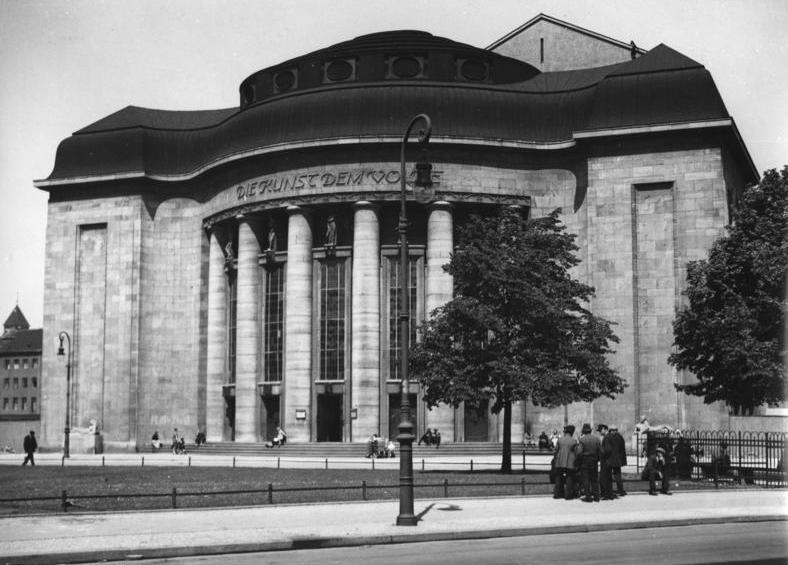
Today however, the Volsksbuhne gives itself up to boulevard interpretations of history. Its productions are fraught with overburdening scenery beneath which the actors strive in vain to reach the audience. But the audience accepts this theatre as Newyorkers do Keith’s intellectualized circus-tent — a projector of big spectacles. Every production must at least be whale-sized, and lion-voiced. It must have more setting than meaning; more mass movement than individual strength. When the last curtain falls, many shrug their shoulders when you ask them what the play was about. Nor is this important. What is important is the extravaganza of back-ground — the giant scale on which things here are done. Certainly superior to any American manner, with a revolving stage a distinct advantage in giving a play a breadth unthinkable on the Manhattan footboards.
The audience which fills this once proletarian playhouse is now redolent with perfumes and manners. Opera clothes are to be seen, spyglasses and lorgnettes.
During the pause one sees a miniature fashion-show in the foyer.
But the Prolets for whom the playhouse was intended are seldom to be seen. For this theatre has become the home for reactionary productions. Not only do creampuffy plays come before the public here, but plays distinctly bourgeois in tone, as “Tolstoi or Lenin,” produced last winter.
The real proletarian theatre is homeless, wandering from stage to stage with its productions. Its latest is a miner-play written by Anna Gmeyner, an Austrian comrade, entitled “Army without Heroes.”
Miss Gmeyner observed intimately the life of Scotch miners, and her effort to realize the various aspects of a serious mine-accident in a play, while limiting it to a mere report of what happens there during the time, has succeeded in filling the house on Sunday mornings, when worker-plays are usually given.
The play takes the audience through all the nerve-rending phases of a mine-accident, pointing out how the director’s negligence is responsible; taking us into the sorrow-stricken homes of widows, introducing us to the unspoken horrors that brood over every minepit in the world.
3. “THE LEFT-CURVE.”
“Speaking choruses” are the latest style in German propaganda method. These consist of troupes of youthful comrades who, in song, dance and pantomime, ridicule the leading reactionaries, protest against police brutality and the tightening noose of the law. These choruses make up a vagrant vaudeville-minstrel combination. The program varies with the daily news. Every occurrence registers itself in satiric song or sketch, drawing the laughter of the worker audiences.

These groups, the most famous of which is the Red Speaking Chorus of Berlin, furnish the humor to balance the colossal heaviness of drama itself. Proletarian troubadors, singing of revolution in the midst of most brutal suppressions. (Communist leaders expect the party soon to be driven underground, their papers smothered, and the coming years to be given to quietly intense activities.)
The “Left-Curve” is one of the newest speaking-choruses. Their production the other night left little to be desired. The Police-Club dance was greeted by a storm of applause. Parodies of popular hits were sung; republicanism was flayed in pantomime as black clergy, royalists, militarists, and soupy democrats came in for their share of comment; the cops came on the scene jumping like billygoats afflicted with St. Vitus —: and the audience surrendered to immense belly-quaking laughter.
The revolutionary world moves amid dramatic situations from which laughter and tears are squeezed out of the proletariat. Its plays, its speaking-choruses, the readings given by its many poets — Weinert, the clear-voiced; Becher, the impassioned; Grunberg, the intellectual; Wittvogel, the Oriental — and a host of others, are magnets for the crowds. No wonder Berlin is the hot-bed of European radicalism today. Its leaders have not only a sense of sorrow. They are fortunately blessed with a rich fund of humor.
4. MANHATTANIMATION.
Down to automats and quick-lunch stands, Berlin has borrowed the clothes of Manhattan. Its nights are alive with green and red banners of light, advertising some mighty new soap or medicine tablet. Flunkeys in mocha-colored overcoats open the doors of stores for entering customers. Newskids shout the latest sensations into the ears of theatre crowds. Potsdam Platz is a coffeehouse edition of Times Square. Herman Platz is a washed-out Flatbush. Berlin’s theatres are not clumped together into a White Way section, but are scattered about the city. This is an advantage to traffic.

But the grand life of the main avenues is not for the worker who must remain satisfied with the crudities of the ancient barroom. This is his coffee-house, club-house, loungeabout place, often his hotel; he can at least forget his troubles here, while in the process of acquiring new ones.
But the placid security of coffee-houses and the glitter of theatre crowds is not so secure, at bottom, while ill-paid and overworked prolets become intelligent enough to understand something of the causes for their intensifying misery.
The New Masses was the continuation of Workers Monthly which began publishing in 1924 as a merger of the ‘Liberator’, the Trade Union Educational League magazine ‘Labor Herald’, and Friends of Soviet Russia’s monthly ‘Soviet Russia Pictorial’ as an explicitly Communist Party publication, but drawing in a wide range of contributors and sympathizers. In 1927 Workers Monthly ceased and The New Masses began. A major left cultural magazine of the late 1920s and early 1940s, the early editors of The New Masses included Hugo Gellert, John F. Sloan, Max Eastman, Mike Gold, and Joseph Freeman. Writers included William Carlos Williams, Theodore Dreiser, John Dos Passos, Upton Sinclair, Richard Wright, Ralph Ellison, Dorothy Parker, Dorothy Day, John Breecher, Langston Hughes, Eugene O’Neill, Rex Stout and Ernest Hemingway. Artists included Hugo Gellert, Stuart Davis, Boardman Robinson, Wanda Gag, William Gropper and Otto Soglow. Over time, the New Masses became narrower politically and the articles more commentary than comment. However, particularly in it first years, New Masses was the epitome of the era’s finest revolutionary cultural and artistic traditions.
PDF of full issue: https://www.marxists.org/history/usa/pubs/new-masses/1930/v05n10-mar-1930-New-Masses.pdf
 Revolution's Newsstand