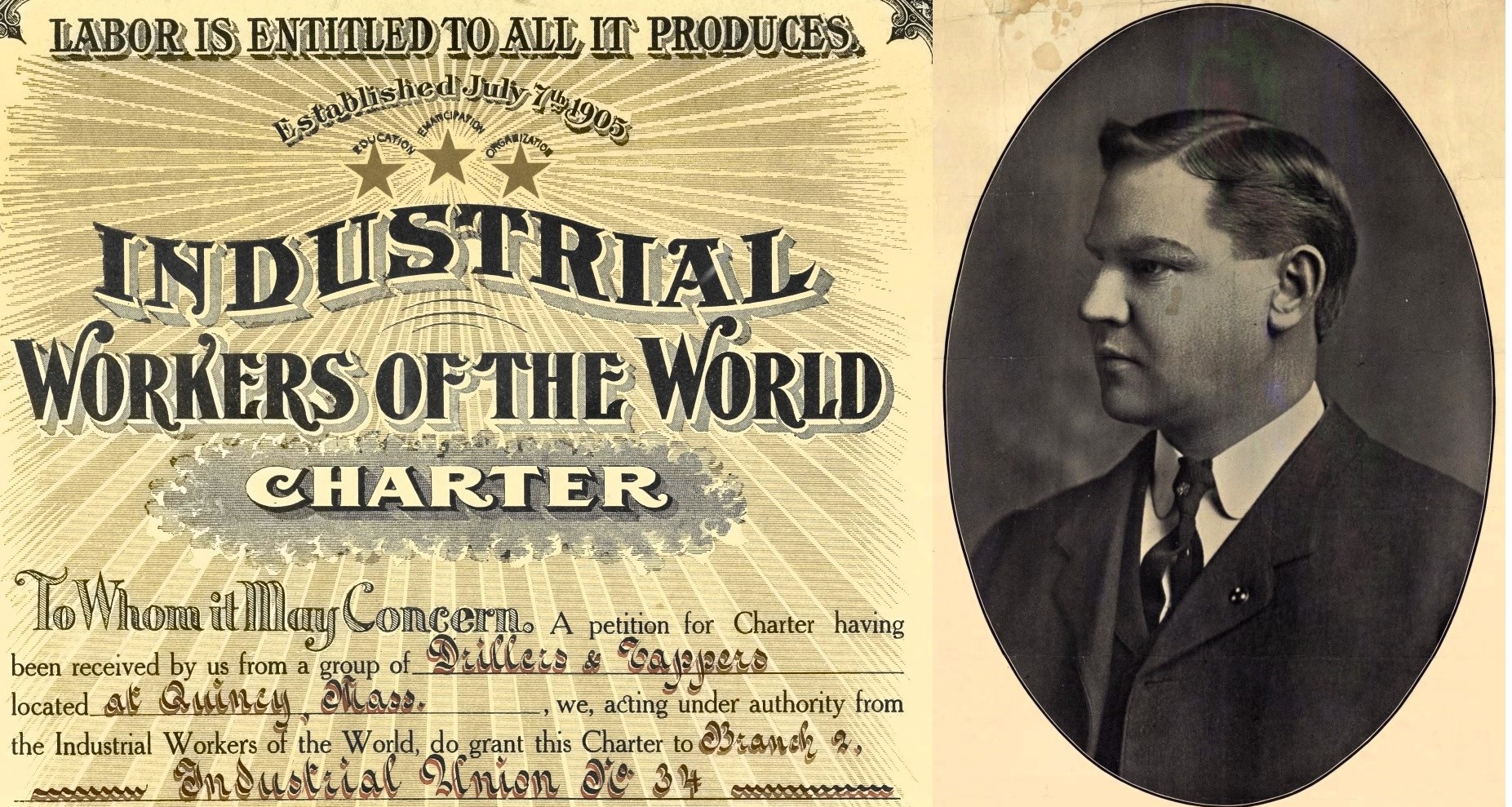
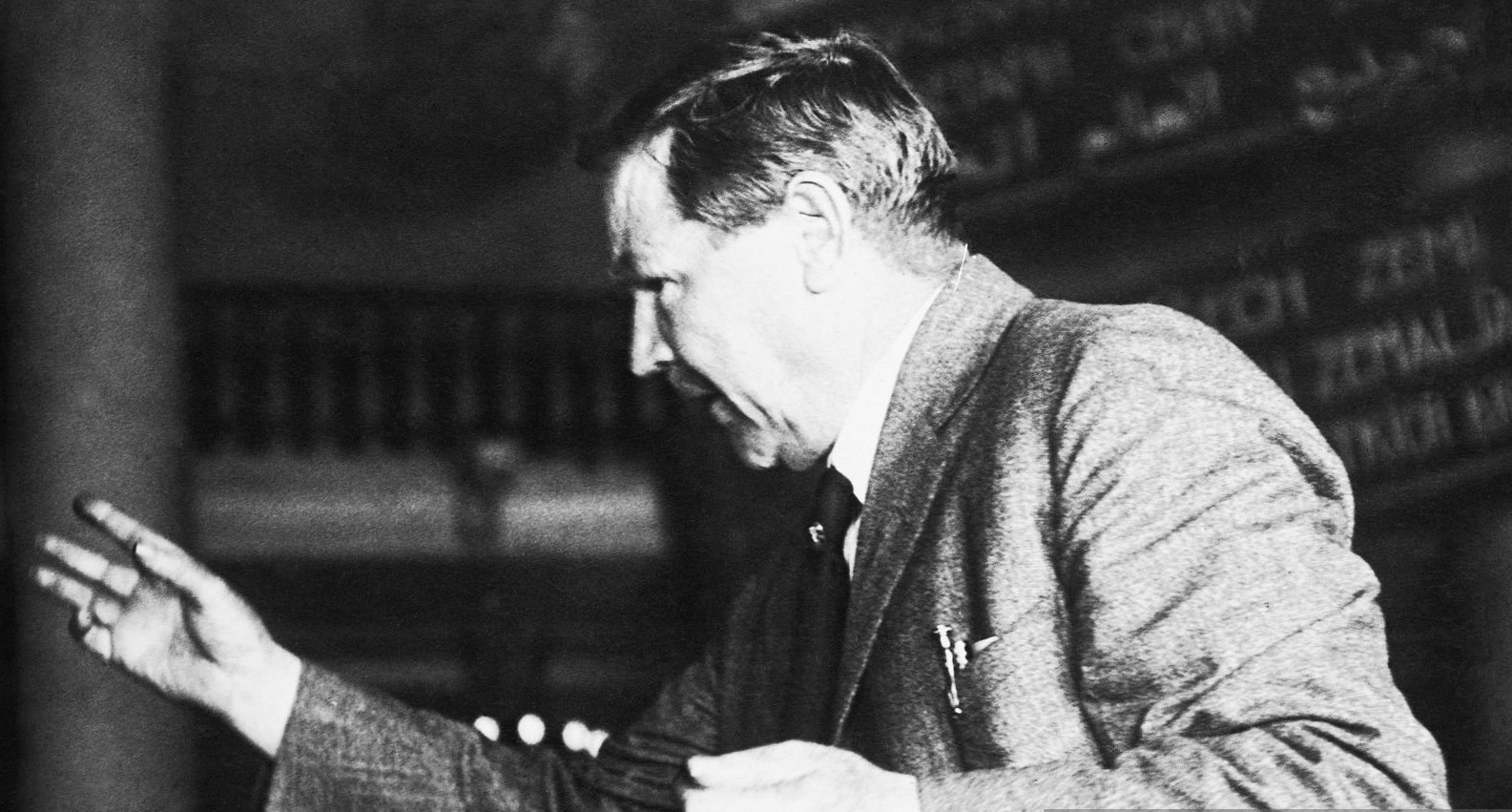
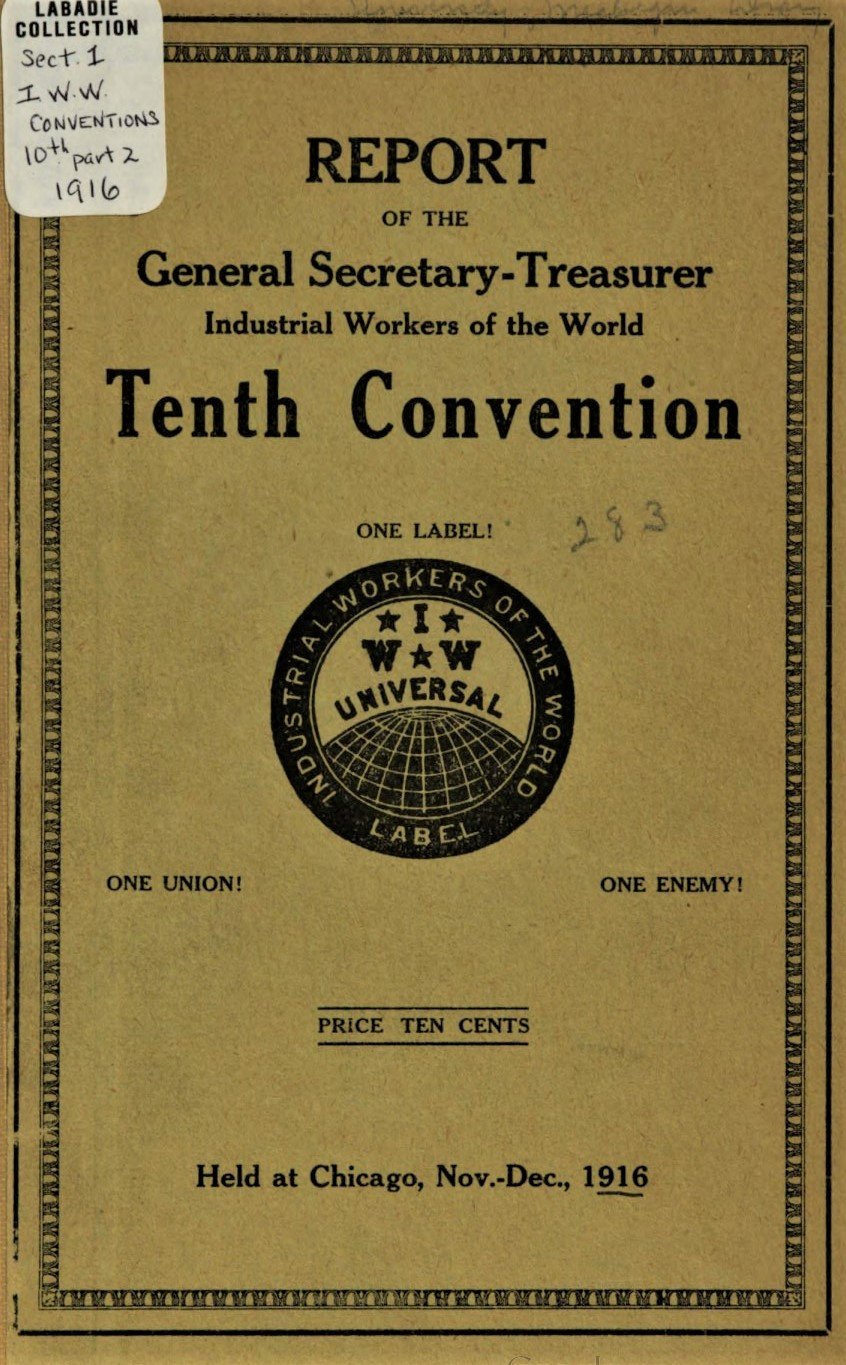
Haywood was elected General Secretary of the I.W.W. in 1914, taking his office in 1915. He continued in that position, with a break while on trial for ‘espionage’, until the end of 1918. The Tenth Convention was held in Chicago at the end of November and beginning of December, 1916. As you would expect, the report is lengthy and detailed with sections on communications, areas of industrial organizing (Metal Mine, Coal Mine, Railroad, Metal and Machinery, Textile, Marine Transport, and Lumber), strikes, management of strikes, propaganda and literature, free speech fights, the Delegate System, defense work, education, and Haywood’s own recommendations. Also included is a valuable list offered by Haywood of the 116 locals and unions chartered by the I.W.W. since its last convention, giving a glimpse of the work and geography of an I.W.W. close to its zenith of influence numbering over 100,000 members.
‘Report of the General Secretary-Treasurer to the Tenth Convention of the Industrial Workers of the World’ by William D. Haywood from Proceedings of the 10th Convention of the Industrial Workers of the World. Chicago, 1916.
The work of organizing for this biennial period has been the greatest in the history of the I.W.W. One hundred and sixteen (116) charters have been issued to workers in the various industries.
One of the new unions, Agricultural Workers’ Industrial Union, No. 400, chartered April 21st, 1915, has achieved marvelous results, not only in membership, eighteen thousand members being enrolled, but in the improvement of wages, hours, and working conditions.
The members of No. 400 were always referred to as the undesirable element of society: “Hoboes.” “Pesky Go-abouts,” “Vags,” and as such were subjected to the abuse and hostilities of petty authorities everywhere: Compelled to steal rides on the railroads to and, from the harvest fields; fighting with trainmen and guards for the privilege; risking life, limb, and health, to get a chance for a few weeks’ work; jailed for vagrancy when out of work, and starving and enslaved when on the job.
The Industrial Workers of the World came as a mighty boon to these harvest workers. What they have done for themselves in the last two seasons is but a marker in comparison to what will be accomplished in the future. With a considerable minority of farm laborers and harvest workers organized and educated, with the knowledge of the principles of Industrial Unionism, the rest of the world will be asking the Industrial Workers of the World, “What are we going to have for breakfast in the morning ”
Thinking that perhaps the Interstate Commerce Commission, who have much to say about the railroads and the disposition of freight and passengers from state to state, some help might be secured from that source in the means of transportation, preventing such terrible disasters as occurred at Tripp, North Dakota, during the harvest season, on the 20th of last April I wrote the following letter:
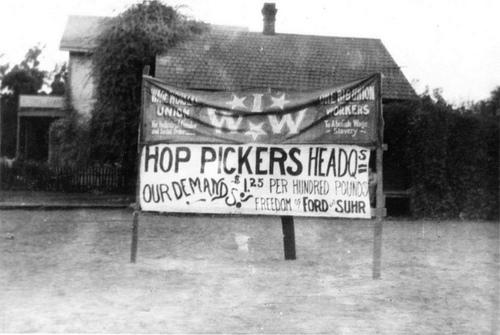
“Interstate Commerce Commission, Washington, D.C., Gentlemen: — In the course of a month or six weeks thousands of members of the Industrial Workers of the World will be going to the harvest. Commencing in Texas, Oklahoma, and Kansas, about the first of June. Heretofore these men who harvest and garner the food supply of the Nation have been compelled to bum their way, riding in box cars, on the top, and on the rods underneath, at greater danger to their health, their limbs, and their lives. Last fall when the proposition of conveying these Agricultural Workers from state to state was submitted to the Railroad Companies for a reduced fare it was the excuse of the Railroad Companies that certain rules of the Interstate Commerce Commission required that advance notice be given. In other countries harvest workers receive transportation to and from the harvest fields. We demand for the Agricultural Workers of this organization some consideration commensurate with the social value of their labor. As the Interstate Commerce Commission has a voice in the regulation of railroads, and can increase the fares, we demand that the Commission make arrangements with all railroads throughout the grain and fruit belts, to the end that proper accommodations be furnished, and that the harvest workers receive free transportation, to and from their places of labor. Yours respectfully, (Signed) WM. D. HAYWOOD,General Sec’y-Treas.”
This is the reply received:
“Mr. Wm. D. Haywood, General Sec’y-Treas. Industrial Workers of the World, Dear Sir:— Your letter of April 20, requesting that the Commission make arrangements with railroads throughout the grain and fruit belts for the free transportation of harvest laborers, has been received. There is being mailed to you, under separate cover, a copy of the act to regulate commerce, sections 1 and 22 of which prescribe the classes of persons eligible to receive free or reduced rate transportation. You will note that the carriers could not, under the present law, transport harvest laborers free of charge. Section 22 of the act provides that ‘nothing in this Act shall prevent * * * the issuance of mileage, excursion, or commutation passenger tickets. This provision has been construed by the Commission as conferring special authority upon the carriers to furnish reduced rates or fares through the issuance of mileage, excursion and commutation tickets. However, it is left to the discretion of the carriers whether or not such reduced rates or fares shall be granted, and the commission has no authority to compel carriers to establish such fares. Respectfully, (Signed) G. B. McGINTY, Secretary.”
You will note that the Railroad Companies have the power without additional legislation to reduce rates or give accommodations to harvest workers. There are few countries in the world where Agricultural Workers are not carried free of charge to and from the harvest fields. It is up to the I.W.W. to enforce this safety measure on the railroads of this country. A membership card in good standing should be a free pass for transportation, especially during the harvest season.
Metal Mine Workers.
Another of the new unions, Metal Mine Workers Industrial Union, No. 490, chartered February 3, 1916, organized chiefly during the recent strike on the Mesaba Range, added some thousands to the general membership.
The headquarters of this union is at Virginia, Minn., with branches in the surrounding mining camps: Virginia, Biwabik, Eveleth, Gilbert, Chisholm, Kinney, Hibbing, Crosby, Aurora, Buhl, Winton and Keewatin. Some of these camps are organized to a man, with the workers in other industries lining up.
The unions in the iron mining country bids fair to become a permanent feature of the Industrial Workers of the World. None of these branches of the Metal Mine Workers are shackled with any time agreements or the check-off system so much sought after by the U.M.W.A. and the W.F.M. In every mine the conditions have been materially improved while the men are free-handed to make demands for betterment when the time is opportune.
Prospects in the copper mines of the west are showing up fine. Unions are established in several camps in Arizona.
At Copper Hill, where a so-called organizer of the “Civilized Plane” type recently received some harsh treatment, the I.W.W. has a growing membership. The Mexicans of that state who have always been discriminated against by working men and bosses “alike are showing pronounced activity in the organization, and will become earnest members of the I.W.W.
The situation at Butte, Mont., the greatest copper camp in the world, where a splendid union was destroyed through the machinations of bosses, stool pigeons, and so-called international officials, an interesting story could be told of the foolhardiness of said officials, but sufficient for our purpose is to say, it is improving. The membership is gaining in strength, and in the near future will be able to assert themselves and work under their own charter.
In the Joplin, Mo., lead district an effort was made to conduct an open union, but the opposition of the mine owners and business element was too strong. The delegate system will have to be carried on for some time among the lead miners.
Coal Mine Workers.
In the anthracite region of Pennsylvania splendid headway has been made among the Polish, Lithuanian and Italian workers of that district, where the miners organized and unorganized alike are up in arms against the four years’ contract imposed upon them by the officials of the United Miner Workers of America. This contract is an aftermath of the infamous settlement arrived at by the commission appointed by Mr. Roosevelt when President, and through his connivance and the assistance of Mark Hanna, they cajoled John Mitchell, the “Greatest Labor Leader the world has ever known,” into accepting a crust when the miners at that time had a chance to get a big part of the whole loaf.
There has never been a great strike in the coal mines of Pennsylvania since the pernicious settlement which Mr. Roosevelt effected, and which augurs not for industrial peace, but securely fastened industrial slavery upon the men of the pits. The coal miners have just awakened to this fact and are becoming educated to the power they possess when organized in One Big Union, not striving for harmony and contentment between themselves and their employers, but for bread, meat, and advancement for their class.
The coming bodes good for the men of the depths. No contracts and no contractors is their slogan.
Railroad Workers.
After some preliminary meetings a charter was granted to the Railroad Workers’ Industrial Union, No. 600, on December 15th, 1915. Less than one year old, this union has made steady progress, and its membership today comprises men in practically all vocations in the industry; organized by a few stalwarts who had given the question mature thought and deliberate consideration the union was formed and is established on a firm basis. With several delegates on the road steady progress is being made.
No. 600 issued the “Railroad Special” of Solidarity which has been pronounced to be the best piece of propaganda for Railroad Workers ever printed.
The action of the four brotherhoods in voting for a strike for ten hours pay on an eight-hour basis, and the resultant legislation by congress has side-tracked the agitation in some quarters. But this will not flag the activity of No. 600, which is on the main line with the right of way to nearly a million unorganized railroad workers who are waiting for the high sign of the One Big Union. With a live man on the job who can devote his entire time to the interests of No. 600 it would be safe to predict a strong membership in this union before the time of the next convention rolls around.
Metal and Machinery Workers.
At the meeting of the General Executive Board in April I was instructed to issue a charter to Metal and Machinery Workers’ Industrial Union No. 300. The idea being to organize branches of this union in the steel and machinery centers throughout the country.
The work of building up the membership has been slow, but that it is certain of success is shown in several places like Schenectady, N.Y., Cleveland and Toledo, Ohio, and Detroit, Mich., where the agitation for No. 300 is becoming strong. This union also requires a secretary who can also act as an organizer. With the earnest co-operation of the membership success will be assured.
Textile Workers.
It became necessary owing to the delinquency of the Secretary and Treasurer of the National Industrial Union of Textile Workers to close the books and taken over the effects of that union until such time as it could be re-established on a permanent working basis with headquarters.
This action which took place has in no way retarded the Textile Unions which are now united direct with the General Organization, and paying per capita at the same rate as other unions.
Reduction in hours and a general increase in wages are the marked improvements among the Textile Workers during the last two years. At Paterson, N.J., a nine-hour day has been secured; at Lawrence, Mass., a five per cent raise was granted in January, and later a ten per cent increase to the workers in the woolen mills.
The bosses of silk, cotton, and woolen materials got a healthy lesson from the strikes conducted by the I.W.W. in recent years.
When the books of the National Industrial Union of Textile Workers were closed, March 12th, 1916, that organization was indebted to headquarters in the sum of six thousand two hundred eighty-eight dollars and eighty-five cents ($6,288.85).
Marine Transport Workers.
The decadence of National Industrial Unions was shown at an early date in the Marine Transport Industry. Though an indebtedness of $1,390.75 to General Headquarters in 1914 was canceled, the National industrial Union was not able to survive, and the books were closed on April 20th, 1915. The following letter was addressed to the unions:
“New York, N.Y., April 20, 1915. To All Locals and Members of the Marine Transport Workers of the I.W.W., Fellow Workers: — Under the present existing financial crisis and unemployment caused by the European War, it is absolutely necessary for the welfare of the organization to close the office of the National Industrial Union of Marine Transport Workers. The reasons for this action are as follows: 1. It takes about one hundred and twenty-five dollars ($125.00) per month as expenses to keep the office of the N.I.U. of M.T.W. going. It would be better if the said amount was used for something else. 2. The General Headquarters could easily take care of the present business transacted by the National Union Office without any additional expenses to General Headquarters. In so doing, it would save whatever expenditures are borne by the National Office. 3. All the money that will have to be expended to maintain the National Office, can be better used for agitation and organization work in this particular industry, by doing that, we shall be able to accomplish more results than by keeping an office. So after the 20th of April, 1915, all due stamps and supplies are to be purchased direct from the General Headquarters of the Industrial Workers of the World, which office is located at 164 W. Washington street, Chicago, Ill. Wm. D. Haywood, General Secretary-Treasurer. It is important that all the members of the Marine Transport Workers should know that the General Headquarters of the Organization has done all within its power to aid the National Industrial Union of Marine Transport Workers, in agitation and organization work. In the year of 1914 General Headquarters donated the sum of $1,390.75, which is an average of about $116.00 per month for one year. There hasn’t been any friction between General Headquarters and the National Industrial Union Offices at any time, as nothing but the best of relations and co-operation has existed at all times. The matter of closing the office of the National Industrial Union of Marine Transport Workers has been taken up with the General Executive Board and the General Officers, and it is the consensus of opinion of all, that the best thing which can be done at this time is to close it up. There isn’t any doubt that if we put our activities into the organization like a genuine union man should, we shall be in a position to make the office of the National Industrial Union of Marine Transport Workers indispensable in the near future. We can make the National Office function according to the program of organization as laid down by the Industrial Workers of the World, if we once make up our mind to do so. It is all left up to us now to do whatever we can, and to prove to the bosses that we mean business. Yours for Industrial Freedom, C.L. FILIGNO, Nat. Secretary-Treasurer.”
It might be remarked here that the expensive and bitter experience with National Industrial Unions should clearly demonstrate that they are a failure as a working part of the I.W.W.
The Marine Transport Workers were on the rocks when they became united with headquarters, since then, every effort has been made to build them up. The General Office advanced $100.00 as a loan to No. 8 of Philadelphia; has an organizer under pay in that port. The General Office has also made allowances for organizing to No. 1, Marine Transport Workers, New York City, N.Y., of about $800.00. But some special work is necessary to crystalize the efforts in the Marine Transport Industry which is showing activity not only on the Atlantic Coast but on the Great Lakes and in all ports on the Pacific Coast.
Lumber Workers.
The Lumber Workers united with No. 400 did splendid work for themselves last fall and winter, raising the wages in many places from $16.00 to $40.00 a month and board. Instances were reported of the lumber camps being fixed up with iron bunks, good bedding, and shower baths installed.
This winter the lumberjacks, if united in a solid phalanx, can easily increase their wages to not less than $60.00 a month and board, good food, with other conditions much better than they are at present.
Delegate System.
This method has proved to be the most effective system of organizing ever adopted. The delegates are organizers on the job under the control and responsible to a recruiting or industrial union which issues the credential. Delegates are equipped with membership books, due stamps, constitutions, application blanks, report blanks, and literature. They are empowered to initiate new members wherever they find them, making out their card, putting in stamps for dues paid, furnishing a report to the Secretary for all moneys collected.
To the Delegate System is largely due the thousands of new members, especially those initiated by A.W.O. No. 400 during the last year.
Strikes.
A small strike took place at Rockford. Ill., at the Spangle-Loomis plant, which resulted in improvements of the working conditions, but was followed by the arrest of sixteen of our members who were sentenced to from thirty days to six months in the county jail/
Numerous small strikes have occurred in the anthracite regions of Pennsylvania culminating in a general strike of nearly thirty thousand (30,000) miners, mainly as a protest against the arrest and imprisonment of the strikers and organizers on the Mesaba Range, Minnesota.
The Marine Transport Workers have had several strikes in Philadelphia and New York. More wages and better conditions have been secured at both places by all workers in this line of industry.
The Textile Workers of Nashua, N.H., after losing a strike under the mismanagement of united Textile Workers, called upon the I.W.W. for organizers — Fellow Workers Ettor and Schmidt responded. They got their union started again and have bettered their conditions.
The Granite Workers at Lohrville, Wis., won two strikes hands down, compelling the company to discharge a superintendent and reinstate an I.W.W. blacksmith who had been discriminated against.
The Bakery Workers of New York and Philadelphia have set a pace for others to follow. The Italian Bakers of New York are working eight hours, no night shift, at wages from six to eight dollars a week more than is being paid to members of the A.F. of L.
The silk workers at Paterson, N.J., demanded an eight-hour day and a new scale of prices which has been enforced in many of the mills of the silk city.
Papers and Literature.
The Industrial Workers of the World is not altogether a tradition but will be handed down to the sons of men in the written word as well as in many different languages.
Solidarity, the official English paper, has had a desperate struggle to exist. The General Office has been called upon to aid the paper in times of stress, but in turn Solidarity has been the support of the organization in many a serious crisis. With a keener appreciation of the splendid propaganda value of this paper every member will not only be a subscriber himself, but tireless in his efforts to spread it among other workers who are searching for knowledge on Industrial Unionism.
That improvement can be made in Solidarity will be admitted by all. One great need, in my humble opinion, is a closer association with the General Organization and a better acquaintance with the active membership.
The Industrial Worker was started again about the first week in April of this year. It speaks for itself every issue. It is a living, pulsing message to the working class not only on the Pacific Coast but everywhere. It talks in a language all workers understand. The members who know The Worker wear it under their vest. The best thing that can be said about the Industrial Worker is that it is a real agitator on the job and is back to stay.
Direct Action, the I.W.W. paper published at Sidney, Australia, has for the past few months been issued weekly until, on September 30, 1916, the office was invaded, the editor, Thomas Glynn, Peter Larkin, J. Hamilton, B. Bessant and P. Reeve, the entire force, were arrested, thrown into prison charged with high treason. Membership books, due stamps and $2,000.00 worth of literature was confiscated. The latest reports are that two members of the organization have since been arrested and sentenced to death, but the story of the invasion of the plant and confiscation of the property is best told in the following letter:
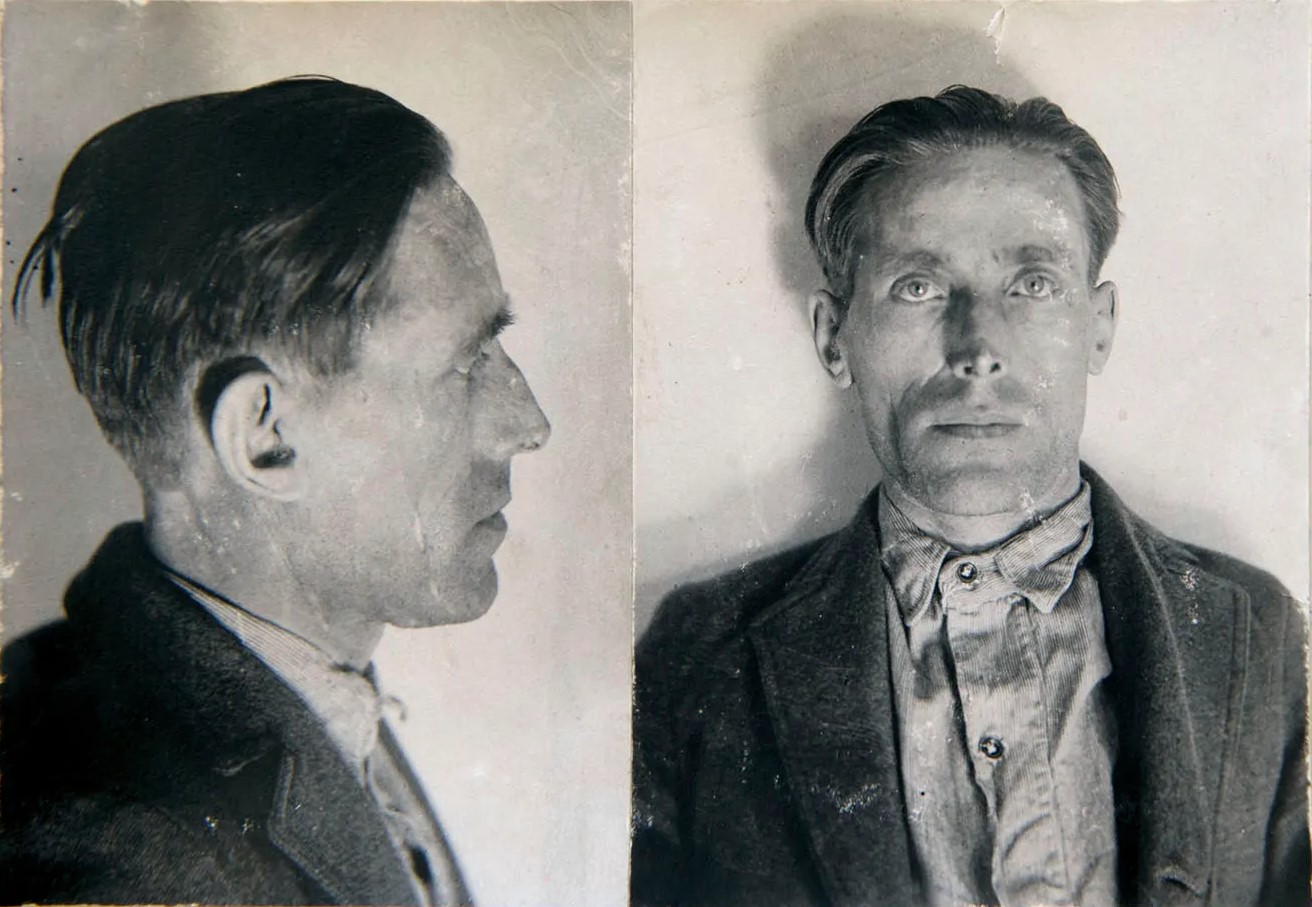
“Sidney, Australia, October 1, 1916. To the General Secretary-Treasurer I.W.W., U.S.A. Dear Haywood: — Since my last communication enclosing £8 for supplies and debt owing on Constitutions forwarded to T. Barker which you have not perhaps received, and may not ever receive (the censorship being so strict now), things have developed some. The military powers have taken full control and without actually declaring martial law. The industrial barons have thrown aside the guise (as not needed) called the people’s rights. It’s the British War Office that talks in Australia today under a law called the War Precaution Act. Any and everything is done that they want to do to suppress the working class. Conscription “comes” into force by proclamation on Tuesday next, October 3rd. We are making a desperate effort to get the working class to ignore the proclamation. We have some hope of getting a general strike on Wednesday next for one day’s duration. The working class are woefully unprepared for the immediate struggle confronting them. Four hundred and fifty thousand pounds has been distributed amongst the press and trade union secretaries, to mislead the workers. September 23 last, thirty plain clothes police with military powers swooped down on our headquarters and arrested all men on the premises, holding them all for three hours, and finally charging T. Glynn, Secretary-Treasurer Local and Editor of Direct Action, Peter Larkin, J. Hamilton, B. Bessant and P. Reeve with treason. Since then eight more Wobblies have been arrested on various charges. Word reached us this morning that three more I.W.W.’s have been arrested charged with murder — shooting a policeman. The police that swooped down on the hall took away charter, all office books and stamps, along with £400 worth of literature. However, we are doing business as usual. Peter Larkin wants you to inform his brother Jim. I don’t know where Jim is at the, time of writing, but believe he is in Chicago. I fear there is a bad time in store for the working class here in the next few months. Maltese, Japs and Chinese coolie labor is being shipped in by the thousands with their own police to keep them right. I’m writing this post haste. Fellow Worker on elbow waiting to smuggle this aboard American mail boat will post in America to you. Hope miners are winning out on the Range. Best wishes in fight. I’m expecting to be arrested myself next couple of days. The intentions of the authorities is to arrest all prominent I.W.W. speakers and hold them for duration of war. Hell of a job they have taken on, eh? Yours for the lot, E.A. GIFFNEY, General Secretary-Treasurer G.E.B. P.S. — No bail granted I.W.W. men.”
The papers printed in foreign languages — A Bermunkas (Hungarian), II Proletario (Italian), Solidarnosc (Polish), Darbininku Balsas (Lithuanian), Rabochaya (Russian), El Rebelde (Spanish), Industrial Unionist (Jewish), A Luz (Portuguese), Allarm (Swedish), Industrijalni Radnik (Slovonian) — as well as the Industrial Worker published in London, England— are all doing splendid work for the movement and merit a much wider distribution.
Other papers like L’Avvenire, Cultura O’Brera and The International Socialist Review, the first mentioned paper, L’Avvenire, published by Carlo Tresca, working consistently in the interest of the I.W.W. These papers are entitled to the support of the organization.
We should devise means for a more general distribution of the papers, pamphlets, leaflets and song books of the Industrial Workers of the World. It must be remembered that the printed word is the best medium of agitation and education. More and newer pamphlets are required, descriptive of industries — agriculture, mining, transportation, both railroad and marine, as well as other industries showing the methods of production and the conditions under which the producers labor.
Management of Strikes.
Experience in conducting strikes of large proportion has taught us the necessity of developing a corps of workers capable of efficiently handling the several mechanical departments that must co-operate to bring success. It is impossible to expect workers to step from their jobs and take up bookkeeping involving thousands of accounts.
In time of strike great excitement prevails and accuracy under such circumstances is out of the question for any but skilled accountants.
Likewise, publicity work is of great importance. Many times facts and details properly presented to the public brings support to the strike that could be secured in no other way.
Capitalist papers can never be depended upon to give the strikers’ side of the struggle. Bulletins must be issued; circulars, pamphlets, posters and stickers gotten out and widely distributed.
The management of the strike itself will, as nearly as possible, be left in the hands of the strikers. A General Office Committee, composed exclusively of members of the union, job committees, picket line, investigation committees, entertainment committee, relief committee, etc., should be formed. With such a corps of workers, financial, publicity and relief agents, with well equipped organizers, no strike will ever be lost.
Education.
The growing demands for a school conducted by the Industrial Workers of the World presents a need which deserves earnest consideration. While our membership are perhaps better informed on economics than any other body of the working class, we have thousands of young men who have been denied more than the third grade of a common school education, and have no learning whatever as to their actual relations to life, knowledge of industrial changes, new processes of manufacture, the development of machinery, why they are wage slaves, why we must organize to control and operate industry, and how to organize is the vital message. Such a school, with a little assistance at the beginning, would, I believe, become self sustaining.
Free Speech.
Many earnest fights have been made by the Industrial Workers of the World to re-establish the right of Free Speech in the United States, several having occurred within the last two years.
At Sioux City, Iowa, the authorities attempted to deny this inherent right. Some plain clothes policemen invaded the hall of the union there and attempted to take out one of the members, when fourteen others who were present insisted on the plain clothes men showing a warrant, which they did not have. They all went to the station and were later sentenced to jail. A call was issued and members from different parts of the country went to their defense. The authorities attempted to prevent them from speaking on the street. More than eighty were arrested and thrown into prison. They declared a hunger strike and so conducted themselves in other .ways as to badly frighten the chief of police, the judge of the court, and the city was finally compelled to capitulate.
The fight for Free Speech was won and celebrated on the rock pile by a great demonstration. The blocks of granite brought to Sioux City for the entertainment of members of the I.WW. will remain unbroken until they pay the going wages and establish union conditions.
For a time it looked as though another Free Speech fight would have to take place at Spokane, Wash. The business element was trying to drive the soap boxers from their chosen corner. A compromise was effected with no loss or advantage to the unions.
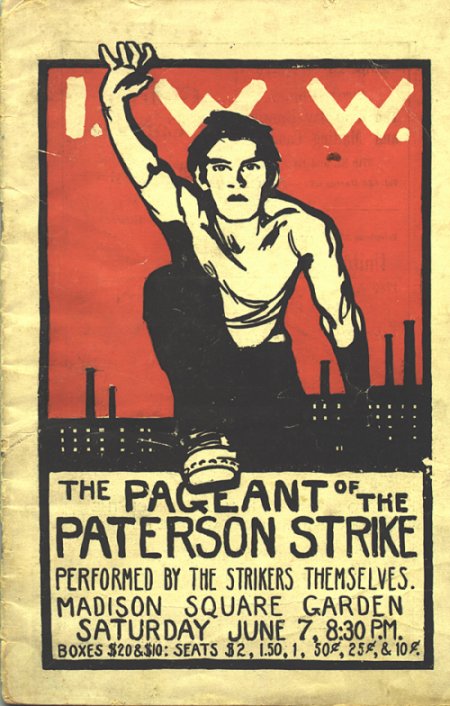
Mayor Fordyce and Chief Bimson of Paterson, N.J., working in the interest of the silk bosses, attempted to prevent meetings of the I.W.W. from being held in that city. Fellow Worker E.G. Flynn was arrested and deported from the town when she went there to speak at a meeting that had been arranged for her by Textile Workers’ Union No. 152. When I was apprised of this fact I sent the following telegram to President Wilson:
“Chicago, III., September 15, 1915. Mr. Woodrow T. Wilson, President of the United States, Washington, D.C. Elizabeth Gurley Flynn has recently been deported from Paterson, N.J. Miss Flynn is a resident of New York City, an Organizer of the Industrial Workers of the World, a labor organization. A Union of this body is located at 90 Market street, Paterson. They arranged a meeting; Miss Flynn was to have been the speaker. When she arrived Chief of Police Bimson, acting under orders of Mayor Fordyce, caused her to be arrested. The chief said: ‘You may have the right to speak, but we have the power to prevent you.’ She was led to the depot and placed on an outgoing train. New Jersey denied the civic rights, the inalienable rights, guaranteed to citizens. We are not asking protection of the Federal Government now. I am but advising you that New Jersey has violated the Constitution under which the State was chartered. The Industrial Workers of the World propose to fight this issue to re-establish the right of free speech and the right of free assembly. WM. D. HAYWOOD, Secretary-Treasurer I.W.W.”
Fellow Worker Flynn has held meetings in Paterson since; also other Organizers.
The affair now on at Everett, Wash., has the semblance of a free speech fight, but it really began as an organizing campaign. After the terrible tragedy in which several of our members were killed and others wounded, I received the following telegram:
“Wm. D. Haywood, All members charged first degree murder reported good authority. All will be transferred to Everett, where mob law will be enacted. Use all available means of protection; notify President Wilson situation serious. Act and answer.”
I immediately telegraphed to the President as follows:
“President Wilson, Washington, D.C. Men and women, members of the Industrial Workers of the World, involved in the tragic occurrence at Everett, Wash., are in imminent danger of mob action. Twenty dead, many wounded, and three hundred jailed. They were making an effort to re-establish free speech. They were attacked by henchmen of the Lumber Trust. Last September members of this Organization were met by citizens of Everett, and were escorted by a band to the park to speak. This fact is mentioned to show that the people of Everett were not opposed to the Organization. There are several nationalities among the prisoners. International complications may arise if more than even-handed justice is done. WM. D. HAYWOOD, General Secretary-Treasurer I.W.W.”
to which I received this reply:
“Wm. D. Haywood, Secretary-Treasurer I.W.W., Your wire of the seventh to President referred to this department shows no facts making for Federal jurisdiction, but because of possibility of jurisdiction account of boat feature, matter has been referred to United States Attorney, Seattle. GREGORY.”
The Everett matter is so serious in its nature, and involves the Organization to such an extent, that it will require the consolidated effort to the end that the right to organize will be established in that part of Washington.
Defense.
The General Office has assisted to the limit of its ability in the defense of our Fellow Workers, and no matter upon what charge they had been arrested. While hundreds of men have been imprisoned, few have been convicted and most of those for minor offenses.
Frank Shafter was charged with murder at Plentywood, Mont., but was acquitted.
James Rowan and Fellow Worker Barrett held on the same charge at Edmonton, Alberta, Canada, were released without bail.
James Schmidt at Aberdeen, S.D., was also charged with murder, his trial resulting in a hung jury. Later the case against him was dismissed.
Charles Cline at San Antonio, Tex., was convicted at the fourth trial and sentenced to life imprisonment.
The several serious cases pending are Carlo Tresca, Sam Scarlett, Joseph Schmidt, Joe Cernogorcevich, Joe Orlandich, Milica Masanovich, Philip Masanovich, Joe Nickich, and the men charged with murder at Everett, Wash. It must be remembered, too, that Ford and Suhr are still in prison, and the agitation to secure their release must be unceasing.
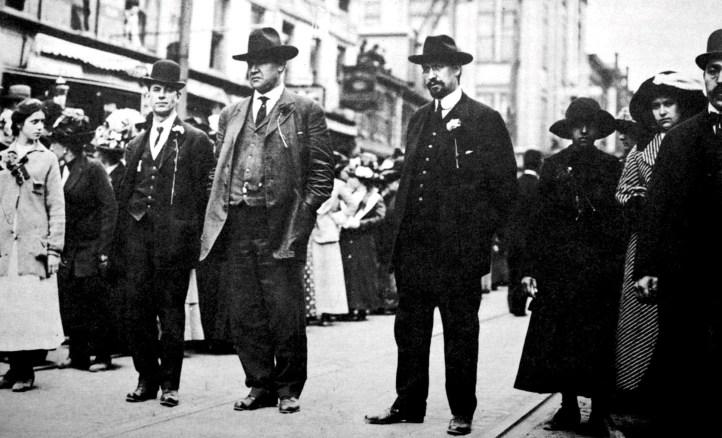
The battle on the economic field is becoming more defined. The exploiting class has, in many instances, thrown aside the mask of hypocrisy and shamelessly employed the police, state constabulary, militia, detectives and private gunmen in their craven desire to keep the working class in industrial slavery.
We have experienced two cruel, bitter years. Many of our members have been called upon to make heavy, painful sacrifices. More than a score have been murdered by legal authorities, hired gunmen and private citizens banded together as red-handed vigilantes. Hundreds of men and some women have been cast into noisome, filthy jails; insulted, abused and maltreated because they dared in their own way to turn the searchlight of truth upon the merciless system of exploitation that coins the tears and blood of workers’ children into diamonds and rubies to decorate the heels of bankers’ wives..
These pitiless pirates are abroad in all parts of the country, in all lands of the world; language and nationality has no meaning to them, they are all the same. Whether it be Governor Spry, the members of the Supreme Court, and the Warden of the State of Utah, who, as the sun rose on that November morning, caused Joe Hill to be led out and shot to death, or Governor Burnquist, whose telegram to Sheriff Minning of St. Louis County, Minnesota, can be attributed to the arrest of hundreds of striking miners on the Mesaba Range, and who was perhaps directly responsible for the killing of the people for which seventeen of our members were charged with first degree murder, eight of whom are still under indictment, six — Carlo Tresca, Sam Scarlett, Joe Cernogorcevich, Joe Orlandich, Milica Masanovich, Philip Masanovich and Joe Nickich — in prison. Mrs. Militza Masonovitch and Joseph Schmidt were released on two thousand ($2,000.00) dollars bail; all of whom are being held for trial. Or Sheriff Ben S. Phillips and the authorities of Pennsylvania who invaded a peaceful union meeting at Old Forge, and without warrant or lawful procedure of any kind, rounded up two hundred and sixty-two (262) innocent coal miners, and hauled them to jail, while their anguished wives and children cried in vain for the liberation of their husbands and fathers. Or like Sheriff Donald McRae, Governor Lister and the black-hearted bandits of the Commercial Club of Everett, Wash., who murdered in cold blood a score of working men who had ventured to come to that town to say publicly upon the streets that they were members of the Industrial Workers of the World, badly wounded fifty others, and caused the state militia and police to imprison and hold incommunicado two hundred and ninety-seven (297) men, crowded to suffocation in the Seattle jail.
In the face of these iniquities, these grievous outrages, there is need to pledge ourselves again to the only organization that can give relief to the working class, to the principles of Industrial Unionism, which means a World of the Workers, For the Workers, and By the Workers.
Recommendations.
As the Organization grows and develops it will be found that the energies of men and material must be concentrated.
A General Headquarters will have to be established where the offices and departments can be located. The Publishing Bureau and the General Office under one roof. Such a move would lessen the expense of maintaining the Organization. All of our own printing could be done by the Publishing Bureau. The rent paid could be cut in half. The Executive Board will, I believe, embody in their report some recommendations in this regard.
I would say, for reasons previously set forth, that the word “NATIONAL” be eliminated from the Constitution and By-Laws of the Industrial Workers of the World.
It has occurred to me that the formation of a General Recruiting Union would fill a pressing need. The reason for this proposition is that there has been some comment, if not complaint, about the A.W.O. No. 400 and other unions lining up individuals not eligible in the industries under their jurisdiction. The thought expressed was the Agricultural Worked Union is becoming a mass organization instead of, as its charter provides, an Industrial Union. A Recruiting Union would fill the requirements that have developed. This union would be in touch with all Delegates and Organizers in the field. Every Delegate and Organizer would carry credentials and supplies of the General Recruiting Union, the office of which could be established at the General Headquarters.
A Recruiting Secretary would be necessary and Recruiting Unions now organized would work for the General Recruiting Union, eventually assembling the entire membership of casual, seasonal and migratory workers.
The General Recruiting Union would be the clearing office, transferring members of recruiting unions to their proper industrial unions. Having Delegates and Organizers continually at work, with a universal initiation fee and dues, a feature to be a six month’s subscription to any paper that a new member desires Delegates and Organizers to be paid in part by commission, as this has proved to be an incentive and should not be overlooked.
The General Recruiting Union would be the means of organizing Industrial Unions, and, in my opinion, would grow to be a mighty auxiliary for organization work.
The Union-at-Large does not fill the need here set forth, as the thing in mind is to have some part of the organization where unattached persons can become active members of the organization^ where they can hold membership until a union in the industry and vicinity in which they are employed is organized.
In considering these and other suggestions coming before this convention it must be remembered that men have a right to difference of opinion which, if honestly expressed, will result in sound conclusions.
The principles of this Organization are as sound and ring as true as worthy metal. The idea of the Industrial Workers of the World, founded as it is on the class struggle, is imperishable. Its ideals quicken the pulse and strengthen the heart of every member. Its members are to a remarkable degree free from all religious superstitions, no longer hoodwinked by political chicanery — looking upon the exploiter, whether a farmer, a small business man or a trust magnate, with a clear vision that recognizes a common enemy.
Youthful, courageous and full of vigor, this Organization is facing a future teeming with fruitful possibilities.
Trusting to see the time in our day when every worker will enjoy the full sunlight of life, I am,
Yours for Industrial Freedom,
WM. D. HAYWOOD, General Secretary-Treasurer.
During the two years ending September 1st, 1916, the following unions have been chartered:
Textile Workers’ Industrial Union, No. 211, Belton, S.C.; September 4, 1914.
Silk Workers’ Industrial Union, No. 212, Summit, N J.; September 16, 1914.
Steamboat & Barge Workers’ Industrial Union, No. 5, M.T.W., Stockton, Cal.; September 23, 1914.
Propaganda League, Moose Jaw, Sask., Canada; September 28, 1914.
Ladies’ Tailors, Branch 5, No. 192, Baltimore, Md.; September 18, 1914.
Propaganda League, Boston, Mass.; September 30, 1914.
Swedish Branch No. 3, No. 178, Seattle, Wash.; October 12, 1914.
Propaganda League, Sioux City, Iowa; October 14, 1914.
Marine Transport Workers’ Industrial Union, Fort Williams, Ontario, Canada; October 14, 1914.
Propaganda League, Los Angeles, Cal.; Oct. 11, 1914.
Minot Industrial Union, No. 585, Minot, N.D; December 1, 1914.
Women’s Propaganda League, Stockton, Cal.; November 16, 1914.
Italian Propaganda League, Los Angeles, Cal.; November 30, 1914.
Propaganda League, Brooklyn, N.Y.; December 21, 1914.
Cotton Workers’ Industrial Union, No. 167, East Taunton, Mass.; December 22, 1914.
Coal Miners’ Industrial Union, No. 241, Firestone, Colo.; December 30, 1914.
Texarkana Industrial Union, No. 591, Texarkana, Ark.; January 20, 1915.
Italian Propaganda League, Leghe di Propaganda Locale Italians, Boston, Mass.
Sioux City Industrial Union, No. 592, Sioux City, Iowa; March 10, 1915.
Shirt Workers’ Industrial Union, No. 198, New York City, N.Y.; March 15, 1915.
Iron, Steel & Tin Plate Workers’ Industrial Union, No. 309, Elwood, Ind.; March 4, 1915.
General Laborers’ Industrial Union, No. 324, Boston, Mass.; March 29, 1915.
Hotel & Restaurant Workers’ Industrial Union, No. 112, New York, N.Y.; March 30, 1915.
Scandinavian Branch No. 3, No. 178, Seattle, Wash.; October 12, 1914.
Chicago West Side Industrial Union, No. 593, Chicago, Ill.; April 12, 1915.
Agricultural Workers’ Organization, No. 400; April 21, 1915.
Polish Branch No. 2, No. 511, Old Forge, Pa.; April 29, 1915.
Propaganda League, Cleveland, Ohio; May 12, 1915.
Belgian Branch No. 4, No. 530, Olneyville, R.I.; May 12, 1915.
Omaha Industrial Union, No. 595, Omaha, Neb.; July 6, 1915.
Council Bluffs’ Industrial Union, No. 596, Council Bluffs, la.; July 29, 1915.
Hungarian Branch No. 7, No. 85, Chicago, Ill.; August 3, 1915.
Oil Workers’ Industrial Union, No. 454, Cushing, Okla.; June 21, 1915.
Oatman Industrial Union, No. 594, Oatman, Ariz.; June 21, 1915.
Agricultural Workers’ Industrial Union, No. 444, Sacramento, Cal.; December 18, 1915.
Coal Mine Workers’ Industrial Union, No. 503, Plains, Pa.; December 31, 1915.
Coal Mine Workers’ Industrial Union, No. 504, Austin Heights, Pa.; December 2, 1915.
Lithuanian Branch No. 2, No. 480, Rockford, Ill.; December 28, 1915.
Vehicle Workers’ Industrial Union, No. 350, Pittsburgh, Pa.; December 28, 1915.
Coal Mine Workers’ Industrial Union, No. 505, Parsons, Pa.; December 15, 1915.
Railroad Workers’ Industrial Union, No. 600, Chicago, Ill.; December 15, 1915.
Macaroni Workers’ Industrial Union, No. 301, Long Island City, N.Y.; December 1, 1915.
Recruiting Local Industrial Union, No. 499, San Jose, Cal.; November 2, 1915.
Textile Workers’ Industrial Union, No. 476, New Brunswick, N.J.; November 27, 1915.
Coal Mine Workers’ Industrial Union, No. 509, Pittston Junction, Pa.; November 18, 1915.
Coal Mine Workers’ Industrial Union, No. 510, Minooka, Pa.; November 18, 1915.
Fish, Oyster & Shrimp Workers’ Industrial Union, No. 601, Apalachicola, Fla.; November 12, 1915.
Recruiting Local Industrial Union, No. 602, Los Angeles, Cal.; November 27, 1915.
Coal Mine Workers’ Industrial Union, No. 507, Dupont, Pa.; October 25, 1915.
Coal Mine Workers’ Industrial Union, No. 506, Duryea, Pa.; October 2, 1915.
Railroad Shop Workers’ Industrial Union, No. 265, East Dedham, Mass.; September 2, 1915.
Metal & Machinery Workers’ Industrial Union, No. 310, Waterbury, Conn.; September 2, 1915.
Sugar Workers’ Industrial Union, No. 495, Brooklyn, N.Y.; September 20, 1915.
Coal Mine Workers’ Industrial Union, No. 502, Pittston, Pa.; January 19, 1916.
Coal Mine Workers’ Union, No. 511, Lackawanna, Branch No. 3, Old Forge, Pa.; January 27, 1916.
Shoe Workers’ Industrial Union, No. 177, Detroit, Mich.; January 25, 1916.
Metal Mine Workers’ Industrial Union, No. 490, Minneapolis, Minn.; February 3, 1916.
Textile Workers’ Industrial Union, No. 358, South Barre, Mass.; February 14, 1916.
Metal Mine & Smelter Workers’ Industrial Union, No. 603, Webb City, Mo.; February 15, 1916.
Lithuanian Propaganda League, Cleveland, Ohio; January 20, 1916.
Construction Workers’ Industrial Union, No. 573, Minneapolis, Minn.; March 6, 1916.
Cigar Workers’ Industrial Union, No. 109, Philadelphia, Pa.; February 17, 1916.
Recruiting Union, No. 599, Brooklyn, N.Y.; March 13, 1916.
Lithuanian Branch No. 8, No. 85, Chicago, Ill.; March 13, 1916.
Metal Mine & Smelter Workers’ Industrial Union, No. 313, Branch 1, Porterville, Cal.; March 14, 1916.
Shop Workers’ Industrial Union, No. 266, Athenia, N.J.; March 15, 1916.
Coal Mine Workers; Industrial Union, No. 501, Jessup, Pa.; March 14, 1916.
Recruiting Union, No. 604, Chicago, Ill.; March 25, 1916.
Domestic Workers’ Industrial Union, No. 113, Denver, Colo.; March 27, 1916.
Car Repair Workers’ Industrial Union, No. 267, Dalton, Ill.; March 29, 1916.
Coal Mine Workers’ Industrial Union, No. 580, Wyoming, Pa.; April 4, 1916.
Recruiting Union, No. 605, Jackson, Mich.; April 6, 1916.
Coal Mine Workers’ Industrial Union, No. 581, Plainsville, Pa.; April 10, 1916.
Textile Industrial Workers’ Union, No. 359, Nashua, N.H.; April 12, 1916.
Alkali & Chemical Workers’ Industrial Union, No. 464, Detroit, Mich.; April 11, 1916.
Quarry Workers’ Industrial Union, No. 364, Lohrville, Wis.; April 11, 1916.
Metal & Machinery Workers’ Industrial Union, No. 300, Chicago, III.; April 14, 1916.
Marine Transport Workers’ Industrial Union, No. 245, Duluth, Minn.; April 18, 1916.
Construction Workers’ Industrial Union, No. 574, Rockford, Ill.; April 24, 1916.
Recruiting Union, No. 606, Cleveland, Ohio; April 24, 1916.
Textile Workers’ Union, No. 436, Lithuanian Branch No. 1, Lowell, Mass.; April 24, 1916.
Textile Workers’ Union, No. 436, Portuguese Branch No. 2, Lowell, Mass.; April 24, 1916.
Recruiting Union, No. 607, Monaca, Pa.; May 2, 1916.
Baltimore Branch, Railroad Workers’ Industrial Union, No. 600, Baltimore, Md.; May 8, 1916.
Hotel & Restaurant Workers’ Industrial Union, No. 608, Chicago, Ill., May 10, 1916.
Domestic Workers’ Industrial Union, No. 114, Salt Lake City, Utah; May 10, 1916.
Packing House Workers’ Industrial Union, No. 609, Chicago, Ill.; May 17, 1916.
Marblehead Branch Quarry Workers’ Industrial Union, No. 364, Marblehead, Wis.; May 17, 1916.
Electrical Workers’ Industrial Union, No. 487, New York, N.Y.; May 22, 1916.
Salt Workers’ Industrial Union, No. 610, Philadelphia, Pa.; May 31, 1916.
Bakery Workers’ Industrial Union, No. 404, Providence, R.I.; June 8, 1916.
Building Workers’ Industrial Union, No. 575, Cleveland, Ohio; June 7, 1916.
Piano Workers’ Industrial Union, No. 561, New York, N.Y.; June 8, 1916.
Sugar Refinery Workers’ Industrial Union, No. 496, Philadelphia, Pa.; June 8, 1916.
Biwabik Branch Metal Mine Workers’ Industrial Union, No. 490, Biwabik, Minn.; June 12, 1916.
Virginia Branch Metal Mine Workers’ Industrial Union, No. 490, Virginia. Minn.; June 12, 1916.
Recruiting Union, No. 611, Alexander, Ind.; June 14, 1916.
Brooklyn Branch Bakery Workers’ Industrial Union, No. 46, Brooklyn, N.Y.; June 15, 1916.
Shoe Repairers’ Industrial Union, No. 612, Philadelphia, Pa.; June 15, 1916.
Eveleth Branch, Metal Mine Workers’ Industrial Union, No. 490, Eveleth, Minn.; June 19, 1916.
Gilbert Branch Metal Mine Workers’ Industrial Union, No. 490; June 19, 1916.
Chisholm Branch Metal Mine Workers’ Industrial Union, No; 490, Chisholm, Minn.; June 19, 1916.
Kinney Branch Metal Mine Workers’ Industrial Union, No. 490, Kinney, Minn.; June 19, 1916.
Hibbing Branch Metal Mine Workers’ Industrial Union, No. 490, Hibbing, Minn.; June 19, 1916.
Crosby Branch Metal Mine Workers’ Industrial Union, No. 490, Crosby, Minn.; June 19, 1916.
Aurora Branch Metal Mine Workers’ Industrial Union, No. 490; June 19, 1916.
Buhl Branch Metal Mine Workers’ Industrial Union, No. 490; June 19, 1916.
Philadelphia Branch Industrial Union, No. 600, Philadelphia, Pa.; June 20, 1916.
Seal Fishermen Industrial Union. No. 449, Pittsburgh, Cal.; June 20, 1916.
Shoe Repair Workers’ Industrial Union, No. 613, Cleveland, Ohio; June 30, 1916.
Coal Mine Workers’ Industrial Union, No. 583, Luzerne, Pa.; July 7, 1916.
Schenectady Branch Metal & Machinery Workers’ Industrial Union, No. 300, Schenectady, N.Y.; July 9, 1916.
Macaroni Workers’ Industrial Union, No. 502, Jersey City, N.J.; July 11, 1916.
Aurora Branch Railroad Workers’ Industrial Union, No. 600, Aurora, Ill.; July 21, 1916.
Coopers’ Industrial Union, No. 559, Philadelphia, Pa.; August 2, 1916.
Hod Carriers’ Industrial Union, No. 463, New York City, N.Y.; August 5, 1916.
Proceedings of the 10th Convention of the Industrial Workers of the World. I.W.W. Publishing, Chicago, 1916.
PDF of full book: https://archive.org/download/16Proceedings10thConvIWW/16-Proceedings10thConvIWW.pdf
 Revolution's Newsstand