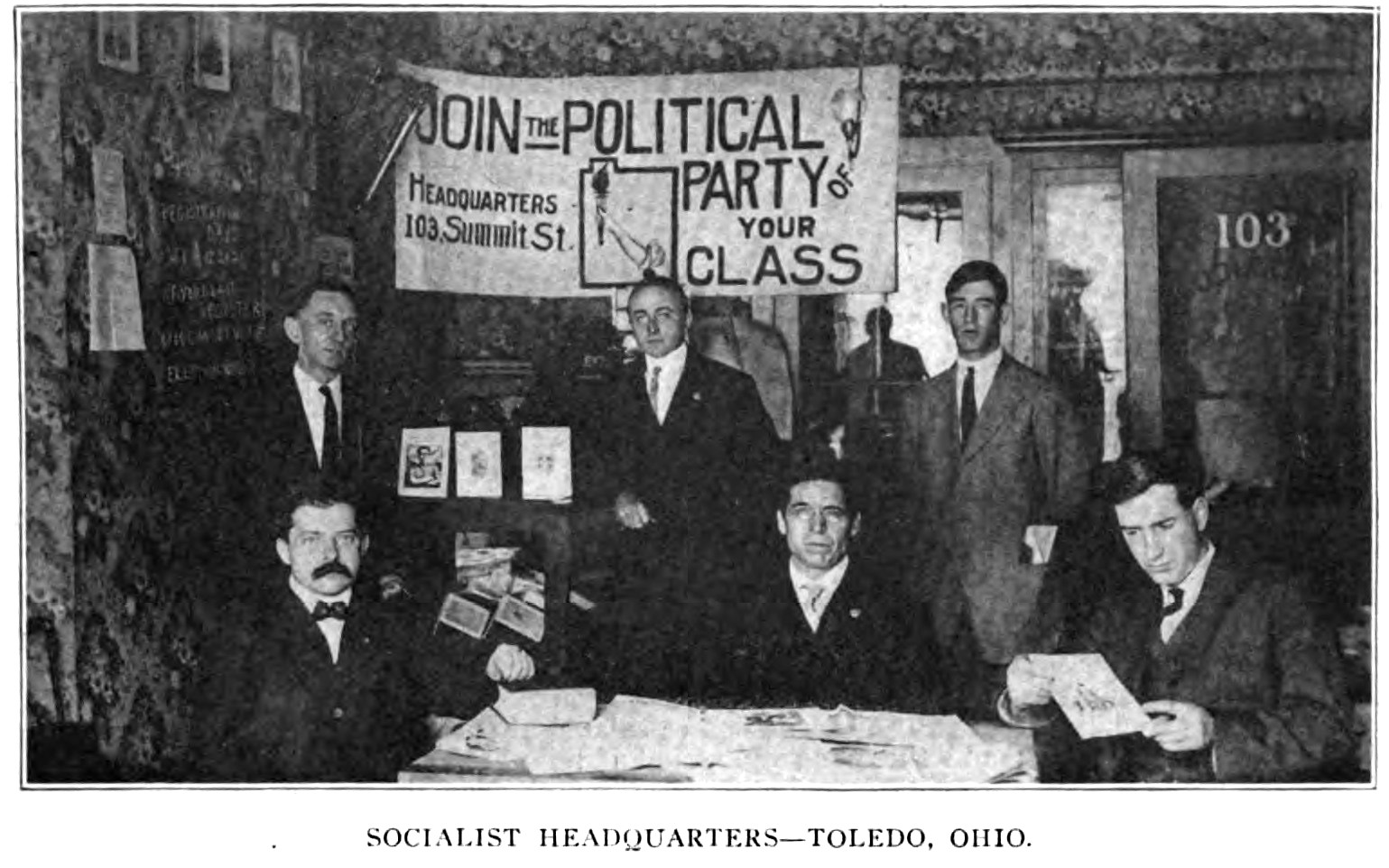
A fascinating look at the sources of Socialism’s phenomenal rise in the Midwest before World War One by Ohio-born Frank Bohn. Bohn, like many, had left the Socialist Labor Party around Debs’ 1908 campaign to join the Socialist Party, and was an organizer in his native Midwest for the Party at this time.
‘Socialism in the Middle West’ by Frank Bohn from The New York Call. Vol. 4 No. 143. May 23, 1911.
At the last election Ohio distinguished itself by polling the largest vote ever cast for the Socialist party in any State of the Union. This vote was not the product of unstable causes. In 1904 the Ohio vote was 26,000, in 1908, 33,000: The 1910 vote of over 60,000 was the normal result following two years of hard work and careful organization on the part of Ohio Comrades. Needless to say, the writer was anxious to observe at first hand the methods which had led to these results and to become acquaint- ed with the Comrades who had developed them.
The middle West is a region of rapidly developing industrial cities, large and small. In Ohio there are eighty of more than 5,000 population and five of more than 100,000. We have previously explained to the readers of The Call why it is that the Socialist movement develops first in the small industrial towns. So Ohio now leads in the number of dues paying party members, having more than 6,000.
Marysville, may be taken as a representative of the type of smaller towns in Ohio. It has 5,000 people. During the past twelve months it has increased the membership of its local from 7 to 112. A weekly Socialist paper is published at Marysville, which has a circulation larger than either of the capitalist papers. The problem of having a paper in a small town has been solved in this part of the country. At Findlay, Ohio, a co-operative organization publishes seventy-two local papers. A part of each paper is devoted to general propaganda and educational matter. This is the same for all papers. A portion, as large as local Comrades may wish, is devoted to news of the particular town in which it is to be circulated. Such, a stem might well be developed in New England and the Middle Atlantic States. The up-State towns in New York, above all, would profit by this method.
The social distinctions in the small towns are now much more clearly marked than formerly. It must be remembered that practically the entire population of the average city of from 5,000 to 15,000 people in the Middle West is American. Formerly a large degree of social equality obtained. This resulted not only from the common origin of the wealthy and the poorer elements of the population, but also from the manner of living, their ideas and the education of their children. All this is now changed. During the past twenty years, towns of 2,000 people and up have developed water works, electric lights, usually a gas plant. and have built fine new high schools. Electricity and gas for lighting and heating, paved streets, automobiles and he new homes, which correspond to these luxuries, have been, of course. appropriated by the “better people” of the community. The workers live in small unpainted cottages on the unpaved streets. They use oil lamps and carry coal in buckets. The new high school building is the pride of a small town in the Middle West, but the working class is fortunate if it can send its children through the Trade schools.
The old-time American workingman is very much embittered when he sees men he has known from boyhood, and who are no better than he is “enjoying” the new luxuries of the present generation, while his condition is becoming steadily worse. His poverty and the other man’s wealth are known to the whole community. He thinks at first that he was born to something better, but missed his opportunities through some failure of his own. Then comes the Socialist movement with the true explanation of the social condition. The point of departure in the reasoning of the man in the small town is usually as regards his conception of government. In the larger cities it comes often through the failure of the labor union to succeed and the necessity of revolutionary theory and practice. In the small town the worker is bred both religious and patriotic. When his living conditions have deteriorated, when he sees his children denied the opportunities that would make their life easier than his, and after he has seen several local politicians grow rich through town and country political graft–then he is ready for a larger view of life. Its form is usually bitter enmity toward the wretches who have debased his country and its government. The tremendous hold the Appeal to Reason has upon this population is due to the fact that its editors comprehend perfectly the psychology of the American born worker and specifically the worker in the small town. The Appeal to Reason comes into the home of this man and he begins to sweat from anger. This is the first act in the making of a revolutionist.
Beside the other factors which make propaganda in the larger cities hard, which were analyzed by the writer in an article for The Call last autumn, another element is evident. The workers in the small towns do not have to contend with a local labor union machine, whose business it is to deliver the working class vote to the Democratic and Republican politicians. In Toledo this gang has supported Brand Whitlock, the heir of Golden Rule Jones. In Cleveland it was pie for Tom Johnson during his whole career. In Chicago, however, the old party machine which is indorsed by the American Federation of Labor always loses in the election. In Pittsburg we have conditions coming to a head. The Socialist party there numbers in dues paying members, 1,500 strong. According to the reports in Justice, the Socialist party paper in Pittsburg, corruption and disruption in the American Federation of Labor there beggars all description. Consequently the Socialist party organization has been educated to a knowledge of how little may be expected from that source. The same is true of Chicago.
The middle West is the home of the metal working industries. These industries have, during the past twenty years, developed entirely out of the craft system. As a result craft unionism in the factory has been abolished. It exists only in the building trades. The machinists cannot make head against the ten-hour day because in the old sense, there are no machinists. But there is a ten-hour day. Industrial development has not abolished work.
The Socialist party has permeated to every factory and every working class home in the remotest village. The whole mental life of this population is being revolutionized. The writer found that a profound interest in revolutionary unionism had been everywhere developed by the party. The workers are again taking up the matter of shop organization. The rallying cry has already sounded forth. It is “One Big Union and the Eight-Hour Day.”

We are on the eve of one of the most important labor struggles in the history of the country. It will take place in the metal industries of the Middle West. On one side the forces of Capitalism will be led by the Steel Trust. On the other, the workers, angered by twenty years of defeat, but with renewed hope, will be solidified industrially, and will be in possession of a considerable degree of political power. The struggle will be gigantic, bitter, and desperate, and will be fought with any and every weapon which the rival forces can lay hold of. Kid gloves are not fashionable in the iron and steel industry. The fight will not begin this year. It will develop in the next period of business prosperity, when the workers are pretty generally employed. At the present time, with from 25 to 50 per cent of the workers unemployed, the Socialist party is making the greatest strides. Revolutionary unionism will later come abreast of it. Here, between the Ohio River and the Great Lakes, from Buffalo and Pittsburg to St. Louis and Minneapolis. where the flat country is cobwebbed by railroads and thick with factories, is the industrial heart of America. The coming struggle is likely to be of crucial importance. The numbers involved will give it the form of a labor rebellion. For an intimation of the nature of the conflict we must return to the old days of the K. of L. in Pittsburg, Cleveland, and Chicago.
The present is a time of preparation. To 800,000 working class homes in this middle West goes the Appeal to Reason. The International Socialist Review, The New York Call, the Chicago Daily Socialist, Pittsburg Justice and more than a hundred other Socialist papers. Within two year the Socialist party will carry scores of small towns and two or three more large cities. And the more cities and towns carried by the Socialist party, the greater the police power in the hands of the workers, the more bitter relentless and decisive will be the battle which every revolutionary worker in the middle West is now eagerly awaiting.
The New York Call was the first English-language Socialist daily paper in New York City and the second in the US after the Chicago Daily Socialist. The paper was the center of the Socialist Party and under the influence of Morris Hillquit, Charles Ervin, Julius Gerber, and William Butscher. The paper was opposed to World War One, and, unsurprising given the era’s fluidity, ambivalent on the Russian Revolution even after the expulsion of the SP’s Left Wing. The paper is an invaluable resource for information on the city’s workers movement and history and one of the most important papers in the history of US socialism. The paper ran from 1908 until 1923.
PDF of full issue: https://www.marxists.org/history/usa/pubs/the-new-york-call/1911/110523-newyorkcall-v04n143.pdf
 Revolution's Newsstand