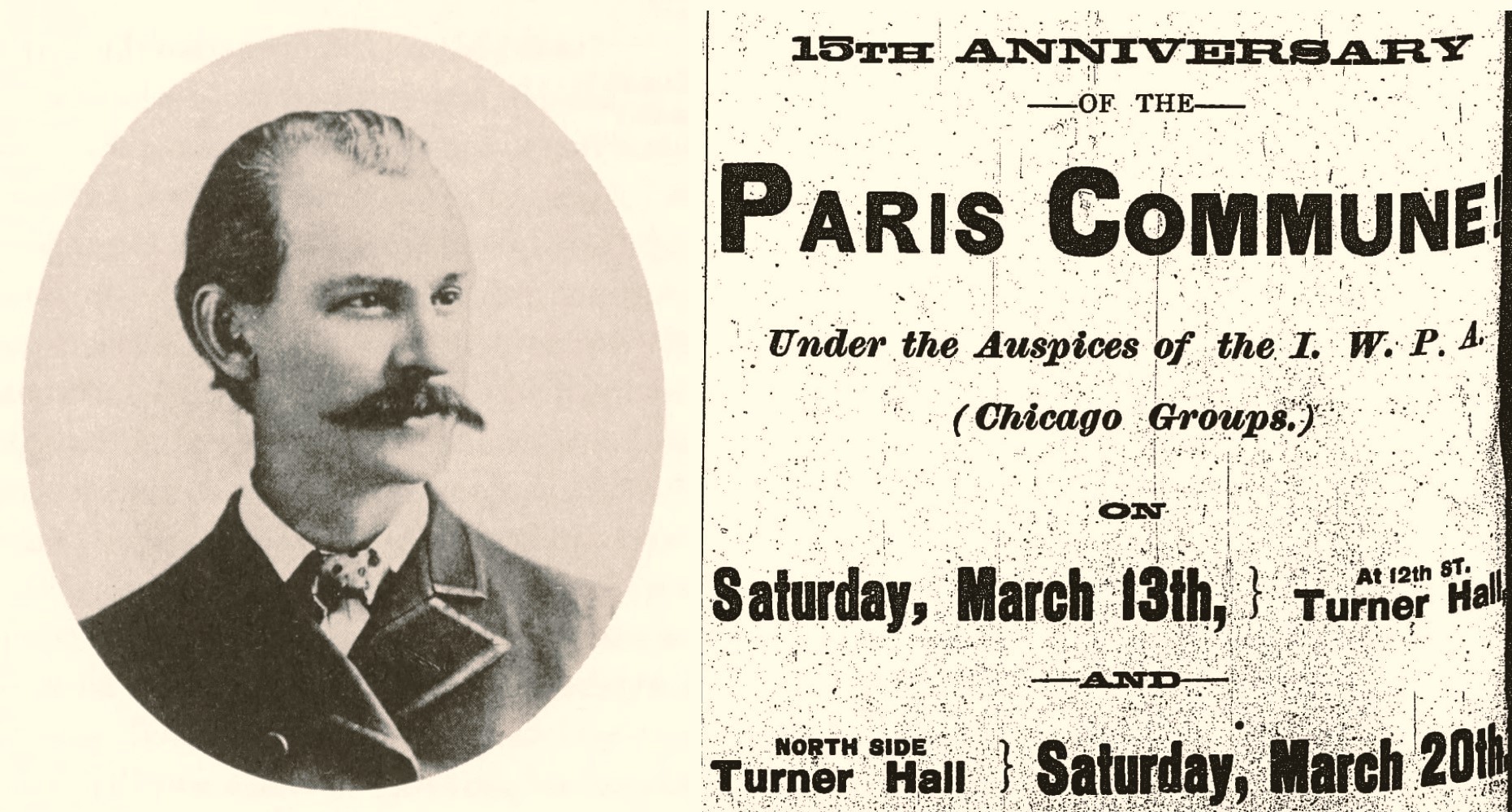
The record of a moment with real historical meaning as martyrs of two continents meet. Only fifteen years after the Commune, and just weeks before Haymarket, 1,500 Chicago revolutionaries were addressed by the soon-to-be executed Albert Parsons as the International Working People’s Association gathered at the city’s Turner Hall to commemorate the workers of Paris.
‘American Workingmen Pay Homage to the Martyrs to Liberty, Fraternity, Equality’ from The Alarm (Chicago). Vol. 3 No. 1. March 20, 1886.
THE PARIS COMMUNE. FIFTEENTH ANNIVERSARY OF THE REVOLT OF LABOR IN FRANCE.
American Workingmen Pay Homage to the artyrs to Liberty, Fraternity, Equality.
Twelfth Street Turner all was crowded by over 1,500 persons last Saturday who had gathered to celebrate the fifteenth anniversary of the Paris Commune.
The scarlet banner, typifying the red blood, the solidarity of the human race, adorned the spacious hall and hung pendant from the galleries and stage. Numerous mottos printed in large letters were displayed, among which were such as “Every government is a conspiracy of the rich against the poor,” “Liberty without equality is a lie” “The means of life belong to all,” “Obedience to statute law is slavery,” “Not to be a slave is to dare and do,” etc., etc.
The spacious hall presented an unwonted scene with its brilliant lights, crimson banners, beautiful mottos and vast throng of revolutionary workmen and their wives and children, all bent on doing honor to the workingmen of France who sacrificed their lives that labor might be free. The programme of the evening consisted of a theatrical performance, speeches, singing, music and dancing. The stage performance concluded at 10 o’clock, when A.R. Parsons took the platform and announced to the audience that Mme. Delescluz, of New York City, which was engaged to be present and deliver an address, she having been a participant in the Paris Commune, had sent word that illness prevented her coming. Mr. Parsons then spoke briefly upon the Commune. He called attention to the fact that the history of the revolt of the Paris workmen had been written by its enemies, by the men who, in France, as well as everywhere else, America not excepted, held labor in bondage, and slaughtered the workers in cold blood whenever they offered resistance. The Paris Commune was for this reason, but imperfectly understood by the mass of American workmen. The Paris Commune, which was proclaimed March 18, 1871, was a revolt of labor against the domination of capital, an attempt by force of arms to secure labor’s economic emancipation and secure forever the right of labor to live and enjoy the fruits of its labor. The speaker referred to the heroic struggles and immortal acts of those brave men and women of the Commune. Beneath the walls of Paris the victorious German army rested on its arms. Napoleon III was a prisoner of war and the empire was overthrown. Repeatedly had the French workmen besought their German fellow workers not to bathe their hands in the blood of their comrades or lend themselves an instrument of aggrandizement to their German despoilers and enslavers of labor. With the downfall of the French empire the capitalists of France sought to establish a capitalistic republic in which, like our American republic, all are free and equal who possess and control capital. They entered into a conspiracy and sought by force of arms to establish their right to govern the workmen of France under the guise of the republic. The workers saw their design, and as Socialism was a healthy growth among them, they undertook by force of arms to thwart the foul conspiracy. The capitalists established their provisional government with headquarters in the city of Versailles, where they proclaimed their right to govern and rule the workers of France and organized an army of armed hirelings for that purpose. They sought by bribery, threats, corruption, the agency of the church and the superstition of patriotism to turn aside the determination of the people to govern themselves.

The workmen and women of Paris rejected all these treasonable overtures and prepared for the defense of their rights. One hundred thousand men of the National Guard comprised the army of the Commune. The tri-color gave way to the red flag which was raised in every quarter. “Liberty, Fraternity, Equality” was proclaimed, and they at once began to regulate all the affairs of industry to suit themselves. were no longer masters and servants, employer and employe, capitalist and wage-slave. The capitalists saw in the Commune the overthrow of their power over the people, the end of their robbery of the poor. To defeat the people they massed their armies around the walls of Paris and for ten weeks besieged the fated Commune. At the expiration of that period, by means of overwhelming numbers and treachery, they entered the city and the Commune fell. Then followed a scene of carnage which is unparalleled in history. Over 20,000 unarmed prisoners of war were imprisoned within the walls of the plain of Satory, and both they and their wives and children, many of whom had called to search out their fathers, husband or sons, were ruthlessly slaughtered together. Atrocity unparalleled! The brutality of capitalism was displayed upon a wholesale and gigantic scale, for over 70,000 defenseless prisoners were put to death by drumhead court-martials after the conflict was all over.
But, friends, we have not time to enter into the details of this bloody crime against humanity. We of America know ourselves what the brutal spirit of capitalism is. In this republic of property the United States troops, the police and the armed hirelings of capital have been, and are now being employed in many states of the union to defend the right of property to hold labor in subjection. The imperialism of capital is crushing the lives and liberties of the American workingmen as truly as it does the same thing among the workers of so-called despotic Europe. Knights of Labor and other organizations of labor are discharged or locked-out, because of membership in labor organizations. Hundreds of thousands are prevented from using the means of life, and kept in compulsory idleness, vagabondage, misery and poverty. The things make it necessary to proclaim and maintain the American Commune, and the day draws nigh, when the workers of the whole world will rise and forever destroy class rule and the robbery of man’s birthright. That red flag which hangs out before you is the symbol of emancipated labor, the ensign of “liberty, fraternity, equality.
The speaker concluded by reading a poem written by Mrs. Mary Miller, of the American group, when the band struck up the Marsellaise hymn and the enthusiastic audience joined in the refrain, “Vive la Commune!” Mons. Deguery read a communication in French from the Societe Revolutionaire, composed of the survivors of the Paris Commune, residing in New York City.
The floor was then cleared, the orchestra took up its position on the stage, and to the strains of soft and enchanting music, all entered heartily into the joys of the dance and the festivities of the hour until early morn.
The celebration will be concluded by a grand concert, recitations and ball in the North Side Turner Hall on Saturday evening, March 20.
The Alarm was an extremely important paper at a momentous moment in the history of the US and international workers’ movement. The Alarm was the paper of the International Working People’s Association produced weekly in Chicago and edited by Albert Parsons. The IWPA was formed by anarchists and social revolutionists who left the Socialist Labor Party in 1883 led by Johann Most who had recently arrived in the States. The SLP was then dominated by German-speaking Lassalleans focused on electoral work, and a smaller group of Marxists largely focused on craft unions. In the immigrant slums of proletarian Chicago, neither were as appealing as the city’s Lehr-und-Wehr Vereine (Education and Defense Societies) which armed and trained themselves for the class war. With 5000 members by the mid-1880s, the IWPA quickly far outgrew the SLP, and signified the larger dominance of anarchism on radical thought in that decade. The Alarm first appeared on October 4, 1884, one of eight IWPA papers that formed, but the only one in English. Parsons was formerly the assistant-editor of the SLP’s ‘People’ newspaper and a pioneer member of the American Typographical Union. By early 1886 Alarm claimed a run of 3000, while the other Chicago IWPA papers, the daily German Arbeiter-Zeitung (Workers’ Newspaper) edited by August Spies and weeklies Der Vorbote (The Harbinger) had between 7-8000 each, while the weekly Der Fackel (The Torch) ran 12000 copies an issue. A Czech-language weekly Budoucnost (The Future) was also produced. Parsons, assisted by Lizzie Holmes and his wife Lucy Parsons, issued a militant working-class paper. The Alarm was incendiary in its language, literally. Along with openly advocating the use of force, The Alarm published bomb-making instructions. Suppressed immediately after May 4, 1886, the last issue edited by Parson was April 24. On November 5, 1887, one week before Parson’s execution, The Alarm was relaunched by Dyer Lum but only lasted half a year. Restarted again in 1888, The Alarm finally ended in February 1889. The Alarm is a crucial resource to understanding the rise of anarchism in the US and the world of Haymarket and one of the most radical eras in US working class history.
PDF of full issue: https://dds.crl.edu/item/54016
 Revolution's Newsstand