
Murray Scheier reports on the Labor Sports movement in an early issue of the pioneering journal ‘Health.’
‘Workers’ Health Through Sport and Hiking’ by Murray Scheier from Health. Vol. 1 No. 3. July, 1934.
IN JANUARY, 1927, the first step was taken to build a left-wing workers sports movement in the United States. The roots of this undertaking, however, lie in the European countries. Immigrants brought with them the traditions of workers’ sports organizations, such as German Turnerbunds, Bohemian Sokols, Finnish Socialist Athletic League, etc. These foreign-language groups felt the need of organizing workers’ sports here.
In the year 1924, the Workers’ Sports Alliance was formed. It consisted of Finns, Czechs and Hungarians. This group dissolved after one year due to lack of initiative on the part of leaders, who were followers of the second international. Three years later, on January 24th and 25th, 1927, a conference in Detroit gave birth to the Labor Sports Union of America. The composition of the elements present at this conference gave it an encouraging outlook for existence. There were the Finish, Hungarian, Czech, Jewish and, above all, some American sports clubs represented.
The class-conscious trade unionists saw that employers were using company sport organizations in their own advantage. The revolutionary immigrants observed that the youth of their nationality was rapidly being won away from their working-class parents through sports organizations controlled by bosses. These workers took note of this and soon began to redouble their efforts in building up a strong workers sports movement under the leadership of the Labor Sports Union.
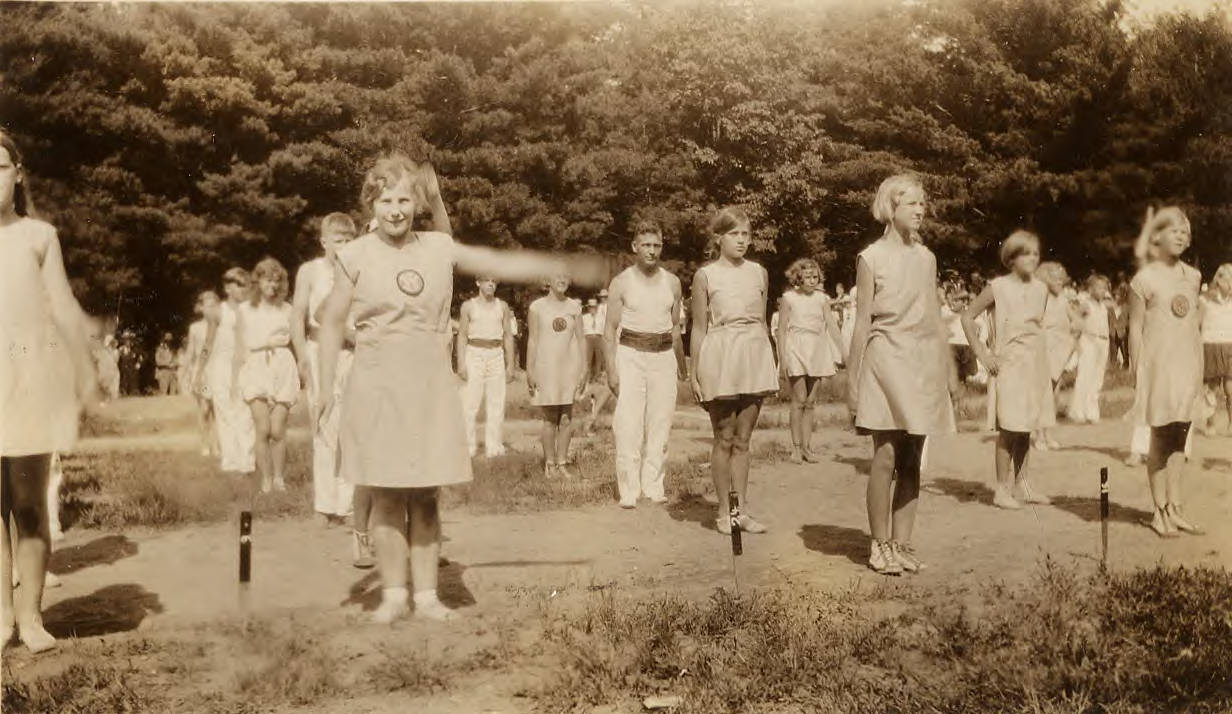
In 1927, the first successful national track and field meet was held in Waukeegan, Ill. A year later saw the first Labor Olympics, an excellent two-day meet held in New York. It featured a national track meet, a national swimming meet and a soccer game. At the third national convention it was voted unanimously to affiliate the Labor Sports Union to the Red Sports International. The same year a national physical training school was organized at Loon Lake, Mich. Some of the students today are active members, organizers and instructors in our workers sports clubs. In July, 1932, the L.S.U. arranged a Counter-Olympic meet in Chicago as an answer to the bosses’ Olympic held in the state where Tom Mooney is imprisoned. This meet convinced those who were still skeptical about our organization that it is the only fighting worker’s sports movement in the country.
The vast number of white and negro working-class athletes on the field, at the dining table and in the sleeping quarters, showed that it was a real workers’ meet. Thus in looking over the seven years of the workers sports movement, we can say that it has splendidly justified its existence. The fact that it is as yet weak and narrow, in comparison with the labor sport organizations in other countries, can be traced to the relative immaturity of the American labor movement. With the growth of the mood of organization of the American workers, come greater opportunities for the organization of ten-fold larger workers’ sports movement; a movement that must base itself on the workers, in big industry; a movement of negro and white athletes of all shades of opinion united on a fundamental program of the workers sports movement.
The fundamental purpose of the labor sports movement is the struggle against the organizational and ideological influence of the bourgeois sport organizations over the American working class sports- men, and the winning of these sportsmen for the revolutionary struggles of the working class. It does not hypocritically state, as the reformists do, that its purpose is to improve the health of the workers; first, because it recognizes that it cannot provide the recreational facilities that the bourgeoisie can provide, and secondly because there are definite limits to the ability of sports to overcome the ravages of industry and living conditions of the workers. Its activities do, however, afford some beneficial recreational for workers who otherwise have little opportunity for such recreation.
During the summer these activities are naturally outdoor activities, especially walks and hikes. In spite of the lure of the automobile, hiking is growing in popularity among the workers of the city. This is probably due to the ease by which a large group can be organized and to the few facilities required.

Hiking has often been called the lazy man’s sport. This theory is entirely wrong. On the contrary, it is one of the most balanced and wholesome sports for both body and mind.
In our metropolis of New York, hiking territory is naturally diminishing. Where only a few years ago we found ideal hiking regions and almost untouched woodlands, there is today a new parkway. There are, however, still many hiking possibilities around New York. The beautiful Palisades, hanging over the Hudson, still has a large lure for interested hikers. Its forests, brooks, large rocky hills and vast lawns rank first amongst the many places to hike. Hunters Island in the Upper Bronx or Tibbets Brook Park are popular places amongst the walkers and climbers.
To enumerate all the hiking places would be of little interest to the reader. The writer recommends that the reader join one of the many sport clubs which endeavor to organize all workers interested in hiking and outdoor recreation. The Nature Friends, a section of the Labor Sports Union, and the only workers’ hiking organization in this country with headquarters at 12 East 17th Street, New York, arranges well-conducted hikes every weekend. They know the trails, how to arrange outings, where to go and what to do once they are there. The various Labor Sports Union clubs such as the Red Sparks Clubs, 64 Second Avenue, arrange hikes as well as other sport activities such as baseball, basketball, calisthenics, volley ball, swimming, soccer, etc.
Hiking has its advantages, both from a physical and recreational point of view. We probably forgot how to breathe properly. This we will learn when in the company of good hikers. Then too, it is quite obvious that the nerves are in need of a little greasing either from hard work, pounding the pavement looking for work, or through the ceaseless class struggle. Once we are in the open, observing the natural surroundings, and escaping the turmoil of cars, elevators, subways, etc., the nerves will relax and begin to function along more natural and rational channels. The blood, too, will circulate better. The heart will obtain the proper exercise. The digestive apparatus will function on a better scale. The mind will be eased from the uneven taxation of city life. We will feel a little tired physically at first, and not be able to attend our regular Sunday movie; but all this will strengthen us and at the same time make us feel relaxed. The sight and nerve systems will improve considerably. Remember, walking up a hill slowly is more wholesome than running down a hill quickly.
Hike leadership constitutes a fair sized job. The group must be willing to co-operate in order to obtain the greatest pleasures from this sport. Hikes in strange territory should be laid out. One or more leaders have to explore the trail and its surroundings. Schedules of trains, bus, or trolley must be consulted, and the leader must watch his time so as to conform with transportation. Wise walkers travel quietly, especially when passing through villages. A steady pace is better than alternate slow and rapid pace interspersed with rests, and the pace of the hikes must be regulated for the slowest walker in the group. Hikes on a Sunday should in general, not be more than four to seven miles. The hike should always end up at a place where there is playing space; for games after the hike prove the best possible means for joy and pleasure. To build a campfire at the resting place makes the hike more pleasant for all. The rest at the campfire makes it fitting for various discussions, get acquainted with the guests and have a chance to discuss our movement.
Especially does the hike become more beneficial when there is some sort of entertainment, or a talk on geology or botany by those who are well prepared to make this of general interest.
It is part of good sportsmanship to leave everything unmolested, to see that all fires are thoroughly extinguished, and that campus or rest grounds are left clean. Trees must be spared injury and wild flowers picked in a minimum amount, the rare ones to be merely enjoyed in passing. The best way to carry all necessary equipments for a long hike is in a knapsack. For a short hike, food and a poncho should be the only necessary articles. A canteen filled with water is essential only when the hiker has no knowledge of the drinking water regions. A large cooking pot taken along by the leader to make either tea or coffee at the resting place makes the hikers enjoy a real party. A first-aid kit with anti-snake bite serum should also be brought along by the leader. Photographs taken on hikes keep friendships and help to crystalize the experiences of the trip, as well as to give material for entertainment on rainy days.
Hikes or long walks to the country, parks or forests should be held often. This will enable us to get away from the noise and turmoil of the city and its dusty gas-filled air. One can tell very easily as the hikers mount the cars, busses, or subway for home that they had spent a delightful day somewhere in the open. The rosy flush of cheeks, the light of surprised happiness in shining eyes, the physically tired but buoyant steps as men and women come back singing revolutionary songs; the peace and contentment in the eyes of those who were tired and worn at the outset, indicate that the hike has accomplished its purpose-refreshing the jagged nerves, and stretching the cramped muscles of the cooped-up city worker.
Health was the precursor to Health and Hygiene and the creation of Dr. Paul Luttinger. Only three issues were published before Health and Hygiene was published monthly under the direction of the Communist Party USA’s ‘Daily Worker Medical Advisory Board Panel’ in New York City between 1934 and 1939. An invaluable resource for those interested in the history history of medicine, occupational health and safety, advertising, socialized health, etc.
PDF of full issue: https://www.marxists.org/history/usa/pubs/health-luttinger/v1n3-jul-1934-Health-NYAM-enh.pdf
 Revolution's Newsstand