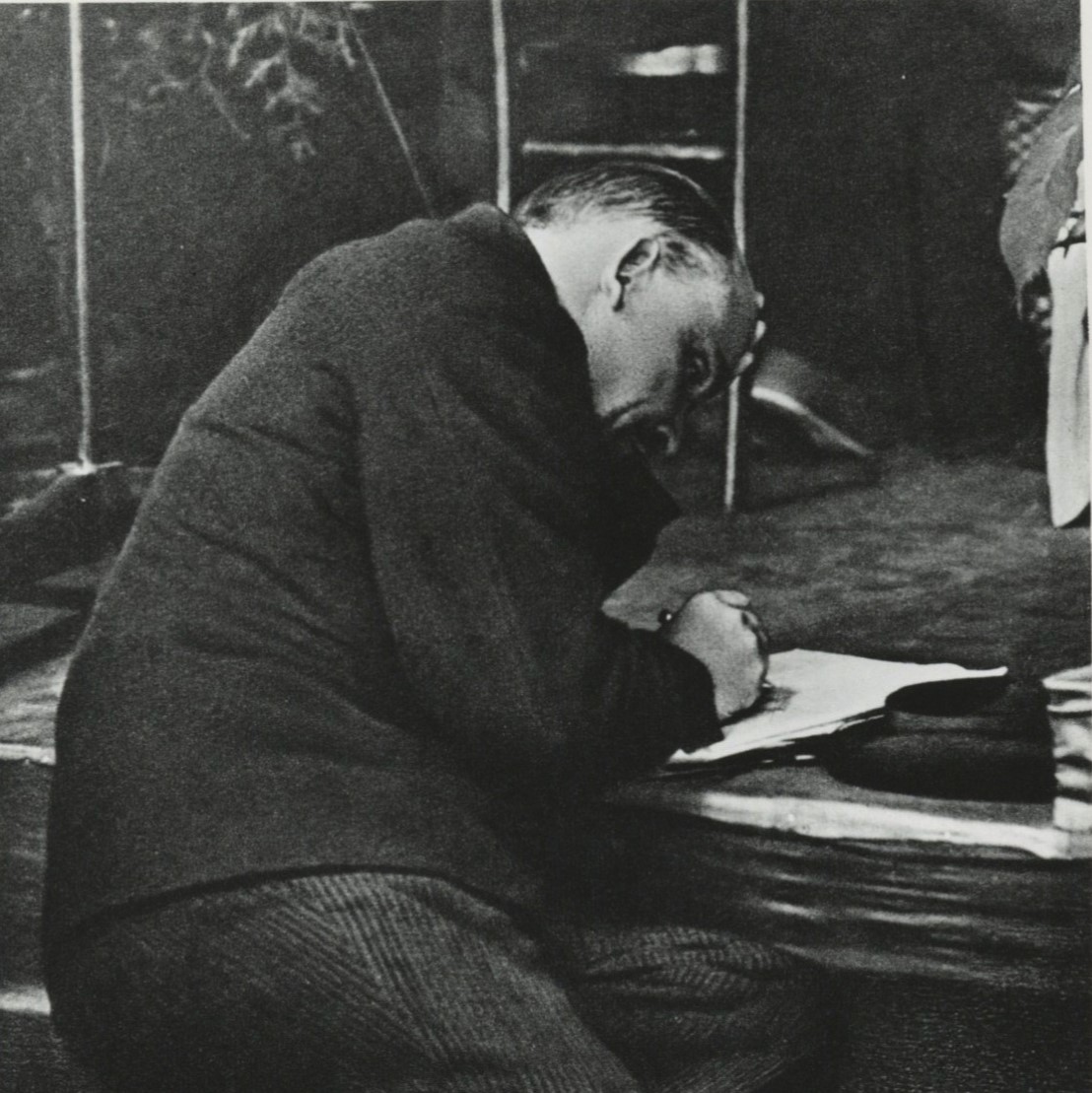
This theses was written by Lenin on December 4, 1922 as instructions for the Soviet delegation, led by Karl Radek who wrote an essay on it, to the Hague Conference convened by the Second International’s Amsterdam Trade Union International to discuss the mounting crisis in the Ruhr and the danger of new international war.
‘Sketch of the Theses on the Question of the Tasks of our Delegation at the Hague’ (1922) by V. I. Lenin from International Press Correspondence. Vol. 4 No. 32. June 5, 1924.
With reference to the question of combatting the danger of war, in relation to the Hague conference, I am of the opinion that the greatest difficulty consists in overcoming that prejudice which regards this question as if it were simple, plain and comparatively easy.
“We shall reply to war with strike or revolution” is the phrase customarily employed by all the influential leaders among the reformists of the working class. And often enough the workers and peasants are satisfied and quieted by the radical appearance of such replies.
The best method would perhaps be to begin with a most determined rejection of such views. It should be explained that particularly at the present time, since the last war, none but the completest fools and most hopeless liars could suppose that a reply of this description is of any value whatever towards the solution of the problem of war against war; it should be explained that it is impossible to “reply” to a war by a strike, just as it is impossible to reply to a war by a “revolution” in the plain and literal sense of the word.
It must be definitely explained how great is the secrecy surrounding the birth of a war, and how helpless is an ordinary labour organization, in face of a really impending war.
It must be explained over and over again in a thoroughly concrete manner how the situation was during the last war, and as to the reasons why the situation could not be otherwise.
Special attention must be called to the fact that the question of “defense of native country” will inevitably be put, and that the overwhelming majority of the workers will inevitably solve this question in favour of their own bourgeoisie.
Therefore the points to be placed in the foreground are: firstly, the discussion of the question of “defense of native country”, secondly, and in combination with this, the discussion of the question of “defeatism”, and finally, the discussion of the sole possible means of combatting war, i.e. the maintenance or formation of an illegal organization of all revolutionists taking part in the war, for the purpose of carrying on unceasing work against the war.
The boycott of war is an imbecile phrase. Communists are forced to take part in every reactionary war.
It would be an excellent thing to take a number of examples from German pre-war literature, or as a special instance the Basle congress in 1912 for the purpose of demonstrating in an effectively concrete manner that the theoretical recognition of the fact that war is a crime, that war is unallowable for socialists, etc., is all mere empty words, since these assertions have nothing concrete behind them. We give masses no actual living idea of how a war can break out. On the contrary, the dominating press hushes this question up to such an extent, and spreads such a daily veil of lies over it, that the weak socialist press is completely powerless in comparison, the more in that it has always adopted a wrong viewpoint on the subject, even in peace times. Even the communist press is at fault in this respect in most countries.
I believe that our delegates will have to divide the task amongst them at the international congress of the Co-operatives and Trade Unionists, and will have to expose down to the smallest detail, all those sophistries being employed at the present time in justification of war.
Perhaps these sophistries form the chief medium for involving the masses in war, the chief weapons of the bourgeois press, and the most important circumstance in explanation of our powerlessness against war is the fact that we either fail to shatter these sophistries before it is too late, or we damage our own cause still further by cheap, boastful, and entirely empty phrases: we shall not permit any war, we realize the criminal nature of war, and so forth, in the spirit of the Basle manifesto of 1912.
I believe that if we have a few speakers at the Hague conference who are capable of delivering a speech in this or that language against war, their most important task will be to refute the idea that those present at the conference are opponents of war, that they have any idea as to how war can and must break out when they least expect it, or that they have found even a fraction of the means required for combatting war, or that they have the faintest notion of adopting any rational line of action calculated to be efficient in the war against war.
In connection with the latest experiences of the war, we must show what a great number of theoretical and practical questions we have to face on the very day following the declaration of war questions which will rob the overwhelming majority of those called to the colours of the possibility of taking up a position to them with clear heads and conscientious objectivity.
I believe that this question will have to be discussed with the utmost detail, and along two lines:
In the first place by the repetition and analysis of everything which immediately preceded the war, showing clearly to all present that they do not know, or pretend that they do not know, whilst in reality they do not want to admit it, the crux of the whole question, the essential point which has to be recognized before there is any thought of combatting war. I am of the opinion that the full discussion of this point implies an analysis of all judgments, and all opinions held at that time with regard to the war by the Russian socialists. It is necessary to point out that these judgments were not formed accidentally, but arose out of the nature of all modern wars. It must be pointed out that without an analysis of these views, and without an explanation of how they were inevitably bound to be formed and of how they are of decisive significance for the question of combatting war without such analysis it is impossible to speak of any preparation for the event of war, or even of a conscious attitude towards war.
In the second place every present-day conflict, even the most trifling, must be adduced as an example of how a war may break out any day with no further cause than a quarrel between England and France with regard to some detail of their agreement with Turkey, or between America and Japan over some unimportant difference referring to a question of the Pacific Ocean, or between any of the other great powers with regard to disagreements about colonies, tariffs or general commercial politics.
I am of the opinion that, should there be the slightest doubt about our being able to say all we have to say against war, at the Hague conference we must find out a number of astute devices enabling us to say at least the most important things, and what we have not been permitted to say we must issue in the form of a pamphlet. We must not shrink from incurring the possibility that the chairman will break off the conference.
I believe that we would further promote our object by including in the delegation, not only those speakers capable of delivering complete speeches, and commissioned to do this, that is, develop the main lines of argument and to state the necessary conditions for the combatting of war. Our delegation should also include persons with a knowledge of all three leading foreign languages, who would then enter into conversation with the delegates, and would be able to judge in how far the main arguments are comprehensible, and to what extent the necessity exists of adducing this or that argument or example.
It may be that in some questions the sole effective means will be to adduce actual examples from the late war. In other questions the greatest impression may perhaps be made by the discussion of the present conflicts between the various states, and the attendant possibility of recourse to arms. With reference to the war against war, it occurs to me that declarations have been made with regard to this subject by our Communist delegates, in their speeches both inside and outside of Parliament, which have contained entirely wrong and frivolous assertions about war against war. I believe that such declarations, especially those made since the war, should be decidedly and relentlessly opposed, and the names of the speakers stated. This may be done with the utmost consideration when necessary, but not a single case of this kind should be passed over in silence, for the adoption of a frivolous attitude towards this question is such a tremendous evil that it outweighs every other consideration, and it is absolutely impossible to exercise any indulgence.
All and every material must be collected without delay, and every separate partial question, every subdivision of a partial question, and the whole of the “strategy”, must be discussed in detail at the congress.
In such a question not only an error on our part could not be tolerated, but even a lack of completeness on any essential.
International Press Correspondence, widely known as”Inprecorr” was published by the Executive Committee of the Communist International (ECCI) regularly in German and English, occasionally in many other languages, beginning in 1921 and lasting in English until 1938. Inprecorr’s role was to supply translated articles to the English-speaking press of the International from the Comintern’s different sections, as well as news and statements from the ECCI. Many ‘Daily Worker’ and ‘Communist’ articles originated in Inprecorr, and it also published articles by American comrades for use in other countries. It was published at least weekly, and often thrice weekly. Inprecorr is an invaluable English-language source on the history of the Communist International and its sections.
PDF of full of full issue: https://www.marxists.org/history/international/comintern/inprecor/1924/v04n32-jun-05-1924-inprecor.pdf
 Revolution's Newsstand