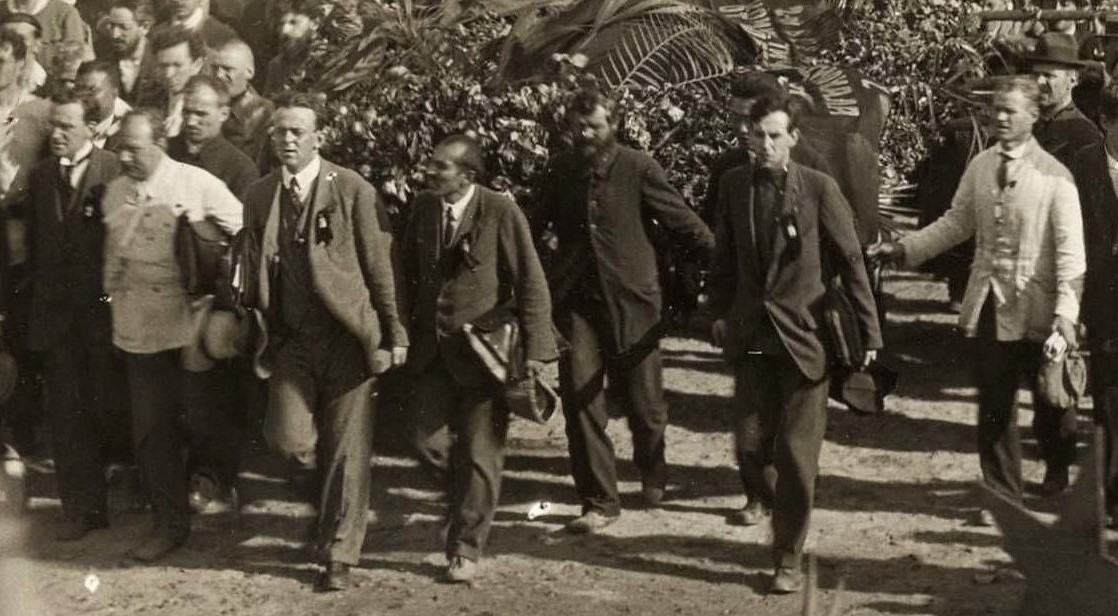
From a speech by Max Eastman, Reed’s editor and friend, at the John Reed Memorial Meeting in New York City on October 25, 1920.
‘John Reed’ by Max Eastman from The Liberator. Vol 3 No. 12. December 1920.
WE have been reading in the great newspapers of this city the last few days very appreciative accounts of the life and character of John Reed. They have permitted themselves to admire his courage and honesty and the great spirit of humorous adventure that was in him. They permit themselves to admire him in spite of the fact that he died an outlaw and a man wanted by the police as a criminal. They admire him because he is dead. But we speak to a different purpose. We pay our tribute to John Reed because he was an outlaw. We do not have to examine the indictment, or find out what special poison the hounds of the Attorney-General had on their teeth against John Reed. We know what his crime was-it is the oldest in all the codes of history, the crime of fighting loyalty to the slaves. And we pay our tribute to him now that he lies dead, only exactly as we used to pay it when he stood here making us laugh and feel brave, because he was so full of brave laughter. Our tribute to John Reed is a pledge that the cause he died for shall live.
He would not want us to be very solemn or tearful in talking about what he was. He always knew there was something humorous about the amount of trouble he stirred up wherever he went. He knew that he was a very unusual phenomenon, but I am not sure that he knew just what it was, besides his literary gifts, which made him so unusual.
John Reed belonged to a peculiar class of people who are known as the intelligentsia, and he was uniquely distinguished among the members of that class by the fact that he possessed a great intelligence. You will notice a rumor in the morning’s papers that in Russia they have had to establish a special institution in Moscow in order to “take care of” the intelligentsia. And I judge from what I read about it that it is something similar in its general character to a home for the feeble-minded. For one of the conditions of admission is a solemn agreement upon the part of the inmates that they will “withdraw from all participation in Russia’s affairs”-at least they will withdraw until the crisis is past, and everybody feels sure
It is strange that these people who specialize in idealism should be just the ones that you have to put out of the way when you set out to realize an ideal. It is because they are so emotionally excited about ideals that they have no energy, and no passion, left with which to confront facts, or with which to define and pursue an historic method by which it might be possible to pass from the facts to the realization of their ideal. That is the trouble with them all. And the thing that made John Reed’s character so unusual in the life of our times is that although he was gifted with the power to use ideas emotionally, and paint them for the imagination with colors of flame-he was a poet, he was an idealist-nevertheless he was never deluded by the emotional coloring of ideas into ignoring their real meaning when translated into the terms of action upon matters of fact. He knew the cold tone of voice in which a scientist says what things are. He knew the hard mood in which a captain of industry says how things can be achieved. He was a poet who could understand science. He was an idealist who could face facts.
You all know how Jack Reed came out of Harvard College, universally acclaimed as a wonder-boy, with enough verbal ingenuity and imaginative fertility to fill up the newspapers of two hemispheres, and save the world for democracy with his own solitary typewriter. But he never to my knowledge uttered one single word of the solemn ideological bunk which had been fed to him in that institution. From the day of his graduation he was perfectly willing to let the world of democracy go to smash, and inside of a year, and a half he came down to my house one morning to see if I knew of anything he could do to help it along. We were just starting The Masses at that time, and we didn’t have anybody to write for it. All we had was a very celebrated group of artists, an editor, and a financial deficit that was large enough to give promise of a very momentous enterprise. I cannot help laughing when t think what a whirlwind of jokes and paragraphs and projects and ideas and energy and enthusiasm and poetry and bad judgment Jack Reed brought into those editorial meetings. But he also brought with him a beautiful little story that is a very jewel of reality in American fiction. And it was the arrival of Jack Reed with that story and that enthusiasm, more than any other thing, that convinced us that we had to have a magazine like The Masses whether it was possible or not.
Jack was just beginning at that time his phenomenal career as a popular journalist, and I had the opportunity to watch the impulse of his life develop at the same time in two directions which were fundamentally opposed to each other, and between which at some culminating moment he would inevitably be compelled to choose. On the one hand, because of the inexhaustible fertility of his pen, and because of the great boyhood spirit of world-adventure which everybody loved, all the newspapers and popular magazines in the country threw their doors wide open to him. They competed for his name, for his stories, the accounts of his adventures in politics, in war, in romance, until both in terms of cash payable and in terms of glory, John Reed stood at the very top of the profession of journalism in America. He was commonly acknowledged to be the greatest war-correspondent in the United States when the war of the world began in Europe. You can imagine the opportunity that this offered to him. And he was not only a war-correspondent, he was not only a journalist. He was also a poet and a writer of fiction and drama that was recognized beyond the popular magazines, in those more solemn institutions that are supposed to preside over the literary art of the period. There was no single point or phase of success or profit or contemporary applause in the literary world, which John Reed could not at that time have legitimately aspired to, and claimed for his own.
But during these same years there had been growing steadily in his breast a feeling of revolt against the contemporary world, against the conditions of exploitation from which our journalism, and what we call our art of literature, springs, and which it justifies, and over which it spreads a garment of superficial and false beauty. There was growing in his breast a sense of the identity of his struggle towards a great poetry and literature for America, with the struggle of the working-people to gain possession of America and make it human and make it free. And so all through those years when the offices and the drawing-rooms and the coffers of the magnates of capitalist journalism were opening to him, and his name was becoming a synonym for bold romance and light-hearted adventure all over the country, Jack Reed was faithful to our little revolutionary magazine that paid him nothing and gave him about ten thousand readers. He never failed with his contribution. Wherever he went, he never forgot to give us a story that was better than the one he sold to his employers. In that way he kept those two contrary streams of achievement running together as long as he could.
Then, almost at the same moment, war came to America, and the active struggle for a proletarian revolution began in Russia. And John Reed was confronted, as every man of free and penetrating intelligence was confronted, with the choice between popular and profitable hypocrisy in the capitalist journals, and lonely and disreputable truth in the revolutionary press. And he chose the truth. Way over the heads of the American proletariat, and beyond any vision that they had in their eyes, he chose to identify his interest with their interest, and his destiny with their ultimate destiny.
John Reed sacrificed a life to the revolution, not only in Moscow in 1920, but in America in that winter of 1917. And if there is any special tribute I can add to that of these other friends who were active with him at a later time, it is a testimony to the splendor and gayety and wealth and magnificence of the life he sacrificed. All that this contemporary world has with which to tempt a young man of genius, he renounced, when he fell in with the humble ranks, and accepted the bitter wages of a soldier of the revolution.
I should be sad if I thought that John Reed’s memory as a poet would die altogether, because he chose to make a great poem of his life. But I do not think it will. I always used to tell him, when he felt a little sad because he was not doing any creative writing, that, whatever he might do in the future, he could be happy in the thought that he had already written one of the few real poems in American literature. And I fully believe that, side by side with the memory of his magnificent gift of life to the cause of freedom, there will abide in the minds of thoughtful men and women in the free world that is to come, his beautiful poem, which he called “Fog,” but which is almost a poem about his own death.
I cannot say anything half so beautiful about John Reed’s death as what he has said in that poem. And I do not want to say anything more. Those magnetic words will remind you that it is not only a great laughing, lion-hearted fighter for truth and the revolution, that lies buried among the first heroes under the wall of the Kremlin, but it is also a true genius, who could have done almost anything else that he pleased.
The Liberator was published monthly from 1918, first established by Max Eastman and his sister Crystal Eastman continuing The Masses, was shut down by the US Government during World War One. Like The Masses, The Liberator contained some of the best radical journalism of its, or any, day. It combined political coverage with the arts, culture, and a commitment to revolutionary politics. Increasingly, The Liberator oriented to the Communist movement and by late 1922 was a de facto publication of the Party. In 1924, The Liberator merged with Labor Herald and Soviet Russia Pictorial into Workers Monthly. An essential magazine of the US left.
PDF of full issue: https://www.marxists.org/history/usa/culture/pubs/liberator/1920/12/v3n12-w33-dec-1920-liberator-hr.pdf
 Revolution's Newsstand