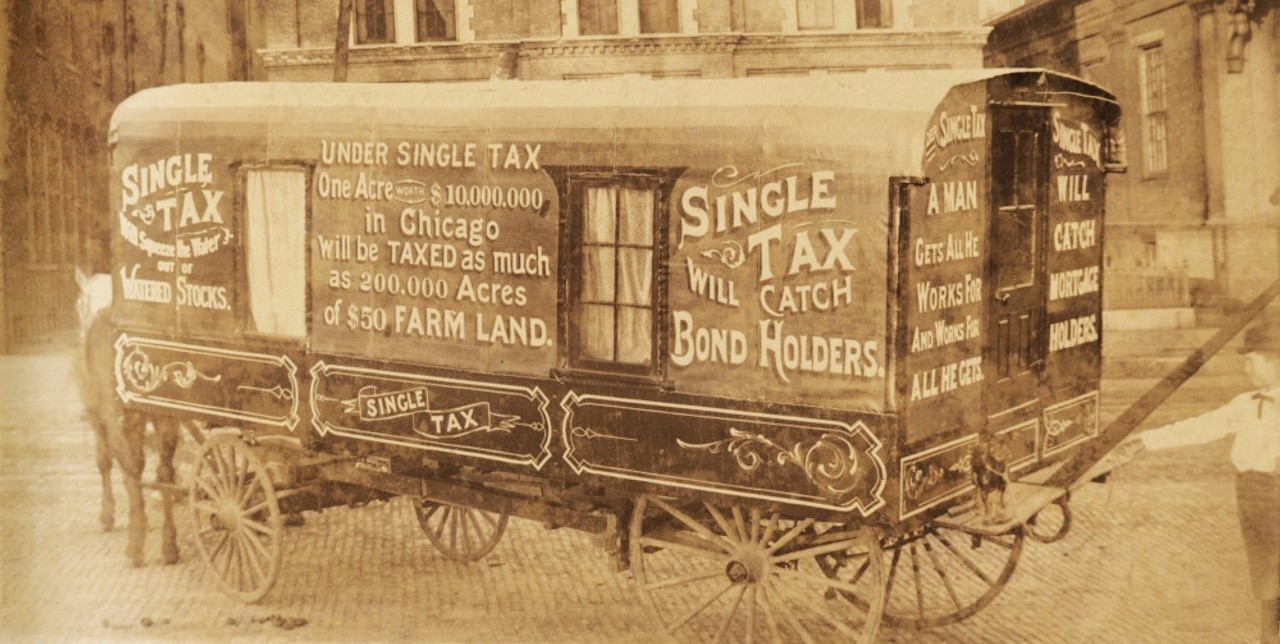
‘Karl Marx on Henry George, A Letter to Adolph Sorge’ (1881) from Workers Monthly. Vol. 5 No. 13. November, 1926.
London, June 30, 1881.
To A. F. Sorge:
Before your copy of Henry George arrived, I had already received two others, one from Swinton and one from Willard Brown; so gave one to Engels, one to Lafargue. For today I must limit myself to formulating my opinion of the book quite briefly. Theoretically, the man is totally arriere! He hasn’t understood anything of the nature of surplus value and therefore, following English example, tosses about in speculations on the independent (verseibstsaendigten) portions of surplus value, which even at that have remained behind the English—over the relationship of profit, rent, tax, etc. His basic dogma (Grunddogma): that everything would be in order, were ground rent paid to the state (you find such payment also among the transition measures contained in the Communist Manifesto… This view originally belonged to the bourgeois economists; it was first put forward (not considering similar demands at the end of the 18th century) by the first radical adherents of Ricardo directly after his death. In 1847 I said in my work against Proudhon concerning this: “We understand that the economists such as Mill (the older one, not his son, John Stuart, who also repeats it somewhat modifiedly), Cherbuliez, Hilditch and others, have demanded that rent be contributed to the state to be used as payment of taxes. It is the frank expression of the hate which the industrial capitalist avows for the land owner who seems to him an inutility, a superfoetation in the collectivity of bourgeois production.”—We, ourselves, as already mentioned, took up this appropriation, among numerous other transition measures, which, as was also remarked in the Manifesto, are and must be contradictory in themselves.
But to make out of this desideratum of the radical English bourgeois economists the socialist panacea, to declare this procedure as the solution of the antagonisms confined within the present-day method of production, that was first done by Collins, a former old Napoleonic Hussar officer born in Belgium, who blessed the world from Paris in the last days of Guizot and in the first of Napoleon the Little, with thick volumes on his “discovery,” just as he also made the other discovery that there is indeed no God, but to be sure an “immortal” human soul and that animals have “no emotion” If they had emotion, therefore soul, we would be cannibals and a kingdom of justice on earth could never be founded. His “anti-landownership theory,” together with his soul, etc., theory, is preached this year-and-a-day monthly in the Paris “Philosophy of the Future” by his few remaining adherents, mostly Belgians. They call themselves “Rational Collectivists” and have praised Henry George. Following them and beside them, the Prussian banker and former lottery owner, Samter, from East Prussia, a flat head, has slapped out this “socialism” in a thick volume.
All these “socialists” since Collins have this in common that they let wage-labor, therefore, also capitalist production, stand, in that they want to trick themselves or the world into believing that by the transformation of ground rents into taxes to the state, all the embarrassments of capitalistic production will have to disappear of their own accord. The whole is therefore, a socialistically garnished attempt to save the capitalistic rule and in fact to found it anew on a still wider basis than the present.
This cloven-foot, which is at the same time an ass’s foot, peeps out unmistakably from the declamations of Henry George. With him the more unforgivably since he would conversely have been obliged to ask himself the question: How did it happen that in the United States, where relatively, that is, compared with civilized Europe, the land was open to the masses and to a certain degree (again relatively) still is, capitalist economy and the corresponding enslavement of the working class have developed faster and more shamelessly than in any other country!
On the other hand, George’s book, as well as the sensation which it has made among you, has the significance of being a first, even if unsuccessful, attempt to free oneself from the orthodox political economy.
For the rest, Henry George seems to know nothing of the history of the early American anti-renteers, who were more practitioners than theoreticians. Otherwise he is a writer of talent (also having talent for Yankee-advertising, as, for example, his article on California in the “Atlantic” shows). He also has the repulsive arrogance and exemption which invariably characterizes all such panacea-breeders.
Fraternal greetings, Your K, Marx.
The Workers Monthly began publishing in 1924 as a merger of the ‘Liberator’, the Trade Union Educational League magazine ‘Labor Herald’, and Friends of Soviet Russia’s monthly ‘Soviet Russia Pictorial’ as an explicitly Party publication. In 1927 Workers Monthly ceased and the Communist Party began publishing The Communist as its theoretical magazine. Editors included Earl Browder and Max Bedacht as the magazine continued the Liberator’s use of graphics and art.
PDF of full issue: https://www.marxists.org/history/usa/culture/pubs/wm/1926/v5n13-nov-1926-1B-FT-80-WM.pdf
 Revolution's Newsstand