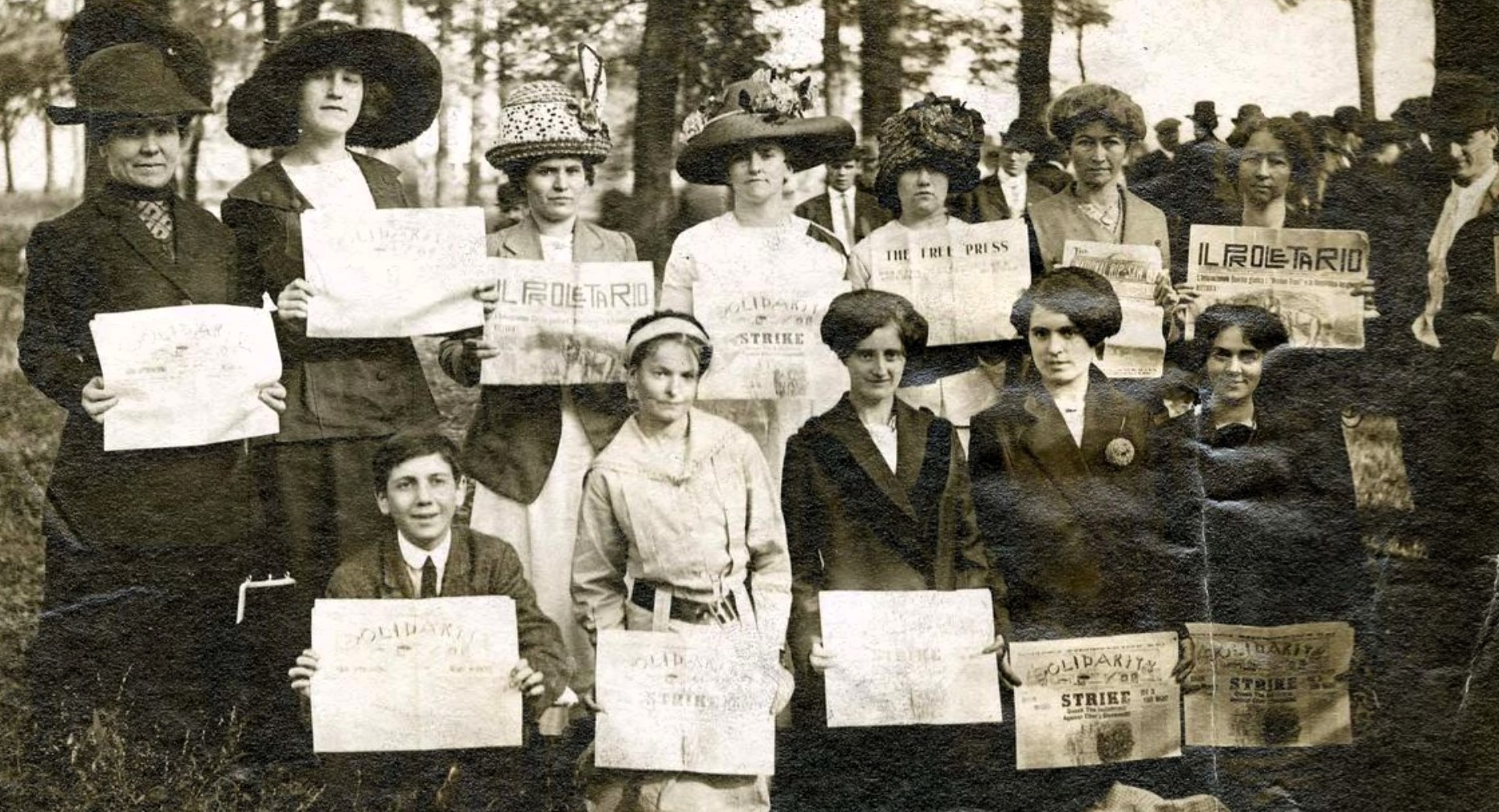
This newsletter of the I.W.W.’s National Industrial Union of Textile Workers, which at the time provided the wobblies their majority of women members nationally and their strongest concentrations in the East, offers an engaging picture of the ups and downs of organizing in the industry. Reports from locals in Fall River, Lowell, Holyoke, Boston, New Bedford, Webster, and Lawrence, Massachusetts, Woonsocket and Providence, Rhode Island, Paterson, Philadelphia, New York City, Rochester, Brooklyn, San Francisco, Baltimore, Seattle, Shelton and Norwalk, Connecticut, and finally Greenville, South Carolina.
‘Strikes, Agitation, Organization and Other Matters: Notes from I.W.W. Textile Locals’ from Solidarity. Vol. 5 No. 218. March 14, 1914.
Boston, Mass., Mar. 3, 1914.
To the Locals connected with the National Industrial Union of Textile Workers, I.W.W.:
Fellow Workers-Owing to press of work in this office it has been impossible to issue this news letter sooner. The failure of the local secretaries in many instances to send in reports of value to the membership has also been a factor in causing delay in issuing the news letter. Much of the news matter contained in this letter was furnished by sympathizers and friends of the movement.
Secretaries are advised to wake up and get busy with reports from their respective locals in order that the membership may know what is happening in the different textile and clothing centers of the country.
LAWRENCE, MASS., No. 20. Secretary reports that the members and many of those not connected with the local are out of employment owing to an industrial depression. He states that there are no indications of renewed industrial activity for the near future. By keeping a large army of the unemployed on the streets of Lawrence the mill barons are of the opinion that it will be possible to stem the tide of revolt; but the fact of so many workers being unemployed has resulted in many of these men and women leaving for other textile centers and so spreading the spirit of revolt beyond the confines of Lawrence, at the same time the local union has an increasing membership of the workers who are wholly dissatisfied with the present conditions in the local mills.
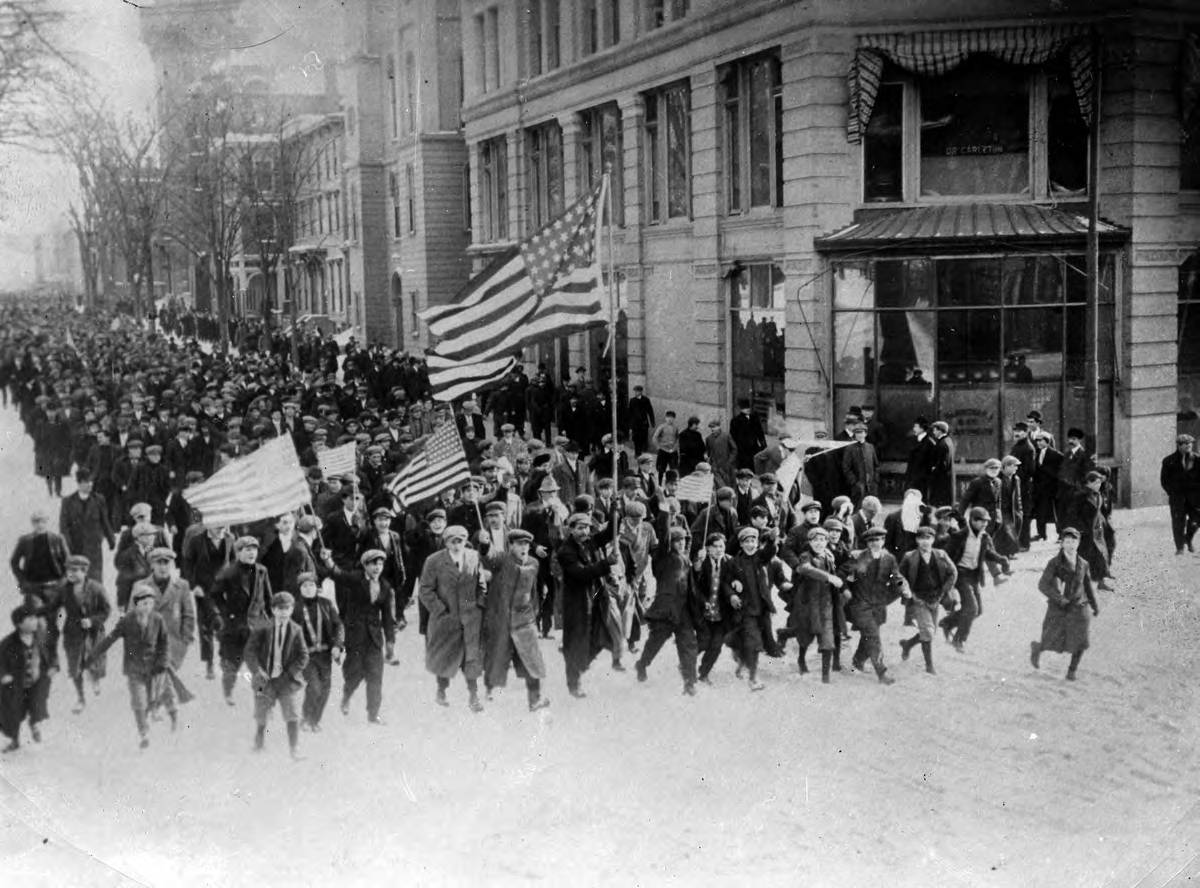
The secretary also reports that great enthusiasm prevails among the members on account of the fact that the convention of the National Union of Textile Workers will convene in that city on May 2nd, 1914.
PATERSON, N.J., No. 152. The secretary reports considerable activity since the big strike. Small strikes have broken out from time to time and the bosses have settled in haste, fearing another long drawn out fight. Most of these strikes have been to compel an increase in wages or to force the boss to discharge those who served on the mill barons picket line during the strike. It has pleased certain labor leaders of the A.F. of L. to circulate, news to the effect that the local at Paterson is dead, but according to the capitalist newspapers of Paterson and vicinity in reports of the activity of the local union of the I.W.W. it is very much alive and has been able only recently to make free speech possible at Paterson by holding a monster mass meeting in protest against the actions of the city government in its endeavor to interfere with the right of Emma Goldman to address a meeting of the workers at Paterson.
The address of the permanent headquarters is 90 Market street.
NEW BEDFORD, MASS, No. 157. After a long period of preparation the secretary reports that a vigorous campaign will be inaugurated in conjunction with locals in the vicinity for the eight-hour work day; and to that end an organizer is to be placed in the field to agitate and arouse the poorly organized workers of the A.F. of L. and unorganized workers to revolutionary action in order that the eight-hour day will be possible in New Bedford in the very near future. The address of permanent headquarters is 45 Delano street.
WEBSTER, MASS, No. 166. Report has been received by this office that in the famous Slater Mills of this town the weavers are operating four looms on broad worsted and woolen goods, and on a class of work which should be on one or two-loom work. The average wage is $10 and $12 a week, with an early grave for the weavers who are unwise enough to work in under such unjust conditions. The state legislature passed what is know as a fining bill, prohibiting the imposing of a fine for imperfections made during the weaving process; but it seems that the management of the Slater Mills are ignorant of the above fact and so the weavers as a result are paying the price. A movement is on foot to start agitation for the shorter work day. When the mill owners of this village learned that the workers were organizing they had a statement in the papers that the wages of the workers had been increased five per cent but the secretary of the local reported that it was a bluff in order to flood the mills with help.
SAN FRANCISCO, CAL, No. 187. For some time past this local has been in very poor condition and it appeared at one time as if the local would disband. The secretary wrote this office, stating that the local has been thoroughly reorganized and now a strong organization is the result of the good work.
NEW YORK CITY, No. 189. Secretary has sent in charter fee for a newly organized branch of clothing workers. The spirit of revolt against the reactionary trade unions of the United Garment Workers of America is causing many of the clothing workers to consider joining the I.W.W. The secretary of the New York District Council reports that it will be possible in the near future reorganize thousands of garment workers as members of the I.W.W.
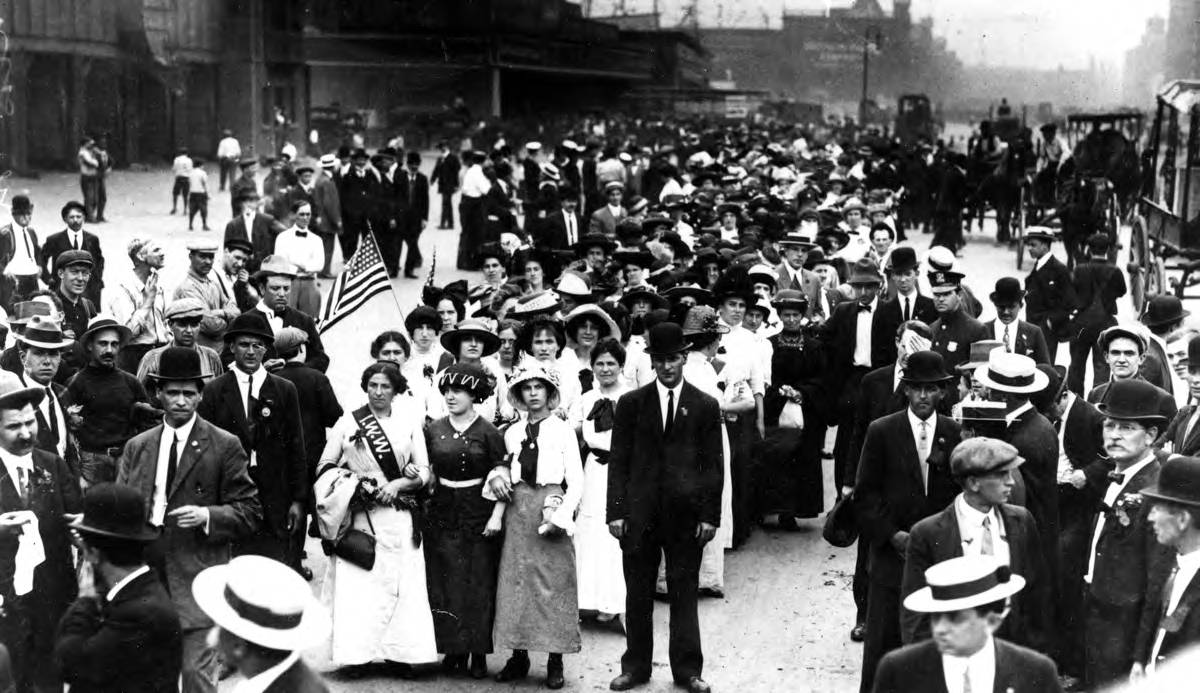
BOSTON, MASS., No. 190. This local union has complete shop control in many instances and it embraces the majority of raincoat makers of Boston as its membership, but the bosses are not pleased with this state of affairs and for that reasons they have been advertising for non-union help, claiming that there is work for hundreds of raincoat makers in Boston, even though hundreds of skilled mechanics are walking the streets out of employment because of dull trade. and the bosses’ conspiracy.
On Feb. 14 the local held a celebration and banquet and celebration in remembrance of the general strike in the raincoat industry during the year of 1912, when a complete victory was won in the face of the most bitter opposition.
BALTIMORE, MD., No. 192. Comment is unnecessary at this time on the strike conducted by the local against the Schloss Bros. clothing factory in order to have the spy system abolished. In substance the strike was called owing to the fact that the concern had hired two spotters and set them to work in the shop as clothing workers. Their sole purpose was to weed out the active members of the local and report their names to the management. It is the belief today in I.W.W. circles that the officials of the United Garment Workers of America grew alarmed at the rapid growth of No. 192, I.W.W., at Baltimore, and to offset their increasing strength made an agreement with the Schloss Brothers and sent these two spotters in the shop to create al strike and then replace the strikers with A.F. of L. men now in New York and elsewhere. When the strike was well under way it was a common sight to see two leading officials of the United Garment Workers of America escorting scabs to the Schloss Bros. factory, well guarded by the police. The attitude and tactics of the leading officials of the garment workers is well summed up in a small news item appearing in the N.Y. Call of Aug. 2nd, 1913. The article is as follows:
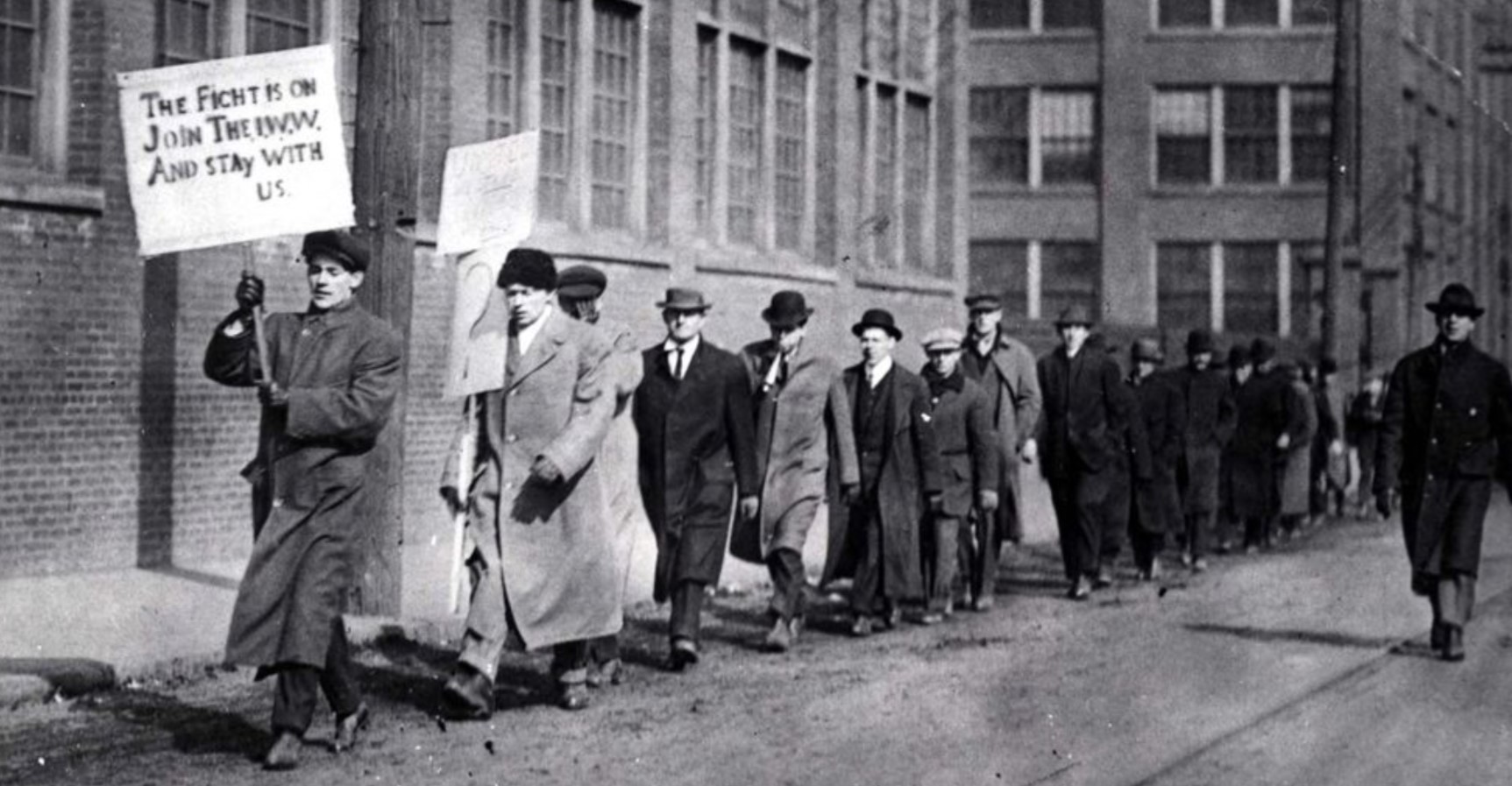
Baltimore, Aug. 1, 1913. Because one of their number was discharged for a minor offense, 250 members of the Industrial Workers of the World left their work at the Henry Sonnobonn & Co. factory today. About 1000 employes have gone out from other manufacturing concerns. According to John H. Ferguson, president of the Baltimore Federation, the Garment Workers Union will not sanction the strike.
He said: “As president of the Federation of Labor I shall endeavor by every means within my power to place safe, sane and reasonable persons in the places of those anarchistically inclined who this morning left the employ of Henry Sonnobonn & Co.”
One of the locals at Boston affiliated with the United Garment Workers of America sent $25.00 to the strikers as an expression of sympathy and also sent a resolution to the joint Board of the Garment Workers at New York protesting against the making of Schloss goods at New York by members of the United Garment Workers of America while the strike was on at Baltimore.
A protest meeting was held in Faneuil hall in Boston. Dec. 6, in disapproval of the tactics of the officials of the United Garment Workers of America in sending strike breakers into the factory of Schloss Bros. The majority of those present at the meeting were members of the United Garment Workers of America. The local not only had to battle with the common enemy, the mill baron, they also had to be ever on their guard to offset the treacherous action of those who receive large salaries from the coffers of the A.F. of L. In the middle of November this strike was declared off, after thirteen weeks of struggle against great odds. The workers went back to the factory with hatred and bitter contempt for the officials of the United Garment Workers of America and their organized scab agency. The work of organizing the clothing workers into the I.W.W. at Baltimore is being pressed with determination by the members and although the industry is passing through a dull season, yet on the other hand that has not interfered to any extent with the work of making possible the one big union of clothing workers.
SEATTLE, WASH., No. 194. Secretary of this local reports, an increase in membership at each meeting and from present indications, owing to unjust conditions in the trade that in the very near future trouble will break out at any time. He also reports that a donation was forwarded by this local to help in establishing a Jewish I.W.W. in the United States.
FALL RIVER, MASS, No. 204. This local union sends in report that in spite of the opposition of the Golden outfit (which by the way received subsidies from the mill barons in the form of advertisements for its magazine misnamed the Textile Worker) the clergy, and city government.

The incompetency of the old line unions is made plain by the way in which the mill barons turned them down when they put in a demand for an increase in wages. The spirit of unrest in the city on the part of the Textile Workers is made evident by the small strikes, independent of the boss-ridden unions.
Since the local union started agitation work the newspaper heading. in dealing with the meetings have read as follows: “I.W.W. Will Start Free Speech Fight,” and other like display.
One of the clergymen of the city was quoted in the local papers as follows, when speaking to the I.W.W. The item in substance is as follows: “Mgr. Cassidy, pastor of St. Patrick’s church, during his announcements at the 10:30 mass yesterday. took several minutes in which he denounced the I.W.W. in most scathing terms.
“During the course of his talk he said there was a certain organization known as the I.W.W. which attempts to right the wrongs of the working man by force. He told of reading their cards and announcements of meetings and referred to the organization as a godless one; an organization which recognizes no God, no Cross or no emblem. He warned the members of his church against joining such an organization, that they let no hall or building, and contribute no money to such a society.
“He referred to the movement of the I.W.W. as a revolutionary one and cited the conditions in the city of Lawrence which a year ago was alive with anarchy and corruption.” The members have ignored the dollar inspired denunciation made by the above official of the church and the organization is increasing in membership as a result of the fighting spirit of the militant membership. The official in question has openly insulted and taunted the workers of Fall River by asking them to take for their motto, “I won’t win in Fall River.”
It appears that one of the mill owners’ spies, alarmed at the growing activity of the local, hurried to his masters with the story that the I.W.W. intended to start a strike, which caused the city authorities, who by the way are controlled by the mill barons, if actions are an indication, to call out the entire police force one cold morning.
The tactics of the mill owners at this time is to divert the attention of the local members away from the real issues involved. The members, however, are aware of the game and refuse to be lead into a trap. They know that the real fight is to be conducted behind the mill gates, and the members are also alive to the fact that the church officials and city government are by their actions and methods adopted in this fight the puppets of the mill barons.
One of the textile workers of Fall River well describes the working conditions in one of the shops as follows:
The American Print Works Company is little better than a slave pen. The men work 13 hours per day and there is no dinner hour and no time for supper. Meals are taken on the jump. The men work on an average 78 hours a week for $8.75. For a 60-hour week, $6.25.
This same fellow worker states that at every meeting held by the local four or five policemen are always hanging around looking for trouble. It is evident that the I.W.W. is a thorn in the flesh of the mill barons. Within the coming month the members of the I.W.W. at Fall River and New Bedford intend to start a lively campaign among the textile workers for the eight-hour day. The secretary reports the organization of a strong local of coal teamsters.
HOLYOKE, MASS., No. 205. Report has been received from this quarter that in the Lyman mill weavers are working for $9.00 and operating 12 looms. Agitation will soon be started in this part of the country for a change in conditions when the mill owners least expect action to be taken.
PHILADELPHIA, PA., No. 425. Considerable unrest is reported from this city and the workers not affiliated with the local are sending in requests to the National Office for literature and information in regard to the I.W.W. The unreliable tactics of the union bosses of the United Garment Workers of America has caused the garment workers to consider affiliation with the I.W.W.
LOWELL, MASS., No. 436. Secretary has stated in letters to this office that agitation among the different workers who toil in the mills of this city is well under way. The organization of the Polish element as a part of the local will soon be a result of the work of the active members.
GREENVILLE, S.C., No. 512. Fellow Worker Frank Norris has been conducting organization work in this part of the country and his report on conditions both in and out of the mills are almost unbelievable if they were not backed up with sufficient proof.
A portion of one of his reports reads as follows:
The conditions here are beyond my powers of description. Slaves working eleven hours a day. Sanitary conditions in the mills are rotten. Windows kept closed tight so no air can get in and in some cases cloth is jacked in between the sash and the window to keep out what little air can get in there. Machines speeded up to the highest possible point. Wages are from 90c to $1.25 a day for weavers. I am inclosing a couple of pay envelopes as samples. All the workers live in company houses. These houses are double affairs with three-room tenements. Furniture is a scarce article. Coal and wood must be bought from the company and for these excessive prices are charged.
Whole families in some instances are working in the mill. Houses are rented to the people on this basis: For one mill worker the family is allowed three rooms for two, three rooms for three workers, and four rooms regardless of how large the family might be. Houses are bare, no plaster or wall paper, not even painted on the inside. Compared with conditions in the New England mill towns, the latter are a paradise.
The workers lack knowledge of the movement and are the easy prey of grafters, who preach contentment and submission, but in spite of it all there is a spark of rebellion slumbering and the masters will have. to reckon with these workers in the near future.
A few of the fellow workers have been carrying on this agitation here for some time. These workers have been discharged, victimized and hounded from mill to mill by the mill barons, and threatened with arrest on trumped up charges, but in spite of it all they have persisted in their agitation and are now just beginning to see their work bear fruit. Many new members have been taken in since my arrival. What is needed more than anything else is job agitators, men who will go into the mills to work and agitate on the inside. There is a large field and plenty of mills to work in. Fellow Worker Morris further states that the Golden has been conducting a strike at Augusta, Ga., but according to press reports the strike was lost on account of the poor tactics and compromising attitude of the above mentioned outfit. During the time Organizer Morris. was assisting the fellow workers to place the union on a strong basis, the mill barons have had strong arm men on the job following the organizer around the town.
To give the locals an idea of the growth and expansion of the textile industry in the southern states the organizer has submitted the following figures: Number of mills, 767; capital stock, $219,763,793; number of spindles, 13,165,973; number of looms, 273,256.
One of the southern newspapers has the following to say in reference to profits made:
“It is difficult to estimate the profits of the southern cotton mills. during 1913, but they are known to have been above normal and the industry as a whole is in a much stronger financial position than was formerly the case.”
The northern capitalists have millions invested in those mills and so it has come to a point when the workers in the north go on a strike the northern mill barons transfer their orders to the southern mills and so prolong the strike and are able to subdue the northern textile workers. It is necessary therefore, that these southern workers become a part of the one big union and so when the time is ripe and action is needed all the workers will strike together.
The local has established headquarters in conjunction with a radical organization and agitation meetings are being held nightly.
WOONSOCKET, R.I., No. 513. Good organization work is being conducted by this local, with the result that within the past month the membership has been increased by one hundred members. News has been received that the Montrose mill of this city has been endeavoring to establish the three-loom system.
So far, however, owing to the militant spirit of the weavers, the attempt has been a failure.
BROOKLYN, N.Y., No. 527. According to an announcement issued yesterday by branch 2 of I.W.W. Local No. 527, of College Point, the strike of the Mynepho Ribbon mill at College Point has come to an end after a nine months’ struggle. A general increase of 10 per cent was granted, with better shop conditions. The strikers wish to thank all who contributed their support, which gained them a victory.
SHELTON, CONN., No. 528. Branch 2 of this local union has been conducting a strike against the firms of Sidney Blumenthal Co. at Derby, Conn. By adopting militant methods the strikers were able to keep strike breakers away from the plant and were also able to prevent the company from making profit on goods made while the strike was on.
The dilatory tactics of S.E. Beardsley, state secretary of the Socialist party of Connecticut, who under the cloak of friendship poisoned the minds of the active strikers, created a break in the ranks of the strikers.
Word has been received by this office that the strike was declared off when it was seen that victory was not possible under the existing conditions. A full report will be furnished the locals on the calling off of this strike in a special report submitted by Organizer Rabinowitz.

PROVIDENCE, R.I., No. 530. Report from this locality is to the effect that the local has an in- creasing membership and considerable propaganda work is now under way with good results for the future.
PHILADELPHIA, No. 533. Reports have been received through the secretary of the district council that the clothing workers of this city are joining the I.W.W. or calling for organizers to arrange meetings with the object in view of organizing new locals. The textile and clothing workers of this section are learning the lesson that if they are to accomplish anything worth while they will have to organize into industrial unions.
NORWALK, CONN., No. 535. This local has had a five days’ strike on its hands on account of discrimination and to get rid of a weaver when not acting as a gumshoe man for the boss.
The strike was in the Gloria mills.
The name of the traitor is D. Andsonik. He is a warper and shop spy. After several conferences with the management it was agreed to grant the strikers ten per cent increase in wages and all the old weavers to be reinstated with no discrimination in the future.
ROCHESTER, N.Y., No. 191. News from this center is to the effect that the local intends to place a good Lithuanian organizer in the field as soon as an able man can be secured for the work. The secretary of the propaganda League reports that the reactionary A.F. of L. has been using the usual dirty tactics in order to break the spirit of the militant workers of that section.
Locals are urged to send delegates to the convention of the National Union to be held at Lawrence May 2, 1914. This convention is of the highest importance to the National Union and its future progress, and I should not be neglected by the locals if they have the welfare of the I.W.W. in mind. Then again. the convention is to be held at Lawrence, where the I.W.W. conducted one of its most successful strikes, which not only bettered the conditions of the Lawrence textile workers but made possible more wages and better shop conditions for thousands of textile workers outside of Lawrence and brought new hope and life to millions of wage earners throughout the world. Local secretaries should arouse the active membership to send both regular and fraternal delegates to the convention. Let us all work to make this the most successful and best convention ever held by the National Union of Textile Workers.
The most widely read of I.W.W. newspapers, Solidarity was published by the Industrial Workers of the World from 1909 until 1917. First produced in New Castle, Pennsylvania, and born during the McKees Rocks strike, Solidarity later moved to Cleveland, Ohio until 1917 then spent its last months in Chicago. With a circulation of around 12,000 and a readership many times that, Solidarity was instrumental in defining the Wobbly world-view at the height of their influence in the working class. It was edited over its life by A.M. Stirton, H.A. Goff, Ben H. Williams, Ralph Chaplin who also provided much of the paper’s color, and others. Like nearly all the left press it fell victim to federal repression in 1917.
PDF of full issue: https://www.marxists.org/history/usa/pubs/solidarity-iww/1914/v05-w218-mar-14-1914-solidarity.pdf
 Revolution's Newsstand