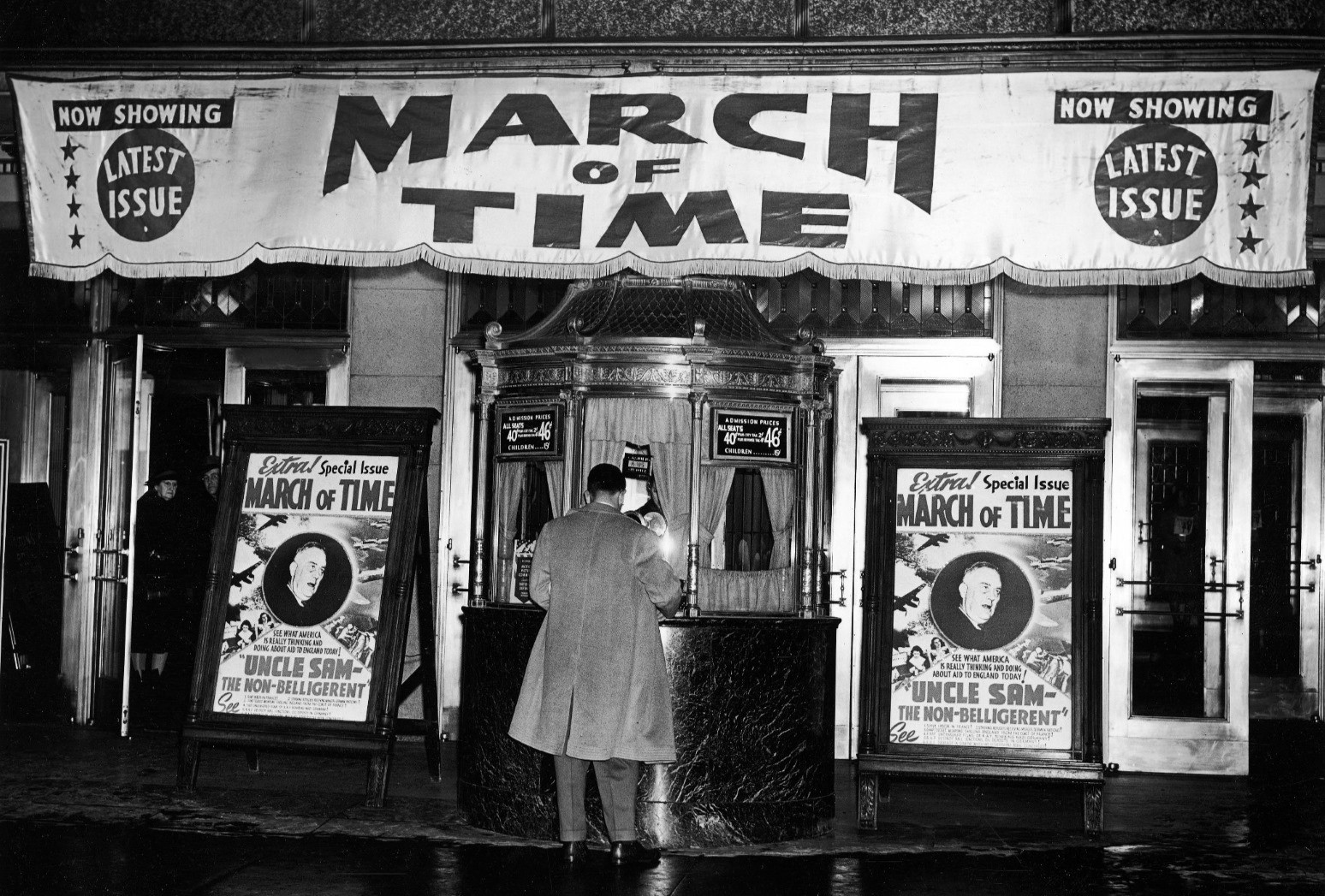
Peter Ellis reviews the beginning of the ‘The March of Time’ (owned by Time, Inc.) newsreels that began showing in 1935 and continued until 1951. The liberal, patriotic propaganda peddled by ‘The March of Time’ helped define the era, being a major source of news for the U.S. public with 25 million people viewing a month at its height.
‘The March of Time’ by Peter Ellis from New Masses. Vol. 16 No. 2. July 9, 1935.
ΤHE newsreel is a habit. We have been taught for years that since the camera cannot lie and since seeing and hearing are believing and since the newsreel draws its material directly from life itself, that the film newspaper is the objective truth put on a screen. To a certain extent it does give one the illusion of reality, in contrast with the Hollywood dramatic product. And by virtue of its acceptance as realistic, the newsreel has become one of the most effective methods in the hands of the State of maintaining the status quo. Yet this powerful medium of propaganda is the most uncreative, undramatic (except in such rare sequences as an Ambridge Massacre or the United Front Parade in Paris last year) and generally the most poorly constructed class of films in existence. Except in a few instances the newsreel doesn’t begin to achieve the excitement and drama which is latent in the documentary film. On the plea that its material is such news the newsreel simply isn’t edited. There is nothing in the excuse of lack of time, because the greater part of each release is staged and faked.
With this situation, it was a simple enough matter to manufacture something that would reduce the orthodox newsreel to insignificance. That is exactly what the March of Time has done to the newsreel. The March of Time was inspired by the successful two-year-old radio program of the same name. It is presented by the editors of Time and Fortune in conjunction with Louis de Rochemont of the Movietone news. Releases are issued once a month; there have been four now. The subjects are planned in advance and worked out on paper; scenarios are written as for other films. The editors compile what they can from the extensive film library of the Fox Movietone news; they buy film from freelancers or from their own correspondents; finally, if necessary they enact sequences.
The episodes are carefully written and skillfully edited with a very specific point of view the standpoint of a militantly alert capitalism. While the three best things in the four releases the Hitler episode in the second release, the Huey Long sequence in the third and the section on the Soviet Union in the fourth are not anti-working class, one of the other episodes did give a foretaste of what the March of Time will do in any acute political crisis. A completely reactionary, chauvinistic and fascist tendency appeared in the section called “Mexico,” in release number three.
The off-screen voice states that “socialistic” Mexico had outlawed religion. But the clergy and the other generation of peasants are determined to continue their worship. There are scenes of improvised churches in caves. The scene shifts to the interior of a peasant’s house. There are a number of children in a huddle, mechanically repeating again and again: “There is no God. There is no God. Professor Gonzales told us there is no God.” This is acted so badly that it is embarrassing. The aged parents come in and hear the mechanical chant, “There is no God.” The old man incites the whole village and they rush into the home of Gonzales, the teacher. We see a rope. He admits attacking religion and they seize him. The final shot shows the white wall of the Church with its cross. The shadow of the professor, hanging by his neck, is projected on the wall. The direct approval of lynching is pointed up by a closeup of the placard on the professor’s body, stating he was killed for “socialistic education.”
Up to now the furtherance of a clear political line has been subordinated to the major task of establishing the March of Time on the market. The March of Time plays up the Nye munitions investigation, makes fun of Huey Long, attacks Hitler and produces a sequence on the Soviet Union that is superficially favorable. The script that accompanies the Russian sequence is actually a subtle attack. But the editors made the opportunistic mistake of buying the film from Julien Bryan, a friend of the Soviet Union, who took his film with a friendly point of view.
The form of The March of Time is not a new development in cinema. The Soviet film makers are old hands at this sort of thing. But The March of Time has shown us how effective the newsreel can be. It provides an object lesson and a goal for the documentists in the revolutionary film movement. The Film and Photo League has for some time been working with the newsreel. While the very nature of their subject matter was exciting and dramatic in itself (the Ford massacre, for instance), their newsreels were formless and as poorly made as the commercial reel. A forward step was made with Scottsboro and Hunger, but the high peak was reached with America Today, No. 1, which contains portions that are as good as anything that has been recorded in films. And Nykino’s Harbor Scene (1935), with a script by David Wolff (in itself a work of high literary merit) is a real achievement, superior to anything of the same genre produced in America. But these are isolated examples. There must be more, we must organize our production policy (we have the technical facilities); for the editors of The March of Time are correct when they shout “Time Marches On!”
The New Masses was the continuation of Workers Monthly which began publishing in 1924 as a merger of the ‘Liberator’, the Trade Union Educational League magazine ‘Labor Herald’, and Friends of Soviet Russia’s monthly ‘Soviet Russia Pictorial’ as an explicitly Communist Party publication, but drawing in a wide range of contributors and sympathizers. In 1927 Workers Monthly ceased and The New Masses began. A major left cultural magazine of the late 1920s and early 1940s, the early editors of The New Masses included Hugo Gellert, John F. Sloan, Max Eastman, Mike Gold, and Joseph Freeman. Writers included William Carlos Williams, Theodore Dreiser, John Dos Passos, Upton Sinclair, Richard Wright, Ralph Ellison, Dorothy Parker, Dorothy Day, John Breecher, Langston Hughes, Eugene O’Neill, Rex Stout and Ernest Hemingway. Artists included Hugo Gellert, Stuart Davis, Boardman Robinson, Wanda Gag, William Gropper and Otto Soglow. Over time, the New Masses became narrower politically and the articles more commentary than comment. However, particularly in it first years, New Masses was the epitome of the era’s finest revolutionary cultural and artistic traditions.
PDF of full issue: https://www.marxists.org/history/usa/pubs/new-masses/1935/v16n02-jul-09-1935-NM.pdf
 Revolution's Newsstand