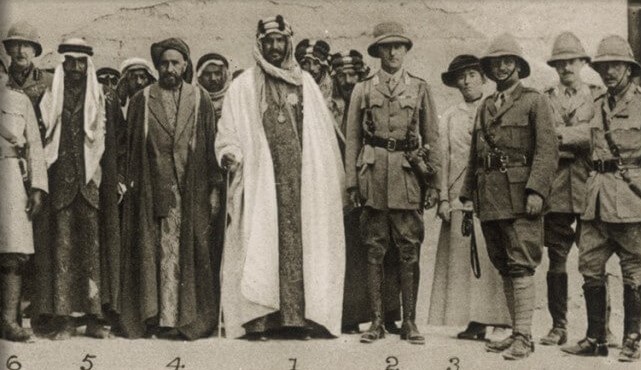
Karl Radek analyzes the roles of Zionism and the House of Saud in the interests of British imperialism just as the ‘Syrian Revolt’ against their frenemy the French began.
‘English Imperialism in Arabia’ by Karl Radek from International Press Correspondence. Vol. 5 No. 71. September 24, 1925.
Whilst the eyes of the whole world are directed to the approaching decisive struggle in Morocco and to the negotiations which are being carried on between the allies and Germany regarding the Guarantee Pact, there is taking place in Near Asia a series of events which are of more than local importance. The most important of them is not the revolt of the Druses in Syria, but the advance of the English in Arabia, which constitutes a fresh, decisive step on the part of the English government towards creating an English Arabian colony which shall connect Egypt with India.
In order the better to understand the present events in Arabia one must briefly call to mind the history of the Arabian question during and after the war. In 1916 the English concluded a Treaty with the French, according to which France was to receive Syria and a district of Mosul. The whole of the rest of Arabia. with the exception of Palestine, was to come under the sceptre of the king of Hejaz, Hussein, and should constitute a sphere of influence of England. This meant a carving up of Arabia, the population of which the English wished to use as cannon-fodder during the war. After the victory over Turkey the English, taking advantage of the temporary occupation of Syria by their own troops, placed Feisal, Hussein’s son, on the throne of Syria and thereby prepared the way for the scrapping of the above-mentioned Treaty.
At the same time England suddenly displayed a great love for the Jewish people. According to the official legend, which contains just about as much truth as the biblical legends regarding the chosen people, the leader of the Zionists, Weitzmann, convinced the old cynic Balfour of the necessity of putting an end to the wandering life of the Jews and of establishing a home for them in Palestine, which is peopled by the Arabs. It goes without saying that the English intentions to express their thanks to Jehovah for uniting Arabia by placing at the disposal of the Jews a portion of the Arabian territory, can be attributed to very definite imperialist interests. It would hardly have done to state that England took possession of Palestine in order to gain a position from which she could control the Arabian Peninsula. It was therefore expedient to play the role of benefactors who were inspired with pity for the Jews.
It was in this way that England, with the mandate for the creation of the Jewish State, completed her political plans. England, by means of her vassals, the Hussein family, had the whole of Arabia in her hands. But the French checkmated the English plans. General Gouraud, who appeared in Syria on the strength of the Treaty of San Remo, simply drove his majesty, king Feisal from his throne. Thereupon the English, as compensation for the loss he had suffered, placed this son of Hussein upon the throne of Iraq, after they had previously taken Mosul from the French and had granted them as compensation 25% of the future yield of mineral oil. The English did not, however, regard this solution as final. From Transjordania, where they had set up the second son of Hussein, Abdullah, as king, they carried on an uninterrupted undermining work against their French allies in Syria.
The changes which followed later were due to the fact that old Hussein did not prove himself a thoroughly obedient tool of English policy. The king of Hejaz took seriously the promises given to him by the English agents during the war to create a united Arabia. The friction which arose between him and the English government was solved by the latter in a very simple manner: it brought weapons into use against him, and of these not a few. The English subventions to Iba-Saud, the leader of the wahabite tribe who live in Central Arabia and are least acquainted with European culture, kindled the old enmity between the wahabites and the Hejaz, which represented a fight between the nomadic tribes of Central Arabia and the trade-driving Hedjaz for the possession of the “Holy places”, which for many years have been visited annually by hundreds of thousands of Arabs and which constitute a considerable source of income to the rulers of the places in question.
After Ibn-Saud had vanquished Hussein, he drove him from his possessions. Hussein took flight to the sea coast of Akaba, in the little towns of Man and Akaba. English warships appeared here and conveyed to Hussein the proposal of the English government that he take up residence in Cyprus which is an English possession. No protests were of any avail. The former ally of England found himself one day on an English warship bound for Cyprus. On the 17th of June 1925 England proclaimed the annexation of the towns of Man and Akaba and their incorporation in Transjordania, that means, it placed them under English protection. At the same time the railway running through Hejaz fell into the hands of the English as far as the station of Tebuk.
At the same time there took place a change of government in Palestine. In 1920, to the accompaniment of a universal cry of triumph on the part of the Jewish press, Sir Herbert Samuel, a Jew and a Zionist, was appointed Governor General in Palestine. Regardless of the protests of the Arab population, Sir Herbert Samuel carried out a policy of supporting the Jewish minority, a policy of promoting Jewish colonisation.
Now, after four years of work, Sir Herbert Samuel disappears from the scene. His place is taken by the English General Plumer, a soldier, who only recognises the interests of English imperialism. For the Zionists the appointment of General Plumer was a quite unexpected event. Does there exist any connection between the seizure of Akaba and Man and the change of government in Palestine? Yes, such a connection does exist, and it may be indicated as follows:
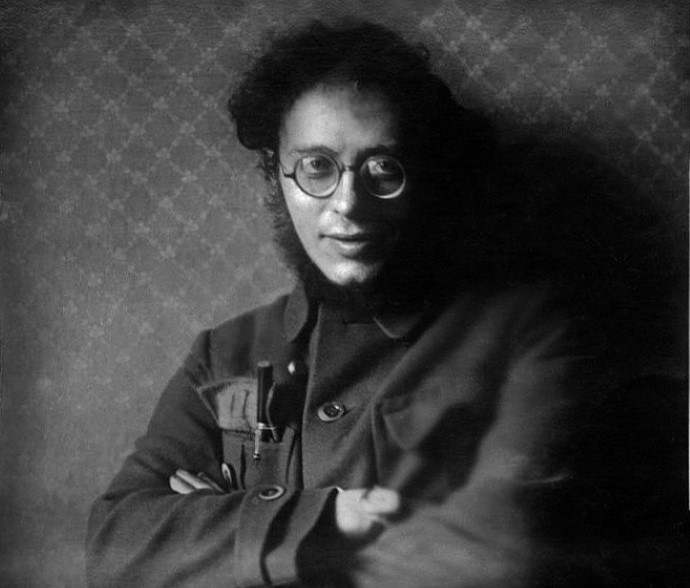
The Suez Canal is in danger. Its Western bank belongs to Egypt. It is impossible to tell what will be the outcome of the struggle for Egypt. England must therefore in the first place make sure of a land route which would replace the Suez Canal at least for the conveyance of troops. The railway line which connects the seaport of Jaffa with Akaba, and which is in the hands of the English, constitutes the connecting link between the Red Sea and the Mediterranean. In addition to this the English press is talking of the construction of a Canal along this line which could compete with the Suez Canal. All this talk is, of course, mere threats, for the outlay for such an undertaking would be enormous. England hopes, however, by means of these threats to impress the Egyptian nationalists.
Secondly, the construction of a railway line from Akaba through the Arabian desert to Koweit is being prepared, which would form a connection with the Persian Gulf and would mean the creation of a route to India. Both the Jaffa-Akaba line, which connects the Red Sea with the Mediterranean Sea, and the Akaba-Koweit line would posses the enormous importance of being out of danger of being cut off by the French.
Thus at the moment when English imperialism is experiencing enormous difficulties, when the ground in China is trembling beneath its feet, England is working with iron determination at strengthening her position in the Near East and at setting up an English State in Arabia.
The struggle of the English for Mosul, which is now assuming a new phase, arises from the same cause. This is a fight for mineral oil, and not only for oil, but also for Arabia. The mountains of Kurdistan dominate the plains of Iraq. If the whole of Kurdistan were in the hands of the Turks, it would mean a danger for English rule in Mesopotamia, which is disguised under the veil of the independent kingdom of Iraq. The Commission of the League of Nations which was set up to investigate the Mosul question, has announced a very ambiguous decision: if England pledges herself to retain the mandate over Iraq for 25 years, she can retain Mosul; if she does not desire to do so, Mosul may again come into the hands of Turkey.
The “Daily Telegraph”, which gave vent to its fury over the decision in a very indignant article, points out that the mineral oil has played a great role in this decision. It points. to the Hungarian Count Teleky. These hints would imply that, in spite of the existing business agreements between Royal Dutch, the English oil syndicate, and the American oil syndicate, Standard Oil, the Americans are continuing to conduct a campaign against the English in Mosul, for there exists no other group of oil interests which could dispute with the English for the control of Mosul.
Of course, it is not that piece of paper known as “the Report of the Commission of the League of Nations” which is causing difficulties for the English, but the fact that the Arab population of Iraq is opposed to the English mandate, that is, to English imperialism in Iraq. It is only by means of the most cynical throttling of the parliament in Iraq, by means of mass arrests and threats of war, that England succeeded in forcing from Iraq the recognition of the English mandate for four years. The continuation of this mandate for a further 20 years will be very difficult. But the English are not bound by the proposal of the Commission of the League of Nations, and will find sufficient ways in order for the time being to obtain the prolongation of the mandate for a few years, and then it will be possible to see the next step.
Whilst England is strengthening her position in the Arabian Peninsula the position of France in Syria is growing weaker. The revolt of the Druses would not in itself constitute any great event. The Druses, an Arab tribe, who have a not very profound religion and which in fact constitutes a mixture between Mohammedanism and christianity, have a total population of 100,000 to 150,000. But this revolt, of which the world gained the first news through the English press, is taking place at the same time as the revolt in Morocco. The English press is calling upon the English authorities in Transjordania and Palestine to avoid everything that could arouse the suspicion of the French that behind the revolt of the Druses there was the hidden hand of England. But he who excuses himself, accuses himself. In any event the whole situation in Syria goes to prove that France has not succeeded in driving in the powerful wedge which is directed against English rule in Arabia.
The hopes of the English to subjugate Arabia by military measures are, however, built upon sand. The Arabs constitute a highly developed people in regard to culture. The Arab press and the Arab literature bear witness to this. Hitherto the Arabs were divided from each other by the desert and by the difference in the level of culture between the nomadic tribes and the tribes carrying on trade. English imperialism which failed when it staked its card on the most developed section of the Arabs, is now staking its cards upon the most backward section, the wahabites. But to the same extent as England, by the construction of railways overcomes the estrangement existing between the Arab tribes, she at the same time causes the cultural elements of the Arabian world to dominate. There where the railways run there rules, not the puppet king of the nomadic tribes, but the merchant. The more England endeavours, at the same time as she strive to unite Arabia economically, to split it politically, to incite one tribe against the other and one religious sect against the other, the more rapidly will the Arabian national movement, which is under the strong influence of the renaissance of the Mohammedan peoples and their struggle for independence, become united.
International Press Correspondence, widely known as”Inprecorr” was published by the Executive Committee of the Communist International (ECCI) regularly in German and English, occasionally in many other languages, beginning in 1921 and lasting in English until 1938. Inprecorr’s role was to supply translated articles to the English-speaking press of the International from the Comintern’s different sections, as well as news and statements from the ECCI. Many ‘Daily Worker’ and ‘Communist’ articles originated in Inprecorr, and it also published articles by American comrades for use in other countries. It was published at least weekly, and often thrice weekly. Inprecorr is an invaluable English-language source on the history of the Communist International and its sections.
PDF of issue: https://www.marxists.org/history/international/comintern/inprecor/1925/v05n71-sep-24-1925-inprecor.pdf
 Revolution's Newsstand