E.F. Doree reports on the solidarity strikes in support of brutally exploited Philadelphia sugar refinery workers by I.W.W. stevedores and sailors bringing the raw sugar from U.S. colonies and exporting the finished product to Europe.
‘Ham-stringing the Sugar Hogs’ by E.F. Doree from the International Socialist Review. Vol. 17 No. 10. April, 1917.
IT is hardly necessary to take time telling the bloody history of the Sugar Trust. Most readers of the Review know how this organization has, in the last few years, grabbed up the Sugar Plantations of the World. Not only has it grabbed up the plantations of the southern states, but it has reached out and taken the fertile fields of Hawaii, the Philippines, and Cuba.
During the Spanish-American war, so the story goes, a body of volunteers passing down Market street in San Francisco, saw Spreckles, the Rockefeller of the sugar industry, throwing flowers down upon the passing troops from an upper window of one of his own buildings. Spreckles turned to a friend and exclaimed: “There go OUR boys to fight for OUR country.”
He was right Practically all of the conquered territory that will grow sugar cane is now the property of Spreckles and the Havemeyers. The land was won for them at the price of American and native blood. We shall not mention the $13.00 a month that the vanguards received.
The beginning of the Sugar Trust was in the blood-fest of the Philippines and Cuba, and we might add of the Hawaiian Islands; their history since then is written in the misery of their slaves.
The story of how the Sugar Kings conquered the natives is known by many people today. It has been written up enough. Sufficient to say that the natives work for practically nothing and live the most wretched lives in poverty and filth. The Sugar Kings get the raw sugar at almost nothing.
The sugar, for the most part, is refined in this country. Bad as are the conditions of the workers who grow the sugar cane, they can not possibly be worse than the refinery slaves.
The working hours in a sugar refinery are never less than twelve hours a day, and if the season is at all a busy one, the workers often put in a fourteen-hour shift before being permitted to go home. The wages in the last two years, according to a published statement of the Sugar companies, have varied from 18 to 25 cents an hour. Some of the workers insist however that many get as low as 15 cents.
Mr. Peterson, chief driver of the Spreckles outfit of Philadelphia, in an interview with a local newspaper man, stated that he could not possibly figure out why his men should strike unless the entire trouble was due to a bunch of irresponsible agitators. He told the reporter that there was plenty of work and that the men might just as well be working twelve hours a day, seven days a week, as to be loafing around. In answer to the question as to how much the workers would get for that amount of work, our genial Mr. Peterson said that “many would earn $21.00 a week, for 84 hours’ work.”
The strike of sugar workers began in Brooklyn in the big Havemeyer plant. This was in the latter part of January. No sooner had these workers revolted that they appealed to other sugar workers to come out. From that moment the strike began to spread. It traveled to Long Island, Jersey City, Yonkers and to several smaller plants.
The strike hit Philadelphia like a flash out of a clear sky. There was scarcely a moment’s notice. All the pent up spirit of the workers seemed to give vent at once. First it was the Spreckles plant, then the Franklin and McCahans. Philadelphia’s sugar supply was cut off before any one really realized what happened.
The first ones to wake up was the Sugar Workers’ Industrial Union No. 497, I.W.W. This union had practically nothing to do with the calling of the strike; it wasn’t called ; everybody simply went out. When the workers reached the streets, they joined the few organized men and went to the National Lithuanian hall where the I.W.W. held their meetings. There the strikers joined the One Big Union by hundreds. The chaos of the walkout was soon cleared. Discipline was injected into the strike. Men began to take on their new duties; their duty to themselves; their duty to fight the bosses.
From that day to this they have fought well, and, when we say fought, we mean it. This strike has been filled with all the brutalities known to big strikes of recent years. Pickets were clubbed and left lying in the streets until their bolder fellow workers carried them away. Men have been arrested and railroaded to jail and penitentiary without being allowed counsel or communication with friends. Members of the strike committee and their lawyer have searched every station house in the city to locate an arrested picket to later learn that the man looked for was being held in the office of a private detective agency. The most notorious of these agencies is the Tate Agency.
The longshoremen in the port of Philadelphia are members of the I.W.W. Most of the sugar is imported by boat. A good deal of sugar is exported by boat.
When the bosses refused to consider the demands of the sugar workers, and the sugar workers had demonstrated that they intended to stick with the fight, the longshoremen on the sugar docks laid down their trucks, stuck their hooks in their pockets, and struck. The 1,500 longshoremen made no demands other than a settlement with the sugar refinery workers by their bosses It was a wonderful and inspiring picture of class solidarity.
No sooner had the longshoremen quit than the bosses prepared to move the boats to other ports to be unloaded. Again the I.W.W. principles were tested and found true. The seamen and fireroom men left the ships. The boats did not move for lack of crew.
When the workers showed this solidarity, the bosses became desperate. They stopped at nothing. Murder was the next thing that happened.
On Feb. 21st, in the morning, a meeting of women was held, mostly the wives and daughters of the strikers. At this meeting they decided to aid in the picketing. On the evening of the same day, these women, loyal members of their class, went out, babes in arm, to face the bitter cold and brutal police.
No sooner had the women shown themselves than the police got busy. At first they jostled the women around but these held their ground. Mothers raised their babies up and shouted “Don’t take the bread from our babies.” But, babies have little effect on police, who evidently feared that the little kiddies might make an impression on the scabs. The women were ordered away. They refused to go, so the police began to slap the faces of some of these valiant mothers. Then is when the men got busy. They had said nothing before, but now they spoke. With bare hands they went to the rescue of the women of their class. The police clubbed right and left. The men refused to yield an inch. Soon the police were forced to retreat. The men pushed on after them and the fight was over.

A moment later Hell broke loose. Without a moment’s warning police, by the hundred, came in from all sides, on foot, on horseback and in patrol wagons, shooting and clubbing. It was a massacre. The workers had no chance. They began to fall. One worker, Martynus Petkus, was killed and several were wounded. To the everlasting credit of the strikers it must be said that, without one gun in their possession, they showed a few of these murderers where the hospitals were located.
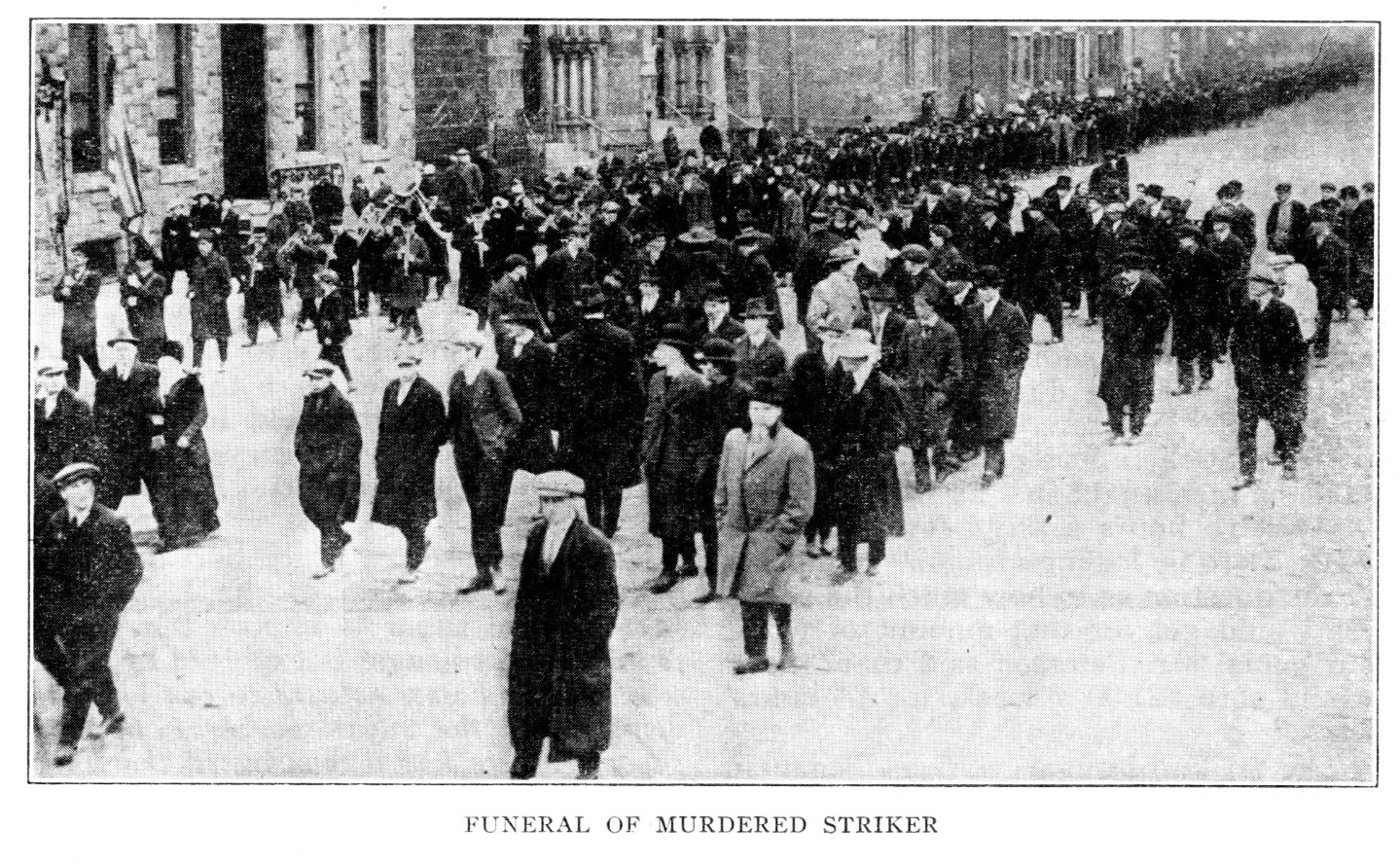
The funeral of our murdered fellow worker was held on Feb. 26th. It is estimated that 10,000 workers attended the funeral of whom 2,500 were members of the One Big Union.
The strike itself is still going on as bitterly as ever. The strikers at the end of six weeks’ struggle are as determined as ever to win. Their slogan now is, “There is no vindication of the dead unless we have a victory for the living.”
What are they fighting for? I am almost ashamed to tell. The conditions they are struggling for are so rotten that they would be doing well to fight against them. At any rate no one will ever say that their demands are exorbitant.
1. A five cent an hour increase in wages,
2. A twelve hour work day,
3. Time and one-half for overtime,
4. Double time for Sundays and holidays,
5. Reinstatement of all workers.
Sugar is a scarce article on the market in this country now and the bosses are feeling the pinch. Today, in contrast to three weeks ago, the superintendent of the Spreckles place, under a guard of police, made a speech from a soap box to the strikers on the picket line. He told his audience that they should leave the I.W.W. and join some other union; then he would deal with them, etc. He said that the I.WW. was too small to represent their interests.
A week ago they had nothing to say to the State and Federal Board of Mediators, today they are making stump speeches to the pickets; tomorrow they will settle with the strikers and the One Big Union, the I.W.W.
The International Socialist Review (ISR) was published monthly in Chicago from 1900 until 1918 by Charles H. Kerr and critically loyal to the Socialist Party of America. It is one of the essential publications in U.S. left history. During the editorship of A.M. Simons it was largely theoretical and moderate. In 1908, Charles H. Kerr took over as editor with strong influence from Mary E Marcy. The magazine became the foremost proponent of the SP’s left wing growing to tens of thousands of subscribers. It remained revolutionary in outlook and anti-militarist during World War One. It liberally used photographs and images, with news, theory, arts and organizing in its pages. It articles, reports and essays are an invaluable record of the U.S. class struggle and the development of Marxism in the decades before the Soviet experience. It was closed down in government repression in 1918.
PDF of full issue: https://www.marxists.org/history/usa/pubs/isr/v17n10-apr-1917-ISR-riaz-ocr.pdf
 Revolution's Newsstand