
Falsely accused of the 1905 murder of Idaho Governor Frank Steunenberg, a mass movement in defense of William D. Haywood and his comrades helped to save hem from the gallows as they were acquitted in 1907. Emerging victorious after 18 months in jail, the Western Federation of Miners leader receives a hero’s welcome in Chicago. Included are reports of his arrival and parade to the hotel, the Luna Park rally, and the text of Haywood’s speech to the 35,000 assembled workers.
‘Miner Welcomed by Enthusiastic Reception and Parade in the Streets’ from The Chicago Daily Socialist. Vol. 1 No. 248. August 12, 1907.
Bill Haywood is here.
He arrived Sunday morning at 7:10 and was met at the union station by a delegation of 500 undesirable citizens. A guard of 100 from the Young People’s Socialist league was on hand with big paper hatbands welcoming the miners chief.
The Greeting.
The first Chicagoan to greet Haywood was Miss Julia Mechanic, 3826 Rhodes avenue. Miss Mechanic is old friend of the Haywood family and during his imprisonment was an active worker in the Moyer-Haywood-Pettibone conference. She stood first in line at the station gate. Great tears rolled down her cheeks as she caught sight of Haywood and in an excess of emotion she kissed the giant digger as he approached with outstretched hand.
Three feet inside the gate Haywood was surrounded by a compact mass of cheering trades unionists and Socialists intent upon contrasting his reception at Denver, where the big electric “Welcome” sign was turned out as his train pulled in.
Several attempts were made to lift the westerner to the shoulders of the crowd, but Haywood good-naturedly repulsed all such efforts.
A thousand hands were outstretched in greeting and the crowd cheered itself hoarse. Outside the station a line of march headed by two open carriages was taken up. Followed by the original 500 the crowd was augmented at every corner by passersbys eager to show their sympathy with and for the liberated miner.
All Cheer.
Crowds lined the sidewalks and wildly shouted their welcome to Chicago. Street cars stopped while passengers and crew alighted to cheer and get a closer view of Bill Haywood, ice wagons were deserted by their drivers who rushed to the carriage to grip the hand of the victim of the Colorado Mine Owners Association.
Haywood tried to acknowledge greetings by bows and removing his hat, but so continuous was the ovation that the hardy miner proved unequal to the task, so placed his hat the side and rode bareheaded through the streets.
The March.
From the union station carriages went south to Jackson, thence east to Clark street passing the strike-bound Western Union and Postal offices, thence south on Clark to Randolph and two blocks west to the Briggs house. Haywood was assigned to room 406 at the hotel.
Shortly after going to his apartments he was waited upon by President John Fitzpatrick and Secretary Edward Nockels of the Chicago Federation of Labor, who welcomed him to Chicago in the name of organized labor. About a score of other labor officials participated in the formal reception at the Briggs house.
In a mistaken spirit of good fellowship some enthusiast ordered several trays of intoxicants sent to the apartments. Haywood passed them all and responded to his toast with a glass of water.
With Telegraphers.
Picket telegraphers at the offices of the Western Union and Postal Telegraph companies delegated one of their number to convey the following note to Haywood at the Briggs house:
“Pickets of Commercial Telegraphers’ union, local No. 1. extend heartiest congratulations and welcome you to the city.”
The following reply was immediately penned by the miner:
“Pickets of Telegraphers on Strike: Your kind note to hand. Am deeply grateful for good wishes. Stand shoulder to shoulder and you can’t lose. Fraternally
“WILLIAM D. HAYWOOD.”
Until noon a constant stream of well-wishers filed in and out of Haywood’s apartments and many thousands more gathered to greet him in the afternoon at Luna park.
Passengers Enthusiastic.
Before his train pulled into Chicago every passenger on the Pullman came to Haywood and congratulated him upon the verdict at Boise. Many men of wealth expressed their hearty sympathy with the Western Federation of Miners in the successful termination of its fight with Colorado mine owners of the Guggenheimer stamp.
An Interchange of cards was had between the labor leader and a Pullman full of capitalists, who recognized in the freed miner the material evidence of the workers’ solidarity.
At stations all along the route from Denver to Chicago the train was met by cheering throngs who gathered show their sympathy with Bill Haywood.
After breakfast at Kings’ restaurant Haywood visited the office of the Chicago Daily Socialist.
As he is not accustomed to being out o’ nights, he did not sleep well on the Pullman so rested at the hotel until time to go to Luna park.
’35,000 at Luna Park Hear Haywood’s Victory Speech’ from The Chicago Daily Socialist. Vol. 1 No. 248. August 12, 1907.
Speech of the Famous Worker Sounds Note of Better Days When Labor Will Be United–Labor Celebrates Work Class Victory and Greet the Miner Who Was Saved From Gallows.
On the hottest day of the year 35,000 persons gathered at Luna park, Halsted street, yesterday to see, hear and cheer William D. Haywood.
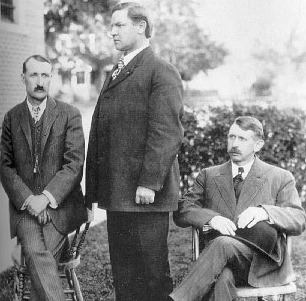
William D. was entirely too formal for the crowd: everybody was waiting to see “Bill” Haywood.
And “Bill” Haywood he was. A giant in stature, Haywood impresses one as a great, big-hearted, whole-souled, big brother.
The immense crowd taxed the capacity of the park. Every available inch of standing room on all sides of the speakers’ stand was occupied. Shade trees within hearing distance were filled with men intent upon catching every word and move of the westerner.
Shows Close.
Every show on the grounds closed its doors and employes stood on the outside of the crowd where an occasional word might be heard. Fearful lest the “Falls of Niagara” might interfere with the speaker this concession was ordered stopped by the park management.
The miniature railway, with its tooting engine making the rounds of the park voluntarily suspended business out of respect for the speaker.
A Great Day.
Good nature, good will, gratitude and general air of thankfulness pervaded the entire assemblage. Standing in the sweltering sun, men and women willingly consented to lower their umbrellas and sunshades that those behind might have an unobstructed view of the stand.
Probably no larger crowd ever assembled in Chicago to listen to a single speaker,
Introduced.
G. T. Fraenckel, Cook county chairman of the Socialist party, presided as chairman of the Luna park meeting and introduced the speakers. Haywood’s appearance at the park was under the auspices of the Cook county Moyer-Haywood conference.
Fraenckel first introduced Secretary Nockels of the Chicago Federation of Labor.
Nockels spoke briefly upon the work of the Moyer-Haywood conference; of the Chicago Federation of Labor’s affiliation with it, and as the representative of organized labor of Chicago congratulated Haywood on his escape from the Colorado Mine Owners association and welcomed him to the city.
Cheered.
Haywood was introduced immediately Nockels finished. It was a full five minutes before anything like quiet could be had. Flags waved, hats were held aloft or thrown in the air; umbrellas and parasols waved a greeting: thousands of handkerchiefs fluttered in honor of Bill Haywood; shouts and cheer upon cheer greeted the speaker. And when the crowd eventually quieted down somebody started it all over by shouting:
“You’re lookin’ fine, Bill.”
And through it all this great big man bowed awkwardly left to right and blushed like a schoolboy and shifted uneasily from foot to foot.
Thanked Workers.
His talk was constantly interrupted by enthusiasts shouting encouragement to the big miner in his fight against oppressive capital. When he spoke feelingly of his gratitude to the working class for effecting his escape from the gallows he was greeted with: “We’ll do it again, Bill.”
Note–Haywood’s speech in full will be published tomorrow.
‘Haywood’s Speech’ from The Chicago Daily Socialist. Vol. 1 No. 249. August 13, 1907.
Mr. Chairman, Members of the Moyer and Haywood Conference of the City of Chicago, Ladies and Gentlemen, Comrades, Brothers and Fellow Workers: It is indeed with a light and cheerful heart that I. address this multitude to extend to you the heartfelt thanks of myself and of the members of the working class throughout the entire west.
The chairman of this meeting has intimated that if ever a time comes when it la necessary again for the united action of the working class of this country, that that support that has been given to me will be cheerfully given again.
I want to say on this occasion that the need for support still continues, and the only thing that is required to All the cup of happiness to overflowing would be the presence of Charles Moyer on my right and of George Pettibone on my left.

And until those two men are free, and a third, Steve Adams, who is in the toils of the Mine Owners association, there is still reason to continue action on the part of the working class of this country.
And I want to say that notwithstanding the fact that to all appearances we have had a fair trial, I owe it to the men and women of Chicago, to the men and women of the United States, to the working class of the world that I am present here today. (Applause.)
Not its Intention.
And let me tell you that it was not the intention of the Mine Owners’ Association, of the government of the state of Idaho, of the government of the state of Colorado and of the federal government of the United States, to accord us a fair trial when they kidnaped us from the state of Colorado. It was their intention to railroad us to the gallows, and I have to thank you for my life. (Applause.)
When the representative of the state of Idaho came to Colorado, strange as it may seem to you, two of the judges of the supreme court of that state were in conference with the governor when he agreed that we should be exiled from our homes.
Remember these were the representatives of Governor Gooding, who came into the state of Colorado on Thursday night, and it was arranged by them that there should be no action taken until Saturday night for fear that we would make application to the courts of the state for a writ of habeas corpus. But when I again tell you that members of that supreme court were in conference with the governor you will understand, it would have been little use for us to apply for a writ of habeas corpus in the red state, the state of Colorado.
Now when we were taken to Idaho, we there applied for a writ of habeas corpus, and we applied to a court one member of which said that he had been hounded around the state and that he was only twenty-four hours ahead of people who were trying to work him an injury. It is unnecessary for me to say that that was merely a phantom of his brain, but he recounts the instance with considerable nerve on his part and said that he climbed over the back fence to escape the people that were looking for him.
You can imagine the dignity of one of the highest jurists of a state of this Union when he climbs over the back fence for fear of meeting face to face a member of the working class (Laughter.) He said he was afraid he was going to be killed, but the chances are that all that would have been done would be to solicit him to give us a square deal,
To Higher Court.
Well, after going through the procedure in Colorado and Idaho, we then, as you know, applied to the supreme court of the United States. Now, again, you will see where we were getting a fair deal. You will remember that President Roosevelt (hisses) on the 14th of last October wrote a letter that is now world renowned, a letter wherein he stated that among other prominent citizens of this country were myself and Moyer, whom he designated as “undesirable.” (Laughter.)
But my only reason for mentioning that fact is to recall to you that the members of the supreme court of the United States were in conference with the president and read that letter. Is there any wonder, then, that they denied us a writ of habeas corpus? (A voice, “No, I should say not!”) There never was an instance in the history of this country before where the members of the working class were up against a combination that consisted of all of the capitalist interests of two state administrations and of the federal government.
Won the Fight.
Now, standing alone, I surely did not win that fight, but with this multitude behind me, with the working class of this nation, we did win the fight. (Applause.) And I stand here at this time typifying what unity means, typifying what it means to stand together shoulder to shoulder in the class struggle (Applause), and there would be no necessity on my part to urge you to continue to stand together, not for me, but for yourselves, and each one of you Individually. (Applause.) And at this time I am going to ask you to do as much for yourselves as you have done for me. (Applause.) To do that it is necessary for you to unite with your fellowmen industrially and politically. (Applause.)
To the union men that I am addressing in this crowd I will say there Is much that you have to learn, and one of those things is that you must not give an employer an agreement or contract of any kind or description. (Applause.) And I will explain to you why you should not do that. You object to any individual bargaining. You say that men of your craft should join with you for a common interest. Well, it is to the interest of men to join together, it is to the interest of unions to join together. If you sign a contract on the part of certain craftsmen and that contract expires on the 15th of next month, and another craft signs a like agreement that expires a couple of months later you see that as unions you are still units, and you are divided as far as the working class movement is concerned? (Applause.)
Individual Rights.
Now, I want to go a step further. I have said that an individual has no right to bargain individually to the detriment of his fellow workingmen. I have said that a local union has no right to bargain as a union. It is merely a unit in the working class movement. Now an international has no right to bargain as an international, because they are a part of the working class movement, and this problem will never be settled until workingmen of all kinds and women of all vocations join hands for the common cause. (Applause)
Briefly want to give you a history Western Federation of Miners. Strange to say, we were conceived jail and born In Butte, Mont, on the 15th of May, 1893, and that the same cell I have occupied for eighteen months with my comrades was the cell in which the Western of Miners was organized in the first place. Since our organization we have done everything that we could to assist members of working class no matter what their affiliation might be, and it is my pleasure to say that bread cast upon the water returns after many days. (Applause) What you have done for us we may grow strong enough to be able to return to you.
I hope that none among you will ever be called upon to suffer, but it will be a strange thing in the onward march of civilization if there are not some martyrs. But in reference to martyrs I don’t want you to think for one minute that I have suffered any martyrdom. Not at all. Not one minute since I have been under arrest or while I was occupying a cell in the penitentiary and in the Canyon county jail and in the Ada county jail, not one minute have I had other than an abiding faith that I would at some time have an opportunity to meet you. (Applause.) And, more than that, I never had any blue spells. I always felt happy and contented. I knew that there were millions of eyes focused on Idaho. I knew that millions of voices were being raised in my behalf. And I knew more than that: I knew that with this united movement on the part of the working class it had gained a gigantic stride forward toward the emancipation of all of you. (Applause.)
About Buchtel.
Now, I want to say a word about Governor Buchtel of Colorado. He is now residing in your city. He has declared, with others, that I am an undesirable citizen, but I just want to point out to you the difference between an undesirable citizen and a desirable citizen from his standpoint.
During the fifteen years of the life of the Western Federation of Miners in the state of Colorado we have endeavored to pass a number of measures for the working class. In many of them we have been successful. All of you will agree with me that the duty of the executive officer of a state is to enforce the laws of the state. If a man occupying an official position does not enforce the laws, why, then, he may rightly be referred to as an undesirable citizen. (Applause.)
On the statute books of the state of Colorado we have an eight hour law applying to men working in and around the mines, mills and smelters. There are at least 8,000 men that are not enjoying that law. Mr. Buchtel is the man that is responsible.
We have an anti-gambling law in the state of Colorado, but we have hundreds of gamblers that are daily fleecing the workers out of their hard earnings, and Governor Buchtel is responsible.
We have a check-weighman law whereby a coal mining company cannot force the men to mine 4,000 pounds of coal for a ton, if that law was properly applied, but it is not, and Governor Buchtel is responsible.
Other Laws.
We have a ventilation law in the state of Colorado that is not enforced, and Governor Buchtel is responsible. We have a semi-monthly pay day, and there are none of the workingmen that get their checks oftener than once a month, and Governor Buchtel is responsible.
And we have an anti-scrip law, whereby workingmen are supposed to get the coin of the realm in pay for the work they have done for the companies, but the scrip is still in use, and Governor Buchtel is responsible. Now, I want to ask you whether or not the members of the Western Federation of Miners and its officers who are trying to enforce those laws are the undesirable citizens or whether the governor who refuses to enforce the law with the power in his hands–is he not the undesirable citizen? (Applause.)
Now, you all recognize the fact, and if you do not I will soon demonstrate it to you, that the miner who digs the ground–the coal and the metalliferous digger is the stepping stone of civilization. It is he who goes down deep into the bowels of the earth and brings up the copper and the tin and the lead and the gold and the silver and. the other metals that are made into the tools that are used by you artisans, and without us you would be wearing a breechcloth and plowing with a crooked stick. There would be no gigantic buildings like you have got in this city. There would not be any of these pleasure resorts. There would not be the iron horse nor the ocean greyhound. You would not have spring in your watch and Roosevelt would not have signed the letter on the undesirables with a steel pen. (Applause.)
Here a glass of water was handed to the speaker, who remarked, “This fellow seems to think this windmill to run with water.”
Some Aims and Purposes.
There is something about the aims and purposes of the Western Federation of Miners and the interests we have against us. Now you know that an undesirable organization does not build hospitals for its sick and its injured. An undesirable organization does not build libraries for the education of its members. An undesirable organization does not have halls and meeting places where we carry on debates with the hope of lighting intelligence in the minds of the citizens of his country, so that we can bring to them the rights and privileges that they should enjoy.
Now, the principles of the Western Federation of Miners have been clearly wet forth on a number of occasions, and it is our purpose to organize industrially and unite politically so that we can bring the working class into their own. And with those principles in view we are never going to swerve from them, and all hell cannot make us swerve. (Applause, during which the speaker turned to another portion of the audience.) I want you all to hear this, that the principles of the Western Federation of Miners are intended for the betterment and uplifting of the working class. We are educating our members working step by step, and from those principles all hell can never swerve us.
I have said good deal on this occasion about the men, but I want to way something about the women. I just want to say a word in behalf of the women, in behalf of the splendid support that they have rendered to us. I am here for the purpose of thanking you in behalf of myself and the boys in jail of the Western Federation of Miners, of my wife and my mother, and of Henrietta, who sends her love to the girls of Chicago, And whatever else may be said in the labor movement, you must always take of your hats to the women, because
Warriors, lawyers, sinner and saint,
May fight and play and pray,
But the world, will wag on to the end of time
In that little woman’s way.
The Chicago Socialist, sometimes daily sometimes weekly, was published from 1902 until 1912 as the paper of the Chicago Socialist Party. The roots of the paper lie with Workers Call, published from 1899 as a Socialist Labor Party publication, becoming a voice of the Springfield Social Democratic Party after splitting with De Leon in July, 1901. It became the Chicago Socialist Party paper with the SDP’s adherence and changed its name to the Chicago Socialist in March, 1902. In 1906 it became a daily and published until 1912 by Local Cook County of the Socialist Party and was edited by A.M. Simons if the International Socialist Review. A cornucopia of historical information on the Chicago workers movements lies within its pages.
PDF of full issue: https://www.marxists.org/history/usa/pubs/chicago-daily-socialist/1907/070813-chicagodailysocialist-v01n249.pdf
PDF of issue 2: https://www.marxists.org/history/usa/pubs/chicago-daily-socialist/1907/070814-chicagodailysocialist-v01n250.pdf
 Revolution's Newsstand