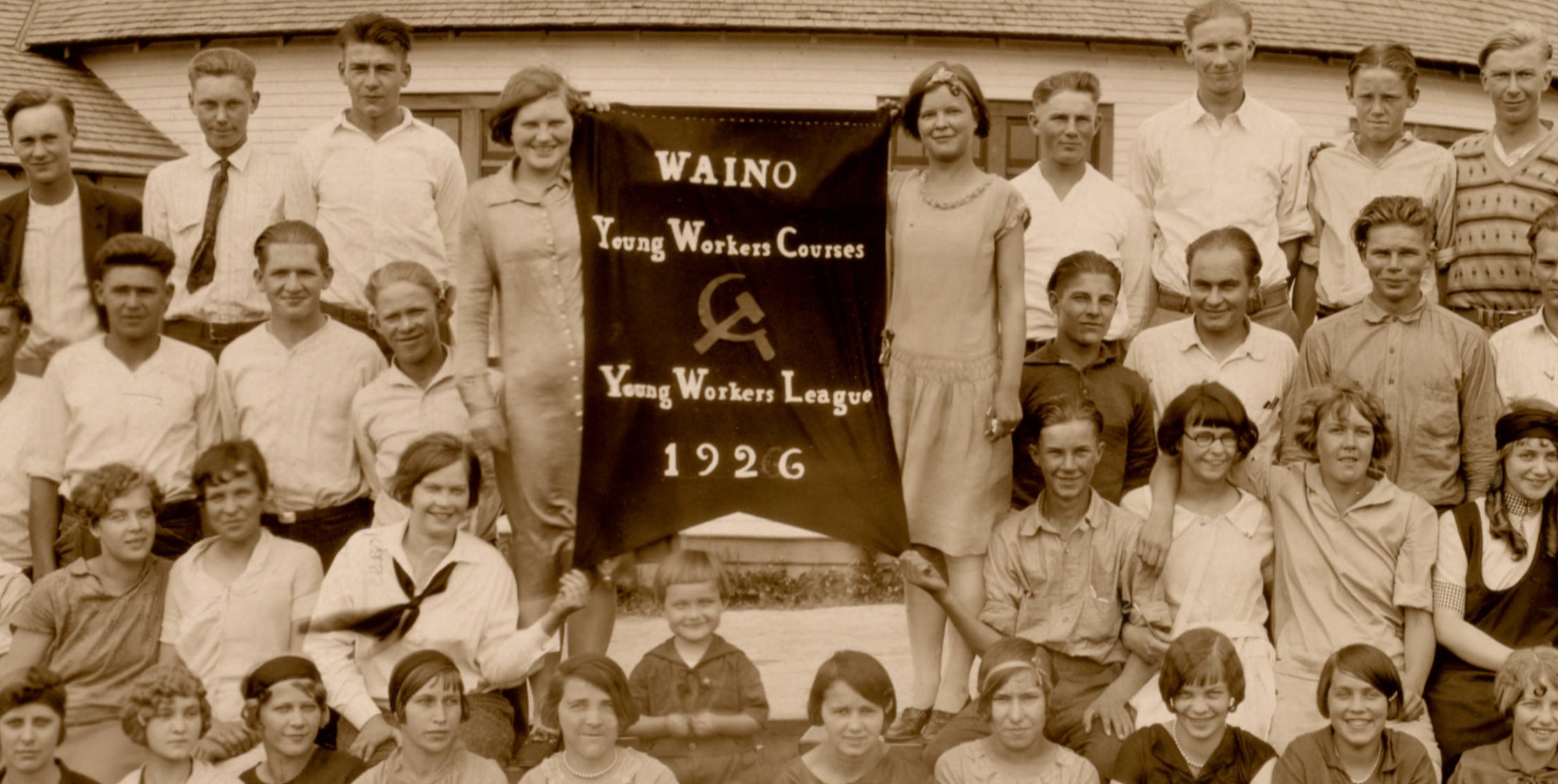
Young Workers League leader Oliver Carlson reports on their school in Waino, Minnesota.
‘The Little Red School House’ by Oliver Carlson from the Daily Worker Saturday Supplement. Vol. 3 No. 216. September 25, 1926.
ONCE upon a time (so the story goes) the little red schoolhouse was the fountainhead of American culture and learning, where the Jacksons, Lincolns, Grants and, in fact, all the great political, industrial, financial and military geniuses were taught the three “R’s” and received the necessary knowledge, and encouragement which sent them forth into the world to make of this country a nation greater and more powerful than history has ever known of heretofore.
But my story is not one that deals with the little red schoolhouse of yesterday. It is the story of the little Red schoolhouse of today. It has only just begun to function, but from the success already achieved We can safely predict that it and its successors will play no small part in moulding the exploited youth of today into able fighters for the abolition of capitalism.
The Waino Young Workers’ School.
NEARLY 500 miles northwest of Chicago lies Waino. It is the center of a farming community dominantly Finnish. The big lumber companies have reaped fortunes in that region, but the big timber is all gone now, so they sell cut-over land to the poor fish from Chicago, Milwaukee and other large cities who have swallowed the stories about “become independent by being a farmer.” Every year yields a new crop of settlers, who struggle on in vain for a year or two and then return to the cities, poorer if no wiser than when they came. The Finns have stuck together, have organized co-operatives and halls of their own, and thus managed to eke out an existence and have become class-conscious.
It was in the above-mentioned region where a Young Workers’ Summer School was conducted last year-and where a larger and more successful one was held again this summer for a period of five weeks, from June 21 to July 24. It was a unique school in more ways than one.
Its Aim, and How Organized.
Of all the students at the courses, and there were 57 of them who completed the entire course not one paid a cent for tuition, for board, or for railroad fare from his home to the school and back again. The course committee, which had been on the job many months before the school opened, had succeeded in getting a sufficient number of organizations to support the idea of the school financially that the students who were selected to attend the courses need have no financial worries. Altho the Workers’ Party and Young Workers’ League were the moving spirits behind the school, still a very large number of non-party organizations gave both financial as well as moral support to it. A number of co-operatives, women’s organizations, farmers’ clubs, etc., are included in these.
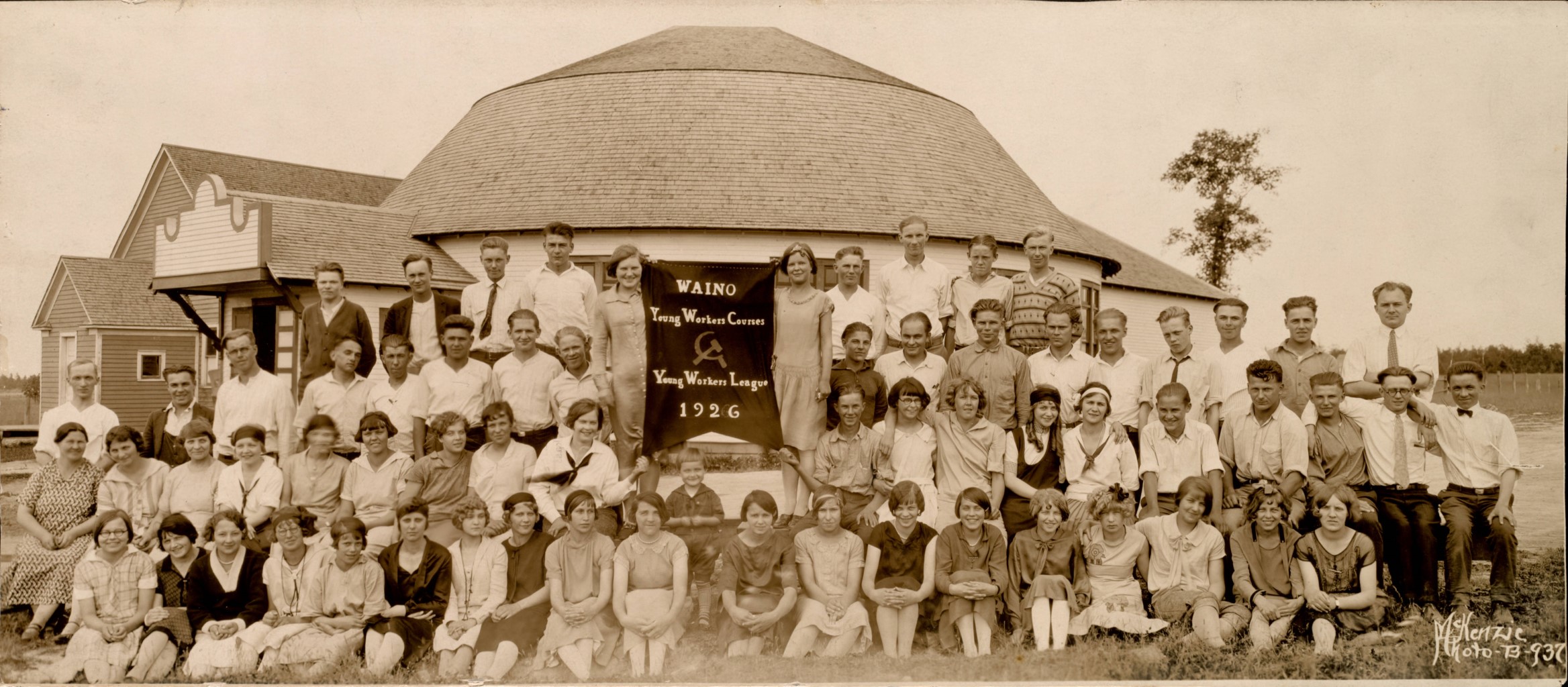
The aim of the school, as expressed in the certificate given each student who completed the course, is:
“To train young workers and farmers to an understanding of their position in present-day society, and of their relation to the working class generally.
“To teach them how to examine and understand the basic forces at work in society.
“To give them a knowledge of the various types of working class organizations, their policies and their tactics, thus preparing them for active and intelligent participation in these organizations, to the end that capitalism shall be abolished and replaced by a classless society based upon production for use instead of for profit.”
In conformity with these aims, the course of study embraced the following subjects: Sociology, Marxian Economics, American Social and Labor History, Forum, Current Events, Working Class Theories, Historical Materialism, Problems of Socialist Reconstruction, Public Speaking, Theory and Practice of Young Workers’ Organizations, and Playground-Athletic-Social Leadership.
The Composition of the School.
ALTHO slightly over 60 students entered the school, only 57 were able to complete the entire course. (It may be important to note that 115 applications were received from prospective students, fully half of whom had to be rejected because of the physical inability to handle so many). These students came from six states: Minnesota, Michigan, Wisconsin, North Dakota, South Dakota and Oregon, and from no less than 39 different cities, towns or villages.
In age, the students varied from 15 to 27 years. The average age was between 18 and 19 years. They were virtually evenly divided as to sex, there being one more girl than boys.
Most of them were workers. The most numerous groupings consisted of lumber workers (13), farm workers (7), domestic workers (9) and clerical workers (7). In addition to these there were students, schoolteachers, pipefitters, millinery workers, etc. Approximately 50 per cent of the students were members either of the Young Workers’ League, the Workers’ Party, or both. The remainder were wholly unorganized or belonging to farmers’ clubs, athletic clubs, co-operatives, etc.
Student Activities.
FROM the very start we were determined that the students should have as much as possible to say about. conducting affairs of the school. The entire student body met regularly every week to discuss school problems and the work of its sub-committees. The student body was responsible not only for keeping the school clean, but also for helping the cooks in clearing the tables and washing dishes, for keeping discipline, conducting entertainments, editing a wall newspaper, supervising and conducting athletics, etc. etc. Every student did his share of work-and the work was done willingly and cheerfully. A student council, consisting of the chairman of each of the sub-committees and two members elected directly from the student body, was in general control of all work. The instructors were not permitted to serve on any committee nor have a vote in the meeting of the student body. Not the slightest friction developed between students and instructors quite to the contrary, this method of putting the responsibility for the success of the school directly upon the students themselves did much to make the school a success and to develop initiative amongst them.
A model Young Workers’ League was formed, divided into seven nuclei. The showing of the students was exceptional. Basic tasks and problems were discussed and executed with a gusto that would surprise many a veteran.
The wall newspaper was one of the finest examples of work that I have seen from young people. It appeared regularly twice a week, containing all manner of material, both serious and humorous, and was well illustrated thruout. I believe that every student in the school contributed at least once to the paper.
The Importance of the School.
UNDOUBTEDLY there were many shortcomings with our Red school in Wisconsin, but the students voted it a huge success and were unanimous in demanding that an advanced school be conducted next year. All of them left the school thoroly imbued with a spirit of class consciousness and have now gone back to their homes to agitate and organize. It is important to note that more than half of the class came from two of the most important sections of the country, i.e., from the Iron Range of Minnesota and the Copper Range of Michigan. They are going back to begin the work of rousing their comrades and fellow-workers Into action. The traditions of struggle from both Calumet and Messaba Range indicate that something can be done to organize and lead the copper and iron ore slaves into action. The students from the little Red school house will be the pioneers to set the machinery into action. The little Red schoolhouse is no longer an experiment. It is a fact, testified to by more than one hundred students, who are carrying the message that they learned there into mine and mill and logging camp. These students are young Americans (nearly 80 per cent of them native born) and they will be the torch-bearers for still greater numbers to follow them in creating a revolutionary mass movement of American workers.
Long live the little Red schoolhouse! May it grow and flourish from coast to coast.
The Saturday Supplement, later changed to a Sunday Supplement, of the Daily Worker was a place for longer articles with debate, international focus, literature, and documents presented. The Daily Worker began in 1924 and was published in New York City by the Communist Party US and its predecessor organizations. Among the most long-lasting and important left publications in US history, it had a circulation of 35,000 at its peak. The Daily Worker came from The Ohio Socialist, published by the Left Wing-dominated Socialist Party of Ohio in Cleveland from 1917 to November 1919, when it became became The Toiler, paper of the Communist Labor Party. In December 1921 the above-ground Workers Party of America merged the Toiler with the paper Workers Council to found The Worker, which became The Daily Worker beginning January 13, 1924.
PDF of full issue: https://www.marxists.org/history/usa/pubs/dailyworker/1926/1926-ny/v03-n216-supplement-sep-25-1926-DW-LOC.pdf
 Revolution's Newsstand