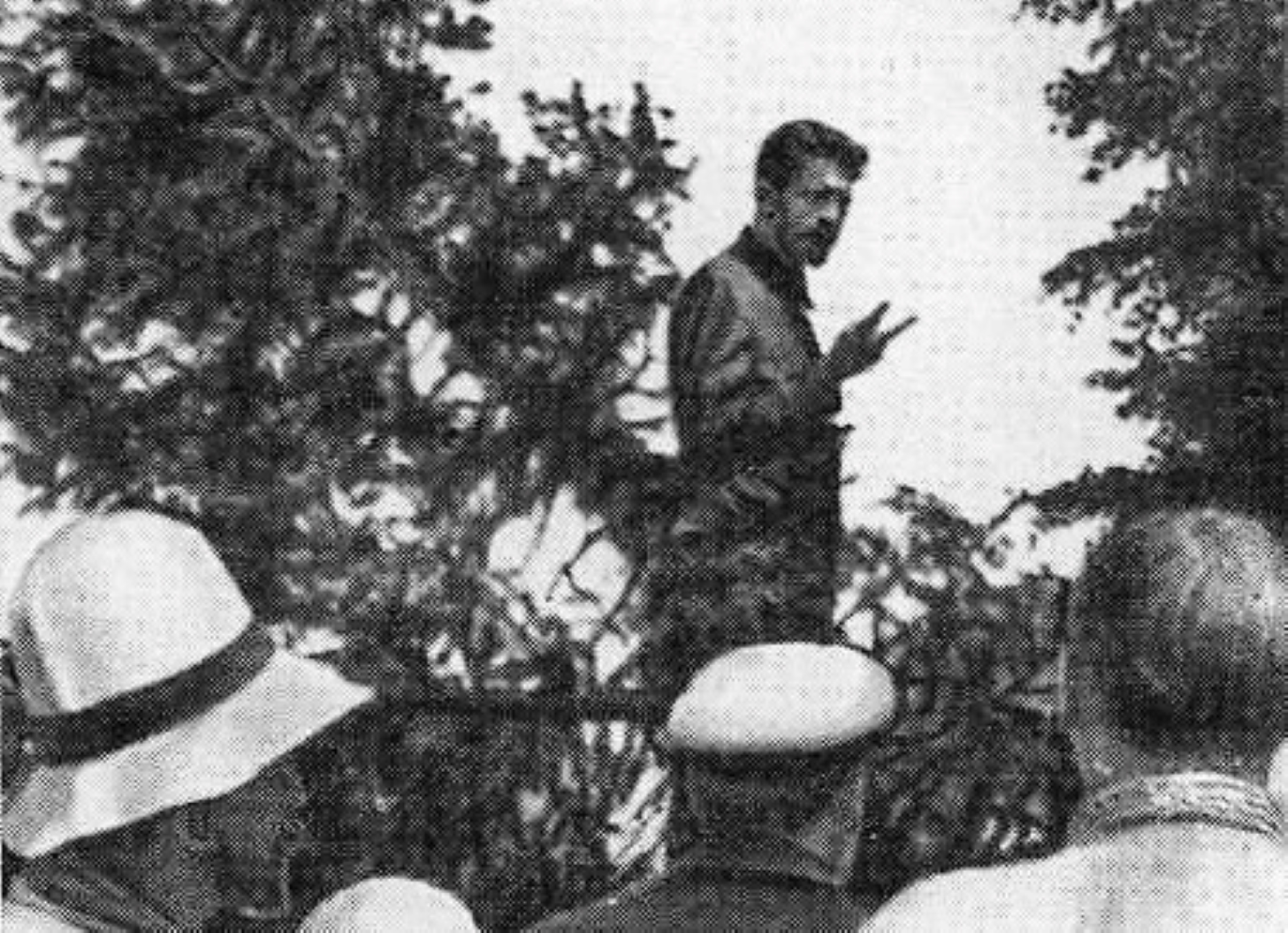
Written by S. J. Rutgers, an originator of the Third International in the U.S., as a pamphlet for the Socialist Propaganda League of America shortly before his departure for Soviet Russia in 1918, Rutgers’ words give a sense of what the Bolshevik Revolution first meant and how it was interpreted by Left Wingers internationally.
‘The Socialism of Revolutionary Struggle’ by S. J. Rutgers from Revolutionary Age. Vol. 1 No. 24. March 29, 1919.
THE development of capitalist society has reached a stage in which free competition rapidly gives way to monopoly, with export and destruction of capitals only means to prolong the present system of exploitation.
This results in a new autocracy, an industrial feudalism, the rule of the money-kings and monopolists and the subjugation of the old and new middle classes and so-called independent capitalists under the control of an iron despotism. Internally this means brutal oppression of the workers, industrially as well as politically, the denial of the right strike, suppression of free speech, press and action, reduction of the standard of living; internationally this means a series of wars for world exploitation and wanton destruction of proletarian life and proletarian organization.
In this gigantic struggle of imperialistic Capitalism, parts of the workers, the intellectual workers, the upper layers of skilled labor, the labor bureaucracy and other groups that lack understanding, confidence or courage, betray the working class. They become the worst enemies in the class struggle, especially so, their social-patriotism and social-imperialism is presented in a form of Socialism and pseudo-Marxian theory liable to deceive the rest of the workers.
The fight against social-patriotism therefore in all its forms must be considered one of the foremost duties of revolutionary Socialism.
The class struggle between the Proletariat and Capital has entered the period of revolutionary struggles for the overthrow of the ruling class. The problem before us is either a revolutionary reconstruction of society on communist principles or the common ruin of the contending classes.
As long as the bourgeoisie had to defend itself against the remnants of feudal classes, it represented progress against reaction, and whatever class-conscious forces were already born in the new underlying working class had to support their exploiters in this struggle. As long as Capitalism represented the social and technical development necessary for the realization of the Socialist commonwealth, the class struggle was an important part of this development and although tending towards revolution it formed a part of the existing social order recognized as such and using legal means based on bourgeois conceptions and bourgeois morals. As soon, however, as the capitalist class has fulfilled its historic mission of create and organizer of social and technical, conditions for Socialism, it becomes thoroughly reactionary and the underlying class has to organize as a strictly independent revolutionary force. Society actually has reached a stage where it is split up into two great hostile camps, into two great classes directly facing each other–Bourgeoisie and Proletariat. Imperialism is the period of overdevelopment of Capitalism, is the period in which Capitalism can only maintain itself by wasting and destroying the wealth it creates. Imperialism is characterized by the production of means of production for the production of other means of production, combined with the production of means to destroy the means of production.
The imperialistic form of expansion through export of capital is one of the manifestation of the tendency to waste and destruction, war is another form and monopoly its economic expression.
The new development of Capitalism into its highest imperialistic form has a deciding influence on the forms and tactics of the proletarian class struggle. The capitalist State, under the control of big business, reduces the influence of parliament and representative bodies in general to a minimum, putting the governmental power more and more in the hands of the Executive branches: president, governors, mayors, committees and judges. The old methods of parliamentary diplomacy whereby labor supported one group of capitalists against another, skillfully manipulating in order to try to secure certain advantages for the workers, have become obsolete. It is only the power of the workers themselves that counts and the power of the working class lies in the masses, its industrially and politically organized action. Representatives only commit in so far as they are backed up and controlled by these masses. Parliamentary action thereby does not lose every importance but changes its character. It has only significance in connection with and as a part of mass action. The backbone of this mass action is industrial action in the basic industries, supplemented by general demonstrations, strikes of protest, political strikes, etc.
In order to become a revolutionary factor, industrial action has to accept general or political purposes, aiming at the overthrow of the present system of exploitation. In this it can co-operate with and back up other forms of mass action and in such united action lies the hope and salvation of revolutionary Socialism. This unity, not as the result of some intellectual scheme but through necessity of facts and actions is on its way, and it is the duty of revolutionary Socialism to further such forms of organization that correspond with this process towards one general mass action of the Proletariat, with tactics and a program of plain, clear-cut class issues, within the grasp of the average worker.
Foremost in the mind of every worker is his will to improve his material conditions and fight against lowering his standard of living. This brings him in his industrial union into a fight for higher wages and shorter hours. But it is easily to be seen, that his standard of living can be effected either directly or indirectly. He may increase his wages, but if the buying power of the increased wage is reduced by high prices or unemployment, he may be worse off than before, as was most convincingly demonstrated during the present war. This struggle must become part of the revolutionary struggle, will develop into the revolutionary struggle.
The fight for higher wages including the fight for a guarantee of such wages under all conditions of sickness, incapacity and unemployment, therefore has to be supplemented by such demands as: taxes on capital and income only, confiscation of war profits, repudiation of national debts, etc. This means that even in the most elementary struggle to maintain life under the present system of exploitation, political action has to supplement economic action, even if this political action has to be backed up by industrial action.
It is most evident that the greatest and strongest foe of the working class is monopolistic and financial capital. Therefore, we should demand confiscation of monopolistic industries, confiscation of the banks, etc., as the first act of a proletarian revolution.
This again is a political issue, for such a confiscation would effect the whole capitalist class, would be impossible as long as the capitalist State can rely upon its material and moral means of power to protect the capitalist interests.
We do not demand State Capitalism. If the state takes over or controls certain industries in the interest of the capitalist class, this simply means strengthening Capitalism, strengthening the State, concentration of the capitalist forces against labor. generally means more exploitation, more slavery, more misery, and since this development on the part of the exploiters is the direct result of their imperialistic tendencies, it also means: more Imperialism and more wars. The interest of the workers, therefore, are opposed to State Capitalism, and labor has to fight it and especially its tendencies towards suppression of freedom, suppression of the right to strike, suppression of democracy. But they have to use the most efficient ways of fighting.
We cannot “prevent” State Capitalism, as little as we could “prevent” other forms of concentration, trusts, etc. and although we know that the present imperialistic form concentration is not necessary for creating the economic conditions for Socialism, as were some of those previous forms of concentration, our fight does not try to turn back the wheel of history but seeks to increase our power to such an extent as to overcome the power of the capitalist class and the capitalist state. And whereas Big Business wants the rationalization of or state control of certain industries in the interest of financial and monopolistic capital, we demand confiscation of the very stronghold of our foe, confiscation of monopolistic industries and of the banks in order to bring them under the control of the workers.
We know that the realization of Socialism, that the seizure of power and the reorganization of society upon a communist basis, now depends upon the strength, the will power and the courage of the workers only.
The economic fight against the State as the most powerful exploiter coincides and becomes one with the political fight against the capitalist State as such. The Iine of division now lies between those workers who consider the State an institution above the classes, an institution to be influenced “democratically” by the “people,” and those who consider the State an instrument of the capitalist class, a stronghold of our enemy. Here again the deciding factor is whether we accept and act in accordance with the class struggle or not. Once our action is based solidly and uncompromisingly on the revolutionary class struggle all minor differences of tactics are overcome by the practical struggle.
The fact that equal rights are impossible in a society based on class dominion necessitates during the revolutionary period of actual transformation of the old society into the new, what Marx called “the dictatorship of the proletariat.” The power in the hands of the Soviets (councils of Workers, Peasants and Soldiers) with the exclusion bourgeois influences was the corresponding demand of the Russian proletarian revolution, and only from the moment of realization of this demand dates the actual proletarian revolution in Russia. As long as classes are struggling for power, democracy can only be a form of supremacy of one class over another. The very principle of their democracy in connection with their conception of the class struggle dictated our Russian comrades to discard the Constituent Assembly.
This is by no means a betrayal of democracy but the first step towards its realization, through the overthrow of class dominion. Representing the ultimate interests of the working class, by far the most numerous and most important class in society, it would be absurd and a violation of real democracy to back down in the struggle because our enemies have succeeded to large extent in poisoning and fooling our own comrades to betray their and our interests.
It is high time to consider in all countries the organization of councils of the working class as a nucleus around which all revolutionary forces may rally for the seizure of power. We are in favor of organized efforts and an organized form of society, we are in favor of law and order, but it has to be our own order, not the bloody disorder which Capitalism styles as the only imaginable “law and order.”
The working class represents democracy because of the very fact that they are the overwhelming majority not only, but because the workers are the only class. that counts in reconstruction of a human society. and we stand for democracy within our own ranks because we know this to be the only way towards final victory. But we have the most perfect horror of and contempt for the hypocritical bourgeois democracy as well as for bourgeois disarmament and bourgeois internationalism.
We do not demand general disarmament under capitalist rule, we demand military strikes to prevent capitalist wars. We want to disarm in the service of capital, but we are willing to fight in the class war. We are opposed to imperialistic wars, and we know that any war on the part of the present capitalist” states is bound to be imperialistic and reactionary. But we do not deny the right to India, China and other suppressed nations to use armed force in their struggles against imperialistic oppression. On the contrary, we are willing to join such war against the exploitation side by side with the Indians, Chinamen, etc. supposing there is any reasonable chance for our joint efforts to overcome our masters. We know that the day is not far distant when there will have to be waged a revolutionary war of the world proletariat against the capitalists of the world, and we welcome any co-operation in this struggle. We specially welcome the co-operation of the suppressed colonial nations, because we know that Capitalism at present only prolongs its bloody life through the support of capital in so-called backward countries in the form of new instruments of enslavement and exploitation for the sake of capitalist “civilization.” The exploited in the countries of the robbers will have join hands with the robbed countries in a war for democracy and world peace. Not a single man nor a single cent for the militarism of our masters against the proletarians, no matter whether it is asked for a standing army or for a so-called citizens army or militia. But when forced in the armies of the bourgeoisie, make the best of it: Knowledge of military science and military practice may be valuable to anybody. We are no pacifists, and when we ask abolition of the military service through military and general strikes we supplement this with the demand for armament of the people to defend their rights and for the overthrow of Capitalism.
“The proletariat, armed and experienced in this war, by forcing its demands through mass action, now that it has still the weapons in its possession, can overcome the capitalists and realize a Socialist society at least in Western Europe.” says Dr. H. Gorter in his Imperialism, the World War and the Social Democracy.
The vital issue in practical actions and policies is the Social Revolution. Tactics must be based on this conception. This means a social process in which the defeats will follow victories: the duration of the period cannot be estimated. But one feature is clear above all others: the workers have to count on their own power alone, they have to work out their own salvation, uncompromisingly against all other classes, united as these are by the new ideology of Imperialism. The workers have to develop their own ideology of the Social Revolution, their own tactics of mass action, their own weapons of labor strikes and labor revolts.
The Revolutionary Age (not to be confused with the 1930s Lovestone group paper of the same name) was a weekly first for the Socialist Party’s Boston Local begun in November, 1918. Under the editorship of early US Communist Louis C. Fraina, and writers like Scott Nearing and John Reed, the paper became the national organ of the SP’s Left Wing Section, embracing the Bolshevik Revolution and a new International. In June 1919, the paper moved to New York City and became the most important publication of the developing communist movement. In August, 1919, it changed its name to ‘The Communist’ (one of a dozen or more so-named papers at the time) as a paper of the newly formed Communist Party of America and ran until 1921.
PDF of full issue: https://www.marxists.org/history/usa/pubs/revolutionaryage/v1n24-mar-29-1919.pdf
 Revolution's Newsstand