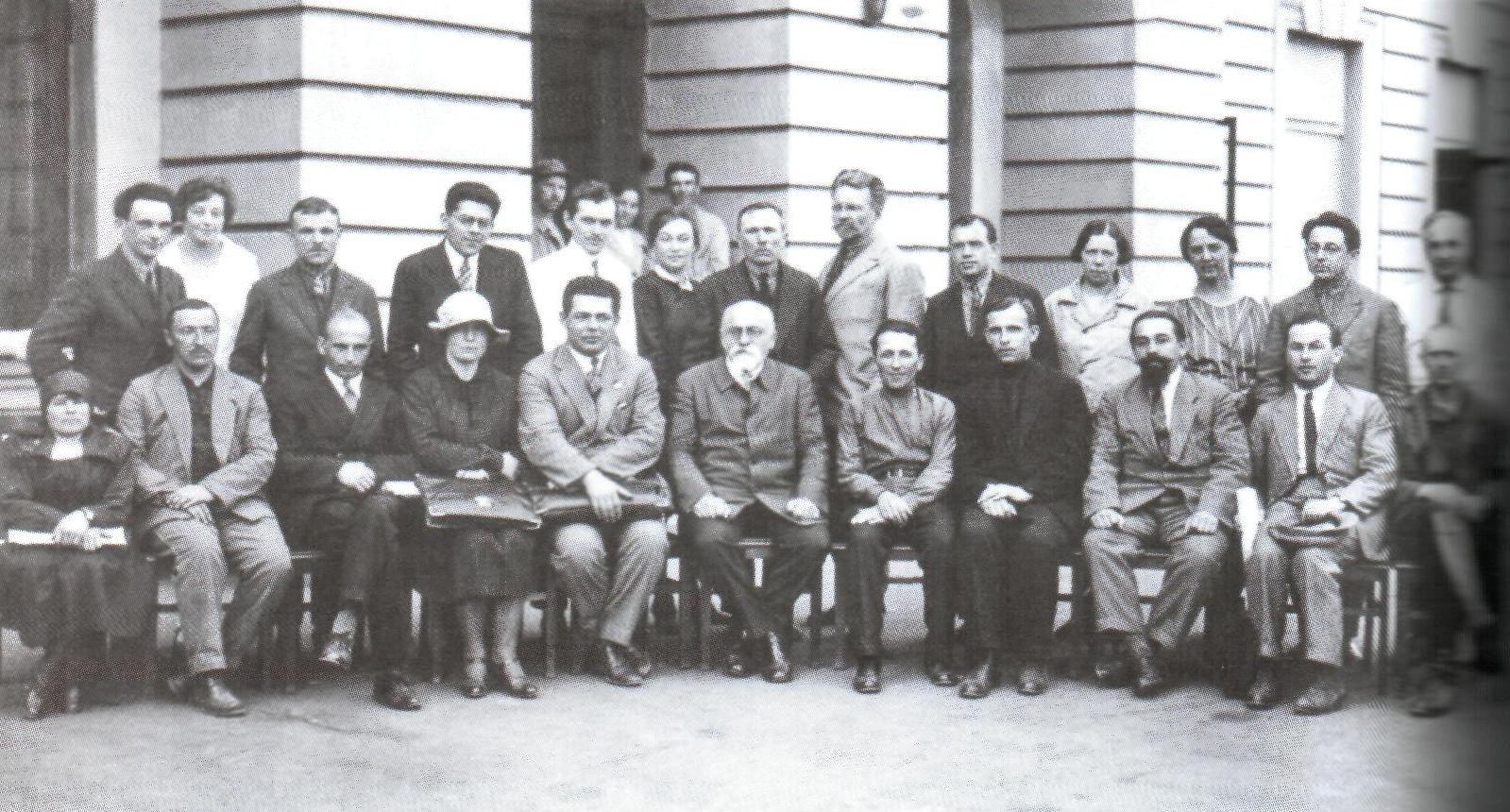
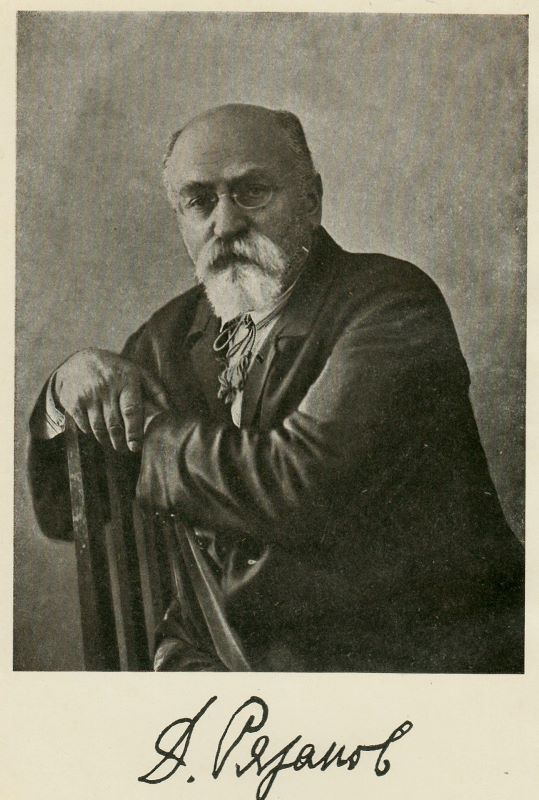
David Riazanov, head of the Marx-Engels Institute which saw to collect, contextualize, and publish the extant workers of Marx Engels, reports to the 5th Comintern Congress on the reasons, efforts, and needs of the Institute, offering a resolution which passed unanimously.
‘Report and Resolution on the Marx-Engels Institute to the Fifth Congress of the Communist International’ by David Riazanov from International Press Correspondence. Vol. 4 No. 57. August 12, 1924.
Riasanov presenteded the following resolution:
“The Fifth Congress of the Communist International welcomes the decisions of the Thirteenth Party Congress of the Russian Communist Party on the necessity of publishing as soon as possible all the works and letters of Marx and Engels with historico-critical commentary. Only an edition of this kind will be a worthy memorial to the founders of scientific Communism, by making a thorough study of the history of the theory and practice of revolutionary Marxism possible for large sections of the proletariat.
“The Congress deems it necessary also to publish, in addition to this international edition of all the works of these leaders, an edition of selected works by Marx and Engels for the proletariat, which must be taken in hand immediately under the supervision of the Communist International. All such editions contain, beside Marx and Engels’ works which are of international importance, also their works dealing with questions which are of particular interest for the proletariat of the relative country.
“The Congress invites all the Parties adhering to the Communist International, as well as individual members, to supply Marx-Engels Institute of the Central Executive Committee of Soviet Union with material bearing on the life and activity Marx and Engels, thereby giving valuable assistance to the Institute. Only with the active collaboration of all communist her parties will it be possible to do justice to such a tremendous task as the publication of the collected works and letters of Marx and Engels, and the preparation of all the necessary material for their scientific biography in connection with the history of socialism and of the labour movement of the 19th century.”
Just a few words in justification of this resolution. The discussion on the programme as well as the interesting discussion in the German Commission on Rosa Luxemburg’s accumulation theory have shown how necessary a thorough study of Marxism is for the young communist generation. We already are running the risk of having in our midst people who know Luxemburgism and Leninism from beginning to end, but who have not the least notion of the a.b.c. of Marxism. This was shown by the discussions. A few short extracts from the works of Marx and Engels will show you how much there is yet to be learned in the school of revolutionary Marxism.
One of the most difficult questions is the link between the peasantry and the proletariat, the question how to make the dictatorship of the proletariat understandable and acceptable to the peasantry. This question was already raised in its entirety by Marx in the following splendid passage: passage: “If we succeed in moving the peasant masses to a coalition with the proletariat, the proletarian revolution will have obtained a choir without which its solo would become a swan’s song in all the peasant nations.”
A great deal has been said about the Marxism of 1848 and 1849 being much more revolutionary than the Marxism after the 49 revolution. I have read such statements even in Communist periodicals. It is for this reason that it is essential to show that the teachings of the revolutionary communism of Marx and Engels were elaborated much more distinctly and more thoroughly on the basis of the experience of the revolutionary years 1848-49, Marx’s classical definition of the dictatorship of the proletariat appeared after the events of ’49–in 1850.
Unfortunately, the present young generation is unable to study because it has not the necessary groundwork for such study. One could say that the old generation too had no such groundwork to go upon. I will give you a few examples. My old Party friend Mehring published the pre-1849 works of Marx and Engels. But this edition was also far from complete. Suffice it to say that until the publication of the “Communist Manifesto” he was not able to represent German ideology as was done by Marx and Engels who dealt with the most reactionary as well as with the most revolutionary digressions of the bourgeoisie. After considerable trouble I have at last succeeded in getting these manuscripts. We have now photographic facsimiles of all unpublished manuscripts by Engels and Marx. In addition to the manuscript on German ideology, we have a number of manuscripts written by Engels in the beginning of the eighties. of the last century, as a supplement of his Anti-Duehring. These manuscripts were hidden in the true sense of the word, for I have ascertained that no one knew of them except Bernstein.
In examining even printed documents, we find that these documents, especially after 1883 were always subject to the censorship of the Party Committee. All of you know that in his introduction to Marx’s “Class Struggle in France”, Engels expressed his opinion on the possibility of barricade fights after the revolution of 1848-49. Bernstein and all others have always asserted that Engels was an opportunist in his later period. I was lucky enough to find the original, and you will presently see what was struck out in it.
“Does this mean that in future street fighting will not take an important part in our struggle? Not at all. It only means that since 1848 conditions are much less favourable for civilian fighters, and much more favourable for the military. Thus, in future, street fights can only be victorious provided these unfavourable conditions are counter-balanced by something else. Therefore, they will be of less frequent occurrence in the beginning of a great revolution than in its later stages. They will also have to be carried on with larger forces. But if this is the case, these forces will probably prefer, as in the French revolution and on September 4 and October 31, 1870 in Paris, open attack to passive barricade tactics.”
The manner in which the case was put to us previously was nothing less than a renunciation of violent revolution, of barricade fighting.
Just one more point. Among Engels’ most important work after the death of Marx is the publication of the Second and Third Volumes of “Capital”. Only those who had something to do with the manuscripts of Marx and Engels can fully appreciate the ccolossal work done by Engels in his old age in addition to his other work for the International. But we suspected long ago that this was by no means all.
And if I tell you that the well-known theories on surplus value are taken from a manuscript which is twice as big, you will understand how many more interesting contributions there are to the question as to who is right, Luxemburg or, let us say Bukharin. To understand theoretically all the laws of capitalist development, it is most important for us to have all the investigations of Marx, who was the first of all the scientific political economists to make an attempt to explain the entire productive process of their society, which they were unable to understand. From this viewpoint, it is most important that we should publish now in this complete edition of Marx and Engels, as a third part, all the manuscripts of Marx without abbreviations and revision, just as Marx gave them himself. For instance, those who have not read or have not understood the book “Herr Vogt”, will never be able to understand Marx’s role in 1860-61 when he prepared the entire Lassalle movement.
Our main task consists in publishing a complete and technically perfect edition in a couple of thousand copies for all big libraries. But we have also another task before us which is not less important. We can hardly expect that an edition of 50 volumes (and there will be hardly less) is within the reach of everyone. We must make a selection of the works of Marx and Engels for every country. This selection will contain all the most important works of Marx and Engels describing all the phases of their development. The first part, the general part must be in the edition for all countries. Then comes the second part, adapted to the national requirements of the various countries.
In the course of the last few years, I have been able to add considerably to our collection of Marx and Engels’ manuscripts, and I shall be very grateful if every member of the Party (and not only the Party) will help us in this work. My request to all Parties is that you send everything (for even what seem uninteresting to you is interesting for us) connected with Ma and Engels to the Marx-Engels Institute through the Comintern.
And there is one thing which I want to impress particularly on the minds of my dear German comrades: that proletariat science differs from bourgeois science in one respect: bourgeois scientists believe that there is nothing higher than their archives, their economic research work. They fail to understand that great and very radical change is taking place in social conditions, that the development of the class struggle is producing new viewpoints and is developing new ideas. They fail to understand the best way to come to an understanding of the whole trend capitalist society is to bury it once and for all. The case is different with proletarian scientists. When there is quiet and some respites they retire to their rooms and study. And in periods of armed fighting they know perfectly well that if the bourgeoisie is overthrown and the dictatorship of the proletariat is to establish science, will have the best opportunity for development. I wish you luck in your revolutionary work, but there is one thing which you must bear in mind-without revolutionary, there cannot be revolutionary practice. (Loud and prolonged applause.)
The resolution moved by comrade Riasanov was carried unanimously.
International Press Correspondence, widely known as”Inprecorr” was published by the Executive Committee of the Communist International (ECCI) regularly in German and English, occasionally in many other languages, beginning in 1921 and lasting in English until 1938. Inprecorr’s role was to supply translated articles to the English-speaking press of the International from the Comintern’s different sections, as well as news and statements from the ECCI. Many ‘Daily Worker’ and ‘Communist’ articles originated in Inprecorr, and it also published articles by American comrades for use in other countries. It was published at least weekly, and often thrice weekly. Inprecorr is an invaluable English-language source on the history of the Communist International and its sections.
PDF of full issue: https://www.marxists.org/history/international/comintern/inprecor/1924/v04n57-aug-12-1924-Inprecor-cpgb.pdf
 Revolution's Newsstand