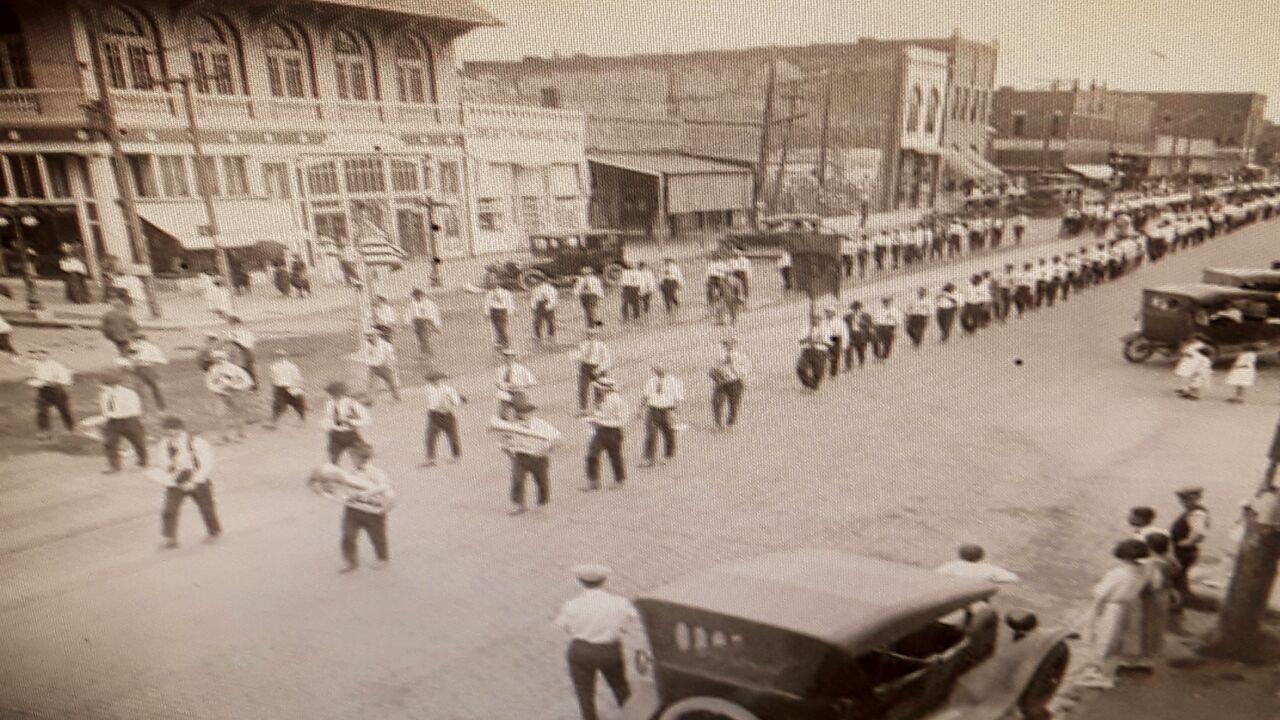
As militant Gastonia workers faced trial for their lives, Verne Smith did a series for the Daily Worker on the history of self-defense and frame-ups in the workers’ movement. Here, he looks at two related events a generation apart; the battles at Verdin and Herrin where southern Illinois’ (so-named Little Egypt because of Mississippi-Ohio River floodplain and numerous Native American monuments) miners defended their strike from the armed importation of scabs resulting in dozens of deaths, and both times in the victory of the miners.
‘Scabs Die in Little Egypt: The Story of Verdin and Herrin’ by Verne Smith from the Daily Worker. Vol. 6 No. 135. August 13, 1929.
SINCE 1898 there has been a feeling in the coal fields of Southern Illinois that a scab has no right to existence. In that year, the miners’ union had just been organized, was fighting for its life, and for the nearest approach to a national contract that has ever been achieved in the industry. The coal operators were importing scabs, part of them Negro miners from Alabama. Some of these men were taken directly from the convict mines of that state, some were lured North by rich promises, and in ignorance of the strike in Illinois.
The Alabama Miners Division of the Afro-American Labor and Protective Association campaigned against the strike breaking; in a conference at Birmingham it passed a resolution: “That we use every effort to intercept the movement of Negro miners from this section to Pana (Illinois), and that we join our efforts and arguments…to relieve Pana mines of all colored laborers carried there and retained there by reason of the strike.”
But the flow of strike-breakers continued. As soon as a carload of Negroes crossed the Illinois line, the car was locked, armed guards posted by railroad and coal companies, and from that moment, the men were prisoners, slaves, unable to quit.
Skirmish at Pana.
On September 28, 1928, [sic, the year was 1898] union miners and 100 “deputy sheriffs” (mine guards) fought a pistol and rifle battle at Pana, with several deaths on each side, and no definite victory.
On October 13, the next month, a train load of scabs destined for the Chicago-Virden Coal Co. mine at Virden, heavily guarded in the usual way, was stopped by armed miners at the Old South Mine, near Virden, and a pitched battle resulted with the mine guards on the train, and those behind the stockade at the mine on one side, and the union miners on the other. Seven union miners were killed, and eight wounded. Five mine guards were killed, and about a dozen wounded. The miners won, completely. The slave train went back the way it came.
“Virden Day.”
National Vice-President John Mitchell and District Secretary W.D. Ryan of the U.M.W.A. were in Pana when the Virden battle started, they came immediately to the scene, and were arrested and held under $200 bond each for “inciting to riot.” There were a few other arrests. Nothing came of them; the coal operators compromised with the union, giving substantial gains to the strikers, Illinois fields were 100 per cent organized, and stayed that way until 1927, when the union was smashed by Lewis’ betrayal. There were strikes again, but never any scabs.

And every year, the miners of Southern Illinois celebrated with parades, brass bands, speeches and festivity, on October 13, “Virden Day.” The commemorated their dead, and promised each other that what these dead had died to win should never be lost. District President Farrington, and his successor, Fishwick, were usually speakers at these celebrations.
But things were happening under cover, in the Illinois Miners Union. Farrington was selling out. He might mouth phrases about the battle of Virden but he was making an agreement with certain mine owners, the Peabody Coal Co. which was later exposed as paying him a $25,000 a year bribe, and according to Lewis, when Lewis and Farrington had one of their periodical spats and told on each other, with other mining companies, particularly the Lester Strip Mines, near Herrin, Williamson County.
When the 1922 strike came Walter Lester, owner of the Herrin mines felt he had authority to proceed to make big money, and break the strike. He had openly received permission from Farrington to use union men and strip the coal, to break it and pile it on the surface. He had, according to Lewis, who ought to know, secret permission to ship the coal.
Imports Gunmen.
As soon as he had 600,000 tons ready to ship, he fired the union men, brought in 45 scabs supplied by the Bertrand scab agency, and 25 thugs as mine guards, supplied by the Hargreaves Corporation, both of Chicago. Lester had a loan from Gary, head of the steel trust, to be used in breaking the strike.
As commander of the guards, and superintendent of the mine, Lester chose a certain one-legged mercenary, C.K. McDowell. A machine gun was mounted on the highest coal pile; shotguns, rifles, and pistols were issued to the guards, and to the office force.
The mine lies on the road from Marion to Herrin. This public highway was blocked by the guards, truck loads of armed thugs patrolled it within and without the barriers, stopping all passers by, searching, insulting and robbing them.
The sheriff came down and commented on the presence of so much loose ammunition around the mine, which violated the Illinois explosives law. McDowell said: “This ammunition is for shooting ducks. I’ve broken strikes before, and I’ll break this one.”
The first scab coal was shipped on Wednesday, June 21. George Henderson and Joe Picovich, with four other miners, came as an official delegation from the Herrin local, U.M.W.A., to the mine to protest the breaking of the agreement not to ship coal. Of course they knew nothing of the district officials’ reason. McDowell turned the machine gun on them as they came up the road, with hands raised, unarmed. Henderson and Picovich were killed, the others jumped into the woods and escaped.
The Virden Tradition.
Then the miners of Herrin remembered Virden Day, which to them was a real tradition, however hypocritically Farrington and Fishwick might view it.
Within half an hour, 500 had assembled. The attack on the mine did not start however, until the next day. In the trial that followed, Herrin shopkeepers testified that committees of miners came and took all the guns in stock during the evening of Wednesday, leaving orders to charge them up to the Herrin local. The miners were arming.
The attack on the well-armed scab-herders at the Lester mine was made with nondescript weapons, collected about the country, but it was excellently carried out. The mine was placed under fire from all surrounding coal piles, and the water supply cut off. There were few casualties on the side of the miners, even though the machine gun was in use continually.
Under the White Flag.
Various forms of treachery were tried by McDowell. He raised a white flag over the machine gun nest. John Conroy and Edna Conroy, witnesses at the trial told of watching from the top of the tipple in another mine, the machine gunner firing rapidly at the miners’ rifle pits in the coal piles with the white flag floating freely above him.
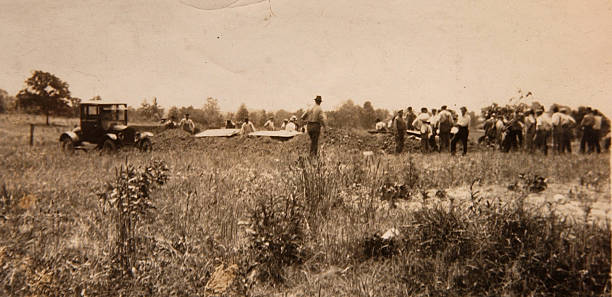
Otis Alexander, a night watchman at another mine, told at the trial how he listened in on the phone when McDowell got in touch with Lester on long distance. Lester told McDowell to hoist a white flag, and get in touch with the union officials, pretending to negotiate a surrender, while using the time to better fortify his men; meanwhile Lester would have troops sent to the mine. The end of the battle at the mine is described by Joseph O’Rourke, commissary clerk supplied by the scab agency as follows:
“I don’t blame the miners for attacking us, for we were knowingly being used as dupes (sic) to keep them from their jobs. We were given arms when we arrived and a machine gun was set up in one corner of the mine. Guards were with us all the time and most of the miners climbed upon the coal piles and earth embankments, and we were unable to see them. The guards kept firing but most of us hid. When the miners blew up our pumping station, we had no water, and the food supplies were in a car in the hands of the miners. About sunrise we put up a white flag, and the miners poured in, and we surrendered our arms.”
The machine gunner was lying dead across his weapon.
About 25 armed miners marched much more than their own number of scabs, and guards, with McDowell and his assistant superintendent, down the road.
The Shooting.
These guards were professional killers, many of them from the coal baronies in West Virginia. To be taken prisoner by the miners, whom they were taught to despise, whom they had spent years arresting, beating, framing up, murdering in cold blood or in armed war, did not at all fit into their idea of how things should go. They made the desperately bad mistake of attempting to overpower their guards and escape, when some confusion resulted from the procession bunching up at a wire fence.
Nobody but a couple of the survivors ever testified as to what happened then, and their evidence is necessarily biased, but the next day, 14 dead scabs were picked up at the fence. Four were found shot in the woods. Six were recaptured, tied together, and taken through Herrin. When they reached a cemetery, something happened again, and they were all shot. One, a professional scab and mine guard, survived. He left a new scab job in a neighboring state to testify at the trial, and said he was shot twice at the fence, five times at the cemetery, and then that somebody cut his throat with a pocket knife. He did have a scar on his throat, but it seemed to be older than the Herrin events.
Mine Doctor’s Story.
The only other witness who actually testified to the shooting at the cemetery, was a doubtful character, a professional company doctor, O.F. Shipman, who insisted that he followed the procession through Herrin, and that the miners let him stand by while they shot the six men without provocation. He admitted he had represented the coal operators and helped defend them from miners’ damage claims in “about 200 cases,” but declared that he “wasn’t prejudiced against the union.” The jury didn’t believe him. The coroners’ jury sat on the cases of George Henderson, and 19 scab and guards, and found that Henderson, “came to his death murdered by bullets fired by McDowell, the mine superintendent,” and that the scabs and guards, “came to death by gunshot wounds at the hands of parties to this jury unknown,” and “as a result of the activities of the officials of the mine.”
Coroner McGowan and Foreman Joe Boringer issued a statement that the verdict of the jury represented the “united sentiment of Williamson County.”
Gompers Helps Prosecution.
Samuel Gompers rushed to the aid of the mining companies with a published statement: “I regret, yes, resent the resort to violence in the Herrin strike. This strike of the miners is on such a high plane of principle it must depend upon the solidarity of action but need not and ought not to fall upon physical force.”
The Illinois Chamber of Commerce howled for the blood of the miners. On August 25 it sent a circular letter to all business men calling for funds to prosecute with. It got the funds. The grand jury of business men speedily indicted 38 miners on four counts. The trial began, Dec. 13, in Marion, with a selected group of the 38 indicted as the first victims; they were: Otis Clark, a local union official; Bert Grace, Joseph Caranachi, Levi Mann, and Peter Hiller. Hiller was a taxi-cab driver, who had been a miner. The others were miners.
D.T. Hartwell was judge. Senator Glenn and the Illinois attorney- general, Brundage, headed the prosecution. Farrington, after fumbling with the case for a time, decided that he had to go through with it, and sent Judge Angus Kerr, the District 12 (Illinois) attorney, as defense counsel. This same Kerr afterwards, while still an employee of the U.M.W., was chief prosecutor of the Zeigler defendants.
The defense took the stand of the coroner’s jury, that the coal company started the battle, and the miners defended themselves. At the same time, it refused to admit that any of the defendants actually on trial did any shooting, and forced the prosecution to try to identify them as being among the group that shot the prisoners during their attempt to break away. The specific death for which they were tried was that of the mine guard Hoffman, killed in the cemetery.
“Ordinary Murder.”
The prosecution’s argument was that this was an ordinary murder, done through a conspiracy of union miners inflamed by a speech by Clark, and that the dead union men really fell during their “criminal attack” on the mine. The prosecution witnesses were practically all of them scab survivors of the battle (four) and business and professional men of Herrin.
The defense witnesses were almost all miners and farmers, eyewitnesses. The defense brought overwhelming evidence that Henderson and Picovich were killed before any fighting started; and that the mine guards had set up a reign of terror in the vicinity. The prosecution avoided this point as much as possible.
There was a clear cut class division between the prosecution and defense witnesses, so much so that the newspapers and the Associated Press were forced to admit it, though bitterly prejudiced against the defendants, and whooping up hatred for them throughout the country in the approved frame up style.
The verdict, rendered January 19, 1923, was “not guilty.” The other charges were dismissed.
The capitalist press simply went wild with enraged hysteria. Brundage issued a statement that the verdict was due to “a condition of terrorism in Herrin.” John Lewis, international president of the union, refused to comment. He had already begun to issue his string of slanders and vilification of “The Red.” Officials of the U.M.W.A. hastily bought out the Lester interests for twice what they were worth, and with Lester thus stopped from exposing his intrigue with these same officials, Lewis began to declare more and more plainly that the whole “Herrin Massacre” was caused by the Communists. He did this even while some of the defendants were still under indictment.
If ever workers stood at the edge of the gallows, these Herrin men did, with treason all around them in the offices of their union. They won, because of the hundred per cent organization of the miners of Southern Illinois, and because these miners had militancy, and the fighting tradition. There were no stool-pigeons. Spies had very little chance to operate. The jury was made up of farmers, who knew the miners, and knew who to believe on the witness stand.
Like Gastonia.
The Herrin case shows many resemblance to that in Gastonia; the company’s reign of terror; the striking back of the workers in open battle; the consistent treachery to the workers of the A.F. of L. officialdom; the defense which is the right of self defense; the automatic grand jury of business men; the desperate attempt of vengeful employers to drag to execution a selected list of workers, without regard to whether they were the ones actually doing the shooting or not; the hue and cry through the capitalist press for conviction; and, let us hope, the solidarity of the working class community with the defendants. This last was what won the case for the Herrin prisoners. If the workers of the South, the exploited textile workers, see their duty to their fellow workers as clearly as the miners of Illinois did in 1922, if the National Textile Workers Union registers in unbroken ranks the amount of determination shown by the hundred per cent organization of the miners in Little Egypt, then the verdict will also be “not guilty” in the Charlotte trial, the Gastonia case.
In Herrin they had an old and solid organization, as far as the rank and file were concerned. In the Gastonia case, there is a new and still unfinished organization. On the other hand, the Gastonia case, in which strikers stood at the doors of their own homes to fight, is better, legally; there is the old common law that “every man’s house (or tent) is his castle.” But the decision will come in terms of organization and support by the working class. The fact that the N.T.W.U. may not be as strong as the union was in Herrin, must be made up for by increased support before the trial for its organization campaign, by increased support by all workers everywhere for the defendants.
The Daily Worker began in 1924 and was published in New York City by the Communist Party US and its predecessor organizations. Among the most long-lasting and important left publications in US history, it had a circulation of 35,000 at its peak. The Daily Worker came from The Ohio Socialist, published by the Left Wing-dominated Socialist Party of Ohio in Cleveland from 1917 to November 1919, when it became became The Toiler, paper of the Communist Labor Party. In December 1921 the above-ground Workers Party of America merged the Toiler with the paper Workers Council to found The Worker, which became The Daily Worker beginning January 13, 1924.
PDF of full issue: https://www.marxists.org/history/usa/pubs/dailyworker/1929/1929-ny/v06-n135-NY-aug-13-1929-DW-LOC.pdf
 Revolution's Newsstand