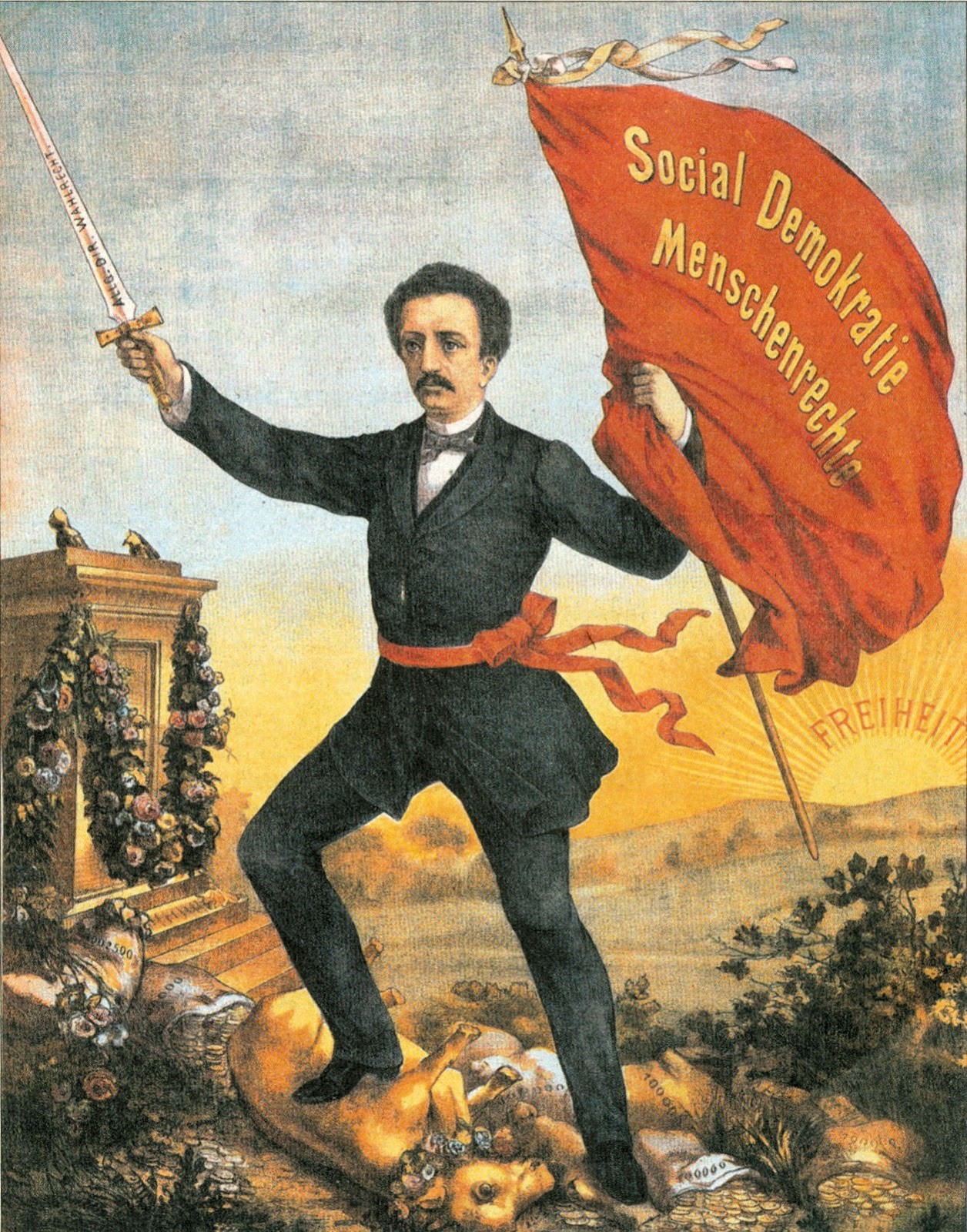
In response to those in the Socialist Party urging the moderation of language, Boudin invokes Ferdinand Lassalle.
‘Hatred and Love’ by Louis B. Boudin from the New York Call. Vol. 4 No. 61. March 2, 1911.
Yesterday I cited the example of Ferdinand Lassalle on a much discussed question of Socialist tactics. I shall do so again today on another mooted point.
We very often hear the complaint made against the more militant Socialist agitators that they don’t make proper use of the gentle arts of persuasion. That they are too combative and defiant; go after their opponents with hammer and tongs, instead of being soft-spoken and insinuating.
In a word, they make plentiful use of “hatred,” and none at all of “love.” It is said that by pursuing such methods of agitation we drive away people of “sympathetic” disposition. whose goodwill and assistance might secure if we only refrained from hurting their tender feelings by our continued show of hatred and use of denunciation.
Only the other day we were reminded by a correspondent of The Call that ours was “a message of love,” and that we ought to take care not to repel those good souls who feel attracted by that “message,” but do not find the “message of love” compatible with the tactics of hatred which we pursue; who would join us in preaching, but cannot join us in fighting.
It is also argued that we cannot expect our opponents to take us seriously and pay any heed to us as long as we come to them as avowed enemies, threatening to get what we want by main force if they wouldn’t give it to us willingly.
In short, we are told, usually by those who extol the beauties of acting along the line of least resistance, that by pursuing the tactics of “hatred.” egging them on with our “fierce denunciations” and the continued flaunting in their face of our threatening attitude, we make it impossible for our opponents to make any concessions. And we alienate the “impartial” and the “sympathetic,” particularly the timid among them who are usually the most loving and lovable, by this talk of that dread “struggle” of ours; by not permitting them to “see the good points on either side” that is, to straddle–and by compelling them to be either with us or against us.
We are reminded of the old saw, that “love conquers the world.” and of the nursery tale about the sun succeeding with its warm rays where the wind failed miserably with his cold, sharp and fierce blasts.
A very interesting question this: What is the relative value of Love and Hatred in the affairs of this world in general and of the Socialist movement in particular? I shall not undertake here to decide this very interesting and very perplexing question, but I shall cite an authority. Authorities have their uses, particularly when one does not know any better way out.
As the clever reader may have guessed already, the authority I shall cite is Ferdinand Lassalle.
There lived once upon a time a man whose name was V.A. Huber–Protessor V.A. Huber–and a good old soul was he. He was a man of the greatest moral integrity and the highest standard of ethics; a good, conservative Christian man. He was full of love for the human family in general, and the poor downtrodden working class in particular. So he devoted some twenty years of his mature life to the service of his fellow men of the working class.
Preaching to other good conservative Christian men their duty toward the poor workers; spreading the “message of love” with all the gentleness of his good loving heart; and arguing and demonstrating in scholarly works (for a great scholar was he), written in highly proper, scholarly, and inoffensive language, the propriety and necessity of diverse measures of social amelioration.
But he didn’t succeed much, for some reason or other.
Then came Lassalle, with his storms and his thunder. It was quite natural that the gentle Huber should not like Lassalle’s methods. But Lassalle had a lingering admiration for the good honest soul of the old scholar, and so he tried to explain to him. The good old gentleman had said, among other things, that Lassalle didn’t succeed much with his new methods of turbulent mass agitation. Lassalle’s answer to this is characteristic:
“When you compare,” he says, “the two of us–yourself and myself–you can see how practical this (mass agitation) is. Really, how long have you played, with the most touching love, and the greatest zeal, the part of the preacher in the desert of your party? To what use? I, and a dozen others, for whom your writings were not intended, have learned to love you from your writings. That was all. Nobody paid any attention to you, and the organs of your own party tried to kill you by silence.
“Now, look at me. My agitation has lasted only nine months; and, lo and behold: the question has become the general order of the day. The whole world is interested, at least up to a certain point. It may not have penetrated their brains as yet. but it has reached at least their ears, which is the first step. And each paper of your own party has taken at least twenty-seven times as much notice of my agitation in these nine months as all of them put together have taken of yours in all these many years.
“And why? Why, simply because I appeared with angry mien and threatening attitude; because they attributed to me and still attribute the most harmful intentions, and it is only such that people care anything about. I shall, therefore, be careful not to disillusion them on this point. Therein lies the best part of my power! It is true that this is very often inconvenient for me personally. From the evil intentions which people ascribe to me there bloom for me charges of high treason–one of which I have now on my hands–and other criminal charges, of which I now have to face not less than five. But for the cause it is very good. The world as a whole is more susceptible to fear than to sympathy and love!”
The New York Call was the first English-language Socialist daily paper in New York City and the second in the US after the Chicago Daily Socialist. The paper was the center of the Socialist Party and under the influence of Morris Hillquit, Charles Ervin, Julius Gerber, and William Butscher. The paper was opposed to World War One, and, unsurprising given the era’s fluidity, ambivalent on the Russian Revolution even after the expulsion of the SP’s Left Wing. The paper is an invaluable resource for information on the city’s workers movement and history and one of the most important papers in the history of US socialism. The paper ran from 1908 until 1923.
PDF of full issue: https://www.marxists.org/history/usa/pubs/the-new-york-call/1911/110302-newyorkcall-v04n061.pdf
 Revolution's Newsstand