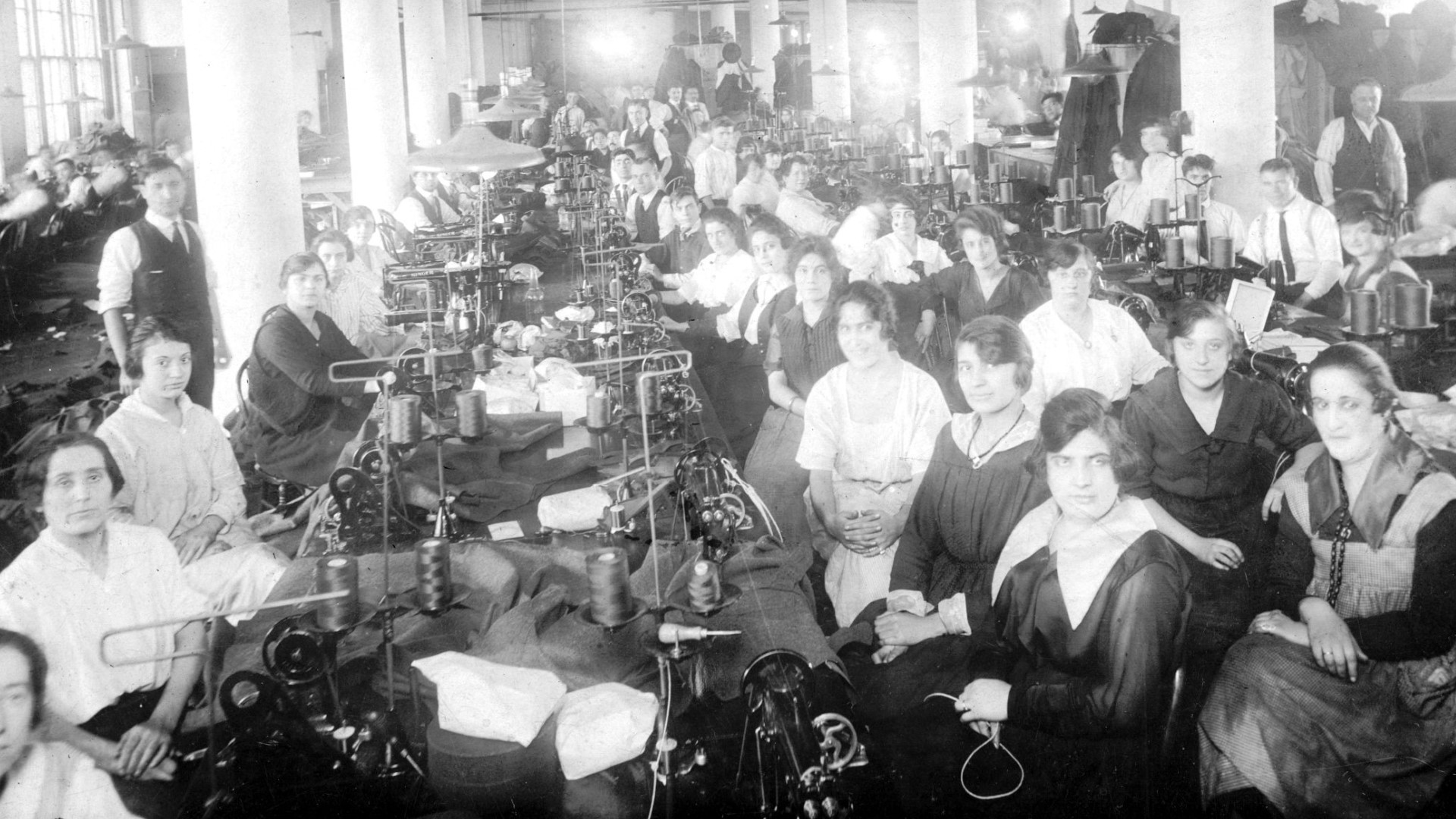
The story of how a powerful, progressive local union was built; Full Fashioned Hosiery Knitters Union of Philadelphia, Local 706 of U.T.W. of A.
‘Here’s a Union For You’ by Gustave Geiges from Labor Age. Vol. 13 No. 8. October, 1924.
DURING the month of November, 1909, twenty-five full fashioned hosiery knitters held a meeting in the Lighthouse Building in Philadelphia, for the purpose of forming an organization. The thought in the mind of all was to advance the interest of the workers individually and collectively. By a unanimous consent of those present, it was decided that they ask for a charter, which was granted by the United Textile Workers of America. We were chartered as the Full Fashioned Hosiery Knitters Union of Philadelphia, Local 706 of U.T.W. of A.
In the early stages of our Union, the employers were very prejudiced against any form of Organization on the part of our workers. This made it a rather difficult task to increase our members. Slow but sure. Along about 1913 and 1914 we had our first real test as a trade union Organization.
At this time the members working in the Peerless and Minora Shops were called out on strike because of the unfair attitude of the men in charge of these plants. Both of these strikes were long-drawn-out fights, lasting for many months. The Minora Shop went out of business about two years after the strike was called and the Peerless Shop has done practically nothing up to this day. Along about 1915 we were forced to face an issue which seemed insurmountable at that time. Our members differed as to the form of Organization and the question of affiliation. We had a divided house. Instead of one united Organization, we had two separate groups, both antagonistic toward the other.
In 1919 we had a general strike which involved practically all of the shops in Philadelphia with the exception of a few independent manufacturers who had agreed to meet our terms. After a thirteen weeks strike we succeeded in establishing the 48 hour work week in the full fashioned hosiery industry in Philadelphia, and in addition to the shorter work week we succeeded in receiving an approximate 20 per cent increase in wages. During these years we were instrumental in overcoming many conditions that were detrimental to the workers, such as a knitter operating two footers, apprentices going on machines after having served their apprenticeship term, received the low rate of $9.00 per week instead of the piece work rate which they were entitled to.
In many cases the foreman would receive the entire amount paid for operating as high as four machines, and he in turn would pay the apprentice just whatever he pleased. These apprentices would do practically all of the work and were held responsible for the work that was turned out on the machine in question. Up until October of 1918 practically 75 per cent of the knitters operating leggers were operating two machines, but due to the determined stand taken by our members against the operation of two machines, we have succeeded in reversing the figures, so that today 75 per cent of the legging machines are being operated as single machine jobs, while only about 25 per cent are being operated as double jobs. We were also successful in securing full pay for all apprentices going on machines for themselves and have eliminated entirely the operation of two footers by any one knitter.
The Big Test
During the year of 1921 our members had to face the most critical period in the history of our Organization. Up until this time we had been doing business with the Full Fashioned Hosiery Manufacturers Association. Representatives of the organization would meet the representatives of the employers and would enter our agreement in regards to conditions and wages that were binding to employee and employer alike. But without any consideration for the workers of the industry, the employers posted notices in all of the associated shops notifying the membership that on and after January 11, 1921, all employees would have to accept a 15 per cent reduction In wages. Most of the employers refused even to recognize a committee of their own men. Under no consideration would they meet the representatives of the organization. We had very little money in our treasury, but never-the-less we decided to fight against what we believed to be an attempt on the part of the employers to destroy our organization.

The employers in taking this unfair sand, did something for the workers of our industry that we ourselves could not accomplish. ‘They united both factions into one solid fighting group. Up until this time the one group known as Local 706 fought their own battles in their own way and the other group known as Branch 14 of the American Federation of Full Fashioned Hosiery Workers, decided the policies of the latter organization. Both group now realized that the very life of the workers was at stake. The representatives of both organizations held a number of meetings, and finally decided that they were going to share one another’s burdens, fight shoulder to shoulder as a solid unit. The members working for the employers that refused to take unfair advantage of the workers, assessed themselves to the extent of 25 per cent of their wages. But the members working were in such a small minority, that we were unable to pay strike pay until the first week of May, 1921.
Most of the members involved in this strike were laid off during the month of June, 1920. The strike was called on the second day of January, 1921. The members on strike were thus out of work actually ten months before they received one penny strike pay. The sacrifices made by the strikers up to this time will linger forever in the memories of all who participated in this fight. The first strike pay that was paid to the strikers amounted to $11.00 for married men, $7.00 for single men, and $4.00 for boys and girls. This was gradually increased up to $22.00 for the married men, and the strike pay of the others was increased proportionately. There is no need mentioning the tactics used by the employers during this strike. As in all other strike situations, the employers left no stone unturned in their effort to break the moral of the strikers. The mills were filled with scabs, which later proved a very costly proposition to the employers, because practically all of them were incompetent. There were very few desertions in our ranks and as a result the employers were dependent almost entirely upon unskilled help.
Union of Unions
During the latter part of October, 1921, a joint meeting was held of representatives of employers and employees. At this meeting an agreement was made whereby every striker was to return to work on his or her job, or the equivalent, under the same conditions as prevailed previous to the strike taking place. After the strike was over, the members of the two factions decided that it was about time to get all of the workers into one solid organization. After having held several meetings it was decided that on May 1, 1922, we would amalgamate into one organization—this was agreed to by a unanimous vote of the members of both organizations.
Through the amalgamation, we became known as Local 706, Branch No. 1, of the American Federation of Full Fashioned Hosiery Workers, affiliated with the United Textile Workers of America. Through the latter body, we are members of the American Federation of Labor.
The Union owns a building which is clear of all debts. This building was almost entirely destroyed by fire in the month of February, 1920, but the determination of our members to go forward was again manifested (not by talk but by deed). They decided to assess themselves in order to reconstruct the building, which lay practically in ruins. The cost of reconstruction amounted to over $50,000 and we believe that there is no local union in the entire country that has a finer and more up-to-date building than we, the local organization of Full Fashioned Hosiery Knitters possess in the city of Philadelphia.
Owing to the tremendous sacrifices made by our members in the past we decided to levy an assessment in order to prepare for the future. As has been stated, the members working during the strike of 1921 assessed themselves 25 per cent., and ever since January, 1921, the entire knitter membership have been paying assessments varying from 20 per cent. to 25 per cent.
In addition to paying their dues and assessments, they have assisted financially many of the individual members who were in distress because of sickness or some other unavoidable accident. We have started what could be termed a Co-operative Insurance Co., known to our members as the Hosiery Workers’ Protective Association. Every member agrees in writing to contribute $1.00 through the Secretary, to the nearest relative of any deceased member. This is an entirely voluntary proposition and only those who are members will derive benefits from the Association. We honestly believe that our success as a labor organization has been due to our consideration and thoughtfulness of others. We have never failed to respond to an appeal that was worthy of support, whether members of our organization or any other organization.
Helping Each Other
In addition to the many features that have been mentioned, we are very much interested in the educational work that is being conducted through the medium of the Trade Union Movement, having had a class studying economics during this year. Last but not least, we are in favor of Progressive Political Action as agreed upon by the C.P.P.A. in the Convention in Cleveland on July 4th. We hope that those who read this article will be inspired, because we believe that where there is no vision, life becomes merely a chance, but where there is vision, along with courage and conviction, life becomes a reality and a factor in molding even the destiny of nations.
Labor Age was a left-labor monthly magazine with origins in Socialist Review, journal of the Intercollegiate Socialist Society. Published by the Labor Publication Society from 1921-1933 aligned with the League for Industrial Democracy of left-wing trade unionists across industries. During 1929-33 the magazine was affiliated with the Conference for Progressive Labor Action (CPLA) led by A. J. Muste. James Maurer, Harry W. Laidler, and Louis Budenz were also writers. The orientation of the magazine was industrial unionism, planning, nationalization, and was illustrated with photos and cartoons. With its stress on worker education, social unionism and rank and file activism, it is one of the essential journals of the radical US labor socialist movement of its time.
PDF of full issue: https://www.marxists.org/history/usa/pubs/laborage/v13n08-oct-1924-LA.pdf
 Revolution's Newsstand