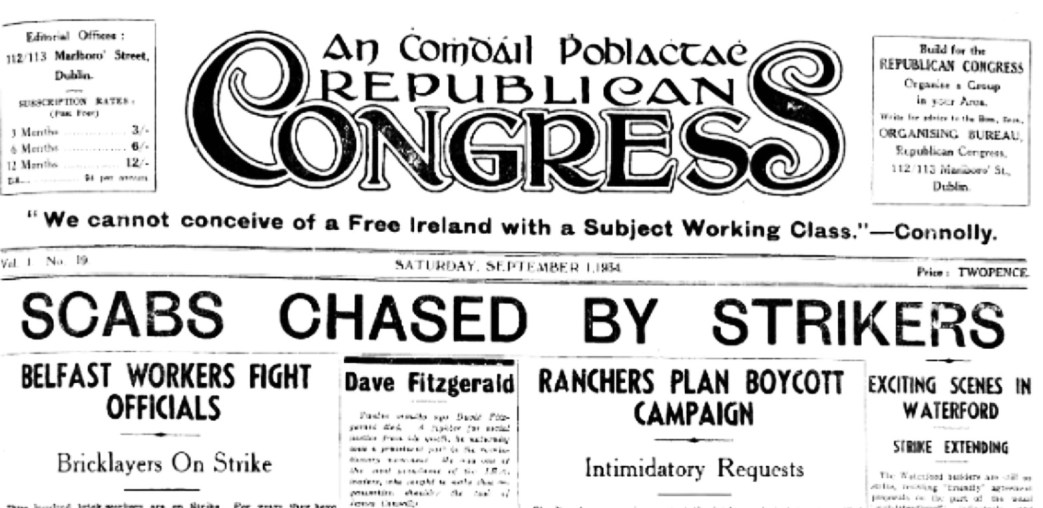
In an echo of the Civil War a decade previous, Ireland in the mid-1930s saw confrontations between Republicans and fascist Blueshirts. Uniting with Communists, the a left wing in the I.R.A. split to form the Republican Congress in 1934. Though short-lived, Congress remains a point of reference for the Irish left and socialist Republicans.
‘The Irish Republican Congress’ by James Shields from International Press Correspondence. Vol. 14 No. 51. September 28, 1934.
“The unheard-of poverty and torment of the Irish peasants is one of the most instructive examples of the lengths to which the landlords and liberal bourgeoisie of a ‘ruling nation’ will go.” (Lenin.)
Many years have passed since Lenin wrote the above words concerning the oppression of Ireland by the British ruling class. To-day we are now witnessing further examples of the terrific lengths to which British imperialism is prepared to go in order to try and keep its stranglehold on the masses of Ireland.
For the past two years it has been waging the most savage economic warfare upon the Irish Free State. Along with this it is openly instigating and supporting those menacing forces which are striving within Ireland to establish a fascist regime–the Blueshirt fascist movement. The latter is the agent and tool of the British imperialists, with whose help it hopes to be able to enforce submission of the Irish masses to capitalist Britain’s dictates.
Through ruthless economic blockade, supplemented by the efforts of its Blueshirt allies, British imperialism seeks to carry out the aim of starving and terrorising the Irish workers and toilers, and so crush the revolutionary struggle which is directed towards securing the unity and complete national independence of Ireland.
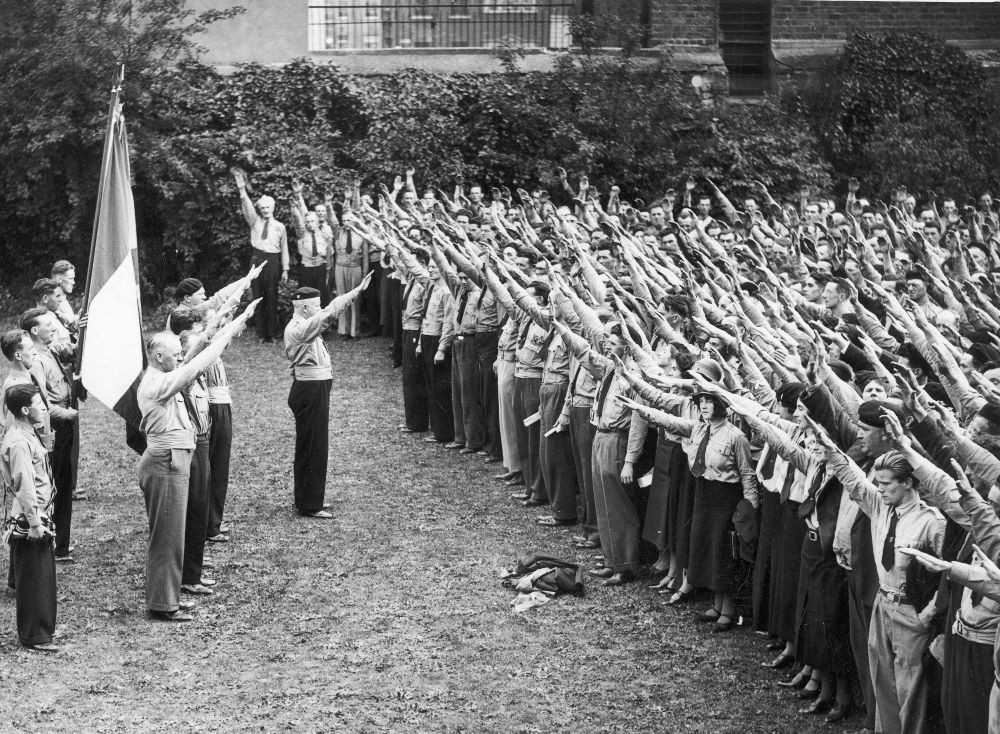
A reflection of the lengths to which it is going in its attempt to strangle the trade of the Irish Free State is illustrated by the following figures.
Trade returns of the Irish Free State for the first six months of the present year as compared with the corresponding period of 1931 (the year before the economic war was begun) show that exports and re-exports have fallen from £17,161,856 to £8,821,021, that is, a drop of nearly 50 per cent.
Imports have fallen from £25,083,055 to £19,627,372–a drop of nearly 22 per cent. In the sphere of livestock exports, the fall has become particularly marked. These have dropped from £8,018,547 in the first six months of 1931 to £2,761,865 this year, or a decline of over 66 per cent.
As a consequence of this trade war new and added burdens are being placed on to the shoulders of the Irish workers and toilers. Mass poverty and unemployment are being accentuated.
The “Daily Telegraph,” press organ of the British imperialists, records its evil glee about this. It gives voice to its satisfaction at the possibility of the stoppage of poor relief payments by the County Councils owing to growing financial difficulties, stating: “The County Councils are now faced with a crisis. It is the lost export trade with Britain which has precipitated the present crisis.” (“Daily Telegraph,” August 13.)
But the offensive of British imperialism is encountering a growing resistance on the part of the masses of Ireland. In the ranks of the Irish workers and poor farmers a wave of mass struggle is rising, and this struggle is growing in intensity and volume as the whole trend of events dissipates the illusions which were largely entertained regarding the role of the De Valera government.
The De Valera government, as the Irish Communists have long pointed out, is a capitalist government whose main concern is to protect and advance the interests of the Irish manufacturing capitalists. It is thoroughly demonstrating this to-day by its attitude in relation to the struggles of the Irish worker and poor farmer masses.

Far from leading a vigorous struggle to bring about Ireland’s national liberation, the De Valera government is holding back the mass fight against British imperialism. Aiming at strengthening the interests of the Irish national capitalists whom it represents, it is endeavouring to utilise the anti-imperialist hostility of the Irish people in order to win certain economic and fiscal advantages for Irish capitalism whilst at the same time it directly proceeds to an intensification of the attack upon the Irish masses themselves.
Throughout the ranks of the workers and poor farmers in Ireland the recognition of this is growing and dissatisfaction and active discontent is becoming widespread. More and more is the realisation growing that if the struggle of the Irish masses for national independence is to be successful, then it can only become so to the extent to which it breaks through the shackles being imposed upon it by De Valera.
In recent months the fight of the masses of Ireland in this respect has been undergoing big development. In sharp opposition to the tolerant and encouraging attitude of the De Valera government in relation to the Blueshirt fascists, the Irish workers have been increasingly demonstrating their hatred and hostility towards these tools of British imperialism. In town after town the Blueshirts have been driven off the streets.
In Cork, where Blueshirt influence is reckoned to be relatively strong, during the recent conflict which arose between Blueshirts and police over a cattle sale, the workers of Cork seized the occasion to give battle to the hated Blueshirts and quickly forced them to retreat.
Similarly in Dublin. On the occasion of the recent Blueshirt national congress, crowds of workers assembled in the street outside the hotel where Blueshirt delegates were staying and then proceeded to storm the building. Lorry-loads of police were hurriedly rushed to the spot to protect these fascists from the workers’ anger.
The terrific mass hostility which the Blueshirts are encountering has greatly alarmed the main promoters of this movement, and has resulted in growing internal dissensions within its ranks on matters of tactics and policy. Its inability to make the head- way that was anticipated has now ultimately led to a split in its leadership and General O’Duffy has been forced to resign. His place has now been taken by Commandant Cronin, who was previously O’Duffy’s chief lieutenant, and who, his masters anticipate, will more capably exercise that skill which O’Duffy lacked in advocating a type of specious demagogy which is calculated to disarm the masses with regard to fascism’s real intentions, make its programme appear more attractive, and avoid the errors of what Blueshirt elements of the type of Professor Hogan described as the “hysterical leadership” of O’Duffy.
It is not only in the sphere of struggle against the Blueshirt menace that the growing fight of the Irish masses has been energetically expressing itself. A rising growth of the economic struggle has also become manifest. This is evidenced by the long and stubborn strike of the Dublin printers for wage increases, the strikes which have taken place amongst seamen, dockers, transport workers and other sections, the growing activity of the unemployed, the resistance to tenant evictions, etc.
All this is sharply indicative of the rising ferment now going on in the ranks of the Irish masses, and demonstrates how the revolutionary mass struggle is beginning to sweep more powerfully to the forefront. As it continues to grow and develop, the stronger becomes the urge for uniting the whole of the mass forces of the workers and poor farmers in a mighty campaign which will drive decisively forward towards the establishment of the unity and complete national independence of Ireland.
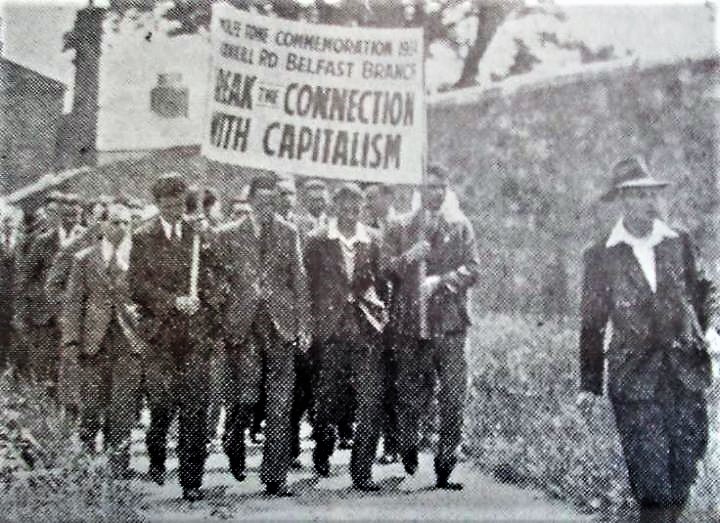
In this connection great importance is attached to the Republican Congress which is to be held in Dublin on September 29 and 30.
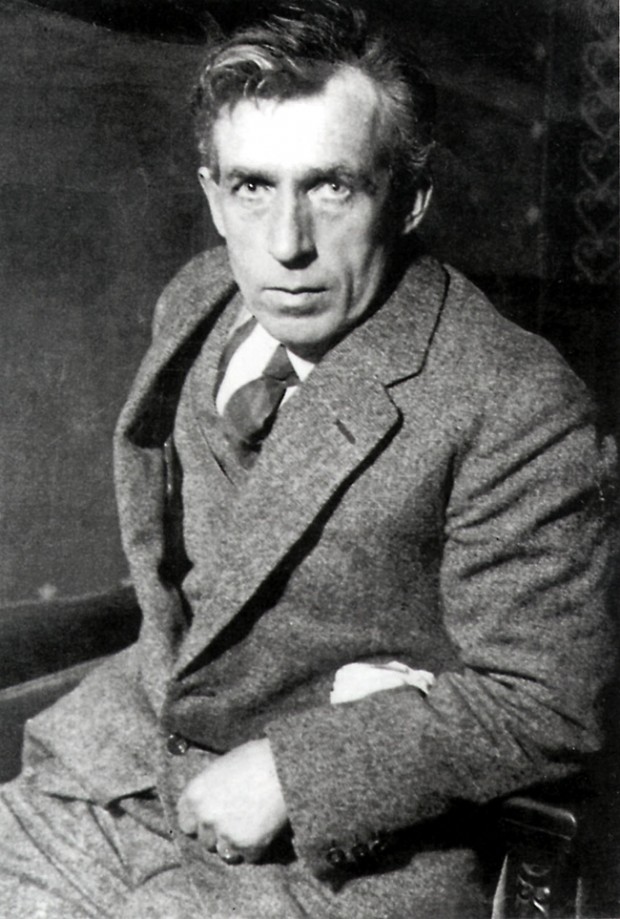
This Congress is receiving wide support from working-class and republican organisations throughout Ireland, in the North as well as the South, and delegates from all parts, from the Irish Communist Party, trade unions, and numerous other bodies, will participate in its proceedings. Amongst the sponsors of the Congress are a number of well-known republican fighters who formerly belonged to the Irish Republican Army, but have since broken away from the latter on account of its policy of tailing behind De Valera, and its failure to assist in mobilising the Irish masses in their struggle. These include Michael Price, George Gilmore, Peadar O’Donnell, Frank Ryan, and a number of others.
When the manifesto calling for the Congress was first issued in April last, the Irish Communist Party welcomed the proposal and declared:
“The Congress must be the starting point of a nationwide struggle based on the immediate issues confronting the working masses for the winning of national freedom and the establishment of the united Republic of the workers and farmers.”
Since that time the campaign in support of the Congress has gained increasing support, testifying to the mass feeling in favour of making this Congress a real effective beginning for launching the widest united front campaign which will bring in the employed and unemployed workers and the masses of poor farmers into the fight as never before.
The alarm at this development which is felt by British imperialism has been voiced in its organ, the “Daily Telegraph,” which has made a very sharp attack on the Republican Congress, declaring “its principles are the crudest Communism, the dictatorship of the ‘have nots'” and urging and urging “whatever influence the Church can exercise must certainly be used against this new Communist army.”
It is clear that what the “Telegraph has in mind is the powerful challenge to British imperialism which this Congress can be the means of raising if it takes up the task of uniting the Irish masses for determined struggle in support of the unity and in- dependence of Ireland, on the basis of the issues immediately facing the workers and poor farmers.
The attention of the Congress delegates, as has been pointed out by the Irish Communist Party, should be concentrated upon this and the steps which require to be taken in order to develop such a campaign. This requires to be emphasised, as some circles in the Congress Organising Bureau are proposing that the Congress should become a platform for the organising of a new political party. Such a proposal, if treated seriously could only put further obstacles in the way of obtaining that wide unity of action of all anti-imperialist forces in Ireland, which is now so necessary, and would hinder instead of help forward the fight. Any attempt to bring forward this line should be strongly combated.
The role of the Congress should be to discuss the political issues facing the Irish masses and how to secure the widest and most effective forms of united front activity on these for develop- ing mass action everywhere.
With this clear, it is obvious that the Congress should throw up a powerful Campaign Committee charged with the task of carrying out the drive for the united front demands which it will formulate, in every part of Ireland.
In this way the whole struggle against imperialism and its fascist agents in Ireland can become enormously strengthened, the fight against capitalist reaction successfully extended, and the way flung open for a mighty forward drive which will lead to the abolition of the imperialist border, to a united independent Ireland.
PDF of full issue: https://www.marxists.org/history/international/comintern/inprecor/1934/v14n51-sep-28-1934-Inprecor-op.pdf
 Revolution's Newsstand