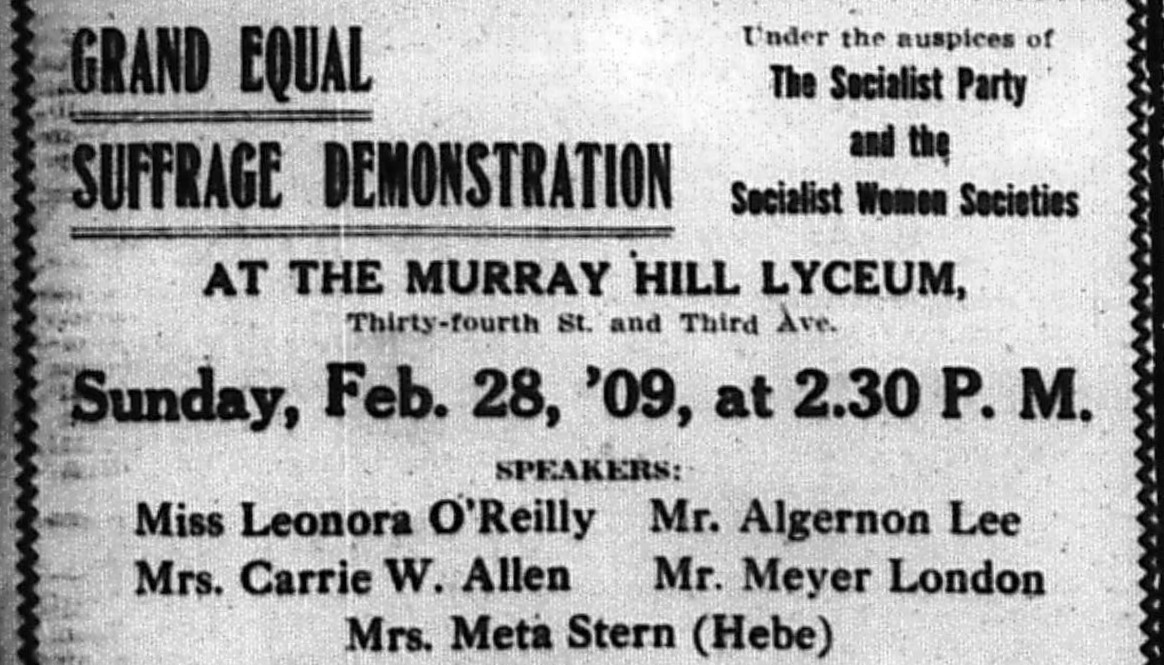
Where International Women’s Day began. The Women’s Committee of the Socialist Party (Antoinette Konikow, Meta L. Stern (Hebe), Theresa Malkiel, Winnie Branstetter and May Wood-Simons) called for and won endorsement from the National Executive for a formal suffrage campaign by the Party around the 1908 Presidential elections. That campaign culminated in demonstrations and meetings held on February 28, 1909. Centered on New York City, but held in a number of cities, the report from the Committee on their activities to the International Conference of Socialist Women held the following year inspired the creation of the first International Working Women’s Day. First called to be held March 19, 1911, on the 40th anniversary of the Paris Commune, while the U.S. kept its February date. A few years later, March 8 would become the date on which it was celebrated. Here is a report from those February 28, 1909 meetings held in a half dozen New York City locations.
‘Suffragists and Socialists Demand Votes for Women’ from The New York Call. Vol. 2 No. 51. March 1, 1909.
Workers of Manhattan, Brooklyn, Queens and Yonkers Unite with Those of the Entire Nation in Stirring Demonstrations for Equal Rights.
In accordance with a request made by the national committee, the Socialist party all through the country yesterday afternoon gave demonstrations to the woman suffragists, and held many meetings at which the principles of equal rights were explained and votes for women were demanded. In this city the principal meeting has held at Murray Hill Lyceum, at 34th street and Third avenue, with an enthusiasm that foretold an active and energetic campaign and successful results. The two wanting numerically, but two thousand people who were present were alive to the principles of equal rights and gave much spiritual encouragement to the workers in the movement. The speakers were frequently applauded, and the arguments were greeted with a boisterous approval. There were four women and two men speakers, and each spoke with a sincerity that filled the audience with enthusiasm and appreciation.
Miss O’Reilly Scores Antis.
The one who made the strongest appeal for her sisters was Miss Leonora O’Reilly. She was introduced by the chairman of the meeting, Mrs. Meta L. Stern, whose literary name is “Hebe,” as “the woman who we to Albany with the suffragists, and who was responsible for the phrase, “We do not want the ballot, we need it.” A phrase that will become the slogan in the working woman’s ballot for the right to vote,” said Mrs. Stern. O’Reilly was simply attired, modest in appearance, and unassuming in her manners. But no sooner did she begin to speak when her voice, her face, her very personality, told of a sincerity that won admiration. She gained the audience with the beginning of her first sentence. In addition to her sincerity she is eloquent and humorous. In simple words, but in a decided tone, she hit hard at her opponents, and said words that impressed the most obdurate.
Albany Meeting a Farce.
She began her address by telling of the hearing in Albany last Wednesday, she did not know what to call that meeting. She was not sure whether it was a comedy, a tragedy or farce. She quoted one anti as saying that what was wanted was not an extended franchise, but a restricted one.
“Now, is it not time for you men.” said the speaker, “to consider the significance of these words? This demand will be made and carried out as soon as it will be realized that you want more than they care to give. The restrictions will be made. First it will be an educational qualification, then a property qualification, until the workingmen will be disfranchised, and only the idiots who support the ruling class will be left to do the voting.” “One woman, she said, “spoke on the fallen woman, and called the attention of the Senators that she would vote. But she did not mention the fact that her companion is allowed to vote.”
After reviewing the political situation of today she said in a low voice: “You men made a mess of it, and you know it. Your political house needs cleaning, and a man is not earthly good when it comes to cleaning: let us do it.”
Speaking of the suffragists who are jailed, she said she wished they would jail her. “But then there would be so many jailed with me,” she said, “that all the jails would be packed. Nay, you would have to build new ones. In such event I would like you men on the outside to see to it that the jails equipped with modern improvements so that they be fit for schools when we get the vote.” (Tremendous Applause.)
Socialism Stands for Suffrage.
Mrs. Stern made a strong speech in which she explained that Socialism stands for woman’s suffrage. “Every Socialist is in favor of women’s suffrage,” she said. “because Socialism stands for true democracy, and true democracy is impossible without equal rights. Every man who the Socialist ticket is in favor of woman’s suffrage, and at the last election 423,000 voted for it.”
She gave an outline of woman’s place in the industrial field, and said that she who contributes to the wealth country by producing commodities should be allowed to participate administration of the community which she so usefully and faithfully serves.”
Meyer London and Algernon Lee, editors of The Evening Call, were the two men who addressed the meeting.
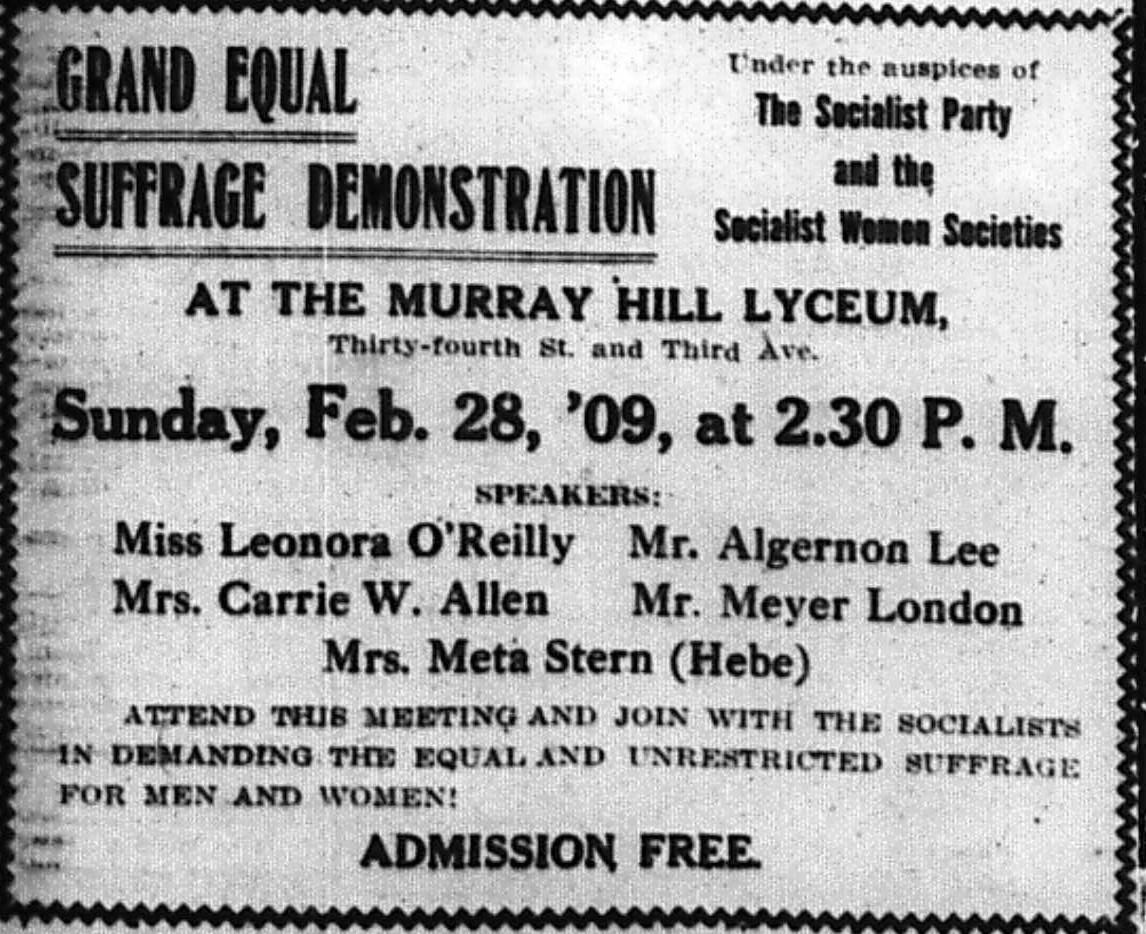
Mr. Lee explained that since its very existence the Socialist party was pledged to the cause of woman’s rights and said that the National Executive Committee had decided to carry on the campaign for equal suffrage with great energy. He gave a history of the class struggles and class exploitations, and showed that there always existed a controlling class that ruled mankind. He spoke on the industrial and economic evolution that brought the race to the state under which a movement for equality became possible.
No Sex Distinction.
“The capitalistic society has wiped out sex distinction.” he said, and a woman has now the right to own property. She has the right of a man. The rich woman has the right of the rich man; the capitalist woman is a capitalist. But it is the working woman who is deprived of her rights. Capitalism has destroyed the home and forced her from her fireside into the factory, and it is for the men as well as the women of the working class to make an organized effort for universal right and industrial and political equality.”
He explained that it was not a question whether woman suffrage was expedient, but it was inevitable, and the sooner we have it the better.
Mrs. Carry W. Allen spoke on the relation of woman suffrage to Socialism, and said that while woman suffrage stood for political freedom Socialism stood for both economic and political freedom.
“It is impossible to haves Socialism without woman suffrage.” she said. “In this battle for freedom democracy is the first demand; without democracy the demand for freedom is a farce.”
Meyer London made a witty speech in which he flayed mercilessly the antis who went to Albany to advise the lawmakers not to give freedom to their sisters.
The Woman of the Dog Show.
“She who opposed woman suffrage is the same woman who attends the dog show, horse show, automobile show, cat show, and other shows. And I can imagine the kind of a show they made of themselves in Albany,” said the speaker. He disapproved of the suffragists going to Albany to ask for the right to vote.
“I like the ways of the London suffragettes,” he said. “They fight for their rights. This is the way to do the only thing to do, because you cannot argue with them.”
“Go down to Albany if you want, but do not give them any logic. Hammer at the table and say: Cheap politicians, second-hand lawyers, ex-saloonkeepers, give us our rights,” stormed the speaker.
The house went wild with applause as he gave this piece of advice. He then poked fun at Elihu Root. who expressed himself against suffrage because it would destroy the sanctity of the home.
“Root is a polite man,” he said “When he will meet a lady in the car he will tip his hat and offer a seat. But he will not make a law that will provide a cent for a woman who works for ten hours a day in a factory. They speak of the sanctity of the home,” he said, “but they take our children out of the home and send them to the shop.”
Mrs. Anita Block opened meeting and explained the purpose and the aim of the demonstrations. She, with Mrs. Stern, represented the Women Socialists of New York.
The Brooklyn Meeting.
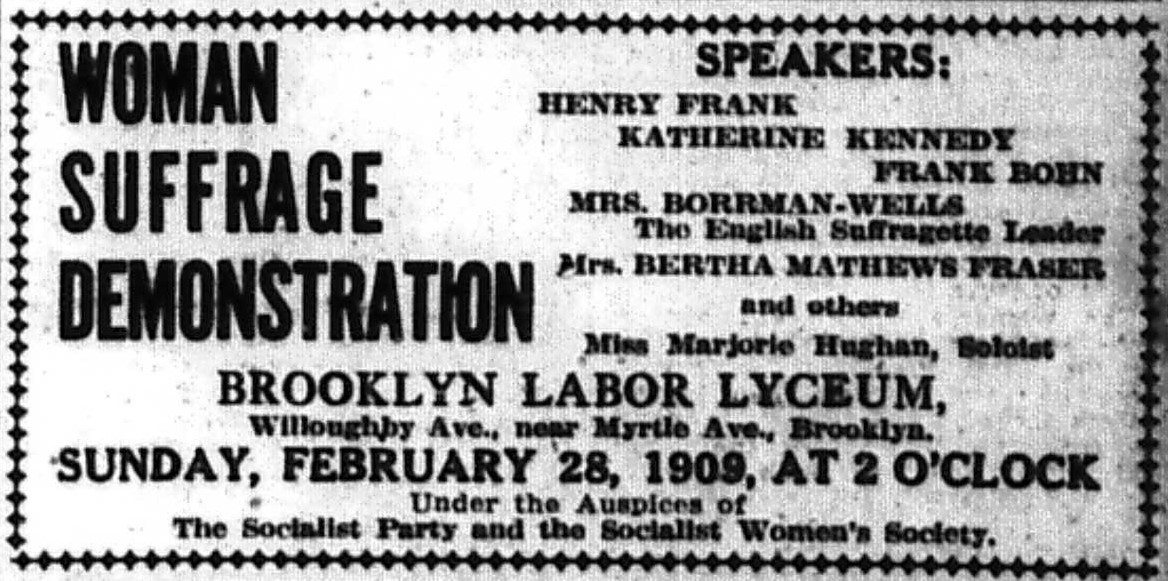
In Brooklyn a thousand enthusiasts filled the main hall of the Labor Lyceum and heartily cheered the eloquent speeches in behalf of votes for women, delivered by Mrs. Katherine Kennedy, Mrs. Priscilla Hackstaff. honorary president of the Political Equality League: Henry Frank, Frank Bohn and Mrs. Bertha M. Fraser who presided. A rousing woman suffrage song, well rendered by Miss Marjorie Hughan, and a recitation, “The God of Gold,” delivered effectively by little Miss Sadie Sass, now of the Socialist Sunday School, were also warmly applauded.
Mrs. Fraser, in opening the meeting, drew a touching picture of the horrors of child labor and said that she was sure that the women of the land would never degrade their motherhood by voting for a system that sanctioned such things, as the men had degraded their fatherhood. She closed her brief talk by appealing to all women to join the only party that recognized them as equals to the men in every way–the Socialist party. Mr. Bohn declared this to be a meeting of rebels. “I am here,” said he, “to speak for the 14,500,000 working women of this country. I don’t care about the parasites, but I do care about those who suffer in slavery.” The speaker then told of the pitiless conditions under which the 7,000,000 female workers in shop. mill and office labored, and of the miserable stunted lives of the 7,500,000 others who conducted places where their husbands ate and slept and which were called “homes.”
He warned the working girls in the audience that marriage to the average wage slave was no escape from drudgery. “The woman,” declared Mr. Bohn, “who sells herself to one man for life for a bare living and a cheap calico dress is just as degraded as the one who sells herself to ten men in a year for silks and a suite in the Waldorf.” Woman should have political liberty in order to help establish industrial freedom under which she would not have to sell herself to anybody.
Mr. Bohn ridiculed the idea of a sex rebellion and said that what was needed was a rebellion of the working class to overthrow the present system of wage slavery. In the labor unions women were treated as equals and he urged all working girls to join the unions, both for their own interests and those of the men workers. The speaker concluded by saying that when industrial liberty was won all minor questions would be settled without much trouble.
Plea for Homes.
Mrs. Hackstaff made a plea for the women who really have homes which are sacred and where love reigns, and wanted to know how mothers could safeguard their girls and boys against the temptations of the street and understand life if they had no voice in our government. She told of the efforts of women to have the age of consent raised to a reasonable figure, and what a hard fight it was, especially in the South, where it ranged from ten years to fourteen.
In Georgia the age was ten years, and when, a short time ago, thousands of prominent women of that state tried to have it raised to fourteen, the legislators turned them down unceremoniously. A proposed child labor law was also defeated. “Do you think.” said she, “that they would have dared to do that if the women of Georgia had been able to vote.”
Mrs. Hackstaff finished her talk by declaring that the suffragists stood by the Declaration of Independence, and did not believe in taxation without representation.
Mrs. Kennedy began by saying that there should be no distinction between suffragists and Socialists, but unfortunately there was, as although all Socialists were suffragists, all the latter were not yet Socialists. She then spoke of the wonderful progress being made by the suffragists in England and America, and said that the old idea of woman being mere postscripts to man was fast coming to an end.
Most of the objections to woman suffrage, asserted the speaker, were based on the stupid prejudices of both men and women. She took up a number of these objections and ridiculed them unmercifully. Drawing a vivid sketch of the horrors of prostitution, both by the women of the streets and those who sell themselves to one man for titles or wealth, she showed how all were the victims of a vicious, false system of society and that woman demanded the right to help overthrow that system and establish one of justice and human brotherhood,
War, the church, old party politics, and man’s boasted chivalry toward woman ail came in for hard knocks at the hands of Mrs. Kennedy, after which she closed her speech with an impassioned plea to her hearers to enlist in this fight for the freedom of humanity.
Mr. Frank stated that all the rights man had were obtained by struggling for them, and that woman’s rights would have to come that way too. Taking up the objection to woman suffrage made by the man who President Roosevelt said had more brain than any other man in the country. Elihu Root–that is, that men and women were differently constructed by God–the speaker roasted Root without mercy, and held the great twister of the laws and corporation lawyer up to the scorn of the audience.
Mr. Frank closed by advising the suffragists to put the question of Votes for women fairly up to the church and refuse to help pay the salary of any minister who should dare to oppose their demands.
At the Parkside Church.
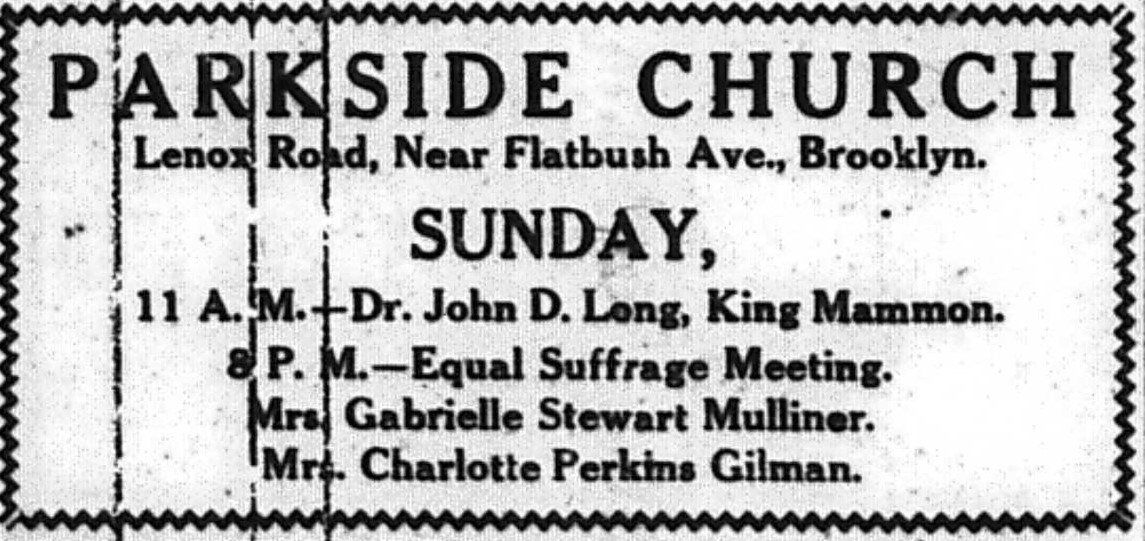
The congregation of the Parkside Church, Brooklyn, also joined in the demonstration for woman suffrage. The Rev. John D. Long, pastor of the church and general secretary of the Christian Socialist Fellowship, acted as chairman of the meeting. Miss Gabrielle Stewart Mulliner, chairman of the legislative committee of the New York State Federation of Women’s Clubs, said that city, state and national governments would be purified if the right to vote was extended to women.

“It is my opinion,” said Mrs. Charlotte P. Gilman, “that a woman may vote without violating her duty to her home. It is true that a woman’s duty is centered in her home and motherhood. Home should mean the whole country and not be confined to three or four rooms or a city or a state. If home was accepted in this light wives would be always with their husbands and so many men would not go wrong.
“Woman’s suffrage is really connected with the social movement. A grand awakening to the social equality of the world is going on.”
The Meeting in Queens.
Fesller’s Hall, Long Island City was filled by audience that showed great enthusiasm for the cause of woman suffrage as outlined in the able speeches of Professor George R. Kirkpatrick of The Evening Call lecture bureau and Dr. Antoinette F. Konikow.
Louis Order, who presided, announced that the meeting would be followed by other demonstrations to awaken the interests of the working class in Queens in the question of votes for women. The officers of the meeting were: Mrs. Ellie Hillie. Mrs. Anna Pfeifer and Mrs. Francisca Kretchner.
On the East Side.
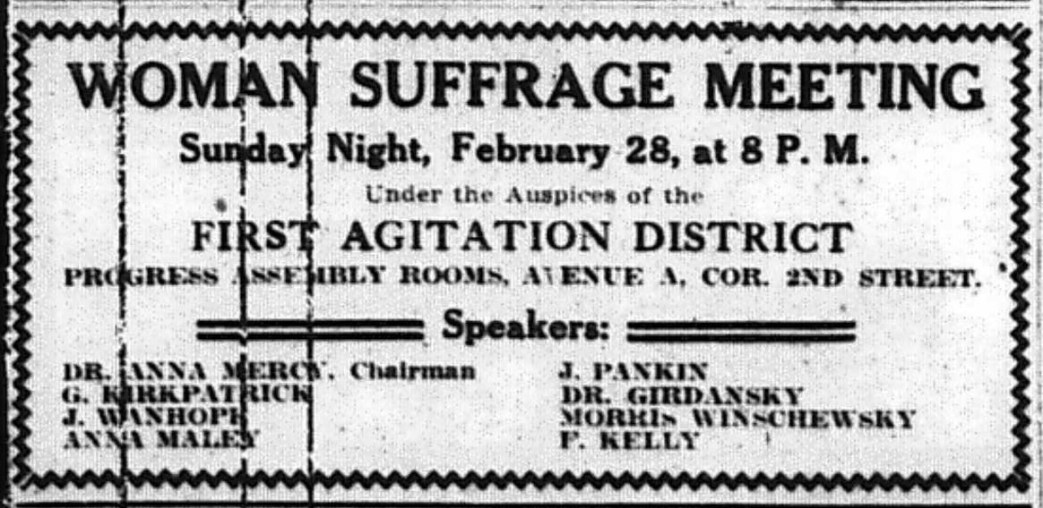
The Progress Assembly rooms, Avenue A and 2d street, were crowded by an enthusiastic audience that cheered to the echo the sentiments of freedom for women and equality with man that were espoused at the suffrage meeting held under the auspices of the First Agitation District of the Socialist party.
Dr. Anna Mercy, of the East Bide Equal Suffrage League, presided, and the speakers were Henrietta Mercy, Mrs. Florence Kelley, Miss Anna A. Maley, Jacob Panken and B. Gottlieb. A petition to the Legislature favoring action upon the suffrage question was circulated and received hearty endorsement.
Suffrage in Yonkers.
The meeting in Yonkers was held in the Public Library Hall and was addressed by Alexander Irvine, Miss Frances M. Gill, secretary of the general committee of the Socialist party of Local New York, Edward King, of the Ethical Culture Leage, and J. T. Britt Gearity, editor of the Socialist Review.
Mr. Irvine said that he was in favor of women in politics not only because she would purify it, but that she wants it. “The very identical speech that Senator Root gave in 1894 he delivered at Albany a few weeks ago,” he said in part, “about making the women masculine and taking away all her loveliness and charm. He told the truth when he said that politics were rotten then and are rotten now. Society women went up to Albany and talked against the cause. They said that it would disrupt and destroy the home and that women would sell their votes for a bag of peanuts. These same society women do not need the peanuts and have no home to destroy.
“For sixty years a woman sat on the throne of England. In a few years a woman will sit in the presidential chair of the United States. All working women need the ballot from the woman who sells her virtue for bread to the mother who struggles to bring up her family on a mere pittance.”
The New York Call was the first English-language Socialist daily paper in New York City and the second in the US after the Chicago Daily Socialist. The paper was the center of the Socialist Party and under the influence of Morris Hillquit, Charles Ervin, Julius Gerber, and William Butscher. The paper was opposed to World War One, and, unsurprising given the era’s fluidity, ambivalent on the Russian Revolution even after the expulsion of the SP’s Left Wing. The paper is an invaluable resource for information on the city’s workers movement and history and one of the most important papers in the history of US socialism. The paper ran from 1908 until 1923.
PDF of full issue: https://www.marxists.org/history/usa/pubs/the-new-york-call/1909/090301-newyorkcall-v02w051.pdf
 Revolution's Newsstand