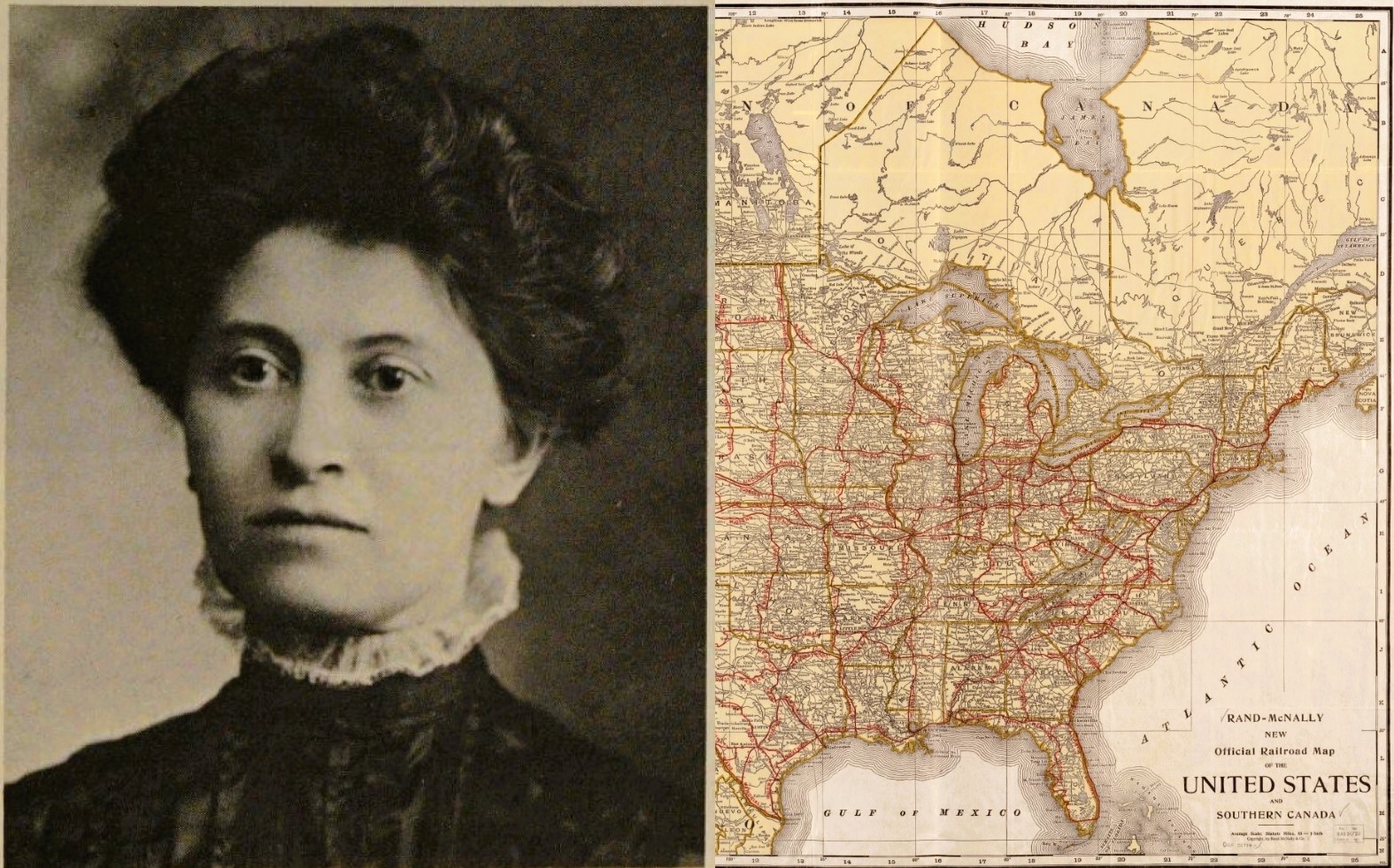
An International Women’s Day special as we travel across the U.S. with one of its originators, Theresa S. Malkiel, on an extensive tour for the Socialist Party in the summer of 1911. Not only an education into the Socialist movement of the time, Malkiel’s account is a pleasure to read as she, a working class Jewish immigrant woman from New York City, travels from the relative knowns of the East Coast to find herself under vast Western skies, on Oklahoma dirt farms, down Arkansas coal mines, and riding in segregated Southern street cars; all observed with her wit and humanity. We are introduced to dozens of comrades and locales from the Great Plains to the Appalachians. Written for the New York Call, the collection includes the article ‘’Socialists’ Despise Negros in the South’ where a disgusted Malkiel denounced the racism and segregation practiced by ‘socialists’ and their Party. Coming from so well-known and high-ranking a figure, Malkiel’s critique was widely read and debated, particularly by Black activists, with both Hubert H. Harrison and W.E.B. Du Bois making a number of references to it. Enjoy!
‘Mrs. Malkiel Having Successful Tour’ from New York Call Vol. 4. No. 171. June 20, 1911.
Speaks to Good Sized Audiences in Rochester, Syracuse and Buffalo.
Mrs. Theresa Malkiel, who is making a speaking and agitation tour under the auspices of the Women’s National Committee of the Socialist party, sends the following account of her trip:
“I struck Rochester on June 3 and spoke to an audience of Socialists that filled the hall. It seems that they did not know definitely about the meeting until Monday and no special attempt to advertise it was made. There were about two hundred Comrades present and they were all enthusiastic and confident of the future. They start the meetings with Socialist songs and it adds vim to the occasion. I wish there were more of the spirit in New York. I was much pleased with the whole atmosphere, the element in, the party and the team work they are doing.
“Next day I spoke at Syracuse and had a good meeting: pretty fair attendance, mostly Jewish Comrades and a number of girls. Stopped with a Jewish Comrade and had my first experience as an agitator. Yesterday I rode around Rochester in an auto, today I was helping to dress the babies. The poor mother had three of them and had to ship two off to school. I took the children to school while the mother tended the baby. My impression is that the workingmen get along better in small cities. The Comrade is earning $14 a week and seems to get along comfortably, at least much better than one could on that sum in New York.
“At Buffalo I had a splendid meeting. There were about six hundred people present. The local possesses the dandiest headquarters I have seen. It has a large hall and dancing room and gives the young folks an opportunity to spend the time pleasantly together and helps draw them into the party. It is a pleasure to see the type of young men and women that have joined the party recently. When I got to Niagara Falls I found that I had to speak at the Second Presbyterian Church. The world surely do move. Russian Jewess in the pulpit of a Christian church talking on Socialism!
“The church was crowded and I held them for over two hours. The chairman, a good Christian, said none of their ministers could hold the congregation for that length of time. The audience rose in a body to extend the thanks of the church to the speaker for the message she brought. A large quantity of books were sold here and at Buffalo. Comrades Spargo and Mrs. Allen spoke at the same church. I understand.
“I was gratified with the success, as I had very poor promise from Comrade Parsons, the organizer. who told me before the meeting that they did not expect much of a success, as they had a disappointing meeting with one of the speakers lately. However, after the meeting he expressed himself as very well satisfied. The next day I went over to Buffalo and held a session with the women Comrades, and planned out with them the method of agitation among women. They have formed a women’s committee and will be heard. from in the future. Am going on into Ohio next.”
‘Socialist Woman Agitator on Road’ by Theresa Malkiel from New York Call Vol. 4. No. 181. June 30, 1911.
Mrs. Malkiel Finds Plenty of Enthusiasm in Middle West.
TERRE HAUTE, Ind. June 26. I arrived in this city in the rain. This is the home of Gene Debs. Everybody here, Socialists and non- Socialists alike, seem to adore him. He has a lovely wife and every one says that they lead an ideal life. Am sorry that he is away on his tour, for I had anticipated a long chat with the man of the golden heart.
The first man I met at the State office was Comrade Reynolds. He seems as young as ever and sends his greetings to the New York Comrades. Socialism is in the air, everybody is interested in it, but the local has but forty members. Spoke in the afternoon from the Courthouse steps. and had a big, appreciative crowd. After the meeting went to see the slums. Lord: what a sight. Our worst tenement district cannot hold a candle to it. But a few steps away from the woods and fields with the fragrant flowers, next to the town dump and close to the slaughter houses are huddled about a hundred broken down huts. It is almost impossible to get near them for the stench. Their condition beggars description: the worst hovels that Sinclair describes in “The Jungle” are palaces as compared with these. They are inhabited by free born American citizens, our sovereigns, who frequently feed on the offal from the dumps. I shall never forget the sight. Comrade O’Neal is now the State secretary and the Comrades expect very much from him.
I arrived at Mt. Vernon on time. The Comrades met me and took me to the meeting place. It was held in the open air: had a good crowd and sold considerable literature. There is a small local here, but the Comrades are wide awake and will give a good account of themselves.
Good Meeting at Akron.
I had a very good meeting at Akron, Ohio. Stopped with Comrade Prenevitskys, a dandy good hearted couple who made me feel at home at once Held a big outdoor meeting with, a great enthusiastic crowd, sold all the books and could have sold more. Have promised the Comrades to home hack when I am in West Virginia for another meeting if I can spare the time. The town is as large as Yonkers and has over two hundred members in good standing. It is a great manufacturing center and has some of the largest rubber factories in the world. One of them extends over ten city blocks. The smell of rubber is all over town and is suffocating. The workers are totally unorganized and get starvation wages. There are many. women and children working in the mills.
At Rittman a Comrade told me that he worked in a paper mill for a week at a time without going home for an hour’s sleep, tending the machine day and night. eating while watching the machine and sleeping in a chair, while waiting for the machine to make its turn. His wife, who has also worked in a paper mill, told me that she has worked thirty-six hours at a stretch, twelve hours a day one week and thirteen hours the next on a night shift, working two shifts at the time the change is made. And yet we are told that Socialists will destroy the home. God save the mark. A railroad man told me that he has worked fifty-two hours at a stretch: No wonder there are so many accidents.
Have reached Columbus and reported at the State headquarters. Comrade Storck is an earnest man and has the cause at heart. Held a fine meeting in the park and sold a large quantity of books. The local has 1,500 members, but a good many of them are newcomers and are not entirely clear in their views, but they are very earnest and with proper direction will grow into the movement. They are taking in new members by the score. The trouble will be in welding them into a homogeneous whole.
Spirits Not on the Job.
Am stopping with a Comrade who is working in a railroad yard. His wife is working hard for the movement and amuses herself with spiritualism in the intervals when she is not busy working for Socialism. They tried to convert me and had a seance for my benefit. They tried hard, but the spirits could do nothing for me, so we went for a walk.
Spoke again next day and had a run-in with the police, who are trying to stop the meetings. The Comrades asked me whether I was afraid of being arrested. I told them to go head and we will try it, one has to get in jug some time. They got a band to play so as to drown my voice but I stuck to my guns and spoke for two hours. Columbus is a beautiful town. It is lit by electric arches spanning the streets, the trolley lines issue six tickets for a quarter. The people seem to be more free than out East. There is a great awakening among the masses throughout Ohio, only our Comrades do not know how to take full advantage of their opportunity Many of them are young in the movement. There is scarcely any distribution of literature and but very little system. But little agitation is carried on except during campaigns. I entered Indiana at Marion. The air is full of fragrance and one feels as if he were in an immense garden. The cost of living is half what it is in New York. The meeting was arranged in a hall, but it was so hot that the audience voted to go outdoors, where we held a rousing meeting.
The meeting at Peru was very good: It was managed by the women. Strange to say, but wherever the meeting were arranged by women they were more successful: everything was according to program, while the men seem to be doing things in a happy- go-lucky way.
‘Mrs. Malkiel’s Tour Through the West’ by Theresa Malkiel from The New York Call Vol. 4. No. 200. July 19, 1911.
Socialist Lecturer Sees Indications of the Coming Panic.
RICH HILL, Mo., July 15. I had a great meeting at Springfield, Ill. It was held at the picnic grounds. To begin with, the first thing that struck my eye as I arrived were the large signs on all the street cars: “All come to the Socialist picnic.” The miners here have been working but one or two days a week, but when the bosses found out that there was to be a great turnout of miners at the picnic where Duncan McDonald was to speak, they blew the whistle on the morning of the affair and called every one to work.
This kept the miners away in the afternoon, but they all turned out in the evening. It was really inspiring to see these grimy, earnest miners come out of the bowels of the earth and hurry to hear the new gospel of emancipation. We had with us the Mayor and City Clerk of Spalding, two earnest Socialists.
The tears came into the Mayor’s eyes and his great powerful frame e shook with emotion when the chairman described how the miners of Spalding, tired of being hounded by e capitalists, elected their own brothers and put them in charge of the town.
Signs of Hard Times.
Let me tell you, the further I go West, the clearer I can hear the rumbling of the coming storm. Factories, mills and mines are being closed by the score. A new panic is fast approaching and with the growing dissatisfaction I shudder to think of the consequences.
At East St. Louis I was met by a Comrade and taken to the house of an engineer party member. The St. Louis Socialists were inquiring about me as one of the St. Louis papers wanted an interview. The reporter saw me right after the meeting. The newspapers all along are alive to our movement. Had quite a good crowd and sold considerable literature. After the meeting, crossed the famous Mississippi with the St. Louis Comrades. The Socialists who met me are good and earnest members, but the local is in a turmoil. The local is split in two factions; there is a legal and extra legal board and they are so busy fighting among themselves that they have scarcely any time for agitation. It is strange, but I find the movement in a much healthier condition in the smaller towns. There is something demoralizing about the large cities, it seems, or there would be more harmony. Too many leaders and not enough men willing to do the work for its own sake.
Luxury and Poverty.
Went to see the town in the morning. Saw the waterfront and the sight made me sick. God! Wherever I go the same old thing: The rich men in luxury while the poor are wretched. Wretched is no name for the dirt, the squalor and the poverty a few steps away from the marvelous palaces. And in the dirt lie the poor in bunches, on the hot, filthy stones in the stupor of drink. After leaving St. Louis I thought I was back in the fourteenth century. They say Missouri wants to be shown. No wonder: it needs it. The railroads are the worst ever, slow and filthy and connections poor; the small towns are not yet awake. My last stop was at Rich Hill, a quiet town. Once a prosperous town, it has dwindled with the closing of most of the mines. Half of the population left to look for a job, and the rest remained to vegetate.
The only recreation is the moving pictures. You, in New York, cannot realize what they mean to the folks out here. They bring life back to them as it is today.
Good Meeting in Park.
Spoke in the public park, the pride of the town, four blocks square, and had half of the town turn out to hear me. I rather startled them out of their repose when I turned the subject on the woman question. They never heard anything of the kind before.
The suffragists have not penetrated into this part of the country. They have listened to Socialist speakers off and on, but none of them touched the question. The same is, unfortunately, true of most of the places I visited. Woman seems to be left out of the game completely. And yet she is even more ready to embrace the new gospel than the men, if it is only presented to her in the proper light. Here, as elsewhere, women have been my most attentive listeners and I am told my words started them thinking. Comrade Mitchell, of Columbia, told me that three years before the abolition of slavery people did not think and talk half as much as they do now. They talk about Socialism. The old man has been first an abolitionist, then a greenbacker, a Populist, and now is a Socialist. Am leaving for Girard and the home of the Appeal. I am longing to see the brave band.
‘Mrs. Malkiel Talks to Kansas Crowds’ by Theresa Malkiel from The New York Call Vol. 4. No. 205. July 24, 1911.
Socialist Lecturer Has Good Meetings in Girard and Columbus.
COLUMBUS, Kan., July 20. At last I arrived in Girard. Comrade May Wood Simons met me at the depot. Her warm welcome made me feel at home at once. Had a splendid meeting in the public park. I was a little nervous at first, as all the big guns on the Appeal staff were there to hear me. Had a big crowd, and was told that it was the best meeting they have had, and sold more literature than ever.
The meeting was well advertised, as Mayor Houghton saw to the posting of the bills himself. Think of it, the Mayor of the town advertising your meeting! Houghton is well liked everywhere, but Girard itself is very conservative. The Appeal, which has such an enormous circulation all over the country, has but a small circulation here.
It is mostly a middle class town. Comrade Wayland is the most congenial and good-natured man I have met. And there is not a finer set of boys in the country than the ones who work on the Appeal.
Impressed With Appeal Plant.
I was very much impressed with the Appeal plant. It is certainly a beehive. Can you imagine what it means to send out half a million papers? The piles of papers, files upon files of mailing bags, and the regular army of workers hustling for dear life to send the message to the working class of America. I do not believe there is another institution in the West that carries with it the power that the Appeal does,
From Girard I went to Columbus. It is a live little town, and I had a very successful meeting. The Comrades were surprised at the large sale of literature. Well, at last I am in the real West, and it feels good. You can almost see when you cross the line. Everybody is open-hearted, generous to a fault, and there is no haggling and pettiness. No one but a traveler, going from place to place like a wandering Jew, knows what this means.
The weather has been the. hottest in the memory of the oldest inhabitant, the mercury often going to 113. But the free Western air feels good, and I am leaning out of the window taking in a plentiful supply to fill the lungs.
Farmers and Miners in Crowd.
The meeting at Columbus was held in the afternoon, as all the farmers from the surrounding country gather there Saturday afternoon to make their purchases. It was a great audience. Bearded farmers with their wives and children; grimy, sturdy miners, just emerging from the mines. and folks of all kinds. I spoke for two hours, and had to quit for fear that I would tire them, and yet they asked for more.
A year ago the local had seven members; today they have sixty-five in good standing; elected one Councilman, and expect to elect another next week. Last winter they hired a moving picture theater, and gave the Audience some pictures, followed by a lecture. It worked wonders. They spoke every Sunday to packed houses and turned away many people for want of room.
The clergy and the business people started a move to prohibit the Sunday meetings as disturbing the Sabbath. Word was passed to the miners to boycott the merchants, and especially the Mayor, who is a large storekeeper. It worked like magic. There was no more talk of stopping the meetings, and our Comrades kept right on with their work, and increased their membership tenfold. And all of it due to the energy of three men: Comrade Snyder, formerly a lawyer in Chicago, and now an insurance man; Comrade Kuntz, a florist, and Comrade Walker, a miner. It is their energy that put a Socialist in Council, made Socialism the talk of the county, and will carry the whole town before long.
Organization in Early Days.
Comrade Walker, who is a member of the United Mine Workers’ Union, told me how eighteen years ago they organized the Knights of Labor. They dared not to meet in the open. Every man affiliated with the organization. was discharged if found out. It was pathetic to hear the old miner relate how they stole out in the dark of the night into some lonely spot on the prairie, a small group of brave spirits, I and there plotted, organized and hoped.
“And I have lived to see the Miners’ Union grow to be one of the strongest organizations in this country.” added Walker, “and I shall yet see Socialism triumph, even as I saw the miners succeed.” As he spoke his eyes lit up with the fire of youth; he seemed to have left this squalid earth and to be lifted higher to a heaven, and nearer to our conception of God. This, in spite of the fact, that hard toll and privation have broken his health and aged him before his time. Only the freedom of the great prairie can produce such men. The further West I go the more I am convinced that the light of freedom will come from there.
‘Missouri Folk Waking Up to Socialism’ by Theresa Malkiel from The New York Call Vol. 4. No. 212. July 31, 1911.
Farmers and Miners Living In Towns Beginning to Realize Conditions.
MILTONVALE, Mo., July 27. In my last report I omitted my meeting at Columbia, Mo. A pleasant surprise awaited me on my arrival. Columbia is a very beautiful place. I was met at the depot by an old Comrade, a retired farmer, who has a beautiful house with all modern conveniences. His wife, though not a Socialist, is a sweet old lady, full of true Southern hospitality. Their daughter, a young school teacher, is an intelligent girl, and I spent a pleasant afternoon while waiting for my meeting. Columbia is a college town, and has an intercollegiate chapter. But when the students cannot agree on any points or want to be enlightened on the subject of Socialism they go to Comrade Hutchinson, a shoemaker by trade.
When I peeped in his shop, where Socialist propaganda is forever carried on, and where students and college professors gather to get enlightenment, I was for a moment carried back to the days of the early Christians when work was carried on in subterranean abodes and back corners. Comrade Hutchinson is certainly a type of which our party can be proud. Another is our good, old Comrade, Mitchell, who has a double task to perform. Agitate for Socialism, and when he gets home, assure his good old mate that Socialists will not take away her savings.
Meeting a Good One.
Had a splendid meeting: an earnest, intelligent audience. The farmers are waking up; they are on the eve of hard times; most of the crops have been burned by the drought. There are very few industries in the State, and the cost of living is high. As I go along I see that the soil is poor and vegetation meager, the farm houses look small and dilapidated, but the mansions of the good, old slaveholders stand out in their full glory surrounded by beautiful grounds,
Some still have their rows of cabins where the darkies used to live. As I shut my eyes I seem to hear the whip sing on the bare backs of the slaves. The same feeling overcame me when I spoke on the Courthouse steps at St. Louis. That is where the slaves were sold at public auction. As I spoke of the system of wage slavery, I seemed to hear the voice of the old auctioneer offering the bodies of young slaves for sale. Today they only sell their hands. The Comrades tell me that even Missouri is fast waking up.
I am, I believe, the first woman who spoke here on the street, and the Comrades seemed elated over the result.
After leaving Columbus, I went to Fort Scott, to the home of the fattest. sweetest little woman I have ever met. She could not do enough for me. Met Comrade Stallard; he is a fine, typical Western chap, with plenty of common sense and devotion to the cause. He is just the kind of State secretary I would like to see in all of our State organisations.
Held one of the biggest meetings they ever held there on the Court- house lawn. The audience laughed and cried, and the Comrades seemed to be delighted with the meeting. My next stop was Bolcourt. It is a flag station with about thirty miners huts and a single hotel. Comrades Mr. and Mrs. Boro, who met me, suggested that I go to their farm two miles away. When they mentioned a dip in the river I was with them on the spot. We had to walk two miles, a third of it on a railroad trestle sixty feet high. Comrade Boro is an Italian, and his wife American. They live in the lowlands, and two years ago the flood carried away everything they had, and they had to escape in a rowboat.
Their hut to this day bears the marks of the food. Their experience has not dampened their spirits; in spite of the drought that requires constant working of the fields to save the crops from burning, they found time to carry my posters all over the sur- rounding country. I walked the trestle like a born hobo, but the plunge in the cool river rewarded me for my travel. After supper we started back to the station for the meeting. But before we had crossed half of the trestle I was startled by Comrade Boro’s exclamation that a train was coming.
Socialism Wakes Them Up.
We got to the meeting in good time; the schoolhouse grounds were crowded with miners and farmers, the two elements making up the bulk of the population. People came fifteen and twenty miles to attend the meeting and afterward said they were glad they came. The message of Socialism is finding a fruitful soil and I will bring results. It was almost 11 o’clock when we walked back in company of three other women who came to the meeting from a distance and were going to stay at the Boros. The moon shone so bright that we did not want to go in the house and slept outdoors. In the morning when got back to the station to take a train, I met the miner boys ready to go under the ground to their work. They are brave and intelligent, and will make a valuable addition to our movement. I reached Lawrence about noon. Stopped with Comrade Clark. The town boasts of the State University and Haskell Institute for Indians. Most of the population is middle class, hence the meeting was not as big as at other places. I was told, however, that it was as well attended as the meetings of Debs, Warren and others.
The audience seemed to be appreciative. The farmers around here have a hard struggle, and in a way they seem worse off than the wage earners. They are beginning to realize where the shoe pinches.
Arrived in Miltonvale, the home of Rip Van Winkle. It is 1,350 feet above the sea, surrounded by hills, and has a “Wild West” appearance.
‘Kansas as Seen by a Socialist’ by Theresa Malkiel from The New York Call Vol. 4. No. 216. August 5, 1911.
Mrs. Malkiel Tells of Conditions in Sun Flower State.
RANSOM, Kan., July 31. From Miltonville I went to Formoso, where I had a good meeting and organized new local. After the meeting I was met by the Comrades from Lowel, who came to take me over to their town some miles from here, This whole section is mainly agricultural, with sprinkling of middle class people who live on the farmer.
Conditions here are unusually good. The farmers have had unusually good crops for the past five years and even now expect to profit by the general drought which has affected this section but little. Most of the people here are early settlers who had to contend with the elements and hostile Indians, but have succeeded in accumulating large tracts of land at comparatively low prices.
Many own automobiles, and horses and cattle. But the later generation is less fortunate; it had to buy mortgaged farms or else rent and give half to a third of the produce for the use of the land.
Comrade Dahl, with whom I was stopping and whose son met me with his auto at Formoso, fourteen miles from here, is a Norwegian: he came here in 1866, with his two brothers. They had about a thousand dollars in stock and provisions. But before they got fairly settled the Indians swooped down on them and destroyed everything they had, leaving them penniles, 105 miles from the nearest settlement.
Return to Wilderness.
The old man, who is now 73 and still hale and hearty, told me that he walked the distance in less than two days, stopping in town long enough for him and his brother to earn the price of a covered wagon, a team of oxen, and a load of corn. with which they went back to the wilderness. Here they worked for forty-two years, and today the brother, who has seven sturdy boys, owns 3,000 acres of land, while Comrade Dahl has three boys and owns a large tract of land, plenty of stock and an auto.
Strange enough, all the farmers in this section, thirty-seven men and women, are members of Lowell local, which is the Socialist center of the county. In the other Dahl family there are thirteen members of the local.
The farm where I was stopping is in the midst of the beautiful plateau of Northern Kansas, 2,500 feet above the level of the sea. The people are earnest and honest sons and daughters of toll; strangers to sin and temptation, imbued with the idea that if they have, others should also have plenty. In mingling with them one feels that he has left the kingdom of mammon and entered the realm of toil. Far from the madding crowd, amidst the beauties of human nature and surrounded by human kindness. one realizes more than ever what this world might be and what it is not.
Taking it as a whole, I find that this part of Kansas is far from the modern economic development and is the most conservative as respects Socialism and woman suffrage. The conception of woman’s sphere is the same as it was a hundred years ago. Had a good meeting at Lowell.
Big Meetings at Hutchinson.
At Hutchinson I had a big meeting, in fact, two. Spoke in the park and then in the aerodrome. The first meeting was for the Comrades and spoke pretty plainly on what I thought the Comrades should do. I gave them my opinion of the man or woman who thought they had done their duty when they declared themselves Socialists, and especially if they paid their dues and carried a red card.
As I go along I see that everywhere the spirit of unrest, the desire for a change, is growing much faster than our movement. What we need is good, devoted workers. The Socialists must no longer be satisfied with their petty business meetings, but go out and talk and preach, every mother’s son and daughter. The locals should not depend upon professional agitators, but develop their own workers.
The meeting here was a good example of what women can do and what it means to win them over to our cause. When the local first received word from the State secretary about my tour it decided not to take the date. Their treasury was empty and the local heavily in debt. Then two little women, Miss Bartholomew and Mrs. Rottman, a mother of four beautiful, well cared for children, put their heads together and decided to have me come here just the same. They hustled among the well-to-do Socialist sympathizers and raised enough money to pay all expenses. They went to work and made arrangements with the proprietor of an amusement park for a picnic. The proprietor agreed to give them the theater free.
Reconsiders Decision.
When they brought the report of their work to the local it reconsidered its decision not to hold a meeting and gave the women full authority to carry out their plans. The result was a well attended meeting and some money in the treasury to pay the local’s debts. The women can have anything they want now.
Arrived at Nickerson the next day and held one of the biggest meetings they ever had. Spoke in front of one of the churches and had the ministers of the various denominations among my audience. The meeting lasted until 11 p.m. when the entire local escorted me to the railway station to catch the midnight train. the only means of reaching Ransom in time for the meeting the next day. The train was an hour late, so we held another meeting on the railway platform.
I do not remember when I ever heard so many good wishes on my departure. “God bless you and keep you from all harm.” “We need your enthusiasm and good work.” were among the shouts that speeded me as the train departed. There is nothing sweeter to the ears of a tired worker than these spontaneous outbursts of good will and appreciation from the honest toilers. They were almost all Americans and all callings of life were represented in the crowd from the laborer and farmer to the preacher and professional man. among them an old couple long past three-score.
Wreck Ahead Delays Train.
I took a sleeper but was told we would have to turn out early in the morning. But before we had gone far the sleeper was switched from the local on a side track to wait for the through express. We slept until 5 a.m. You see, the Missouri Pacific cares little what it does with its passengers. Then we were attached to another train and after a run of seventy miles came to a stop. The train ahead had been wrecked. Luckily. there was no loss of life. but it took a couple of hours to clear the tracks. I had an opportunity to see a railroad wreck at first hand.
As I looked at the rotten ties that were pulled from under the twisted rails I did not wonder that the rails spread. The wonder is that there are not more wrecks and loss of life, but passengers’ lives are cheap and rails cost money. This is our wonderful system of private efficiency. It would not do to have the people own the railways: they might not care how much. money they spent to make the roads safe there would be no loss of life or property: no use for claim agents and adjusters, and no work for lawyers. Terrible, isn’t it? Our way lay through the prairies and fields. It is heartbreaking to see the burnt crops. The fields are withered as if by a fire; the people leave the wheat in the field: it does not pay to harvest: the corn is burnt to a crisp; there is not a sign of potatoes or other vegetables, and the farmers are selling their stock for a song, as they have no feed. The drought is simply devastating, and there will be something doing here before very long.
Woman Does Good Work.
Had a good meeting at Ransom and am to speak at Brownell tomorrow. At stopping on a fine farm with Comrade Schoeppel, Mrs. Schoeppel met me in an auto and drove me to her home. She may be classed as an ideal woman. The mother of seven growing children, the youngest 18 months, she does her own housework. making even her own soap. Living far away from the world, she manages to keep up with the progress of the times, and is wideawake and as well posted as the brightest man in New York. They subscribe to eighteen publications. She is the county secretary and heart and Foul of the Socialist movement in this vicinity.
We had a big meeting in the high school. The place was crowded and standing room was at a premium. Nobody stirred. although I spoke for two hours and forty minutes. My arms ached from the handshakes I received after the meeting. I held one of those White House receptions, for everybody, young and old, just crowded around and shook hands.
When we started for home, however, we found ourselves in impenetrable darkness. It had rained for the first time in weeks, and the Socialist was responsible for that, too. You could not see the road and many of my hearers had traveled twenty miles to the meeting. I do not know how they ever got home, for it took as an hour and a half to go two miles. It is surprising how fast the farmer is waking up, and the women think as well as the men, although they haven’t yet recognized the necessity of belonging to the party. So far Mrs. Schoeppel is the only woman in the local. Sold all the books I had, and could have sold three times as many. I have not seen The Call since I left Girard.
‘Conditions Appear Bad in Oklahoma’ by Theresa Malkiel from The New York Call Vol. 4. No. 223. August 11, 1911.
Farmers Eager for Socialism, but Need Better Organization.
LAMAR, Okla., Aug. 3.I entered Oklahoma at Aline. Had quite a good meeting and sold all the books I had. The country is beautiful, all the more is the pity that the farmer’s lot is getting worse from day to day. The people who took claims on government land have retired and rent their farms for half or a third of the crop. Most of the Comrades are tenants. This is the real primitive West and conditions here are more like they were on the old frontier. Of course, their methods of cultivation are up to date, but the houses are mostly hastily put together, shanties with the least amount of comfort. Everything seems temporary.
I was quite comfortable at Comrade Smith’s, put when I reached my next stop I hit the real thing–a farmer’s hut knocked together from rough boards in some places pasted over with newspapers, and in others just bare boards, black and uninviting. Lumber is hard to get here and the land does not belong to them, so they put up whatever they can to get along.
The meeting was held in the schoolhouse, which was packed to the doors and a large crowd stood outside. I got so interested in my talk that I did not notice the time, and when I stopped I found it was half past twelve. Sold a large quantity of books owing to the fact that a number of girls went out among the crowd with them.
There is plenty of sentiment, but the organization in Oklahoma is woefully weak. There is little system, most of the Comrades are new members and have no experience in party work, although the enthusiasm is not lacking. But they were not competent to teach, for they must learn themselves.
The drought had a very depressing effect on the people here, but the rains for the past two weeks changed the outlook and the farmers here begin to look up. The country here is beautiful, but the people are far behind the times. The exploitation of the children by the parents is simply frightful. One is constantly reminded pf the adage: “Ignorance is the people’s worst enemy.” The life of drudgery that the children here lead moves one to tears. One has to see the children of the tenant farmers to realize what a child slave is like.
The majority of Comrades are well meaning and earnest, but as in all new territory, we have many cranks flocking to the movement who retard our growth. A little girl told me the other day: “You see, my people are dreadfully set against my being a Socialist and point to the people who are the only Socialists in town and are rather queer.” Of course, we will outgrow this with time.
Had a good meeting at Guthrie and sold a lot of books. For the first time in my life I ran across the Jim Crow law. Guthrie is a beautiful town and the mineral springs are wonderful. From Guthrie I went to Oak City where we had a good meeting. We had to drive four and a half hours in the hot sun and got almost black from sunburn. Got to Newalla to Comrade Mallory’s house; from there back to Shawnee for the other meeting. Got to Lamar early in the morning and was met by Dr. Adams, a bright Comrade, struggling hard to conquer nature and ignorance.
The meeting at Lamar was very good. The people of Oklahoma are ready to accept the gospel of Socialism; all we need is active workers, well grounded in Socialism themselves. Organization is the weakest point here. The majority of farmers here do not have a cent to their name; they do not own the farms, but rent them on shares; they do not see any money except when the cotton crop is gathered; in other times they could borrow money until the harvest, but the bankers have shut down this year. The fear of the crisis hangs like a pall all over the land. Many a farmer around here has nothing but corn cakes and a bit of pork left over from last year. The people are simply desperate. The Comrades find it hard to raise money for propaganda and pay their dues. In order to raise the money they set aside five or ten acres of cotton and cultivate it jointly: the proceeds go to the locals and is used to pay the members’ dues and for propaganda.
Owing to the severe drought the State secretary was unable to fill all dates in Oklahoma., so I had five days to spare. While at Lamar the Comrades from Dustin, Okla., came over and asked me to speak there. The meeting was well attended, especially if we consider that it was arranged without notice, and considerable literature sold,
I find conditions in Oklahoma worse than in any of the States I have visited. Although $54,000,000 have been deposited in the banks of Oklahoma, the average man is going from bad to worse. In Hughes County, where Lamar is situated, out of 2,808 farmers, only 514 own their own farms. The rest are tenants paying from one-half to a third of the crops. Eggs are sold at 7 cents per dozen and spring chickens 7 cents a pound. And even at that price there was no market during the dry spell. It is no wonder that the farmer is turning his eyes to the Socialist party. He listens eagerly to our arguments and they fall on fertile soil. It is different with the inhabitants of the towns. They are mostly retired farmers and merchants as bigoted and hard fisted as they make them. It is a hard proposition to drive a Socialist argument home where the listener thrives on the misfortune of others. Self-Interest makes them bullet proof against the wiles of the Socialist agitator. Will enter Arkansas next.
‘Woman Agitator Down in Arkansas’ by Theresa Malkiel from The New York Call Vol. 4. No. 227. August 15, 1911.
Has Numerous Novel Experiences in an Unfamiliar Country.
HOT SPRINGS, Ark., Aug. 9. Well, I am in Arkansas. What a relief from the low plains of Oklahoma! The scenery is beautiful, and the forest clad hills just beckon to one. But if the scenery is good, the hotels, like everywhere else, are abominable. They charge good prices, but the service and filth are beyond description. I am surprised that the traveling salesmen who have to put up here do not force them to make a change. At one place, a first class hotel, they had no butter, while the fields are full of cattle and butter selling at 15 cents a pound.
I reached Fort Smith in the morning and could not get a train for Huntington till the afternoon. I went out for a ride on the trolley and ran plumb against one of the most sacred institutions of the South. I entered a car and sat down in the rear near a window. Afterwards other passengers entered, among them a young malatto woman who sat down beside me.
The conductor came to me at once and asked me to move to the front part of the car, as I could not sit with the colored woman. I told him that I did not mind it, but he insisted that I was committing a crime against the laws of Arkansas and I had to yield.
When I arrived at Huntington I was met by Dan Hogan and his folks, the dearest bunch of humanity I ever came across. I felt as if I was among my own family. Only one who has traveled like I am doing can realize what it means. Comrade Dan Hogan as good natured as he is fat, his wife is a dear soul, and their daughter Freda is a grand girl; she has the making of a great woman and will be heard from in the near future. Huntington is a mining town, and I am going down into the mines before I leave here. This is the land of peaches. Comrade Hogan has some that weigh 1 pound each. As I came here five days ahead of my dates I filled my time with special appointments.
Down in the Coal Mine.
First I went down into a coal mine. We went down in a cage. Down we went 125 feet below the surface, with no light except the miners’ lamps in their caps.
When we reached bottom we found ourselves in a narrow damp passage. The roof of which was black slate and the walls of coal. A single track ran for about a hundred feet to a place where it opened into various rooms, where the coal is mined; there are in all about 320 rooms in the mine we entered, and the first one we entered was where a miner had his skull crushed only last Friday by a layer of slate coming down from the ceiling. As I stood there in the gaping darkness my conception of hell suddenly took on a new form. I came face to face with it right here in this world, where the miner has to face it every day of his life, and more than ever I became determined to leave no stone unturned until this living hell is eliminated from our midst. All my conceptions of the place could not compare with the real thing.
The air was stifling, it was hard to breathe, a cold sweat appeared on my forehead, not from fear, but at the mere thought that men and boys, nay, mere children of 12, are compelled to spend their lives here, and the worst of it is, that they are used to it and think it natural.
We crept into the coal car and were carried along the track by a poor, half blind donkey. Everything was rather quiet, as it was Saturday afternoon and there were but few men in the mine. In fact but few work in the mines nowadays. Conditions here are terrible, people work but one or two days a week and are desperate: they do not earn enough to keep soul and body together; hence the fact that the workingmen whom but a short while ago we could not reach at all, are turning to us, urged by empty stomachs.
And again I must repeat my cry: If we but could get efficient workers to carry on our propaganda! In this very State the secretary informed me that he could not arrange but five meetings, yet I find that ten times as many could have been arranged if he had gone about it in the right way. They have a new secretary, a woman, and she gives promise of good work.
Should Use the Women.
Our Comrades make a great mistake in not availing themselves of the women’s services. I find them more painstaking and earnest. Their enthusiasm is fresh, and they go about their work with a vim, while many of the men act as if they had that tired feeling. Yesterday afternoon I met with the local Comrades and in the evening we drove six miles by beautiful moonlight to Midland: we found the house crowded, although many went away it was 9 o’clock when we reached there. I spoke until 12 and had to promise to come again today for a talk with the women. Tonight I spoke to a few hundred Slav mine workers in their own tongue and I have made a good impression. This the first time they had some one to talk on Socialism in their own mother tongue. All these meetings were hurriedly arranged, not being on the schedule. I was supposed to rest these days.
I spoke again at Midland to the women and organized them, twenty-five strong. This is a good start. Spoke at Huntington at the theater until 11 and took the train for Little Rock, as I was anxious to get to Hot Springs for a day before my meeting at Bald Knob. The ride from Huntington to Little Rock is superb. I had a few hours before I could get the train for Hot Springs, so I went to take a look at the capital. The State House is of white marble and stands on a big hill with a superb view of the surrounding country. The custodian took me all around.
In this respect I find the Southern men very obliging. Last night while waiting for the train I went to a hotel at the suggestion of the station agent who promised to call me when the train was ready. Sure enough he did.
An Agitator’s Life.
Got to Hot Springs at 2:30. traveling part of the way in a Pullman and part in a mixed freight; such is the life of an agitator. The Comrades from Huntington telegraphed ahead but I found no one at the station. I went to the post office and found a card directing me to go to a certain hotel. There a woman Comrade came to see me and informed me that one of the Comrades, a business man, insisted on my going to his house. Again I took my grips and was on the way. Started out to see the town and the baths. Could not get a bath, as a permit is necessary, and the government office is closed at 4.
I went through the reservation park and the ostrich farm and saw the natural spring where the water rushes out of the rocks at 170-degree heat. It is marvelous and worth while to travel half the continent to see it. There are many fine hotels and fine baths for the rich, but the poor are in the dumps as elsewhere. The government, which owns the springs, rents them out to the bath keepers for $60 per year per tub, or $5 a month, and the keepers coin money, while the one government owned bath house is not fit for dogs to use, and a man or woman cannot get a free bath unless they swear they are paupers. The people cannot use their own. At night I had a splendid meeting and sold some literature.
‘’Socialists’ Despise Negros in the South’ by Theresa Malkiel from The New York Call Vol. 4. No. 233. August 21, 1911.
‘Comrade’ Refuse to Allow Colored Men in Meeting Halls or Party
MEMPHIS, Tenn., August 7. At Bald Knob Ark., I had four meetings in the afternoon I spoke at the picnic grounds to a thousand farmers, and their wives and children. In the evening I spoke in a church. It was extremely hot, but they insisted on a meeting. I spoke for two hours and was tired out when I got through. They want their money’s worth even if they kill the speaker.
The next day I again spoke at Bald Knob, and had an unpleasant experience that sent my blood boiling. There was a picnic of Colored people in town, over a thousand assembled, and they sent a deputation to asking me to speak. I consented, but when our comrades heard of it, they would not allow it, as they claimed it would break up their organization. Lord preserve us from this kind of Socialists.
We must not preach Socialism to the negroes because the white workers are foolish enough to allow the masters to arouse their prejudices against their fellow workers to keep them divided so as to play one of the other. The result is that when the white men strike the darkies (sic) scab and vice versa. And even our Socialist comrades do not be able to see it.
Oh! For the tongue of fire and the lash of a scorpion! Maybe I did not give it to them. But they would not let me speak to the darkies. I was so mad that I came near telling them to go to and leaving the town.
Much Socialist Sentiment
I sold all the books I had and could have sold more. There is plenty of Socialist sentiment by the Socialists will have to learn more on the solidarity of the workingmen. The next day I spoke twice. In afternoon the park on the topic of ‘Women and Socialism,’ and in the evening on ‘Child Labor and Party Organization.’ The day before I spoke on ‘Socialism in Practice.’ My meetings in this town created a furor. They were large and the whole town talked of nothing else.
At one meeting I was shown two Democratic politicians in the crowd.
I challenged to tell me why they were Democrats and I offered to say why I was a Socialist. They kept mum. This gave me the opportunity to point out to the crowd who they were sending to the legislature. The people began to hoot them, so one of them came forward and said he was a Democrat because he believed in their principles. I wanted to know what those principles were and finally he blurted out: “Equals rights for all, and special privileges for none.” The I wanted to know where and when his party had carried them into effect. I finally got him into a tight place that he withdrew to the laughter of the audience.
In the evening, when I spoke in the church, I spoke on the white slave traffic, and got the sympathy of all the church people. Enthusiasm was at high pitch and all the comrades were elated. They feel sure they will double their membership.
Abominable Treatment of Negroes
Arrived at Earl an hour and a half late, which is quite the thing here. The trains are never on time. It was pouring. I was met at the train by a dozen comrades, and at least a couple of hundred negroes who came to hear a Socialist speaker. The poor, poor darkies are running to the Socialist Party as their only hope. And to the everlasting shame of our southern comrades, they treat them like dogs.
It was raining hard and it was sheer folly to speak in the open air, but they surrounded me pleading hard that it was their only chance to hear me, as the white people will not allow them to enter the hall where I was to speak in the evening. I had not the heart to refuse them, and spoke from the platform under shelter, while they stood out in the rain listening to the message of socialism so different than that the people around them were practicing.
There were about 600 hundred darkies (sic) around me before I was through. They are hungry for the truth and all we need to do is speak to them and point the way. Intelligence shown from their face and the words I spoke went straight home. Most of them are tenant farmers who work hard the year round, have to give half of their earnings to the white man who own the land, and are despised in the bargain by the men that live on their labor.
How like the capitalists of the north, only there they exploit men of their own color. I am so sick of it I would like to take wings and fly from these brutal regions.
Exclude Colored Men
Earl never had a Socialist local before, and we organized one with ten white members; they did not attempt to organize the colored people though they could have won any number of them. The meeting was held in a schoolhouse, and old a step I had to ride, for the mud was knee deep.
And again, I was aroused to indignation. A few of the colored people followed us to the meeting in the hope that the Socialists would be more humane than the others and let them in. But our comrades, who strike for the brotherhood of man, and the unity of the workers of the world, turned a deaf ear and a blind eye to the pleadings of their brothers. To my pleading that they could sit in the adjoining room so that they could listen to our work of organization, they would not listen.
We went upstairs and started the work. One colored man tiptoed in with a haunted look and sat in the furthest corner of the room when one of the white men rose and ordered him out. I remonstrated, but they maintained that the least move on my part to allow the darkie to remain would precipitate a riot and kill the movement.
I felt like a coward, but the crowd was waiting for me to begin. There was so much bitterness and scorn in what I told them that night.
I left early the next morning for Memphis and hope to meet some of the comrades at the station, as I had notified them of my coming. Nobody was there and after searching all over the city for several hour, I discovered a bunch of Socialists in the office of a little paper they were publishing. They seemed uneasy at my coming. I soon discovered that they had made no arrangements for my meetings, and instead of greeting me, starting to abuse each other and the National Office in turn for sending me without there constant.
I told them I did not want their meeting, and would go on to Louisville the next train. The finally roused themselves and organized a meeting in the open air, which was a rousing success no thanks the local socialists, It was entirely due to the great socialist sentiment among the people. The next day I left for Louisville, stopping over in Nashville for the night. The heat was unbearable but when I left Memphis by as we moved north it became much cooler and Nashville was very pleasant. The ride from Nashville to Louisville was wonderful. Kentucky is certainly a picturesque place.
As I spend along the hills and mountains covered with centenarian trees and I watched the wonderful blue sky I for once understood how good Ole Abe Lincoln was inspired to think and dream in spite of his humble surroundings, I wonder that Kentucky did not produce more Lincolns, perhaps because of our horrible system of society.
‘Vivid Glimpses of Modern Slavery’ by Theresa Malkiel from The New York Call Vol. 4. No. 240. August 28, 1911.
Mrs. Malkiel Tells of Town Where Plutocrat Owns Everything.
PITTSBURG, Pa., Aug. 25. I arrived at Parkersburg. W. Va., and had a good meeting. From there I went to Sistersville. The ride through the Ohio Valley is beautiful; it. lies among the richest oil fields in the world. It is enough to make one an anarchist to see all this wealth of natural re- sources provided by bountiful nature for the use of the human race and instead of prosperity and contentment to see nothing but want, privation and abject slavery.
Sistersville depends mainly on the work around the coal fields. The people until now have put up with a bare living. but they are awakening to the true situation and will demand more. I had a good outdoor meeting and sold a number of books. I have been hampered by blunders at the National Office; they have failed to send the books as ordered and I have not had enough books to sell for a week past.
From Sistersville I went to Clarksburg. I was met there by Comrade Kintzer, who took me around the various industrial plants. First we went to see the drilling of a gas well. It is wonderful to see the achievements of the human mind, but the ones who do it do not reap the benefit. They drill 2,300 feet below the surface. The entire valley is one bed of gas and oil. They are getting it at 4 cents per 1000 feet. The glass factory was closed, so we went to the tin plate mlil. Talk about Hell! Dante’s Inferno as presented by the late Henry Irving is a paradise in comparison.
Hellish Conditions in Factory.
Half-naked men and boys standing close to the tremendous red hot furnaces, a pair of heavy tongs in hand, lift heavy sheets of red hot tin in and out of the fire at a tremendous speed, for they have to handle about a thousand sheets a day. Close by are the immense rollers tended by a man and a boy who catch the burning hot metal from the furnace man’s tongs, insert it between the rollers and catching it on the other side, send it back and forth, twelve times. The plate goes through a number of processes, each equally dangerous to life and limb.
When we were coming into the mill we met an ambulance taking out two men who had just lost several fingers. These occurrences are very frequent. It is horrible to see these pale and emaciated boys working under in- human conditions. The mill is one perpetual motion. going day and night in order to provide one idler with thousands to squander, while the men who create the wealth suffer for the barest necessaries.
I had a tremendous meeting at the Courthouse Square, where I spoke for two and a half hours until one fellow butted in and told me to go back to England and preach Socialism there. He wanted to know how Socialism stood on the tariff. I told him it did not protect labor, for the coolies were being imported right along.
Another Neatly Answered.
Another fellow wanted to know what right foreigners had to come to his country. I explained to him that he was as much of a foreigner as the rest of us; that the real American was roaming on the prairies of Oklahoma. The meeting closed with cheers for Socialism from over a thousand throats. They crowded around and shook hands until my arms ached. I met a wonderful type again here.
This Comrade had been a minister at Homestead, Pa. When his sympathy for the wage workers became evident he was compelled to give up his parish. He went to Baltimore practice law. He took a position with one of the corporations, only to give it up again, for, as he said, he realized that if he was a beggar in the pulpit he was a rascal at the bar. And the next best thing he chose to be a wage worker, and is now working in a pottery, and is president of the local union. But you can pick him out in the crowd at once. He does not look like a workingman; has a splendid delivery, and is highly cultured.
I had a splendid meeting at Fairmont. After speaking a few moments on the Courthouse steps we asked the crowd inside, and had the building packed to overflowing. I spoke from the judge’s seat and laid down the law. I told them what I thought of them for rewarding Senator Watson for the murder of 600 of their brothers by sending him to the United States Senate.
Twentieth Century Feudalism.
He actually owns their very souls. He owns all the mines for miles around. the gas wells. the city gas plant, the traction lines, the electric plant, all the big commercial buildings, and the park, thus keeping the entire population in his grip.
No matter whether it is a funeral. a wedding, or a birthday party. For he has built a number of churches and controls the cemeteries. The town people are even’ afraid to criticize him aloud.
From there I went to Morgantown. I tried to see the skilled glass workers at work, but they had just quit work. I succeeded in seeing the cut-glass workers. I shall never again buy cut glass: it reeks with blood. The exploitation, especially in the lowest grades, is awful.
A little girl has to cut designs on eighty dozen glasses to earn from 75 cents to $1 a day. Young boys and girls work for $3 a week and less.
I went over to see the White Sulphur Springs. It is a beautiful sight to watch the water sizzle out of the well. The people say the water has great medicinal properties, but nobody is allowed to drink it. It belongs to Senator Elkins’ estate: and although the water is running over in a stream into the gutter, nobody can drink any under penalty of the law unless he buys it from the street vendors in the vicinity who have to buy it from the Senator’s heirs.
Might Steals People’s Property.
Thus again the people are deprived of their inheritance by the law of might. for all this property has been stolen in devious ways. In the evening I spoke at a crowded meeting at the courthouse.
On arriving at Pittsburg I found that I had to go across the river to speak. I scarcely had time to take a sandwich and had to go only to find that, there was nobody to meet me and it was an hour before I located the Comrades who had charge of the meeting. The meeting was held in a grove and there were over 600 present, mostly glass blowers.
They are now giving a hearing to Socialism, for the machine is pressing them hard and they are no longer the aristocrats of labor they were when they would not hobnob with their brothers.
The steel plants around here are wonderful; would like to get a look inside, but am told that nobody is allowed there. Came back to Pittsburg and met Jack Gearity. He is doing good work here, but longs for New York. Fred Merrick is also here, doing good work on Justice. They both send their greetings to the Comrades in New York.
 Revolution's Newsstand