
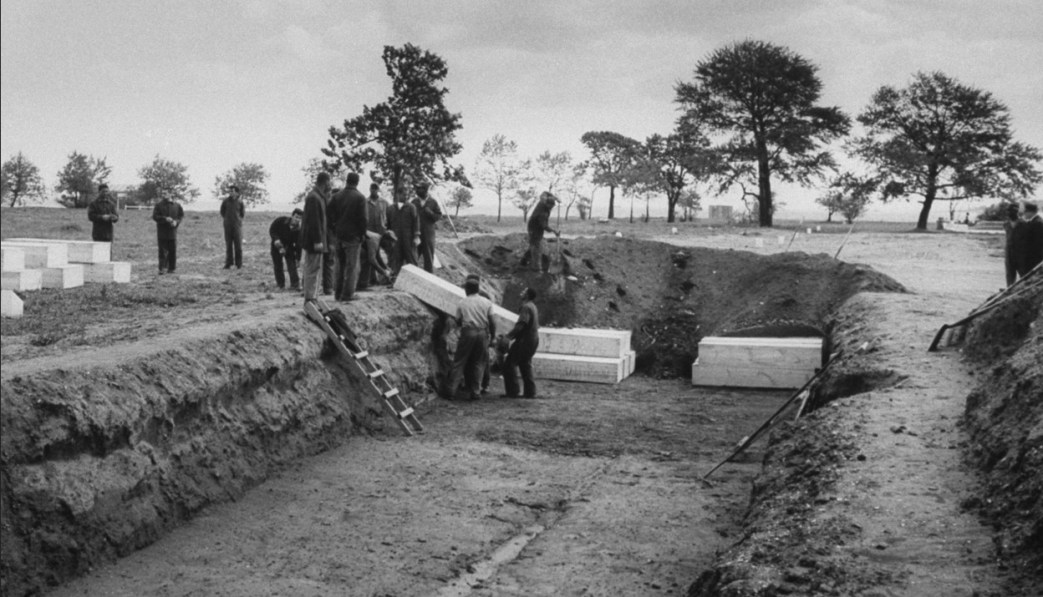
As part of an unemployed demonstration held on May 31, 1909 in New York City, a committee journeyed to the Potter’s Field at Hart Island, then home of over 150,000 unmarked graves, to pay respects to those ‘killed by an unjust social system’ and personally remember friends.
‘Unemployed Adorn Potter’s Field Grave’ from The New York Call. Vol. 2 No. 130. June 1, 1909.
Living Victims Honor Those Already Killed by Unjust Social System.
The convicts at Hart’s Island, where Potter’s Field is situated, the officials of the place and Frederick Bartels, the keeper, were startled when a couple of dozen of the unemployed visited the island for the purpose of paying tribute to the unfortunates who had died in the search for work, succumbed in the struggle for existence.
This was the first time in the history of Hart’s Island that the “unknown dead” had been visited by others than a lone mourner who finds his way occasionally to greet a dead brother or a friend. This innovation was due to a decision adopted by the unemployed of this city to pay a visit to the “martyrs of industrial chaos.” From now on, it has been decided, the grim visit will be repeated every year.
It was just 8 o’clock yesterday morning when the steamer carrying the committee pulled out of the East Twenty-sixth street slip. The committee consisted of a few who are at the head of the unemployed and several of the down-and-out kind who wore sad looks and torn clothes. It was not a cheerful outing, and despite the warm day, bright sun and clear sky, many had their heads bent with the weight of sorrowful memories and heaved heavy sighs at the thoughts of those to whom the visit was to be paid.
There were flowers, too. Small pots were carried by a half dozen men, and the one woman. on the boat brought with her a wreath of considerable dimensions. The flowers in all, when measured by dollars and cents, would not exceed $2. but they were heavy with sentiment and represented a wealth of human emotions.
The City of the Dead.
A shiver went through everyone present when Keeper Bartels showed the place and gave figures. Hart’s Island is 103 acres in size and has been in use since 1869. Since that time there have been buried 158,000 homeless men and women, many of them “unknown dead.” The unfortunates came from hospitals, and were people who had been found dead, picked up in the street, dead from hunger or “destitution,” or killed by their own hands, suicides driven to it by horrible economic conditions. The keeper gave his figures and spoke in a refined, quiet and matter-of-face tone, but the gigantic number of victims sent a shudder through the small body of visitors. “Yes, about 100 a week,” said the keeper, in response to a question.
He took the committee and the newspaper men to the graves and explained the system of an economical burial. He placed them near an open grave, “a trench” he called it.
A trench is 45 feet long, 15 feet wide and 7 feet deep, and holds 150 coffins. The caskets are placed in three rows, 25 in a row. When the trench is filled it is covered up and a small board with a number on is placed on a tombstone. Every small board represents 150 dead!
“He Calleth His Own by Name.”
There is just one monument on the place. It was erected a year ago by Mrs. Bishop Greer, of this city. The monument carries the inscription, “He Calleth His Own by Name.” Perhaps in some mystic theological sense He does. But the keeper assured his hearers that most of the dead are “unknown,” picked up in the allies of miseries, in the gutters, as it were, of a social dumping ground. The unemployed recalled names of many who had died, but no record was kept and no one knew where they were buried. All they knew was that one went to the hospital and did not come back, another was “lost track of, somehow,” a third collapsed, exhausted from starvation, and so on. Names were recalled and sad reminiscences formed part of the homeward trip. But no record was left. They all mingled with 158,000 dead, clustered in groups. 150 in one grove!
After the small pots of plants and few flowers had been deposited the little group of saddened men with uncovered heads paid their tribute to the gigantic mass of victims of capitalism, Cornelius Donovan, the president of the Tenants’ Union, delivered an address, in which he referred to the dead as martyrs of an industrial battlefield. He laid out the road to Potter’s Field in a few words. “From the shop to the municipal, lodging house,” he said. “From the municipal lodging house to the hospital, from the hospital to Potter’s field.”
“It’s Best to Be Dead.”
“Some of you are inclined to pity the poor fellows who are buried here,” he continued. “But when I think what they suffered on this side, when I think of all the misery, the degradation, the pain that they endured while with us, I am inclined to believe that they are better off now.
“Some tell us that they are here because of some weakness. We are told now and again that if they were stronger they would not have found their way to Potter’s Field. What, I ask, if all were strong? Would they all get employment? The fact that there is not enough work for all makes these people underneath our feet martyrs of an unjust Industrial system.”
The speaker explained how the present state of affairs is being kept up by corrupt politicians and then he dramatically exclaimed: “I would rather be here, mingle my dust with the dust of these poor creatures, than be among those who maintain the present social system.”
One of the committee, who was conspicuous for his modesty as well as sadness, was Tom O’Brien. Small, unshaven, ragged but with a bright twinkle in his eye, he attracted the attention of the newspaper men. He held on to a small pot of flowers which he watered religiously every five minutes.
“This is for Bill Deavey,” he said. He then told in an attractive Killarney brogue that Bill was a schoolteacher who had come here and “wint down the road.”
“He died two years ago and is some where out here, and the little pot, it is for him,” he said.
The name, however, could not be traced in the short time allotted to the party, and he was promised to be shown to the grave of his friend when he comes again.
Of the way back Tom grew reminiscent and philosophical.
“This here trip makes you hungry. I am hungry anyhow, but this trip makes you extra hungry–that’s why, I suppose, the fellows did not come along.”
Tom referred to the fact that no more of the unemployed had enlisted in the committee to visit the island. Extra hungry was not a phrase. It came out, as it were, from the emptiness of his stomach. He spoke of the good old time when he would steal out at night when a boy in good old Killarney, and cut some slices of ham and eat. But now-

He told of his troubles and then concluded:
“I tell you what–this here country will not be worth a continental until we have what they call a revolution.” When all went off the boat and hurried to take the car to join a parade that had been arranged Tom and several others lagged behind. Every once in a while the committee would stop to wait for them to “catch up.” but they would soon fall back. “Extra hungry,” said one of the committee.
Some More Hungry Ones.
At the corner of Center and Lafayette streets the committee joined the bulk of the unemployed to start the procession. Alexander Law, James Eads How, Dr. Ben L. Reitman and Louis Braun were busy arranging the line. But they discovered that the men were too feeble to walk and some bread was brought that was devoured as quickly as it was handed out.
“Harry’s Lunch Room” on the corner of Lafayette and Duane streets refused to feed the men even if they paid for it. “I can’t stand for it,” the proprietor said. Fortunately there was P. Trepootikas, a Greek, pushing a cart filled with frankfurters and lemonade. Mr. How gave orders to feed the crowd and the frankfurters were handed out as quickly as the man could place them between two halves of an open roll and put mustard on them.
From the starting point the procession advanced to Manhattan Lyceum, 66 East Fourth street, where a musical programme was rendered and speeches were made by Alexander Irvine and Dr. Williams. The Labor Temple Quartet furnished the music for the procession.
The New York Call was the first English-language Socialist daily paper in New York City and the second in the US after the Chicago Daily Socialist. The paper was the center of the Socialist Party and under the influence of Morris Hillquit, Charles Ervin, Julius Gerber, and William Butscher. The paper was opposed to World War One, and, unsurprising given the era’s fluidity, ambivalent on the Russian Revolution even after the expulsion of the SP’s Left Wing. The paper is an invaluable resource for information on the city’s workers movement and history and one of the most important papers in the history of US socialism. The paper ran from 1908 until 1923.
PDF of full issue: https://www.marxists.org/history/usa/pubs/the-new-york-call/1909/090601-newyorkcall-v02n130.pdf
 Revolution's Newsstand